In a recent blog I mentioned the value of writing to the media to get more people aware of the advantages of CF&D and that we have set up a media team. A CCL Europe member, Brigitte van Gerven, has just written a very good explanation of why CCL Europe is planning to do the same…….
The goal is to establish a good relationship with the mainstream press and other media, make the carbon fee and dividend and CCL more well known among journalists, and to get articles, letters, and opinion pieces published in the mainstream media…..
When we go lobbying politicians their reactions are generally positive, we have their respect and we come across as people who know what they are talking about. But there are still some barriers which make politicians hesitate to go a step further and support CF&D.
1. CF&D should become more well known 2. CF&D should be broadly supported by the public 3. CF&D should be more credible e.g. backed up by experts and studies 4. CF&D should be perceived as feasible within the EU context
The media group can contribute significantly to 1. and 2. and therefore advance our cause. An article in the mainstream press genuinely attracts the attention of politicians and makes them take notice. Even more ideal would be if we succeed in starting a public discussion about the CF&D in the media.
If you would like to join our media team – just drop a note to [email protected].
Ambrose Pritchard, writing in The Telegraph criticises the proposed Democrat Green Deal as being a dirigiste policy with an ulterior motive of ‘fuelling’ the trade war with China. He gives a very cogent explanation of the mechanics of carbon fee and dividend and why he prefers this market led method of carbon pricing. He also argues why the dividend should go directly to consumers…
Mr Biden’s new age Gosplan is not to my taste. Should the Democrats be pledging to install 500 million solar panels and 60,000 wind turbines over the next four years? Is such dirigiste planning the American way?
The laissez faire way is to set a carbon price that ratchets up predictably, letting business respond to the price signal, and letting Schumpeterian competition find its own answers. All former chairmen of the Federal Reserve and a cast of economists of all ideological stripes have backed HR 763, a bipartisan House bill for a carbon tax and dividend.
It starts at $15 a tonne and ratchets up $10 every year until CO2 emissions are almost eliminated. The money raised is rotated back into people’s pockets. The higher the carbon price, the bigger the cheque, and the poor do best.
Needless to say, Ursula von der Leyen’s variant in Europe aims to siphon off its carbon tax to fund the Commission’s apparatus. The EU seems to have learned little from the gilets jaunes and the sociology of revolt.
A hot tip from a fellow member of the CCL UK Media Team gave me the hook to write a letter about Climate Income that has been published in last Sunday’s Observer (26th July). The trigger was an interview in the fashion section of the magazine with the supermodel and activist Lily Cole, whose book Who Cares Wins: Reasons for Optimism in Our Changing World is published on July 30th (Penguin Life). To our delight, Lily Cole ends the interview with a brilliant endorsement of CF&D – which offered a clear lead to this letter…..
Cole, not coal
Lily Cole describes two types of environmental activists, the wizards and the prophets (“We need to be more forgiving”, the Observer Magazine). Currently the prophets seem to grab the headlines in the UK, which results in surveys in which 59% of adults say they can’t afford to be greener. When asked what she would do if she were prime minister for the day, Cole described a method of carbon pricing known as “carbon fee and dividend”, which would enable us all to benefit from the wizardry without having to wear hair shirts.
This method, also known as “climate income”, is already adopted in Switzerland and Canada and is seriously being considered in the US. As Cole states, it would “put a price on pollution”, rendering greener fuels, heating, production methods etc cheaper than those made with fossil fuels. The monies earned from the escalating fees on fossil fuel extraction are given back to the public as a dividend. Our government has even acknowledged its advantages, but isn’t minded to adopt it at the moment.
We in the UK Citizens’ Climate Lobby are working hard to encourage our government to change its mind. Carbon fee and dividend could rebuild the economy in a way that doesn’t compound either the disastrous social and economic effects of the pandemic or the disastrous environmental effects of basing our “rebuilding” on fossil fuels. Catherine Dawson Devizes, Wiltshire
It’s only a few months now since a few of us formed the Media Team in order to share tip-offs, ideas for publication, and, especially, encouragement. There are numbers of possibilities to spread the word this way – check out Writing to the Media, under Action, on this site – but working as a team can increase our power. Please consider joining us – just drop a note to [email protected]. Remember, letters on the same topic persuade editors as well as MPs of that ‘groundswell of public opinion” which is such a key objective for CCL UK.
Meanwhile, if you fancy reading Who Cares Wins (and it does look like an enormously readable and thoughtful book), try to get a book review out on websites like Goodreads, Librarything.com, social media, local environmental group websites or parish newsletters – and send us a copy!
Green prophet: Lily Cole’s new book divides climate activist into Wizards (who innovate) and Prophets (who champion less consumption). Photograph: Phil Fisk/The Observer
In Millions of Britons cannot afford to ‘go green’ poll claims (Independent 8/7/20) Emma Elsworthy reported that 59% of 2000 adults said their budget would not allow them to be any ‘greener’. Government policies such as the Climate Change Levy and Green Deal as well as Macron’s disastrous policy have ‘fuelled’ this assumption that going green has a price. We have to strive to show that with Carbon Fee and Dividend this need not be the case, especially now that everyone is arguing that we can not go back to the status quo after the pandemic.
One celebrity who seems to have got this is Lily Cole, who was interviewed in last week’s Observer newspaper, (the Fashion section) in an article entitled We need to be more forgiving.
Lily has written a book, Who Cares Wins: Reasons for Optimism in Our Changing World. She divides environmentalists into prophets and wizards…
The Tesla tech whiz Elon Musk is just one of the so-called “Wizards” she has interviewed for her book, Who Cares Wins: Reasons for Optimism in Our Changing World. The Wizards are the people who are using technology in an attempt to innovate us out of the environmental crisis. In the other camp are the “Prophets” who say we must cut back, travel less, consume less, simplify. Cole examines both approaches in the book.
Lily discusses how tree hugging activism can be alienating to people who don’t want to end up in prison, which I presume is most of us, and also recounts a horrifying plane free journey we can all sympathise with! Although she is doing a lot to live out and encourage a sustainable lifestyle Lily has realised that piecemeal individual efforts are not enough and that we need a mechanism to make structural change the no brainer option which benefits rather than penalises society and she describes just that….
What law would she introduce if she were prime minister for the day? “From an environmental point of view? Put a price on pollution.” A similar tax caused uproar in France, when fuel tax riots engulfed Paris in 2018. “But the devil is in the detail right? They didn’t design it in the right way, so it impacted people financially. But there are examples, like Canada, where it’s well designed and doesn’t penalise poorer communities, and can even offer wealth redistribution, with the tax redistributed equally among citizens, so the less you pollute the more you make.”
Here’s hoping that, like Lily, we can help shift the perception that that going green has to hurt to be effective and get the message across that there is another way….
I have been a member of CCL for just over a year, having been persuaded by a talk by Prof. David Waltham that this was a group which had an effective and doable solution to climate change and a democratic and sensible way of achieving their goal.
I wasn’t really sure how much the mass lobby last year had achieved and signed up to attend this one with some trepidation, especially as our Devizes CCL group had already started correspondence with our new Conservative MP Danny Kruger and a Zoom meeting at which we had managed successfully to get him to agree to look into the current government thinking on climate policy issues and report back to us. I was worried that the virtual lobby may jeopardise the good rapport we had built (which is so embedded in the principles of CCL but not in that of other pressure groups).
We started thinking about strategy in advance and decided to use a question based on the carbon pricing report published earlier in the month (which we would have lobbied our MP about even if the mass lobby hadn’t happened) and to suggest all CCL lobby participants used it. This was a question which all MPs could do something about, by agreeing to ask about this issue in parliament, and could be the ‘beginning of a beautiful friendship’ or at least a productive one between CCL groups or individuals and the local MP.
The Constituency Office had asked for questions to be submitted beforehand which meant the MP could be prepared to a certain extent and time wouldn’t be wasted. We decided that one person who had been most active in engaging with our MP and building a good rapport would field the question. I think this helped the MP to feel comfortable with the process. Strategy was finalised in a Zoom meeting the night before.
I think because of the rapport we had built with Danny Kruger he decided to have our question first, which was a huge relief because I was worried that the lobby would be taken over by lots of vague demands that no Conservative MP would be likely to have truck with and we would have no time to field our question. We were allowed to ask secondary questions, ‘putting a hand up’ in the chat box if we wanted to ask a question, the MP could then decide who would speak next.
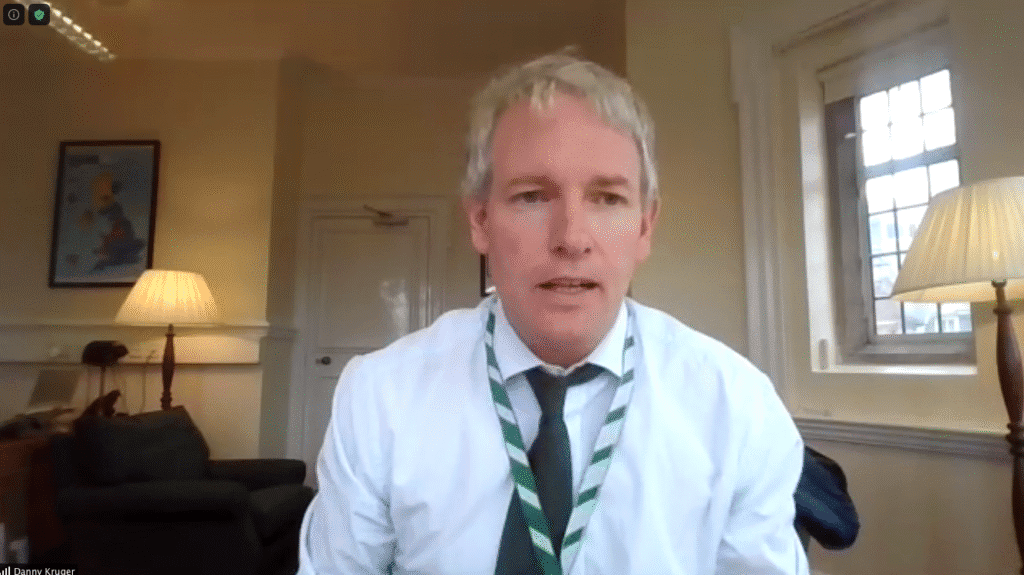
MP Danny Kruger in the Zoom virtual lobby
The Government’s plan to revive the economy had also been published the day before and this also enabled the other questions fielded to be very ‘concrete’ (pun intended) as they were asking about the emphasis on new build and roads rather than investing in retrofitting which had even been promised in the election manifesto. One participant was an expert in passive house construction, again this meant sensible questions could be asked about policy which the MP was capable of looking into. The chat function also enabled participants to add facts or links to information, I copied this to the CCL participants and the MP after the lobby as I am not sure what happens to the content of ‘chats’ afterwards.
The hour long ‘lobby’ went very well and was a means of showing our faces. I do feel that the success of the lobby owed a lot to the fact that we had already built a working relationship with the MP before the lobby, he knew that our approach would be respectful and positive and we knew his background and interests (as a new MP we had to do the research and know what not to mention!). In short, the lobby was a useful tool but should not be seen as the only opportunity to engage with your mp so if your voice wasn’t heard don’t despair, write a letter and hopefully get the ball rolling!
Judging by Danny Kruger’s constituency newsletter released on Saturday the 4th the lobby has achieved what we had hoped for! Danny has gone public on his commitment to discuss carbon fee and dividend (aka climate income) with the government and to look into the retrofitting issue further. Result!
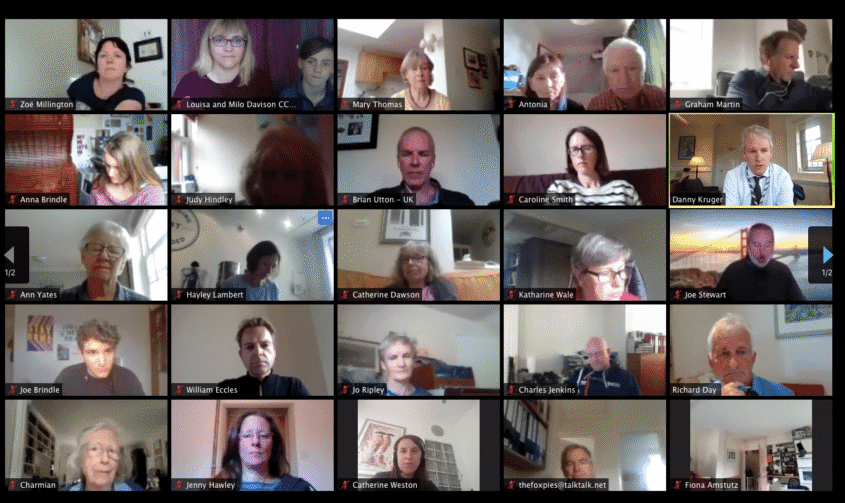
Catherine Dawson took part in The Climate Coalition’s The Time is Now virtual lobby on 30th June 2020. More than 30 people, of which a third were CCL UK members, took part in the Devizes Constituency meeting with Conservative MP Danny Kruger.
Christina Figureres wrote in the Guardian of June 1st about how many international institutions and corporate leaders are learning the lesson of governmental responses to Covid 19 to call for ambitious green economic stimulus packages.
When the government declared a climate emergency last year many of us cried Yay!, and Huzzah! and Bravo! and Jolly good show old bean! but then we waited, and we waited, and we waited, and then politics went back to what it was before, which was Brexit Brexit Brexit Brexit Brexit Brexit Brexit Brexit Brexit Brexit Brexit Brexit Brexit Brexit Brexit Brexit Brexit Brexit Brexit Brexit Brexit Brexit Brexit Brexit Brexit Brexit Brexit Brexit. And then there was an election, which was mostly about Brexit Brexit Brexit Brexit Brexit Brexit Brexit Brexit and Brexit, with a bit of Corbyn thrown in but not a lot of talk of climate change and even less talk of what kind of carbon pricing mechanism we might have once we’d “got Brexit done.”
No system is perfect. Corvid-19 has shown us that. As Britain grinds to a halt, what would have happened if we had tried to carry on as normal as the work dried up, employees laid off with no pay, companies went bust, and no benefits or sick pay for days? Our High Streets could close for good during a terrible recession, led by the biggest fall on the stock markets since 1987.
And, thank goodness, despite that we have a government traditionally of low taxation and a small welfare state, there was a quick realisation that our free market economy – which has given us a safe, stable country – could not cope. It was time to throw in a lifebelt and shore up the weaknesses of the system: relaxing benefit rules, paying salaries.
From a fiscally-Conservative point of view it works because people still have jobs and money to spend which protects growth.
From a socialist or populist-Conservative point-of-view it works because it looks after people.
Of course I’m talking climate change and air pollution. These are caused by another failure of the system: encouraging that which creates monetary wealth irrespective of the poverty it causes to the environment and climate.
To abate this problem, we could simply stop burning fossil fuels (and meat farming).
But the Coronavirus crisis has shown that putting the brakes on the usual run of things shocks the market and throws it under a bus. You save the climate but chuck the world into chaos. People lose their livelihoods. Anxiety and poverty is rife. And the effect would quickly be temporary.
So we can’t ban burning fossil fuels overnight, even though that may feel the obvious solution to desperate times. We need to make them redundant, make them a bad investment by easing them out of our economy and giving the market fair warning. Prices will go up so people need a financial cushion before more cheap clean energy comes online. And the fix would stick.
It works because it protects the economy, it protects jobs and the people the economy is there to serve.
We had a great response to our urgent action to contact the experts at the Climate Assembly -Many thanks to everyone who wrote. Here are a couple of examples.
Dear
Rebecca
Thank you for your
efforts on the Climate Assembly – it’s essential work and very exciting for our
global future.
I was lucky enough
to be part of the Oxford Citizen’s Assembly on Climate Change. It was an amazing
and enlightening experience. Often, how to change individual behaviour seemed to
be the issue, especially as the majority of emissions were coming from buildings
(space heating) and travel.
How do we change
behaviour? By making the
desired behaviour the easiest option and/or the cheapest option, so making the
right choices is a no-brainer.
Pricing carbon can
make this happen. But we know a rise in prices for fuel is unpopular – see
President Macron’s struggle with the Gilets Jaunes. So it seems that carbon
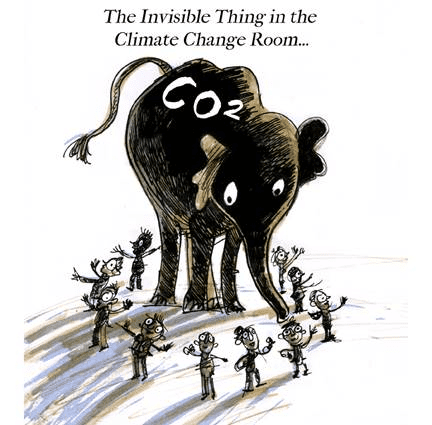
pricing is avoided as a strategy – a bit of an elephant in the
room.
But it is possible
to price carbon in a way that is fair, empowering, simple and
visible.
Carbon Dioxide is a
difficult subject to inspire passion. Unlike plastic, it
is invisible. When we emit it, we can’t see it. We can see the plastic trail
that we leave, but it’s impossible to grasp what size your own carbon dioxide
emission are. But carbon dioxide is key, because the blanket of greenhouse gases
is making Earth warm, melting the arctic and Antarctic and pushing temperatures
worldwide out of the range of recorded history, towards a new climate that none
of us or other life-forms on earth are adapted for.
But the good thing
is, we CAN change this by shutting down the flood of CO2 leaking from humankind
into the atmosphere.
HOW can we take
action on CO2?
We can take action
by putting a meaningful price on carbon, aiming towards $80-$100/tonne.
It is the nudge the
world needs. A puny 5p plastic bag charge drastically reduced plastic bag use by
85%. Pricing really changes behaviour “Our modern economy reflects countless
choices, made by billions of people all over the world. A broad-based carbon
price influences them all. Nothing else can.”
But what is the best
way to price carbon?
I’ve compared
different carbon pricing options. What I’ve discovered
is:
A Carbon Fee and
Dividend (Climate Income) stands out as the most fair, empowering, simple, and
visible way to put a significant price on Carbon.
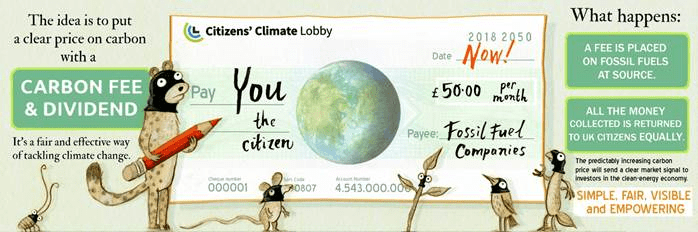
What is Carbon Fee
& Dividend?
The government
places a price on CO2 at source.
The revenue is returned equally to all citizens via a monthly/annual lump sum or ‘dividend’
I think it is the
only way to make a carbon price that is high enough for effective change to be
palatable.
There are a few good
things about a carbon fee and dividend plan. Here they are.
It can appeal to
people who call for social justice and want to battle
inequality
The lump sum system
is progressive:
it
really benefits lower earners most. The richest (and
largest users of CO2-intensive energy) benefit least. Anders Fremstad
of Colorado State University and Mark Paul of Duke University calculate that
taxing a tonne of CO2 at $49 would leave 59% of Americans worse off,
including 75% of the bottom half, if the revenue were used to lower
personal-income taxes. By contrast, recycling the receipts as lump-sum payments
(Dividends) would leave 89% of the bottom half with an average net gain of
$788.
The 6 lowest income
groups all break even or are better off, with the poorest getting the biggest
benefits. The wealthiest, highest fuel users, are the worst
off.
Compared to tax
rebates, it’s demonstrably
fair as all get an equal
dividend.
It’s also possible
to get dividends to the poorest and most marginalised sections of society, by,
for example “investigating inventive ways of paying the dividend to ensure that
the most vulnerable receive it. Linking the dividend to national insurance
numbers would be one way to pay the dividend, but this may mean that the most
vulnerable miss out. The Government should investigate whether new technology
can be used to pay the dividend securely through a mobile app to ensure as many
eligible people as possible receive it.” The Future of Carbon Pricing,
policyexchange.org.uk
It
is motivating and empowering
Through their
dividend the public can support renewables in their choice of what energy to
buy. The dividend is a visible sign of your purchasing power, and the public is
trusted to choose how to spend it; wise choices bring a win-win virtuous spiral
of energy-source-change away from fossil fuels. The dividend also gives voters
an immediate interest in the fight against climate change – a lump sum
arriving in your bank account is a very interesting event. All green energy
sources benefit by becoming comparatively cheaper.
It
sends a signal to industry that the carbon price will be a permanent
policy
The Dividend, once
people are used to it, is hard to withdraw by future governments (see what’s
happened with UK Winter Fuel Payments) – and so acts as a pledge to industry
that the carbon price will endure.
These three aspects
of carbon fee and dividend mean is can appeal to: Green and Social Groups who
want action on climate change but also social justice; the general public who
will find higher fuel prices unacceptable; businesses who want a clear steer to
what the carbon future will be.
Carbon is infused in
all our lives and all our choices. We need to tackle climate change with a way
that involves and empowers everybody, is fair and acceptable and progressive,
and that also is able to set a high enough price for carbon to bring about
change, in a way industry can see will not be overturned by a change of
government.
CCL’s policy of carbon fee and dividend1 is designed to operate at a national level. Fees are levied when fossil fuels are extracted or imported into a nation and the revenue is distributed as an equal income to all citizens of the same country. But there’s a need for climate action at other levels too. CCL should be just as relevant in the personal, workplace, local government and international arenas. We should be offering solutions in these areas that are as beautiful and effective as fee-and-dividend at the national level.
But, at first sight, fee-and-dividend doesn’t translate easily to other levels. Or does it? I think we can even apply it to running a local car park.
I’ve been thinking about the University where I work and what we are doing about the Climate Crisis. Sadly, the answer is “almost nothing” but that’s starting to change. In fact, I’ve been asked to give a talk there about CCL and that got me thinking. Could we introduce a fee-and-dividend scheme for car parking to encourage staff and students to use public transport? The idea is simple, a fee for car-parking is introduced but, instead of the University keeping the money, it redistributes the income as a flat-fee to staff and students. The beauty of this is that you can set a high parking fee, to ensure a strong incentive to walk/cycle/catch the bus, without actually penalizing people very much (because the dividend would offset the full cost).
There are a few details to work on. The scheme would probably need to be split into three separate parts, one for staff, one for students who live off campus and one for students who live on campus. This would recognize that the car-parking needs of these three groups are quite different. There are also tax-implications for staff who get a net-payment (students could just get a discount on their fees). But these are minor issues that I believe could be overcome.
The same idea might also work for councils but it’s a bit trickier in that context. Parking price-hikes in return for council-tax rebates would penalize those not living in town centres and it would also drive even more of us away from the high streets. Perhaps this could only work if done in conjunction with introduction of greatly improved public transport. Still, it’s worth thinking about.
At the international level, too, there is scope for fee-and-dividend approaches. The recent COP meeting in Madrid largely failed because of arguments over which countries should pay into a mitigation-fund and which should benefit from it. The answer could be that everyone should pay in and everyone should get payments out. For example, if we set a carbon price of $10 per tonne of CO2(eq), that would produce a dividend of about $65 per person. The UK, for example, would then pay in about $5 billion but get back a refund of $4.35 billion.
The beauty of this is that, as with my car-parking example, incentives are magnified by the imposition of a relatively high fee whilst keeping the true cost relatively small because of the refund. Perhaps the fee-and-dividend approach to carbon pricing can be used across a wider range of applications than we’ve generally considered. It’s certainly worth thinking about.
1. Sorry, I’m not calling it “Climate Income” here but only because my title wouldn’t work if I did.