Blog

  • National Emergency Briefing

    On November 27th, last year, I was privileged to attend the National Emergency Briefing at Central Hall, Westminster. The briefing was primarily aimed at MPs and Peers but was also attended by around 2000 invited members of the public from climate campaigners to celebrities.

    The queue, when I arrived, stretched around the block but the organisers got us in efficiently and I found myself sitting next to the sustainability manager of Sainsbury’s. However, there wasn’t much time to chat as the talks started. We kicked off with an introduction from Chris Packham and a preview of what to expect from the main meeting organiser, Pofessor Mike Berners-Lee of “How Bad are Bananas?” fame. Then we were into the main part of the meeting, a series of 15 minute talks from some of the UK’s most eminent experts on the impacts of climate change from Health, to National Security and Economics as well as several talks on the science of climate itself.

    I’ve waited until now, to write this blog, because I didn’t want to be writing a long boring description of each talk. Instead, the talks are now all available on-line for you to watch for yourself. Go to https://www.nebriefing.org/ and select each of the talks under “Expert Briefings”. I really can’t recommend these talks highly enough.

    The main message I took away from the meeting is perhaps summed up by a sentence from Lt Gen Richard Nugee’s talk on National Security. In that context he stated that “the threat position is changing faster than expected”. This is true of all the aspects covered by the speakers.

    Another reason for wanting you to go to the NEB website itself is that you can then sign the open letter to Keir Starmer calling for a televised emergency briefing. Please all sign up.

  • How to respond to spouters of ‘Net Zero stupid’

    The Citizens’ Climate Lobby is all about solutions. It’s about how society can make the changes needed, to avoid climate catastrophe, as rapidly and equitably as possible. Our starting point is that global warming is real, dangerous and caused by humans.

    This approach made a lot of sense until recently. There was broad political consensus that climate change was a serious issue and that the UK should aim to get its net emissions down to zero by 2050. Our politicians were proud to be world-leaders in this endeavour.

    Unfortunately, that has changed. We now have anti-science politicians in the UK, and elsewhere, who openly dispute the need for net-zero. Instead, they champion a cynical philosophy in which every country pursues its own, blinkered self-interest even though this is a proven route to a poorer world for everyone.

    As the impacts of climate change become ever more obvious, these short-sighted politicians will change their direction when it suits them to do so. But, in the meantime, when discussing CCL-UK policies we may find ourselves increasingly encountering push-back on whether greenhouse gas emission reductions are necessary at all.

    The problem is anti-net-zero soundbites that have been well crafted to sound plausible even though they disintegrate on closer inspection. Examples I’ve heard, recently, from senior politicians include “2050 is an arbitrary target” and “We can’t afford net-zero”.

    To counter these. I’ve set up a new website (netstupidzero.org) that takes these soundbites and explains, in simple terms, why they’re misleading. You may notice that the site name, itself, is a direct quote from the Reform Party’s Richard Tice who is, perhaps, the most prominent promoter, in the UK, of anti-science disinformation.

    In my website I’ve tried to use common-sense rather than go into detailed scientific explanations. My aim is just to make it easy for anyone to counter anti-net-zero propaganda whenever and wherever it’s used. I hope you find it illuminating and useful.

  • Citizens’ Climate Europe event on ‘How to make ETS2 work for your country’, aka Climate Income….

    Citizens’ Climate Europe event on ‘How to make ETS2 work for your country’, aka Climate Income….

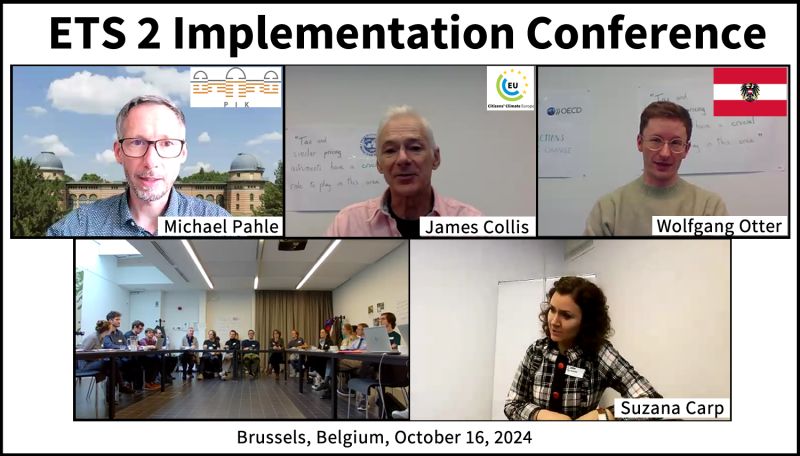
    At the beginning of 2027, the European ETS2, which aims to successively eliminate 40% of EU greenhouse gas emissions through higher fuel prices, will be launched. This July the European Commission already firmly reminded member states (except Austria) to implement ETS2 in national law. At the same time, uncertainties about future prices are high and governments seem unprepared to react to this uncertainty and ensure public support for ETS2. Enough reasons for Citizens’ Climate Europe to bring together a range of perspectives on possible solutions in a hybrid event (in Brussels and online) on 16th October.

    We first heard from Michael Pahle, Head of Working Group “Climate & Energy” at @Potsdam Institut für Klimafolgenforschung, about ETS2 price evolution and the potential of rebates to cushion excessive increases. After a brief explanation on what sets prices, he showed scenarios (not predictions!) of prices ranging from EUR 71 to 261 per ton CO2 in 2030. He emphasised that in addition to price levels, volatility can be a concern. Stability mechanisms act with a delay, while higher prices for certificates would be passed on to consumers much faster. Together, this creates a case for rebates to citizens as a ‘social stability mechanism’ acting fast if prices increase ‘excessively’. Michael Pahle closed with recommended preparation for member states.

    I was the next speaker, taking a wider view on carbon pricing, quoting OECD’s and IPCC’s recommendations as well as the FASTER principles for effective carbon pricing. This set the scene for comparing existing carbon pricing schemes, at €50/t or more, through the lens of these principles. The F in FASTER stands for ‘Fair’, a key criterion for public support, leading to a discussion of possible implementations of Climate Income (also known as Climate Dividends, Klimabonus, Klimageld) highlighting tools and a possible policy workshop for policy makers.

    The final talk of the event was by Wolfgang Otter, Department Head Klimabonus at Austria’s Ministry of Climate Action, Environment, Energy, Mobility, Innovation and Technology, who took us behind the scenes of how a climate dividend, argued for by Michael Pahle and James Collis, got implemented in Austria under the name of Klimabonus. He outlined the main features, i.e., that everyone receives it, that amounts are regionally staggered taking into account increased costs for mobility in more rural areas, that since 2024 Klimabonus is taxed for high income households to increase fairness, and finally that Klimabonus is part of a larger group of measures. He emphasised the importance of simplicity, warning attendees of the trap of fake specificity and recreating social measures that already exist and that adding design complexity significantly impacts implementation cost and success. Finally, he outlined the surprisingly simple but logistically challenging process of paying Austrian citizens’ via bank transfers or vouchers sent by post. He closed his talk with giving us a behind the scenes insight into reactions by the public.

    These talks were followed by a lively Q&A, ranging from detailed questions about the Klimabonus in Austria to more general questions on social and regional staggering and supporting citizens in investing to decarbonise their lives.

    Taken together, the event provided a fascinating insight into the challenges the introduction of ETS2 will result in as well as possible ways to make carbon pricing not only effective, but also socially fair.

    Many attendees requested further follow-up and we are excited to understand the specific reasons and see if we are able to support further in the coming weeks and months.

    Presentations are available here: https://bit.ly/3BSlw5D

    For CC EU Linked In post https://www.linkedin.com/posts/citizens-climate-europe_carbonpricing-eugreendeal-economics-activity-7254430757660585984-BWYk/?utm_source=share&utm_medium=member_desktop

  • Climate Income – How this powerful climate policy can address the cost of living crisis.

    Climate Income – How this powerful climate policy can address the cost of living crisis.

    The next UK government must address the cost of living crisis. It’s also clear from public data that the climate crisis is an ongoing concern for 75%. Now there is the opportunity to kill multiple birds with one stone. The latest developments in the EU Green Deal are contributing to international momentum on the subject of carbon pricing. If the UK wants a closer relationship with Europe, aligning on this key environmental policy offers a number of additional social and economic benefits.

    Carbon pricing, also known as carbon taxation, is overwhelmingly the fastest and most effective tool to cut greenhouse gas emissions. No one claims carbon pricing solves everything, other policies are needed, just that it’s the most important thing to do. Carbon pricing is a cornerstone of the EU Green Deal and improves the effectiveness of all other climate policies. The World Bank tracks international carbon pricing development both in terms of coverage and price level, i.e. how many emissions are covered and at what price.

    Currently the UK prices 40% of carbon via the Emissions Trading Scheme (ETS) which applies to large scale industry (and is almost invisible to consumers). The UK carbon price floor legislation adds strength and has been effective in dramatically reducing coal from UK electricity production. The EU is extending the ETS to Buildings and Road Transport (ETS2) with further expansion under discussion. The same approach in the UK would increase carbon pricing coverage to over 80% and have a direct impact on all households.

    Although most poor and middle income families use much less energy than the richest, it’s a higher proportion of their income. This form of taxation is inherently regressive, hurting the poor more than the rich. Climate Income, where the proceeds of the tax are given back equally to people, makes the vast majority of poor families and most middle income families better off. Making carbon tax popular and progressive in this way is well understood.

    The challenges for politicians in implementing Climate Income are that the public are wary that “tax” means they will likely be worse off, and industry is concerned about international trade competitiveness. The information on these first two issues has improved considerably, though there remains pressure from the fossil fuel lobby, which is still more powerful and better funded than the emerging green industry.

    The recent OECD report International Attitudes Toward Climate Policies surveyed 40,000 citizens from 20 countries. It found that people want to know that the policy works, is fair, and how it will affect them. The report showed that 5 minute videos can build public support, showing fairness by redistributing revenue equally protects poorer households. For the UK, confidence in public support for Climate Income is reinforced by the Scottish Climate Assembly with 77% support for this specific policy.

    Industry fears about “carbon leakage”, when trade and jobs are lost to companies in other countries with lower pollution costs, have often been highlighted as an economic risk. The EU has now taken on this issue directly with the Carbon Border Adjustment Mechanism (CBAM). It is prompting action in relation to carbon pricing from the US, China and India. Evidence from US industry implies that the UK not only has nothing to fear, but in fact has much to be gained. Energy intensive UK industry is highly competitive and is effectively leaving money on the table by not pricing international emissions.

    Whatever the UK’s desired trading relationship with Europe, there are proven examples of Climate Income. Canada and the UK today have similar trading structures with the EU. Canada introduced The Greenhouse Gas Pollution Pricing Act in 2019 rebating 90% to households. Expert consensus is growing that this is the best solution for Canada. Switzerland is in the European Free Trade Agreement and outside the EU. In addition to an aligned EU ETS, as the UK has, Switzerland prices domestic fuel at €120 with 67% returned to households. Austria is in the EU, in the Customs Union and the Euro Zone. Specifically in preparation for the ETS2 Austria introduced KlimaBonus (Climate Bonus) returning 100% to households.

    Being outside the EU may have advantages, EU member states have concerns about legislative complexity and price volatility. Especially when simpler alternatives like a national carbon price are encouraged by Sweden and considered in Germany, where civic society is demanding the government deliver the manifesto promise for KlimaGeld (Climate Money). The UK carbon price floor legislation has the potential to provide harmonised and less volatile pricing than either the ETS or ETS2. Predictability is very helpful to the longer term planning and certainty needs of industry highlighted in the FASTER principles for successful carbon pricing.

    Climate Income is a zero cost policy that addresses two of the top concerns of the public. With the prevailing international winds blowing in support, it does more to reduce emissions than anything else. It’s good for international trade, the economy and jobs. Most households are better off. And it’s endorsed through the biggest statement by economists ever, including every living Nobel Laureate Economist. Time to act on the advice of experts.

    N.B. This article argues for a similar policy advocated by the Young Liberal Democrats described as “A Progressive Carbon Tax” in their Policy Book from 2021. There is an updated European Young Liberal (LYMEC) policy “6.11 The Adoption of C02 Taxes and Tariffs by the EU” in their 2024 Policy Book that shows further support.

    Article published in the Green Liberal Democrat Website and Challenge magazine, May 2024.

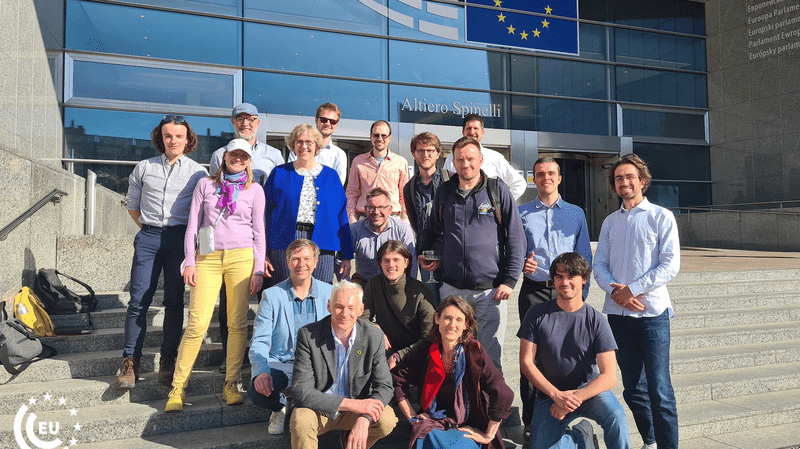
    I am the Chair at Citizens’ Climate Europe and a Member of the EU Climate Change Expert Group for ETS2 Implementation. (Front left in photograph of Citizens’ Climate Europe members from CCL members from France, Germany, Belgium, Sweden, Finland, Poland, UK, Portugal and the Netherlands).

  • What happened at COP28?

    What happened at COP28?

    This is an extract from the slideshow delivered by Cathy Orlando, CCI program director on the 20th December 2023 giving the CCI analysis of the outcome of COP28. The worst case scenario – that fossil fuels would get a free pass and the pledge to work to keep temperature rises within 1.5 Celsius would be dropped, was averted.

    CCI applauds the eventual operationalisation of the Loss and Damage Fund, the declarations on tripling renewables and doubling energy efficiency, and tackling the fossil fuel subsidy issue. Highlighting the role of agricultural systems and the effects of climate change on human health and the natural world as well as the need for the transition to be just were also welcome signs of progress and proof that COP conferences, while not perfect, are important and necessary.

    CCL UK agrees that COP28 confirms that CCI’s campaigning for the reform of financial systems is the path forward.

    Governments’ 2030 targets will lead to 2.5°C of warming by the end of the century: 0.1°C higher than last year. This change is due to weak existing targets rather than any major shifts in new NDC updates: we take the level of emissions anticipated under current policies for those countries that we expect to overachieve their weak 2030 targets.

    Since COP28 the FFNPT now has 12 nation states signed up, in September the State of California became the largest economy to endorse the call (the 5th largest economy in the world and the largest sub-national economy)…… California Senate Majority Whip Senator Lena A Gonzalez (D – Long Beach), said: “It is essential that we commit once and for all to ending our reliance on fossil fuels. People around the world, especially low-income people of color, are suffering the adverse health impacts of fossil fuel pollution, from asthma to cancer. The recent devastating fires and hurricanes emphasize the urgency of taking action, to prevent further extreme weather changes. The science has been clear for decades—fossil fuels are responsible for the climate crisis. We can prevent further harm to our communities, and that is why I am proud that California has now been added to the growing list of governments endorsing the Fossil Fuel Non-Proliferation Treaty. It is time for our nation to be a part of the solution, to forge strong unity and commitment to phasing out the use of fossil fuels.

    France and Kenya formally launched the ‘Taskforce on International Taxation to Scale Up Development, Climate, and Nature Action‘ with Barbados, Antigua, Barbuda, and Spain signing on as members.

    CCI and CCL UK members will continue to educate and campaign for the solutions that will enable the world’s financial resources to be unlocked to ensure a liveable future in 2024.

  • When they say we need fossil fuels…Citizens’ Climate International Laser Talk, November 2023

    When they say we need fossil fuels…….The primary driver of inflation around the world is fossil fuels.  Economies are addicted to fossil fuels at every level: mobility, energy production, agriculture and goods production. When the prices of oil and gas go up, every other price tends to go up. Actually, high fossil fuel prices are historically inseparable from inflation and economic crises. Mark Zandi, chief economist at credit rating agency Moody’s, said in an article for Vox that “every recession since World War II has been preceded by a jump in oil prices”. And there is a term for it: fossilflation.

    Factors driving fossil fuel prices are many, and diverse. Most of the time, though, these come directly from producing countries, which raise and lower production, thus flooding or drying up the market. This is often used as a political tool, driving millions of people into despair. Here is just a sample of the many ways of how fossilflation happens:

    1. The market-rigging actions of the OPEC Plus cartel (including Russia);
    2. Profiteering on energy supply disruptions due to Russia’s invasion of Ukraine;
    3. Climate damages (a.k.a. climateflation) Extreme weather, climate and water-related events caused almost $1.5 trillion of economic losses in the decade to 2019, up from $184 billion in the 1970s, according to a World Meteorological Organization (WMO) report.
    4. Embedded energy costs across all classes of consumer products and business services;
    5. Food system effects including embedded fossil fuel costs and climate damage;
    6. Embedded climate risk and liability costs;
    7. Sovereign debt stresses driven by fossil fuels, including:
      a. Public spending and sovereign debt burdens resulting from disaster response;
      b. Direct spending on disaster response;
      c. Extremely high, punishing interest rates linked to that spending compelled by actions a country did not initiate or decide;
      d. All-time record fossil fuel subsidies ($7 trillion), linked to rigged fossil fuel price spikes;
      e. Public spending to compensate consumers for unaffordable price shocks linked to higher embedded energy costs.

    There is one solution: move away from fossil fuels. We need to do it fast, and we need to do it fairly. That is why at COP 28, Citizens’ Climate International is linking arms with many organisations and calling for a fossil fuel phaseout.

    By breaking free of coal, oil and gas, and replacing them with renewable energy sources, we will protect our planet and our economy.

    Summary

    The primary driver of inflation around the world is fossil fuels. In fact there is a term for it: fossilflation. There is a simple solution: move away from fossil fuels. We need to do it fast, and we need to do it fairly.

    That is why at COP 28, Citizens’ Climate International is linking arms with many organisations and calling for a fossil fuel phaseout. By breaking free of coal, oil and gas, and replacing them by renewable energy sources, we will protect our planet and our economy.

  • Citizen Climate International’s summary of the truth about fossil fuel subsidies and the fossil fuel industry’s decades long disinformation campaign!

    Citizen Climate International’s summary of the truth about fossil fuel subsidies and the fossil fuel industry’s decades long disinformation campaign!

    The IMF, Carbon Pricing and Explicit and Implicit Fossil Fuels Subsidies

    Here are two terms that anyone who wants to preserve a stable climate needs to know: explicit fossil fuel subsidies and implicit fossil fuel subsidies.

    Explicit fossil fuel subsidies from governments directly reduce the price of fossil fuels, thus making it attractive to investors and consumers to buy. Implicit fossil fuel subsidies are the costs taxpayers and insurance are paying for the air pollution and climate impacts experienced because of dirty fossil fuels.

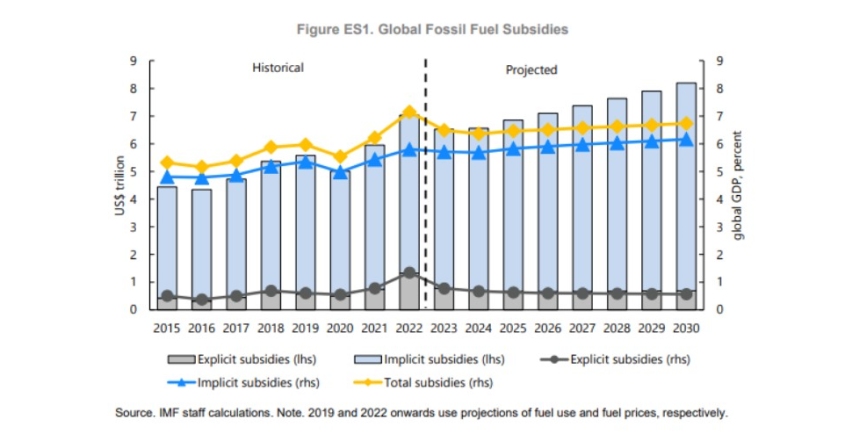
    On August 24, 2023, the International Monetary Fund (IMF) released a report. The conclusion of this report was that subsidies for oil, coal, and natural gas cost the equivalent of 7.1%  of global gross domestic product.

    Explicit subsidies have more than doubled since 2020 but are still only 18% of the total subsidy amount, while nearly 60% is due to implicit subsidies.

    Here is a hopeful conclusion from the report: “Full fossil fuel price reform would reduce global carbon dioxide emissions to an estimated 43 percent below baseline levels in 2030 (in line with keeping global warming to 1.5-2C), while raising revenues worth 3.6 % of global GDP and preventing 1.6 million local air pollution deaths per year.”

    Making polluters pay (a.k.a carbon pricing) offers us the exact tool needed to ensure this price reform. In fact, the IMF Managing Director Kristalina Georgieva at the Paris Summit in June said, “Our analysis shows that without a carbon price, there is no chance that we will meet the 1.5 degrees Celsius target by 2030. We will miss it.”

    Our only home, Earth, has just passed through the hottest three months on record. With the fires, floods, horrendous storms, cryosphere melting and the threats to the Gulf Stream, it is obvious that the impacts of climate change are no longer just a concern for future generations, but are a very real threat at our doorstep. We must listen to the experts and cooperate to enact or strengthen our essential climate policies such as carbon pricing going forward. Happily there are 70 carbon pricing initiatives world wide and the African Summit issued a unanimous call for world leaders to support global price on carbon pollution on September 6, 2023.

    IMF Subsidies Report August 2023

    The Fossil Fuel Industry Funded Climate Disinformation for Decades

    Even to this day, there are individuals who deny or downplay the link between the burning of fossil fuels and the impacts that pollution has on our climate and health. How did this happen?

    Key players in the fossil fuel industry knew decades ago that burning coal, oil, and methane gas to warm our homes, power our cars, and generate electricity was warming the planet. Instead of acting on the knowledge, they began financing a massive disinformation campaign. Now, as a consequence, youth are having to fight for their inalienable right to have a safe and liveable future.

    Happily, when you inform people that the fossil fuel industry funded a climate disinformation campaign for decades, people are more likely to believe you when you present solutions.

    Suggested readings:

  • Fiddling while Rhodes burns, we can remind politicians there is a fair and just way to decarbonise….

    Fiddling while Rhodes burns, we can remind politicians there is a fair and just way to decarbonise….

    Both Labour and Conservative politicians have been spooked by the narrow by-election win in Uxbridge which has been squarely attributed to campaigning on the proposed extension of the Ulez scheme. Few commentators pointed out that Manchester, Bristol, Birmingham and Bradford received a combined £230m in Government funding for their scrappage schemes, but London and the South East have received none.

    Press coverage has rightly pointed out that people should not be made poorer by ill thought out schemes which could be said to put the cart before the horse. There are politicians in both parties who are calling for unpopular policies to be dropped or postponed but neither party is denying the need to reach net zero.

    Sam Hall, director of the Conservative Environment Network, told The Observer that …“Environmental policies are an electoral asset when they are fair, affordable, and deliver for people and their communities. I’d warn Conservatives against listening to calls to ditch environmental commitments following the Uxbridge result. Insulating people’s homes, building more renewables, and attracting investment into new clean industries are popular, bill-cutting and job-creating.” 

    A blog he wrote for CEN points out thatThe Conservatives secured a victory against the odds by focusing the campaign on ULEZ expansion. They effectively pulled off a protest vote against an unpopular mayor instead of the usual dynamic of voters protesting the government. This strategy won’t work at a general election, when the party will be asking for a fifth term in government. Senior Conservatives must resist calls to ditch conservative environmental policies. (Over 150 MPs and Peers have signed up to the CEN).

    What the by-election shows is that policies which create financial hardship won’t work and in fact will be as counter productive as the tax imposed in France which led to the Gilet Jaunes revolt. Climate Income along with grants or loans based on future carbon dividend payments would go a long way to achieving the decarbonisation of the economy without penalising most people (as outlined in our report published last October). 

    Whilst not asking directly for Climate Income the Times editorial today puts the case for a Carbon Tax…..The message from policymakers must be that mitigating climate change can best be tackled through the continual innovations that are characteristic of market economies. And that doing so, using the price mechanism to encourage new technologies, is practical. It is widely understood that a carbon tax would be highly effective in persuading consumers and businesses to switch their energy consumption and behaviour. This would need to apply to carbon consumption and not only production, lest richer countries merely outsource their production to poorer economies. Revenues from a carbon tax could be used to subsidise renewable sources of energy and thereby encourage their wide adoption.

    Update 25/7/23

    Today Lord Deben (outgoing Chair of the CCC) has asked that parties build a cross party consensus on tackling climate change and getting to net zero, based on the recommendation of Chris Skidmore’s UK Net Zero Review. ….“If I were leader of the Labour party at this moment, I know exactly what I’d do,” said Deben. “I would say to the current government: ‘Here is Mr Skidmore’s report, he is a Conservative ex-minister, he was asked to do this report to show how best to deliver net zero by Liz Truss. Now we will accept, if you put it forward, we will do the following basic things [acting on the report’s recommendations]. We will do that. We won’t oppose it. You put them forward, we’ll back it.’” ………..There are those who don’t really take onboard the urgency of climate change, and they are in all political parties.”

    Let’s remind our politicians that there is not only no justification for dropping commitments to net zero while Rhodes burns and people die, but also no need!

     Tomorrow’s national meeting will be dedicated to this action

  • Why Labour is right to stop future UK oil and gas development

    Why Labour is right to stop future UK oil and gas development

    The Labour Party has announced that it intends to stop the development of any new oil and gas fields in UK territory if it forms the next government.

    The move will have far-reaching consequences, leading to a rapid contraction of the UK’s oil and gas industry over the next decade. So it’s no surprise that much of the reaction from newspapers, businesses and trade unions has been very negative. The current prime minister, Rishi Sunak, has gone so far as to call Labour’s proposed policy “bizarre” and the product of “eco-zealots”.

    But Labour is currently well ahead in the polls, and with an election due by early 2025, there’s a real possibility that banning further fossil fuel development could become official UK government policy within the next two years.

    So, it’s important to know if Sunak is right. Is Labour’s vow to halt new oil and gas fields ill-advised and even “bizarre”?

    In fact, according to my calculations, burning all the UK’s existing oil and gas reserves will already produce more than the UK’s fair share of greenhouse gas emissions under the 2015 Paris Climate Agreement – so suggesting we look for more seems bizarre to me.

    It only makes sense if the people making such decisions have no intention of sticking to the UK’s international obligations to tackle climate change.

    Limiting temperature rise

    Under the Paris Agreement, nearly every country in the world is legally obliged to prevent dangerous climate change. Signatories are committed to pursuing efforts to limit global heating to 1.5℃ above pre-industrial levels.

    Recent estimates suggest that in order to meet this target, we must emit no more than the equivalent of 250 billion tonnes (250 gigatonnes) of CO₂ globally. To put this in context, we’ve already emitted 1,500 gigatonnes of CO₂ since the industrial revolution, meaning about 86% of all the emissions we can get away with have already been released into the atmosphere.

    The consequences of exceeding 1.5℃ of global warming will be severe. Temperatures have already risen 1.2℃ above pre-industrial times, and at this level of heating, we are seeing increasingly frequent and intense heat, precipitation, droughts, hurricanes and glacier loss. So, even 1.5℃ of global warming may be too much.

    Emissions from existing reserves

    If the global budget of emissions for keeping temperature rise below 1.5℃ is shared equally across the world’s population, then the UK should contribute no more than 2.5 gigatonnes. Yet 43% of our emissions are “embedded”, meaning they are produced when the goods we buy are manufactured abroad. Our domestic emissions should therefore be no more than the remaining 57% – that’s just 1.4 gigatonnes.

    How does this stack up against the future emissions from the UK’s oil and gas reserves?

    The UK government’s own estimate of reserves (oil and gas remaining in existing fields and likely developments of them) is around 4 billion barrels. A barrel is the oil industry’s rather odd way to measure volume (it equates to about 160 litres). Setting fire to a barrel of oil releases roughly 430 kg of CO₂ into the atmosphere.

    Taking this figure into account, 1.7 gigatonnes of CO₂ would be released into the atmosphere if all of the UK’s reserves were extracted and burned. That’s 300,000 tonnes more than the UK’s remaining emissions budget.

    Stop fossil fuel exploration

    The message is clear: in the UK, we cannot safely burn all of the oil and gas reserves we already have. So, it make no sense to invest money and jeopardise our collective futures by developing new fields.

    Doing so will result in two unfavourable scenarios. Either we will be left with hydrocarbons that we cannot sell as the world transitions to alternative energy sources, or we will burn it anyway and disregard the climate consequences.

    That’s why, in my opinion, it’s “bizarre” to develop new fields. And I’m someone who has spent 40 years working in or with the hydrocarbon exploration industry. Simple arithmetic tells us we have to stop, but it’s arithmetic that many of our political leaders have yet to grasp.

    The same is true on a global scale. The world’s oil reserves are still going up because, every year, we find more oil than we use.

    The latest estimate of global reserves stands at 1,757 billion barrels. Following the same calculations as before, these reserves would generate the equivalent of 760 gigatonnes of CO₂ when burned. That’s three times the world’s safe emissions limit.

    If released, these CO₂ emissions would take global temperatures over 2℃ above the pre-industrial level – a clear breach of the Paris agreement.

    I’m not the first person to point this out. In fact, the International Energy Agency (a multi-government organisation set up in 1974 to promote the security of oil supplies) stated last year that “there is no need for investment in new fossil fuel supply in our net zero pathway”.

    If the International Energy Agency says we should stop developing new fields, then perhaps we should listen. Several nations, including Denmark, Ireland, France and Costa Rica, paid attention and have announced they will discourage continued investment in increasing the production of oil and natural gas. It’s time the UK joined them.

    This article is republished from The Conversation under a Creative Commons license. Read the original article.

  • What makes people support climate policy – especially CLIMATE INCOME ? Answer – a 5 minute video!

    What makes people support climate policy – especially CLIMATE INCOME ? Answer – a 5 minute video!

    A recent report discussed research on attitudes towards climate change and solutions which included Climate Income. The research covered 40,000 respondents from 20 countries representing 72% of global CO2 emissions. The results show climate policy support hinges on three key beliefs:

    • effectiveness – does it work ?
    • inequality – is it fair ?
    • household self-interest – will we be better off ?

    Good News:

    Over 80% of people agree that climate change is important and that their country should take measures to fight climate change.

    Bad News:

    Informing people about the impacts of climate change, with climate impact videos, has little effect…..(to quote a much loved TV character ‘We’re doomed’!)

    Good News:

    Addressing these concerns, with more positive climate policy videos, can substantially increase the support for climate policies. In particular, for carbon tax with transfers (Climate Income), policy support grew more than double any other policy type. Showing just the policy video, support increases on average by ~10%. In Europe that varies between 8% in France to 15% extra support in Italy. Showing both videos raised the average support across European countries by over 14%.

    It is interesting to note that, even before the video viewing, the concept of a carbon tax with the proceeds returned to household garnered wide support in high income European countries. Among those who expressed an opinion support for the policy ranged an average of 54% to 71%.

    We tested the video in Brussels with NGOs who have their own priorities for revenue and thus are often the most resistant to citizen rebates. It prompted interest and one particular quote:

    Now I see why the citizen dividend is needed !

    I heartily recommend sharing these videos with NGOs, public, etc, I suspect legislators will also be interested.

    The report on the survey

    The UK climate policy video

    In short: 5 minute videos can persuade most people to support Climate Income because it offers a solution to climate change rather than just making people feel either helpless or guilty.

    • Exposure to information on solutions is persuasive.
    • Additional exposure to information on climate impact helps, but only marginally.