Charles Appleby, of Saving Our Planet, give his thoughts on the next step for Net Zero
The UK Government commitment to Net Zero Greenhouse gas emissions by 2050 is very welcome.
This higher commitment by the UK Government is an important first step by a major economy towards tackling the global Climate Emergency. This the right thing to do morally, and the only decision that stands a chance of protecting the future of our children and future generations.
Much further work is required internationally: by national governments, local governments, businesses and individuals across the world in order to limit global warming to the 1.5C, as recommended by the IPCC.
But here is the work still required by the UK Government:
Emissions could be cut by 40 percent in just over a decade by the introduction of Carbon Fee and Dividend. Please could all parties give this detailed consideration for early implementation both in the UK and all major economies.
To achieve Net Zero earlier, ideally, than 2050
To monitor progress against this commitment, at least annually, to ensure the UK keeps on track to meet the 2050 target, and by meeting milestones, particularly for 2030
To ensure this commitment is not diluted at the 5 year review point
The UK Government needs now to work to get others countries to make a similar – or stronger – higher commitment, particularly the EU and other of the 19 countries in the Carbon Neutrality Coalition
The UK Govt must also work with UNFCCC to encourage other major countries also to make a higher commitment
As reductions in CO2 emissions begin to be achieved, it is critically important that these translate into real reductions in the use of fossil fuels – so it is critical for governments to find effective ways to restrict fossil fuels from being taken out of the ground.
Measures need to be put in place to ensure UK industries do not face unfair competition from overseas companies operating under less strict CO2 emissions regulations
It is important that the UK achieves Net Zero without using International Carbon Credits
Instead, tree-planting and other nature-based solutions to climate change should not be used to remove ADDITIONAL amounts of CO2 emissions.
As part of early quick wins for this policy of Net Zero emissions, the UK Government needs urgently now to stop fracking and to stop coal mining in the UK
The UK should also look to remove subsidies on fossil fuels – and to use this money towards the cost of transition to a low-carbon economy
But then, we don’t really talk to them. Some of us do though. It’s very easy now with social media. You can even tweet animated gifs at your MP. There are plenty to choose from, but it might be better to DM them, or email them. If you really want to go overboard, you can go out and buy a pen and some paper from WH Smith or some other stationery outlet.
This is what I’m thinking of asking my MP after getting a reply to my email asking for her and her party’s position on carbon pricing that just lists a load of things her party, Labour, will do to tackle climate change, but doesn’t mention carbon pricing at all, and I’ve barely heard any mention of it from Labour.
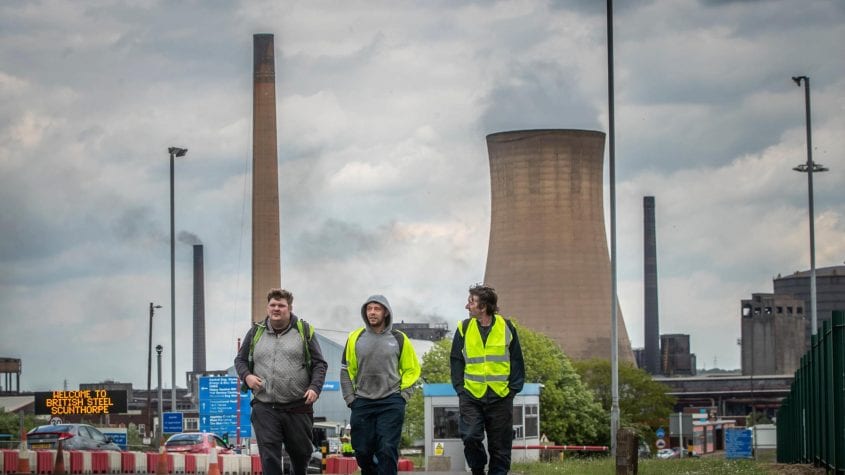
British Steel, an icon of the industrial heritage of the very nation that initiated the Industrial Revolution is on the brink of collapse. Its decline since the 1970s has been precipitous and it is now facing the closure of its last plant in Scunthorpe.
Carbon taxes have been squarely blamed for driving up costs that the business can no longer bear and so it faces collapse. While this is superficially true, the real root cause is the failure of the market to properly price carbon from all sources, domestic and foreign. It’s a failure of the design of the European ETS. In short, this is not a case of too much carbon pricing – it’s a case of not enough.
A Carbon Fee with effective border adjustment taxes would simultaneously action four key goals:
properly price steel, factoring in its carbon emissions,
incentivise reductions in carbon emissions from the sector
protect the British heavy industry from dirty, unfair competition, and
preserve, and indeed nurture, a vital strategic industry
20th Century Policy for a 21st Century Problem
The immediate problem for British Steel is the bill for Carbon Credits that has come due under the European Emissions Trading Scheme (ETS). The company has sought a loan of £100M from the U.K. government to pay this bill but it has no obvious sources of revenue to repay the loan, making propping up British Steel a very risky prospect from the taxpayer’s point of view.
But ultimately, the pressure is coming from British Steel’s inability to raise enough revenue from sales due to the crushing competition that the company faces from cheap imports of steel into the EU from China.
So while the ETS is trying to correct the market failures associated with the externalised costs of fossil fuels used in European production, there is no accounting for the massive emissions embedded in imported steel coming from China, leaving European manufacturers at a huge disadvantage.
Border taxes level the playing field for carbon
A border adjustment tax on carbon imposes tariffs on imports from countries that are not adequately pricing carbon themselves. This immediately strips out the cost advantage of imports from dirty economies associated with underpriced carbon in those economies. In fact, as the carbon price rises, these tariffs dominate the cost of such dirty imports and they become completely uncompetitive.
Furthermore, to keep the market fair in the opposite direction, for exports from the clean producer to the high-carbon economy, the relevant carbon fees are refunded to the producer on export, removing the advantage that the dirty producer has, even in their own territory.
What about the effect on consumer prices?
A common objection to tariffs is that they raise consumer prices, often punishing those who can least afford higher prices. This is an especially prevalent concern in a time of incipient trade wars and the economic distress they cause.
This is where the Dividend element of the Carbon Fee & Dividend policy comes in. All revenues from the carbon pricing, whether from domestic producers or tariffs on imports are fully distributed to citizens. This not only protects low and middle earners, it actually benefits them overall.
Price ALL carbon to rebuild British industry
The U.K. has made significant progress decarbonising its energy supply and just recently it boasted the longest period of coal-free energy production since 1882. But at present, the U.K., and relatively low-carbon economies like France, have no way to fully monetise their cleaner power sector when it comes to international trade.
Plentiful cheap clean energy combined with fees on imported carbon can reverse the decline of the British steel industry
This can be directly addressed by a Carbon Fee & Dividend policy, and when it is, it will give shelter to traditional industries that are being unfairly eroded by dirty imports and will provide a huge boost to investment in new, clean industrial production that can leverage the burgeoning low-carbon energy sector that the U.K. is building.
Carbon taxes are a much discussed mechanism for using market mechanisms to incentivise a transition to a zero-carbon energy from fossil fuels, exploiting the innovation and flexibility that markets can provide.
However, detractors cite potential economic harm to those on low and middle incomes as a reason to avoid such action. Many such detractors turn out to be straight-up fossil fuel shills with no care whatsoever for the poor but who will use any arguments that come to hand to deflect policy makers from adopting a robust carbon tax.
A Carbon Fee and Dividend policy directly answers any such concerns, real or disingenuous, by turning carbon taxation into a progressive policy that actually redistributes wealth from the richest 20% to the poorest 40% while leaving the middle classes broadly unaffected.
Carbon taxes win Nobel Prizes
Carbon taxes have been found to be a highly effective and efficient way of driving the economy to adopt alternatives to fossil fuel energy. Notably, William Nordhaus of Yale University was been jointly awarded the 2018 Nobel Prize in Economic Sciences with Paul Romer for ‘integrating climate change into long-run macroeconomic analysis’.
Nordhaus has proved prescient on the progress of CO2 emissions, writing in 1974, :
I have performed a rough calculation of the atmospheric concentration of carbon dioxide… Assuming that 10% of the atmospheric carbon dioxide is absorbed annually (G. Skirrow), the concentration would be expected to rise from 340 ppm [parts per million] in 1970 to 487 ppm in 2030 – a 43% increase. Although this is below the fateful doubling of carbon dioxide concentration, it may well be too close for comfort.
It turns out we are right on track to hit 487 ppm of carbon dioxide in 2030. In two papers (Nordhaus 1975, 1977), he laid the groundwork for what is now an entire field on the economics of climate change.
Now, there is certainly valid criticism to be made at where Nordhaus and others would set carbon taxes to maximise global growth. Many believe that there is insufficient weight given to factors such as warming feedback and the fate of the poor global south and these are certainly issues of concern. Such concerns would lead to carbon taxes well above the $30/tCO2 that Nordhaus originally proposed. However, there is no doubt that Nordhaus has established carbon taxes as a powerful tool in how we re-shape the economy to prevent climate change.
Clutching at straws and crocodile tears
Of the various stages of climate change denial and resistance to action, one of the later symptoms is an unconvincing concern among opponents that imposing a carbon tax will hurt the poor.
Such attacks coincidentally always seem to come from politicians and lobbying groups closely aligned with the fossil fuel industry and with a long history of denying the existence or risk of climate change in the first place. Such people rarely have a track record of championing high taxes or corporate regulation or social policy that could benefit the poor in other contexts so their concern here is somewhat uncharacteristic.
But if we were to take their challenge seriously, do they have a point? Are carbon taxes bound to condemn the poor to further hardship?
Well, unsurprisingly, it turns out the answer is no.
Carbon Fee and Dividend is a progressive, redistributive policy
The Carbon Fee and Dividend policy has 3 central features:
Tax carbon on fossil fuels as they are sold into the economy
Implement a border adjustment tax system to impose tariffs on imported goods that didn’t bear comparable carbon pricing
Pay the revenues back to citizens as a flat per-head dividend
Imposing a carbon fee and border adjustment tax does raise prices, especially for fossil fuel energy. According to a review of the policy (as proposed by CCL) by Wharton School Public Policy initiative:
For the first year that a $15 per metric ton of CO2 carbon tax is implemented, the cost of gasoline would go up by 16 cents per gallon, natural gas by 19 cents per therm (a 7.4 percent increase), and electricity by 0.6 to 1.1 cents per kilowatt-hour (kWh), depending on whether its source is coal or natural gas.
Seeing the whole picture
So looking at this effect alone, you could be forgiven for imagining the poor suffering further under such a policy. But that’s before you apply a dividend. This is the secret sauce that turns the entire picture around, to the point that the poor become the main beneficiaries of the policy.
According to a comprehensive study carried out by the International Institute for Applied Systems Analysis to model the effects of a carbon fee and dividend policy:
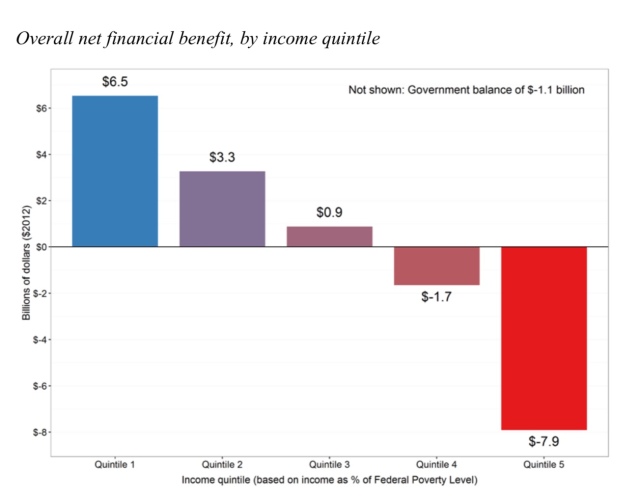
Given these assumptions, the policy confers a net financial benefit on 54% of households nationwide (59% of individuals). The distributional effects are highly progressive. Ninety percent of households living below the Federal Poverty Level are benefited by the policy. The average net benefit in this group is $342 per household, equivalent to nearly 3% of pre-tax income. Overall, the primary distributional effect is to shift purchasing power from the top quintile to the bottom two quintiles of the income distribution
This picture perhaps provides more instruction as to the motivation of rich, conservative fossil fuel lobbyists that oppose such a policy. Using the plight of the poor is nothing more that a disingenuous tactic designed to smear a progressive policy. For all those engaged in an honest debate, the facts are clear.
Only the top 20% by income (those best placed to deal with it) experience a significant net cost from the Carbon Fee and Dividend, leaving the middle class broadly unaffected, while those on low incomes are net beneficiaries.
A Carbon Fee and Dividend is therefore highly effective at mitigating entrenched inequality in society and gives the large majority of citizens a valuable stake in a fossil-fuel free future.
This week’s title is not a description of my dream-job. It’s actually a way forward for all of
us. Too good to be true? Stick
with me and I’ll try to persuade you that I haven’t lost my marbles.
I’ll start where I left-off in my previous column–carbon-taxes
are an effective way to encourage millions of people to find cunning ways to
cut back on greenhouse gas emissions but new taxation is generally about as
popular as Boris Johnson at a Remain rally.
New taxes are particularly resented when they are perceived
as unfair. This is a problem for climate-related
taxes as they can have a disproportionate impact on those least able to
pay. If we make gas more expensive, struggling
pensioners turn their heating off whilst the rest of us complain bitterly but
carry on with our long, hot showers. The
least significant producers of emissions cut-back and the worst polluters don’t
change their behaviour at all! That
doesn’t sound promising.
So, should we forget taxes on carbon emissions? That’s what our political parties have tended
to do until now. Economists may like the
taxation approach but politicians run a mile because it’s a great way to reduce
the number of people who vote for you. To
be fair they tried—when the “fuel-price escalator” was introduced in the 1990s—but
a few blockades by haulage companies were enough to push the emergency
red-button on that particular moving staircase.
Somehow we need to retain the benefits of carbon taxation—economy-wide,
economically-efficient emission reductions driven by the shared brainwaves of
millions of people—without imposing new burdens on those least able to bear
them.
The solution to this conundrum turns out to be remarkably
simple. The revenue from the tax should
be redistributed back to the population as an equal dividend. So for example, if we taxed emissions at the
rate of £25 for each tonne of carbon dioxide, this would bring in enough money
to give every adult in the country an annual cheque of about £250.
But how does that help?
The consequence of the tax is that prices go up but, for the least
well-off third of society, their costs go up by less than £250 and they are
better off. The most affluent third of
society, on the other hand, spend more money and the total increase in prices
they see is more than £250. They are a
bit worse off. At a stroke the burden is
on the rich rather than the poor. Economic modelling suggests that the
remaining third of the population see their costs going up by about the same as
the dividend and they are unaffected.
This approach is called “carbon-fee and dividend” and it is
already being used in Canada. There’s also a Bill before the US Senate which,
remarkably, has support from both Republicans and Democrats. The Left like it because it redistributes
wealth. The Right like it because it’s a
market solution to global warming that allows massive deregulation (e.g. you
don’t need to ban petrol cars if taxation has made them substantially more
expensive to run than electric cars).
So why aren’t we looking at this in the UK? Quite simply, because no-one here has ever heard of it. Had you before you read this column? To find out more, check out https://test.citizensclimatelobby.uk/. Spread the word, please.
The Gillet Jaune protests in France started as protests against climate-related taxes on petrol. Photo: Koshu Kunii
It’s been a dramatic few weeks. Climate Emergencies were declared by the
Scottish, Welsh and UK parliaments last week (and the Irish Parliament this
week) whilst, last Thursday, the government’s own Committee on Climate Change
(CCC) published a report recommending the UK have a target of net-zero
greenhouse gas emissions by 2050.
The last few weeks have also seen climate protests on the
streets of London, whilst the visit from Greta Thunberg—the Swedish girl who
sparked off global school-strikes—stimulated, at the very least, some warm
words and commitments from our politicians.
I also loved David Attenborough’s programme which really described well
what we are facing.
All this activity is raising my spirits. The CCC report, for example, is surprisingly
upbeat and positive. You get a strong
impression of a well-thought through plan that really can deliver. And net-zero by 2050 is just about good
enough to avoid the worst consequences of climate change (as long as everyone
else does the same). I’ve not been this
optimistic about global warming in years.
Hopefully our government will accept the CCC recommendations
before the end of this year. If they do,
the UK really will be an international leader in tackling climate change. Perhaps my fellow columnist at Marlborough
News—MP Claire Perry, the Minister for Clean Energy!–could say a few cautious words
about this in her June column although I appreciate that even the pages of
Marlborough News are not the right place to announce government policy.
Last week also saw publication of a less widely publicised
Government document—a consultation on how the UK will replace the European
Union’s Emission Trading System (ETS) when (if?) we leave the EU. You’re probably unaware of the ETS but it’s
been operating since 2005 and it places a cap on the greenhouse gas emissions
of our biggest polluters (e.g. electricity generating companies, steel makers
and so on). Importantly, this cap is
reduced over time so that these large organisations are forced to reduce their
emissions.
It’s not a bad way to do things but it does have one major
flaw. It only controls about 30% of the
greenhouse gasses we put out. The
remaining emissions come from lots of small things (e.g. heating your home) and
these cannot easily be controlled by an approach like ETS. The government’s current answer to this
problem is to introduce lots of regulations (e.g. a ban on petrol cars from
2040) but that has flaws too. Apart from
the fact that it generates lots of red-tape, it also relies upon a few
(admittedly very clever) people in Whitehall to come up with all the necessary
regulations, and they can’t think of everything.
There is another way. We can tax all emissions. It’s simple and it applies to the entire economy. But taxes are not generally popular even for good causes like combating climate change. We can see that just by looking at the continuing Gillet Jaune protests in France (which started as a protest against climate-related taxes on petrol) or the problems the UK government had with the “fuel price escalator” in the 1990’s and early 2000’s. Any such taxes have to be applied intelligently and I’ll talk about one possible solution in my next column.
global subsidies for fossil fuel energy implied by the underpricing of supply and environmental costs at a staggering $5.2 trillion in 2017, or 6.5 percent of world GDP
Last Sunday I stood beneath an 80m tall wind turbine—its blade tips rushing past at 100 mph. It was a dramatic sight but the loudest sound I could hear was the singing of skylarks. This was quite striking as, a few days before, I’d been reading objections placed in 2015 against placing of a wind turbine at Chapmanslade (near Westbury) and one of the concerns had been about noise.
I’m not suggesting that noise was the deciding factor in the rejection of the Chapmanside proposal but the wind farm I was visiting, Westmill wind and solar farm a few miles north-east of Swindon, has 5 turbines generating 6.5 MW of electricity and their soothing whisper was far less disturbing than that from cars on the minor road running past the farm. Noise really wasn’t an issue.
Westmill is well worth a visit (details at http://www.weset.org). Free tours are run by the Westmill Sustainable Energy Trust once a month through the Spring, Summer and Autumn whilst special visits can be laid on for larger groups. Our volunteer guides for the two-hour walk around the site—Sarah James and Mim Norvell—were extraordinarily knowledgeable. I don’t think there was a single question, the seven of us on the tour asked, that they couldn’t answer:
How much electricity does the site generate?—the wind and solar farms combined generate enough electricity for 4100 homes.
How long did it take for the site to prevent more carbon dioxide emissions than produced by building it?—about 8 months for the wind farm and 2.5 years for the solar farm.
How did the locals react to the wind-farm proposal?—there were many objectors but there were even more supporters.
How long did it take to get planning permission?—16 years for the wind farm but the solar farm was approved very quickly.
How has it affected farming?—the wind turbines have a very small footprint and crops are grown around them whilst sheep graze beneath the solar panels and benefit from the shelter that gives them.
What’s the effect on birds?—there’s been no problem at Westmill although siting of wind farms should avoid bird migration routes.
How about bats?—bats do seem to be attracted to wind turbines and this has caused problems at other sites.
I’m sure you can guess where I’m going with this. To prevent dangerous climate change we need more wind farms and many of the objections don’t add up. They’re not noisy, it doesn’t take 40 years to get the energy back and, with sensible siting, they are not a problem for birds or bats. Of course we do need to be sensitive about exactly where we place them—even I wouldn’t put a turbine in the centre of Stonehenge—but we also need to relax the harsh anti-wind planning rules introduced by the government in 2015.
For a start, Wiltshire Council needs to designate areas where wind-farms will be allowed, this is a step they haven’t yet taken with the result that new wind farms are banned across our county. As I said in a previous column, onshore wind farms are the cheapest form of electricity and they have to be an important component of preventing excessive global warming at an affordable price.