Tag: Climate Change

  • Show the Love!

    Show the Love!

    show the love badges
    Download badges and heartfelt climate conversations

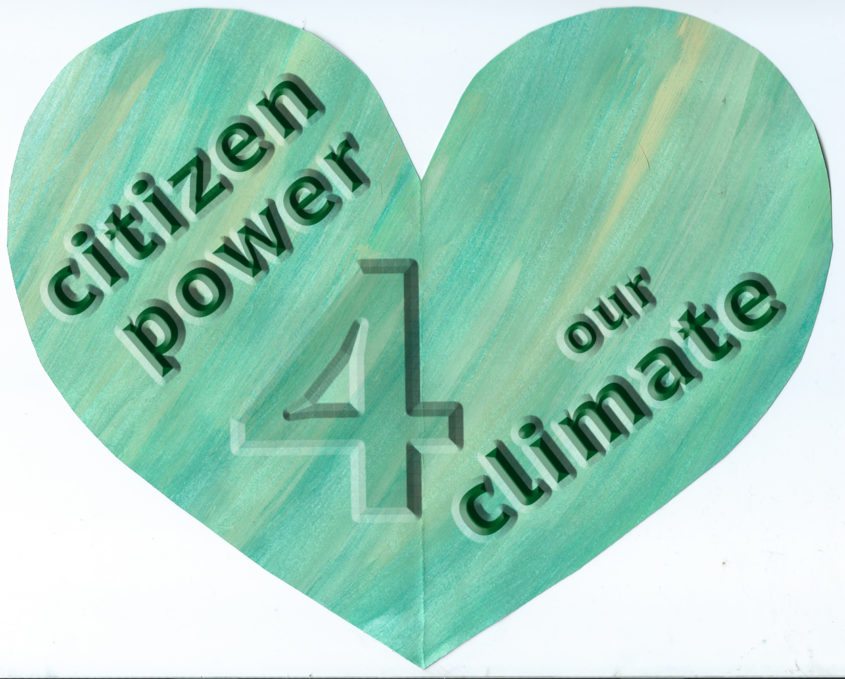
    Valentine’s Day 2018, CCL UK is taking part in Show the Love, an initiative by the Climate Coalition, with our own version of the green hearts.

    There are plenty of ways for you to join in, not just to show the love for our climate and planet, but also to have a conversation with family, friend, colleague or MP about our workable solution, Carbon Fee and Dividend:

    Heartfelt Climate Conversation

    You can download a sheet with both badges and the following conversation points, so you can keep them handy on Feb 14th:

    • Are you concerned about climate change and air pollution?
    • Do you know the main causes? (Answer: carbon dioxide, and other gases and particulates from the burning of fossil fuels)
    • Did you know there’s a solution that will pay us for burning fewer fossil fuels?
      Individual action won’t work fast enough to combat climate change.
      Citizens’ Climate Lobby UK proposes a fee placed on fossil fuels when they enter the country, whether through import or extraction. This would encourage more investment into future clean energy available to everyone.
      The money raised by this fee would be divided equally between UK citizens, which means that those who use alternatives to fossil fuels would come out ahead.

      CCL UK members lobby our Government to adopt this Carbon Fee and Dividend.
      There’s more information on citizensclimatelobby.uk

    Have fun and let us know how you get on.

  • October Campaign – results!

    October Campaign – results!

    MP letter
    Scottish MP Stephen Gethins reply to CCLUKer Charlie Webb

    Our campaign to galvanize Parliament in advance of the recent UN climate negotiations (COP 23) in Bonn – which has just ended – has resulted in a surge of action and some splendid results.

    The numbers tell just a small part of the story. CCLUK members have been talking up our policy up and down the country, sharing it with friends and family, posting it (in many imaginative ways) on Facebook, generally spreading the word.

    How many conversations did you find yourself taking part in? One volunteer signed up 21 letter-writers. Only seven of them actually produced the letters…But that was 21 conversations that wouldn’t have happened otherwise.  Experience has shown what a difference that can make. ( I’ve had people come back to me after a year to say, “Ah! Now I get it!”) (more…)

  • You are exactly the right person to care about climate change

    You are exactly the right person to care about climate change

    When evangelical Christian Katharine Hayhoe is asked ‘do you believe in climate change?’, she answers, ‘no’.

    You’d be forgiven for thinking she’s just another religious climate denier. But you’d be wrong.

    Canadian-born Katharine is a professor of atmospheric science, number 15 on this year’s Fortune World Greatest Leaders list and scientific adviser to Citizens Climate Lobby US. Speaking at All Souls Church, London, last night, she told us the reason she said ‘no’.

    As in many times throughout her talk fusing Christianity and science, she begins with a bible passage, Hebrews 11:1, ‘Now faith is the substance of things hoped for, the evidence of things not seen’. She adds to it: ‘science is the evidence of things you can see’.

    Climate change is not something to believe in: the evidence is there for all to see. It’s provable fact; faith is irrelevant. (more…)

  • Motivating Energy Reduction

    Motivating Energy Reduction

    In my last post, I wrote about how we would be more inclined to fight climate change if we focused on an immediate threat we could see: pollution. However, acting to reduce consumption only on obviously polluted days is just not enough to make a meaningful dent in UK emissions. In reality, the air in all but the most densely populated urban areas of the country is mostly clean. Given this, we need to be more proactive than reactive, working to lessen our energy usage on a daily basis. But, as usual, each time we read an article on climate change and turn off a lightbulb somewhere in our home, we’ll have forgotten the whole thing an hour later.

    This is where motivational science comes back in – to answer the question of how we can keep ourselves focused day-to-day. An obvious response might be “money.” If we show people how much money they are saving per month when they reduce their usage, they will change their behaviours to meet those goals. Unfortunately, energy is so cheap that any change is really inconsequential to our budgets. However, research from a number of behavioural psychologists such as Inside the Nudge Unit author David Halpern leads us to another potential answer: feedback, and lots of it.

    Imagine this: instead of using a speedometer in your car, you get a monthly printout of your average speed for the past four or so weeks. You would only have a vague sense of when you were speeding, and would probably end up going faster a lot more frequently. It’s hard not to, with no immediate feedback on the dashboard. This is how we use electricity in our homes – blindly. We have very little sense of how much electricity our devices use. Sometimes, we even forget that certain things use electricity; according to the American energy.gov site, disconnected phone chargers require 0.26 watts while chargers connected to fully-charged phones use 2.24 watts.

    So, what should we do? Luckily, energy companies are rolling out smart meters that show live displays of energy usage. Even better, every home in the UK will be offered one (for free!) by 2020. All you need to do is to display it prominently. Then, you can begin challenging yourself in real time to reduce consumption.