On November 27th, last year, I was privileged to attend the National Emergency Briefing at Central Hall, Westminster. The briefing was primarily aimed at MPs and Peers but was also attended by around 2000 invited members of the public from climate campaigners to celebrities.
The queue, when I arrived, stretched around the block but the organisers got us in efficiently and I found myself sitting next to the sustainability manager of Sainsbury’s. However, there wasn’t much time to chat as the talks started. We kicked off with an introduction from Chris Packham and a preview of what to expect from the main meeting organiser, Pofessor Mike Berners-Lee of “How Bad are Bananas?” fame. Then we were into the main part of the meeting, a series of 15 minute talks from some of the UK’s most eminent experts on the impacts of climate change from Health, to National Security and Economics as well as several talks on the science of climate itself.
I’ve waited until now, to write this blog, because I didn’t want to be writing a long boring description of each talk. Instead, the talks are now all available on-line for you to watch for yourself. Go to https://www.nebriefing.org/ and select each of the talks under “Expert Briefings”. I really can’t recommend these talks highly enough.
The main message I took away from the meeting is perhaps summed up by a sentence from Lt Gen Richard Nugee’s talk on National Security. In that context he stated that “the threat position is changing faster than expected”. This is true of all the aspects covered by the speakers.
Another reason for wanting you to go to the NEB website itself is that you can then sign the open letter to Keir Starmer calling for a televised emergency briefing. Please all sign up.
The Citizens’ Climate Lobby is all about solutions. It’s about how society can make the changes needed, to avoid climate catastrophe, as rapidly and equitably as possible. Our starting point is that global warming is real, dangerous and caused by humans.
This approach made a lot of sense until recently. There was broad political consensus that climate change was a serious issue and that the UK should aim to get its net emissions down to zero by 2050. Our politicians were proud to be world-leaders in this endeavour.
Unfortunately, that has changed. We now have anti-science politicians in the UK, and elsewhere, who openly dispute the need for net-zero. Instead, they champion a cynical philosophy in which every country pursues its own, blinkered self-interest even though this is a proven route to a poorer world for everyone.
As the impacts of climate change become ever more obvious, these short-sighted politicians will change their direction when it suits them to do so. But, in the meantime, when discussing CCL-UK policies we may find ourselves increasingly encountering push-back on whether greenhouse gas emission reductions are necessary at all.
The problem is anti-net-zero soundbites that have been well crafted to sound plausible even though they disintegrate on closer inspection. Examples I’ve heard, recently, from senior politicians include “2050 is an arbitrary target” and “We can’t afford net-zero”.
To counter these. I’ve set up a new website (netstupidzero.org) that takes these soundbites and explains, in simple terms, why they’re misleading. You may notice that the site name, itself, is a direct quote from the Reform Party’s Richard Tice who is, perhaps, the most prominent promoter, in the UK, of anti-science disinformation.
In my website I’ve tried to use common-sense rather than go into detailed scientific explanations. My aim is just to make it easy for anyone to counter anti-net-zero propaganda whenever and wherever it’s used. I hope you find it illuminating and useful.
This is an extract from the slideshow delivered by Cathy Orlando, CCI program director on the 20th December 2023 giving the CCI analysis of the outcome of COP28. The worst case scenario – that fossil fuels would get a free pass and the pledge to work to keep temperature rises within 1.5 Celsius would be dropped, was averted.
CCI applauds the eventual operationalisation of the Loss and Damage Fund, the declarations on tripling renewables and doubling energy efficiency, and tackling the fossil fuel subsidy issue. Highlighting the role of agricultural systems and the effects of climate change on human health and the natural world as well as the need for the transition to be just were also welcome signs of progress and proof that COP conferences, while not perfect, are important and necessary.
CCL UK agrees thatCOP28 confirms that CCI’s campaigning for the reform of financial systems is the path forward.
Governments’ 2030 targets will lead to 2.5°C of warming by the end of the century: 0.1°C higher than last year. This change is due to weak existing targets rather than any major shifts in new NDC updates: we take the level of emissions anticipated under current policies for those countries that we expect to overachieve their weak 2030 targets.
Since COP28 the FFNPT now has 12 nation states signed up, in September the State of California became the largest economy to endorse the call (the 5th largest economy in the world and the largest sub-national economy)…… California Senate Majority Whip Senator Lena A Gonzalez (D – Long Beach), said: “It is essential that we commit once and for all to ending our reliance on fossil fuels. People around the world, especially low-income people of color, are suffering the adverse health impacts of fossil fuel pollution, from asthma to cancer. The recent devastating fires and hurricanes emphasize the urgency of taking action, to prevent further extreme weather changes. The science has been clear for decades—fossil fuels are responsible for the climate crisis. We can prevent further harm to our communities, and that is why I am proud that California has now been added to the growing list of governments endorsing the Fossil Fuel Non-Proliferation Treaty. It is time for our nation to be a part of the solution, to forge strong unity and commitment to phasing out the use of fossil fuels.”
France and Kenya formally launched the ‘Taskforce on International Taxation to Scale Up Development, Climate, and Nature Action‘ with Barbados, Antigua, Barbuda, and Spain signing on as members.
CCI and CCL UK members will continue to educate and campaign for the solutions that will enable the world’s financial resources to be unlocked to ensure a liveable future in 2024.
When they say we need fossil fuels…….The primary driver of inflation around the world is fossil fuels. Economies are addicted to fossil fuels at every level: mobility, energy production, agriculture and goods production. When the prices of oil and gas go up, every other price tends to go up. Actually, high fossil fuel prices are historically inseparable from inflation and economic crises. Mark Zandi, chief economist at credit rating agency Moody’s, said in an article for Vox that “every recession since World War II has been preceded by a jump in oil prices”. And there is a term for it: fossilflation.
Factors driving fossil fuel prices are many, and diverse. Most of the time, though, these come directly from producing countries, which raise and lower production, thus flooding or drying up the market. This is often used as a political tool, driving millions of people into despair. Here is just a sample of the many ways of how fossilflation happens:
The market-rigging actions of the OPEC Plus cartel (including Russia);
Profiteering on energy supply disruptions due to Russia’s invasion of Ukraine;
Embedded energy costs across all classes of consumer products and business services;
Food system effects including embedded fossil fuel costs and climate damage;
Embedded climate risk and liability costs;
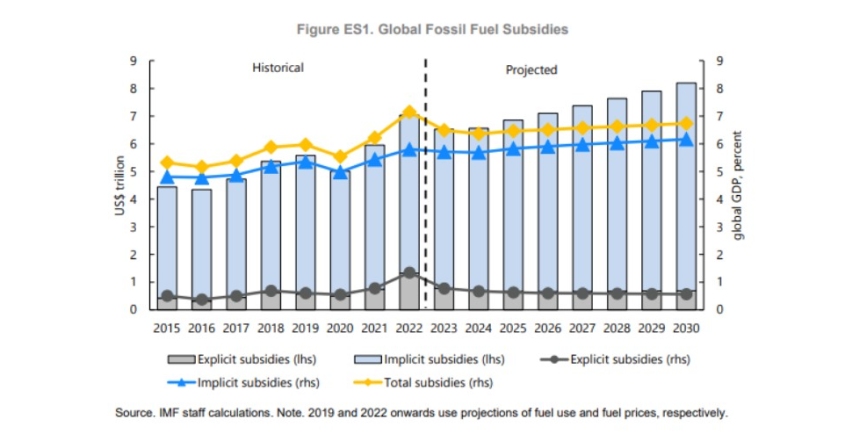
Sovereign debt stresses driven by fossil fuels, including: a. Public spending and sovereign debt burdens resulting from disaster response; b. Direct spending on disaster response; c. Extremely high, punishing interest rates linked to that spending compelled by actions a country did not initiate or decide; d. All-time record fossil fuel subsidies ($7 trillion), linked to rigged fossil fuel price spikes; e. Public spending to compensate consumers for unaffordable price shocks linked to higher embedded energy costs.
There is one solution: move away from fossil fuels. We need to do it fast, and we need to do it fairly. That is why at COP 28, Citizens’ Climate International is linking arms with many organisations and calling for a fossil fuel phaseout.
By breaking free of coal, oil and gas, and replacing them with renewable energy sources, we will protect our planet and our economy.
Summary
The primary driver of inflation around the world is fossil fuels. In fact there is a term for it: fossilflation. There is a simple solution: move away from fossil fuels. We need to do it fast, and we need to do it fairly.
That is why at COP 28, Citizens’ Climate International is linking arms with many organisations and calling for a fossil fuel phaseout. By breaking free of coal, oil and gas, and replacing them by renewable energy sources, we will protect our planet and our economy.
The IMF, Carbon Pricing and Explicit and Implicit Fossil Fuels Subsidies
Here are two terms that anyone who wants to preserve a stable climate needs to know: explicit fossil fuel subsidies and implicit fossil fuel subsidies.
Explicit fossil fuel subsidies from governments directly reduce the price of fossil fuels, thus making it attractive to investors and consumers to buy. Implicit fossil fuel subsidies are the costs taxpayers and insurance are paying for the air pollution and climate impacts experienced because of dirty fossil fuels.
On August 24, 2023, the International Monetary Fund (IMF) released a report. The conclusion of this report was that subsidies for oil, coal, and natural gas cost the equivalent of 7.1% of global gross domestic product.
Explicit subsidies have more than doubled since 2020 but are still only 18% of the total subsidy amount, while nearly 60% is due to implicit subsidies.
Here is a hopeful conclusion from the report: “Full fossil fuel price reform would reduce global carbon dioxide emissions to an estimated 43 percent below baseline levels in 2030 (in line with keeping global warming to 1.5-2C), while raising revenues worth 3.6 % of global GDP and preventing 1.6 million local air pollution deaths per year.”
Making polluters pay (a.k.a carbon pricing) offers us the exact tool needed to ensure this price reform. In fact, the IMF Managing Director Kristalina Georgieva at the Paris Summit in June said, “Our analysis shows that without a carbon price, there is no chance that we will meet the 1.5 degrees Celsius target by 2030. We will miss it.”
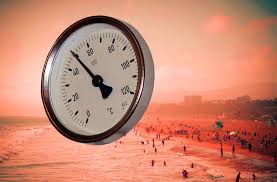
Our only home, Earth, has just passed through the hottest three months on record. With the fires, floods, horrendous storms, cryosphere melting and the threats to the Gulf Stream, it is obvious that the impacts of climate change are no longer just a concern for future generations, but are a very real threat at our doorstep. We must listen to the experts and cooperate to enact or strengthen our essential climate policies such as carbon pricing going forward. Happily there are 70 carbon pricing initiatives world wide and the African Summit issued a unanimous call for world leaders to support global price on carbon pollution on September 6, 2023.
The Fossil Fuel Industry Funded Climate Disinformation for Decades
Even to this day, there are individuals who deny or downplay the link between the burning of fossil fuels and the impacts that pollution has on our climate and health. How did this happen?
Key players in the fossil fuel industry knew decades ago that burning coal, oil, and methane gas to warm our homes, power our cars, and generate electricity was warming the planet. Instead of acting on the knowledge, they began financing a massive disinformation campaign. Now, as a consequence, youth are having to fight for their inalienable right to have a safe and liveable future.
Happily, when you inform people that the fossil fuel industry funded a climate disinformation campaign for decades, people are more likely to believe you when you present solutions.
Both Labour and Conservative politicians have been spooked by the narrow by-election win in Uxbridge which has been squarely attributed to campaigning on the proposed extension of the Ulez scheme. Few commentators pointed out that Manchester, Bristol, Birmingham and Bradford received a combined £230m in Government funding for their scrappage schemes, but London and the South East have received none.
Press coverage has rightly pointed out that people should not be made poorer by ill thought out schemes which could be said to put the cart before the horse. There are politicians in both parties who are calling for unpopular policies to be dropped or postponed but neither party is denying the need to reach net zero.
Sam Hall, director of the Conservative Environment Network, told The Observer that …“Environmental policies are an electoral asset when they are fair, affordable, and deliver for people and their communities. I’d warn Conservatives against listening to calls to ditch environmental commitments following the Uxbridge result. Insulating people’s homes, building more renewables, and attracting investment into new clean industries are popular, bill-cutting and job-creating.”
A blog he wrote for CEN points out that…The Conservatives secured a victory against the odds by focusing the campaign on ULEZ expansion. They effectively pulled off a protest vote against an unpopular mayor instead of the usual dynamic of voters protesting the government. This strategy won’t work at a general election, when the party will be asking for a fifth term in government. Senior Conservatives must resist calls to ditch conservative environmental policies. (Over 150 MPs and Peers have signed up to the CEN).
What the by-election shows is that policies which create financial hardship won’t work and in fact will be as counter productive as the tax imposed in France which led to the Gilet Jaunes revolt. Climate Income along with grants or loans based on future carbon dividend payments would go a long way to achieving the decarbonisation of the economy without penalising most people (as outlined in our report published last October).
Whilst not asking directly for Climate Income the Times editorial today puts the case for a Carbon Tax…..The message from policymakers must be that mitigating climate change can best be tackled through the continual innovations that are characteristic of market economies. And that doing so, using the price mechanism to encourage new technologies, is practical. It is widely understood that a carbon tax would be highly effective in persuading consumers and businesses to switch their energy consumption and behaviour. This would need to apply to carbon consumption and not only production, lest richer countries merely outsource their production to poorer economies. Revenues from a carbon tax could be used to subsidise renewable sources of energy and thereby encourage their wide adoption.
Update 25/7/23
Today Lord Deben (outgoing Chair of the CCC) has asked that parties build a cross party consensus on tackling climate change and getting to net zero, based on the recommendation of Chris Skidmore’s UK Net Zero Review. ….“If I were leader of the Labour party at this moment, I know exactly what I’d do,” said Deben. “I would say to the current government: ‘Here is Mr Skidmore’s report, he is a Conservative ex-minister, he was asked to do this report to show how best to deliver net zero by Liz Truss. Now we will accept, if you put it forward, we will do the following basic things [acting on the report’s recommendations]. We will do that. We won’t oppose it. You put them forward, we’ll back it.’” ………..There are those who don’t really take onboard the urgency of climate change, and they are in all political parties.”
Let’s remind our politicians that there is not only no justification for dropping commitments to net zero while Rhodes burns and people die, but also no need!
Tomorrow’s national meeting will be dedicated to this action
A recent report discussed research on attitudes towards climate change and solutions which included Climate Income. The research covered 40,000 respondents from 20 countries representing 72% of global CO2 emissions. The results show climate policy support hinges on three key beliefs:
• effectiveness – does it work ? • inequality – is it fair ? • household self-interest – will we be better off ?
Good News:
Over 80% of people agree that climate change is important and that their country should take measures to fight climate change.
Bad News:
Informing people about the impacts of climate change, with climate impact videos, has little effect…..(to quote a much loved TV character ‘We’re doomed’!)
Good News:
Addressing these concerns, with more positive climate policy videos, can substantially increase the support for climate policies. In particular, for carbon tax with transfers (Climate Income), policy support grew more than double any other policy type. Showing just the policy video, support increases on average by ~10%. In Europe that varies between 8% in France to 15% extra support in Italy. Showing both videos raised the average support across European countries by over 14%.
It is interesting to note that, even before the video viewing, the concept of a carbon tax with the proceeds returned to household garnered wide support in high income European countries. Among those who expressed an opinion support for the policy ranged an average of 54% to 71%.
We tested the video in Brussels with NGOs who have their own priorities for revenue and thus are often the most resistant to citizen rebates. It prompted interest and one particular quote:
“Now I see why the citizen dividend is needed !”
I heartily recommend sharing these videos with NGOs, public, etc, I suspect legislators will also be interested.
In short: 5 minute videos can persuade most people to support Climate Income because it offers a solution to climate change rather than just making people feel either helpless or guilty.
Exposure to information on solutions is persuasive.
Additional exposure to information on climate impact helps, but only marginally.
I recently wrote this article about Climate Income for the John Ray Initiative Website. (their strapline is : Connecting Environment, Science & Christianity). I was asked to reproduce it here and I hope you all find it useful and inspiring!
What if there was a single ‘silver bullet’ policy that would bring down emissions of CO₂. Would you support it?
‘Of course!’ you say.
Ah, but would you really?
It turns out many people find it quite challenging when shown what this might involve. No, I am not talking hair shirts for everyone. The policy I want to introduce is gentle, yet has terrific leverage. You don’t need to buy the idea I am offering. At most I am asking you to give it a test drive for a few minutes. Then you can decide if you want to follow up on it and find out more, following the links.
My starting assumptions are uncontroversial: our industrial society was built on the use of fossil fuel; now we must transition to renewable energies. Yes we have very many other severe environmental challenges – but this one underpins all the others. The great carbon detox will take decades and we are behind schedule. There is no more time to waste. Personal lifestyle changes by those who are climate concerned will not be enough; some things only governments can do. Yet governments face many other crises – cost of living and economic turmoil, not to mention mass migration, famine and war. The challenge is to tackle the climate crisis in a way aligns with other pressing priorities.
Here is where the test drive begins: ask yourself “What conditions would a climate policy have to satisfy for us to say “Yep, this is the silver bullet we have been looking for”? Its not an easy question so here are my seven conditions and you can decide whether they are adequate. The policy would:
Bear down steadily but relentlessly on the use of fossil fuels. It would mean that fossil fuel extraction and use shrank and shrivelled over the next couple of decades.
Be dead simple – transparent, easy to administer, no scope for dodging or special pleading by vested interests.
Protect the less well-off and be seen to be fair.
Be business-friendly, working with the grain of economic life, not paralysing or disrupting it.
Provide a long-lasting stimulus to the demand for renewable energy, thereby encouraging investment and innovation, scaling up supply, and bringing down the cost of renewable energy.
Assist efforts to de-carbonise in other countries.
Be popular with the public (even those who are climate-confused or uninterested) and ‘lock-in’ support on a cross-party basis, long-term.
Take a bit of time to consider the list. Is anything missing? Would you be willing to support such a silver bullet policy? How do you feel about the list?
My guess is you are feeling incredulous, sceptical and now saying, more cautiously, “Well Yes, I suppose I would support it – but what is the policy, for goodness sake?!”
Here’s the answer: the silver bullet is variously known as Climate Income, or Carbon Fee & Dividend. It is comprised of three elements:
1 Carbon pricing, achieved through a steadily rising levy on fossil fuels, which funds….
2 A Climate Income, paid at a flat rate direct to all adult citizens. In Canada this is called a Climate Action Incentive Payment and in Austria it is calledKlimabonus – and it is paid direct to each citizen’s chosen bank account in both cases. Yes, you read that right: the policy has been already been adopted elsewhere.
3 A ‘Border adjustment mechanism’ to prevent fee-dodging, to avoid our exporters being disadvantaged, and to make it advantageous for those who sell to us to adopt a similar approach (for those who know about it, the EU’s Emissions Trading Scheme also involves a Border Adjustment Mechanism).
This policy satisfies all seven conditions for a silver bullet. The chart below gives some indications of how the ‘magic’ is worked, and what underpins that bold claim.
REQUIREMENT
HOW IT WORKS
1 Drive the use of fossil fuels down – and out.
The levy raises the price of carbon, year on year. Over time, carbon is simply priced out of the market.
2 Dead simple to implement
Levy collected at source from the (relatively few) owners of coal mines, and oil & gas wells, and on imports of the same. Child’s play compared to existing tax regulations (and subsidies!) affecting fossil fuels.Making regular flat rate payments to all UK residents (based on National Insurance and/or NHS numbers) requires a large capacity, very simple system.
3 Protect the least well-off; seen to be fair.
‘Polluter pays’ is well understood. Flat rate – everyone treated the same. Redistributive – most households are better off (and that’s before they switch to lower carbon products and services).The poorest households receive a significant increase in disposable income.
4 Business-friendly – eases the transition off carbon
Business associations call for it – it gives them a degree of certainty and a level playing field. Economists love it!
5 Sustained stimulus for investment & innovation in renewable energy systems
Rising demand for ‘greener’ products, services and infrastructure creates investment opportunities. Little need for the government to ‘pick winners’.
6 Assist de-carbonising in other countries
‘Border adjustment’ has this effect providing an incentive for a similar levy in countries that export to the UK, including coal, oil & gas exports
7 Popular, ‘locking-in’ cross-party support
Climate Income ensures support, including from waverers, and ‘don’t knows/don’t cares’.
I don’t expect you to take my word for any of this. To check out the claims these websites may help:
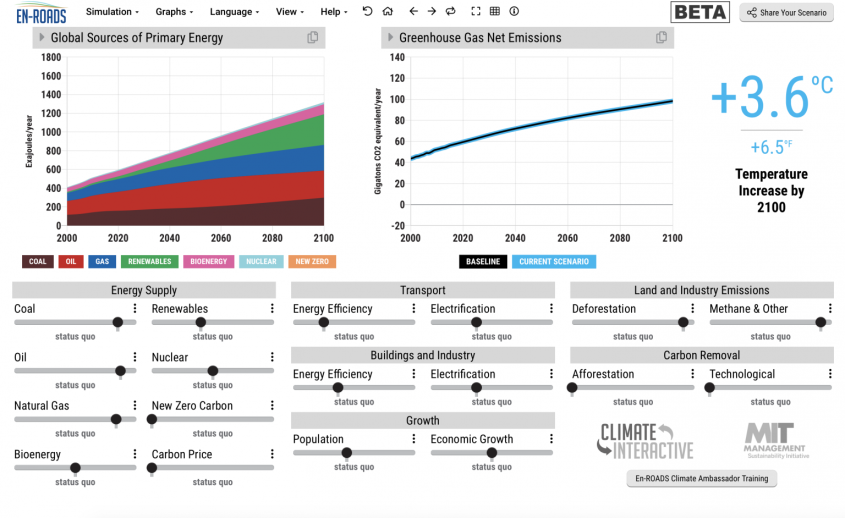
□ Regarding the importance of carbon pricing, visit the EN-ROADS site, a wonderful climate policy simulator devised by a team of climate scientists and policy analysts at MIT. You will have an array of thirty different policy levers – can you combine them to bring down carbon emissions fast enough to prevent catastrophe? It’s a powerful educational tool. If you find a way to get a good result without making assertive use of carbon pricing, and in a way that is half-way credible, politically – then please let me (and the world) know.
□ Regarding the Climate Income itself – giving the money back to citizens – this is what makes the rising fuel levy socially and politically acceptable (instead of causing riots). To get an idea of the redistributive effect it would have in the UK, visit Citizens Climate Lobby UK – one of a family of CCL websites which are stacked full of expert endorsements and campaign testimony. There is even a recent UK report on how it could work in the UK in in the face of the cost of living crisis.
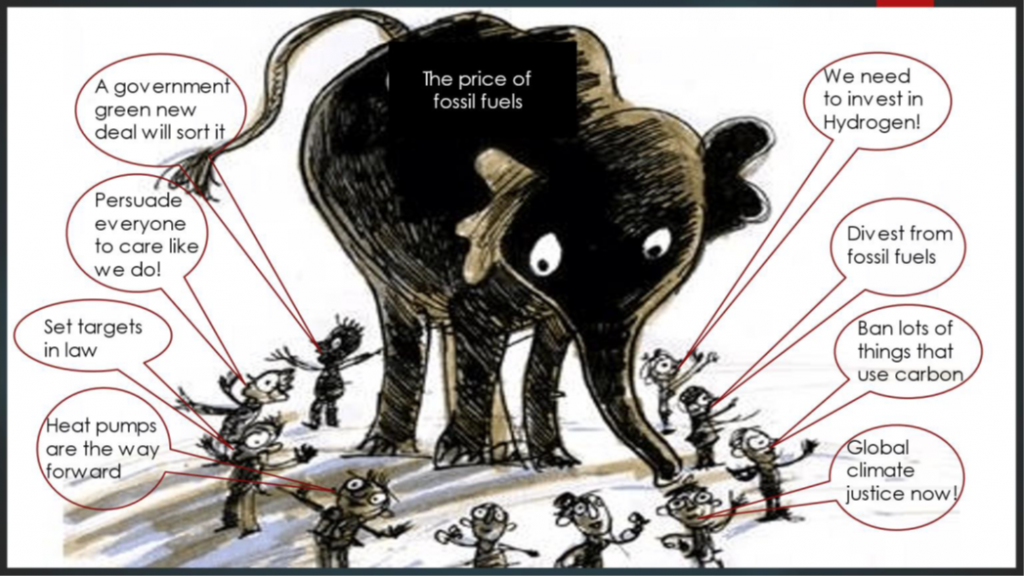
Image credit to Mini Grey from whom this version is adapted with permission
So now, how are you feeling? And have you spotted why many ‘greenies’ are uncomfortable with the idea of Climate Income? One of its great strengths – having support right across the political spectrum – seems also to cause unease.
“What? I’m supposed to march shoulder-to-shoulder with… [insert here the political grouping you love to hate].”
“ Don’t kid me that we should give-the-money-back-to-citizens-and-rely-on-the-market / allow-that-sort-of-state-interference…” [cross out the one that does not apply].
In this country we have a particularly adversarial version of democracy: things have to be done the way we, or our preferred political leaders, think is best. So discussions of climate policy easily slide into arguments between rival political philosophies – market versus state, woke against traditionalists. It’s one of several ways of taking our eye off the carbon ball. An adversarial stance leads us to thinkwe must get othersto think in the way we do, to share a large part of our world-view. We are right (and on the side of the angels); they are mistaken and need winning over.
How likely is that to happen? That’s the question I ask that when giving talks – after explaining what is known about the spread of public opinion. Basically, the research is clear: about 30% are firmly climate concerned. We would need another 20% to become the majority – and then hold that support for, say, twenty years… I say “Hands up if you believe that will really happen.” Only a few hands are raised (would you raise yours?)
And then: “Thank you. Now keep your hand up if you believe that much additional support can be won over fast enough to avoid catastrophe?” I’ve yet to have a single hand remain up.
Adversarial politics has another flaw. We greenies like to say we follow the science. Too often though, we ignore one absolutely solid finding from years of psychological research:uninvited efforts to persuade are the best way to get others to dig in their heels!
Politics doesn’t have to be adversarial. Sometimes we may need to listen more and talk less, to sympathise a bit more with others, and allow that there may be some truth also in what they say. I find it’s rare for anyone to be completely wrong. The implications are profound – and they bring us the idea of relational campaigning, a very different way of ‘doing politics’. It’s beyond the scope of this post to go into this. You can find out more on the websites of Citizens UK, and Citizens Climate Lobby.
Meanwhile a growing number of people are quietly ploughing this furrow under the radar as a way to bring in a Climate Income. Perhaps you might consider joining them…? Remember, you do not have to give up on any of your existing campaign commitments. Climate Income turbo-charges other climate initiatives; it doesn’t undermine them.
Rob Paton is a Quaker. Before retirement he was Professor of Social Enterprise at the Open University. He is active in the Thames Valley chapter of Citizens UK.
Note to see more CCL UK articles by and about Rob Paton and the brilliant work he is doing with Citizens UK please type Rob Paton into the website Search function .
The outcome of COP 27 in Sharm El Sheikh treated the consequences – loss & damage, but not the cause – fossil fuels. It was a huge victory to get loss and damage funding. This is to be celebrated.
We cannot rest yet. There is no mention of oil and gas in the COP 27 outcome. The math is simple: more fossil fuels burned means more adaptation and loss and damage costs. This victory is unbalanced. Anything that is unbalanced is doomed.
We have hope because it’s not the COP sessions that change the world, it’s the actual work that goes on after governments have made those promises. We have hope because we have been working behind the scenes and monitoring progress at the G7, G20, the United Nations, the World Bank and the IMF for several years now. We have hope because our volunteers are doing fantastic work around the world. We have hope because we know that the tracks have been laid for a resilient and equitable future and the train is about to leave the station. Consequently, we have hope because we know that the transformation of the economy will not be linear.
Change is coming. Find out how you can help and spread hope.
I have just sent a quick email to my MP about the decision to approve Woodhouse Colliery. He, thanks to the efforts of our local CCL group, understands and supports the case for Climate Income but I would have written even if I was not campaignong for Climate Income. The decision makes no sense even under ours and Europe’s current carbon pricing system (ETS).
I am perturbed that the Woodhouse colliery has been approved, ostensibly to prevent the need to import coking coal, yet….There are only two potential customers for this coal in the UK: Tata Steel and British Steel. Yet Chris McDonald, chief executive of the Materials Processing Institute, said earlier this year: “British Steel have said they cannot use the coal from this mine because the sulphur levels are too high. Tata Steel have said if the coal were available, then they may or may not use a small amount. There isn’t anyone in the steel industry who’s calling for the mine.”
This retrograde step delays the industrial changes needed to move away from fossil fuels and will decrease our future competitiveness. We will also lose the credibility and leadership we gained at COP26 with the Powering Past Coal Alliance. As the future for steel is acknowledged to be smelting using green hydrogen and electrolysis for recycling steel we would do better to invest in green hydrogen. According to the LGA Cumbria could have 6,000 new jobs by 2030 with the right investments in green infrastructure, with 600 in Copeland.
BEIS has had a 250 million Clean Steel fund since 2019 and an Industrial Energy Transformation Fund, lets use it to get ahead of the game and future proof our industry. Germany and Sweden are already piloting the technology, we will fast lose any competitive edge if we stick to this outdated technology the industry doesn’t want. With a sensible carbon pricing mechanism like Climate Income the price of coal coking of steel would also soon lose any competitive advantage, and it may even do so under ETS. The decision could be called Luddite, or at least extremely short sighted!
I think we need to show our MPs that the decision was foolhardy to say the least. Send them an email or maybe a Christmas card to show that bad decisions on energy and industrial strategy will always come home to roost!