Ambrose Pritchard, writing in The Telegraph criticises the proposed Democrat Green Deal as being a dirigiste policy with an ulterior motive of ‘fuelling’ the trade war with China. He gives a very cogent explanation of the mechanics of carbon fee and dividend and why he prefers this market led method of carbon pricing. He also argues why the dividend should go directly to consumers…
Mr Biden’s new age Gosplan is not to my taste. Should the Democrats be pledging to install 500 million solar panels and 60,000 wind turbines over the next four years? Is such dirigiste planning the American way?
The laissez faire way is to set a carbon price that ratchets up predictably, letting business respond to the price signal, and letting Schumpeterian competition find its own answers. All former chairmen of the Federal Reserve and a cast of economists of all ideological stripes have backed HR 763, a bipartisan House bill for a carbon tax and dividend.
It starts at $15 a tonne and ratchets up $10 every year until CO2 emissions are almost eliminated. The money raised is rotated back into people’s pockets. The higher the carbon price, the bigger the cheque, and the poor do best.
Needless to say, Ursula von der Leyen’s variant in Europe aims to siphon off its carbon tax to fund the Commission’s apparatus. The EU seems to have learned little from the gilets jaunes and the sociology of revolt.
A hot tip from a fellow member of the CCL UK Media Team gave me the hook to write a letter about Climate Income that has been published in last Sunday’s Observer (26th July). The trigger was an interview in the fashion section of the magazine with the supermodel and activist Lily Cole, whose book Who Cares Wins: Reasons for Optimism in Our Changing World is published on July 30th (Penguin Life). To our delight, Lily Cole ends the interview with a brilliant endorsement of CF&D – which offered a clear lead to this letter…..
Cole, not coal
Lily Cole describes two types of environmental activists, the wizards and the prophets (“We need to be more forgiving”, the Observer Magazine). Currently the prophets seem to grab the headlines in the UK, which results in surveys in which 59% of adults say they can’t afford to be greener. When asked what she would do if she were prime minister for the day, Cole described a method of carbon pricing known as “carbon fee and dividend”, which would enable us all to benefit from the wizardry without having to wear hair shirts.
This method, also known as “climate income”, is already adopted in Switzerland and Canada and is seriously being considered in the US. As Cole states, it would “put a price on pollution”, rendering greener fuels, heating, production methods etc cheaper than those made with fossil fuels. The monies earned from the escalating fees on fossil fuel extraction are given back to the public as a dividend. Our government has even acknowledged its advantages, but isn’t minded to adopt it at the moment.
We in the UK Citizens’ Climate Lobby are working hard to encourage our government to change its mind. Carbon fee and dividend could rebuild the economy in a way that doesn’t compound either the disastrous social and economic effects of the pandemic or the disastrous environmental effects of basing our “rebuilding” on fossil fuels. Catherine Dawson Devizes, Wiltshire
It’s only a few months now since a few of us formed the Media Team in order to share tip-offs, ideas for publication, and, especially, encouragement. There are numbers of possibilities to spread the word this way – check out Writing to the Media, under Action, on this site – but working as a team can increase our power. Please consider joining us – just drop a note to [email protected]. Remember, letters on the same topic persuade editors as well as MPs of that ‘groundswell of public opinion” which is such a key objective for CCL UK.
Meanwhile, if you fancy reading Who Cares Wins (and it does look like an enormously readable and thoughtful book), try to get a book review out on websites like Goodreads, Librarything.com, social media, local environmental group websites or parish newsletters – and send us a copy!
Green prophet: Lily Cole’s new book divides climate activist into Wizards (who innovate) and Prophets (who champion less consumption). Photograph: Phil Fisk/The Observer
I have been a member of CCL for just over a year, having been persuaded by a talk by Prof. David Waltham that this was a group which had an effective and doable solution to climate change and a democratic and sensible way of achieving their goal.
I wasn’t really sure how much the mass lobby last year had achieved and signed up to attend this one with some trepidation, especially as our Devizes CCL group had already started correspondence with our new Conservative MP Danny Kruger and a Zoom meeting at which we had managed successfully to get him to agree to look into the current government thinking on climate policy issues and report back to us. I was worried that the virtual lobby may jeopardise the good rapport we had built (which is so embedded in the principles of CCL but not in that of other pressure groups).
We started thinking about strategy in advance and decided to use a question based on the carbon pricing report published earlier in the month (which we would have lobbied our MP about even if the mass lobby hadn’t happened) and to suggest all CCL lobby participants used it. This was a question which all MPs could do something about, by agreeing to ask about this issue in parliament, and could be the ‘beginning of a beautiful friendship’ or at least a productive one between CCL groups or individuals and the local MP.
The Constituency Office had asked for questions to be submitted beforehand which meant the MP could be prepared to a certain extent and time wouldn’t be wasted. We decided that one person who had been most active in engaging with our MP and building a good rapport would field the question. I think this helped the MP to feel comfortable with the process. Strategy was finalised in a Zoom meeting the night before.
I think because of the rapport we had built with Danny Kruger he decided to have our question first, which was a huge relief because I was worried that the lobby would be taken over by lots of vague demands that no Conservative MP would be likely to have truck with and we would have no time to field our question. We were allowed to ask secondary questions, ‘putting a hand up’ in the chat box if we wanted to ask a question, the MP could then decide who would speak next.
MP Danny Kruger in the Zoom virtual lobby
The Government’s plan to revive the economy had also been published the day before and this also enabled the other questions fielded to be very ‘concrete’ (pun intended) as they were asking about the emphasis on new build and roads rather than investing in retrofitting which had even been promised in the election manifesto. One participant was an expert in passive house construction, again this meant sensible questions could be asked about policy which the MP was capable of looking into. The chat function also enabled participants to add facts or links to information, I copied this to the CCL participants and the MP after the lobby as I am not sure what happens to the content of ‘chats’ afterwards.
The hour long ‘lobby’ went very well and was a means of showing our faces. I do feel that the success of the lobby owed a lot to the fact that we had already built a working relationship with the MP before the lobby, he knew that our approach would be respectful and positive and we knew his background and interests (as a new MP we had to do the research and know what not to mention!). In short, the lobby was a useful tool but should not be seen as the only opportunity to engage with your mp so if your voice wasn’t heard don’t despair, write a letter and hopefully get the ball rolling!
Judging by Danny Kruger’s constituency newsletter released on Saturday the 4th the lobby has achieved what we had hoped for! Danny has gone public on his commitment to discuss carbon fee and dividend (aka climate income) with the government and to look into the retrofitting issue further. Result!
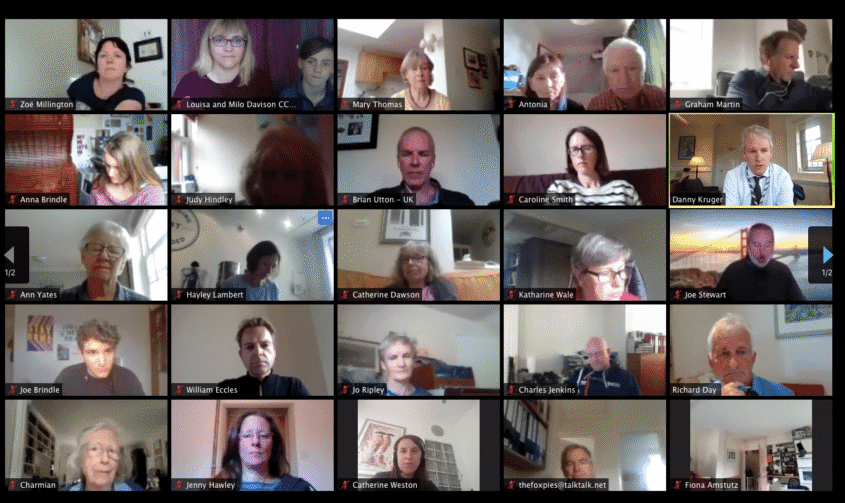
Catherine Dawson took part in The Climate Coalition’s The Time is Now virtual lobby on 30th June 2020. More than 30 people, of which a third were CCL UK members, took part in the Devizes Constituency meeting with Conservative MP Danny Kruger.
CCL’s policy of carbon fee and dividend1 is designed to operate at a national level. Fees are levied when fossil fuels are extracted or imported into a nation and the revenue is distributed as an equal income to all citizens of the same country. But there’s a need for climate action at other levels too. CCL should be just as relevant in the personal, workplace, local government and international arenas. We should be offering solutions in these areas that are as beautiful and effective as fee-and-dividend at the national level.
But, at first sight, fee-and-dividend doesn’t translate easily to other levels. Or does it? I think we can even apply it to running a local car park.
I’ve been thinking about the University where I work and what we are doing about the Climate Crisis. Sadly, the answer is “almost nothing” but that’s starting to change. In fact, I’ve been asked to give a talk there about CCL and that got me thinking. Could we introduce a fee-and-dividend scheme for car parking to encourage staff and students to use public transport? The idea is simple, a fee for car-parking is introduced but, instead of the University keeping the money, it redistributes the income as a flat-fee to staff and students. The beauty of this is that you can set a high parking fee, to ensure a strong incentive to walk/cycle/catch the bus, without actually penalizing people very much (because the dividend would offset the full cost).
There are a few details to work on. The scheme would probably need to be split into three separate parts, one for staff, one for students who live off campus and one for students who live on campus. This would recognize that the car-parking needs of these three groups are quite different. There are also tax-implications for staff who get a net-payment (students could just get a discount on their fees). But these are minor issues that I believe could be overcome.
The same idea might also work for councils but it’s a bit trickier in that context. Parking price-hikes in return for council-tax rebates would penalize those not living in town centres and it would also drive even more of us away from the high streets. Perhaps this could only work if done in conjunction with introduction of greatly improved public transport. Still, it’s worth thinking about.
At the international level, too, there is scope for fee-and-dividend approaches. The recent COP meeting in Madrid largely failed because of arguments over which countries should pay into a mitigation-fund and which should benefit from it. The answer could be that everyone should pay in and everyone should get payments out. For example, if we set a carbon price of $10 per tonne of CO2(eq), that would produce a dividend of about $65 per person. The UK, for example, would then pay in about $5 billion but get back a refund of $4.35 billion.
The beauty of this is that, as with my car-parking example, incentives are magnified by the imposition of a relatively high fee whilst keeping the true cost relatively small because of the refund. Perhaps the fee-and-dividend approach to carbon pricing can be used across a wider range of applications than we’ve generally considered. It’s certainly worth thinking about.
1. Sorry, I’m not calling it “Climate Income” here but only because my title wouldn’t work if I did.
Under the 1992 United Nations Framework Convention on Climate Change (UNFCCC), most countries are treaty-bound to avoid “dangerous climate change”. Countries who signed and ratified the 2015 Paris Accord then had to produce nationally defined contributions (NDCs) to meet the decarbonisation targets.
As the twenty-fifth annual UN Conference of the Parties (COP) begins in Madrid, attention has been focused on Article 6 of the Paris Accord and how this may shape global carbon markets.
Article 6 of the Paris Accord lays out an opportunity to implement the NDCs through cooperation mechanisms. These mechanisms seek to assist the existing targets and raise the ambition of future targets and forms the legal framework to allow market-based solutions, with an option for a common, cross-border carbon market potentially also linked to existing schemes such as the EU emissions trading system (ETS). This could be de-centralised through bi-lateral cooperation or centralised through an international body designated by COP. And another sub-section in Article 6 leaves the door open for non-market-based approaches although this has yet to be defined. The best way to proceed and enact this Article is to be decided at this year’s COP.
This is in response to the virtual collapse of the previous regime- the clean development mechanism (CDM). This was the world’s only global system for trading carbon which was designed to allow developed countries to achieve compliance through purchasing offsets from CDM projects in developing countries. This collapse was brought about by a myriad of factors coming together, such as the US’ refusal to ratify Kyoto; emerging economies classified as developing, such as China and India, meaning they have no emission reduction targets; and the recession and Eurozone crisis throughout Europe.
Eighty-eight of the countries that have continued to commit to the Paris Accord, representing more than half of global emissions, have stated that they plan to use or are using carbon pricing as a tool.
Now, the question is whether the tool will be fit-for-purpose and be all-encompassing. There is potential to create a sensible international carbon trading market that is fair for all countries- whether their economies are developing or developed. The simplest, transparent and most complete solution is the Climate Income from the Citizens’ Climate Lobby.
The UK is a successful case-study in implementing a carbon price that has the desired effect. The carbon price floor (CPF) policy was initiated to support the ETS in 2013 and since then electricity generation using coal has decreased to almost zero. However, the CPF only covers electricity generation, which is not the largest sector of emissions, and the pound per tonne of carbon dioxide (£/tCO2) was frozen at £18/tCO2 in 2016. Although the CPF worked as designed it could be more ambitious by targeting all sectors equally; using pound per tonne of carbon dioxide equivalent (£/tCO2e) to also capture methane emissions and other greenhouse gases; and not allowing a freeze on the price, instead investing more into the alternatives that mature or returning the revenue collected to the public, such as the Climate Income.
Climate Income works by, through new legislation, charging the businesses that extract or import fossil fuels, according to the amount they burn (£/CO2e). Import fees are levied on products imported from countries without a price on carbon along with rebates to UK industries exporting to those countries, discouraging businesses from relocating where they can emit more greenhouse gases.
So, a global carbon market that encourages participation across all countries, taxes the emitters at source, gives the revenue back to the citizens of the country from which the tax was collected, and accounts for importing or exporting sources of emissions sounds like the way forward and hopefully this will be discussed and realised at COP 25 with a commitment to implement this essential global carbon market.
This week, someone wrote to CCL UK, saying they would like to campaign for a carbon tax but wondered if the dividend was the best use of money.
This is a great question – why isn’t the money raised used to subsidise, for example, public transport, or house insulation?
Here’s a few ideas why and something to put in your letter to your MEPs (pick the ones which best fit with their political bent):
The dividend is really what CCL is all about – it will probably be impossible to have a high enough carbon tax to make a difference to emissions without the dividend. (It’s also important to say it’s one tool in a range of measures to tackle climate change, albeit a highly effective one which focuses on emissions.)
Politically – especially centre and right – raising taxes are unpopular. The dividend ensure that, overall, taxes do not go up.
Raising carbon taxes – especially for vehicle petrol, heating and home energy – will cause a lot of impoverishment to the most vulnerable in society. The dividend is divided equally amongst the population and is, effectively, a redistribution of money. This will mean low and middle income families are better off as they buy less stuff and therefore have a lower carbon footprint. So they will receive more in dividends than they will spend on the inevitable higher prices, thus protecting them from impoverishment.
As a result, it rewards those who keep their carbon footprint low.
It does not judge people on their personal choices, or expect everyone doing their bit to change the world (it won’t) but pushes business and the economy into zero carbon options.
It taxes technology on emissions, rather than what looks like the shiny new technology toy or on a limited range of emissions (diesel cars?), thus encouraging true zero greenhouse gas solutions.
Finish with your name, who you represent if applicable (eg business, organisation, charity) and your home address and, if applicable, your work address
We want a much harder-hitting fee on fossil fuels than we already have (petrol duty/road tax/EU ETS) and we can’t do this without a dividend to soften the blow on low and middle income families in particular.
The more emails they receive at [email protected]– from individuals, activists, charities, business owners, etc, YOU! – the more chance we will have for a carbon fee that really cuts down emissions.
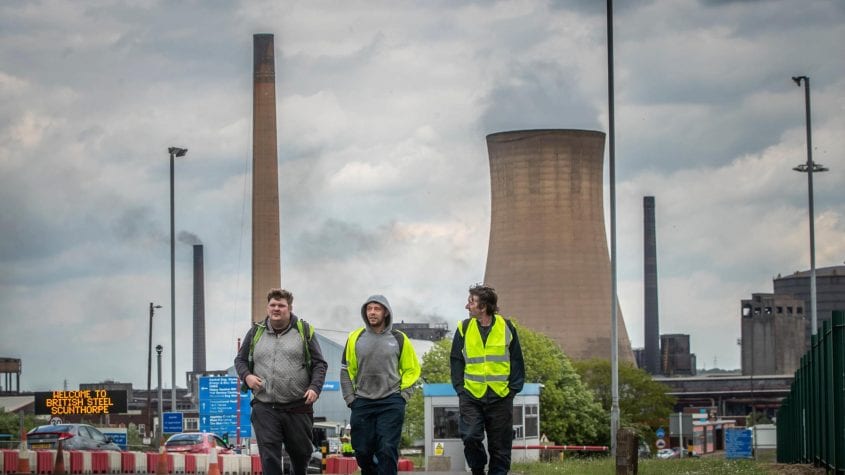
British Steel, an icon of the industrial heritage of the very nation that initiated the Industrial Revolution is on the brink of collapse. Its decline since the 1970s has been precipitous and it is now facing the closure of its last plant in Scunthorpe.
Carbon taxes have been squarely blamed for driving up costs that the business can no longer bear and so it faces collapse. While this is superficially true, the real root cause is the failure of the market to properly price carbon from all sources, domestic and foreign. It’s a failure of the design of the European ETS. In short, this is not a case of too much carbon pricing – it’s a case of not enough.
A Carbon Fee with effective border adjustment taxes would simultaneously action four key goals:
properly price steel, factoring in its carbon emissions,
incentivise reductions in carbon emissions from the sector
protect the British heavy industry from dirty, unfair competition, and
preserve, and indeed nurture, a vital strategic industry
20th Century Policy for a 21st Century Problem
The immediate problem for British Steel is the bill for Carbon Credits that has come due under the European Emissions Trading Scheme (ETS). The company has sought a loan of £100M from the U.K. government to pay this bill but it has no obvious sources of revenue to repay the loan, making propping up British Steel a very risky prospect from the taxpayer’s point of view.
But ultimately, the pressure is coming from British Steel’s inability to raise enough revenue from sales due to the crushing competition that the company faces from cheap imports of steel into the EU from China.
So while the ETS is trying to correct the market failures associated with the externalised costs of fossil fuels used in European production, there is no accounting for the massive emissions embedded in imported steel coming from China, leaving European manufacturers at a huge disadvantage.
Border taxes level the playing field for carbon
A border adjustment tax on carbon imposes tariffs on imports from countries that are not adequately pricing carbon themselves. This immediately strips out the cost advantage of imports from dirty economies associated with underpriced carbon in those economies. In fact, as the carbon price rises, these tariffs dominate the cost of such dirty imports and they become completely uncompetitive.
Furthermore, to keep the market fair in the opposite direction, for exports from the clean producer to the high-carbon economy, the relevant carbon fees are refunded to the producer on export, removing the advantage that the dirty producer has, even in their own territory.
What about the effect on consumer prices?
A common objection to tariffs is that they raise consumer prices, often punishing those who can least afford higher prices. This is an especially prevalent concern in a time of incipient trade wars and the economic distress they cause.
This is where the Dividend element of the Carbon Fee & Dividend policy comes in. All revenues from the carbon pricing, whether from domestic producers or tariffs on imports are fully distributed to citizens. This not only protects low and middle earners, it actually benefits them overall.
Price ALL carbon to rebuild British industry
The U.K. has made significant progress decarbonising its energy supply and just recently it boasted the longest period of coal-free energy production since 1882. But at present, the U.K., and relatively low-carbon economies like France, have no way to fully monetise their cleaner power sector when it comes to international trade.
Plentiful cheap clean energy combined with fees on imported carbon can reverse the decline of the British steel industry
This can be directly addressed by a Carbon Fee & Dividend policy, and when it is, it will give shelter to traditional industries that are being unfairly eroded by dirty imports and will provide a huge boost to investment in new, clean industrial production that can leverage the burgeoning low-carbon energy sector that the U.K. is building.
Carbon taxes are a much discussed mechanism for using market mechanisms to incentivise a transition to a zero-carbon energy from fossil fuels, exploiting the innovation and flexibility that markets can provide.
However, detractors cite potential economic harm to those on low and middle incomes as a reason to avoid such action. Many such detractors turn out to be straight-up fossil fuel shills with no care whatsoever for the poor but who will use any arguments that come to hand to deflect policy makers from adopting a robust carbon tax.
A Carbon Fee and Dividend policy directly answers any such concerns, real or disingenuous, by turning carbon taxation into a progressive policy that actually redistributes wealth from the richest 20% to the poorest 40% while leaving the middle classes broadly unaffected.
Carbon taxes win Nobel Prizes
Carbon taxes have been found to be a highly effective and efficient way of driving the economy to adopt alternatives to fossil fuel energy. Notably, William Nordhaus of Yale University was been jointly awarded the 2018 Nobel Prize in Economic Sciences with Paul Romer for ‘integrating climate change into long-run macroeconomic analysis’.
Nordhaus has proved prescient on the progress of CO2 emissions, writing in 1974, :
I have performed a rough calculation of the atmospheric concentration of carbon dioxide… Assuming that 10% of the atmospheric carbon dioxide is absorbed annually (G. Skirrow), the concentration would be expected to rise from 340 ppm [parts per million] in 1970 to 487 ppm in 2030 – a 43% increase. Although this is below the fateful doubling of carbon dioxide concentration, it may well be too close for comfort.
It turns out we are right on track to hit 487 ppm of carbon dioxide in 2030. In two papers (Nordhaus 1975, 1977), he laid the groundwork for what is now an entire field on the economics of climate change.
Now, there is certainly valid criticism to be made at where Nordhaus and others would set carbon taxes to maximise global growth. Many believe that there is insufficient weight given to factors such as warming feedback and the fate of the poor global south and these are certainly issues of concern. Such concerns would lead to carbon taxes well above the $30/tCO2 that Nordhaus originally proposed. However, there is no doubt that Nordhaus has established carbon taxes as a powerful tool in how we re-shape the economy to prevent climate change.
Clutching at straws and crocodile tears
Of the various stages of climate change denial and resistance to action, one of the later symptoms is an unconvincing concern among opponents that imposing a carbon tax will hurt the poor.
Such attacks coincidentally always seem to come from politicians and lobbying groups closely aligned with the fossil fuel industry and with a long history of denying the existence or risk of climate change in the first place. Such people rarely have a track record of championing high taxes or corporate regulation or social policy that could benefit the poor in other contexts so their concern here is somewhat uncharacteristic.
But if we were to take their challenge seriously, do they have a point? Are carbon taxes bound to condemn the poor to further hardship?
Well, unsurprisingly, it turns out the answer is no.
Carbon Fee and Dividend is a progressive, redistributive policy
The Carbon Fee and Dividend policy has 3 central features:
Tax carbon on fossil fuels as they are sold into the economy
Implement a border adjustment tax system to impose tariffs on imported goods that didn’t bear comparable carbon pricing
Pay the revenues back to citizens as a flat per-head dividend
Imposing a carbon fee and border adjustment tax does raise prices, especially for fossil fuel energy. According to a review of the policy (as proposed by CCL) by Wharton School Public Policy initiative:
For the first year that a $15 per metric ton of CO2 carbon tax is implemented, the cost of gasoline would go up by 16 cents per gallon, natural gas by 19 cents per therm (a 7.4 percent increase), and electricity by 0.6 to 1.1 cents per kilowatt-hour (kWh), depending on whether its source is coal or natural gas.
Seeing the whole picture
So looking at this effect alone, you could be forgiven for imagining the poor suffering further under such a policy. But that’s before you apply a dividend. This is the secret sauce that turns the entire picture around, to the point that the poor become the main beneficiaries of the policy.
According to a comprehensive study carried out by the International Institute for Applied Systems Analysis to model the effects of a carbon fee and dividend policy:
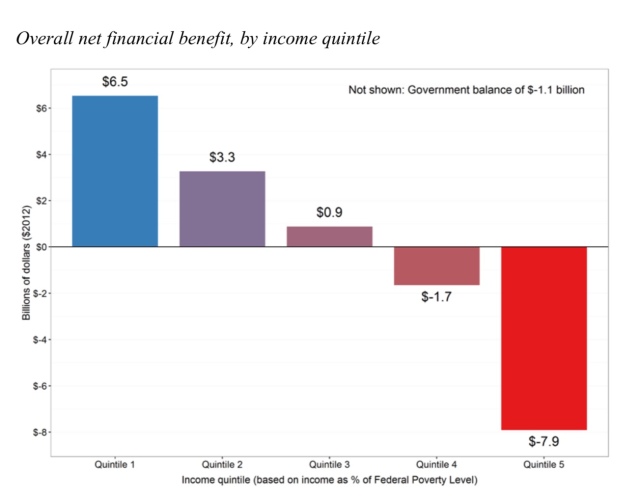
Given these assumptions, the policy confers a net financial benefit on 54% of households nationwide (59% of individuals). The distributional effects are highly progressive. Ninety percent of households living below the Federal Poverty Level are benefited by the policy. The average net benefit in this group is $342 per household, equivalent to nearly 3% of pre-tax income. Overall, the primary distributional effect is to shift purchasing power from the top quintile to the bottom two quintiles of the income distribution
This picture perhaps provides more instruction as to the motivation of rich, conservative fossil fuel lobbyists that oppose such a policy. Using the plight of the poor is nothing more that a disingenuous tactic designed to smear a progressive policy. For all those engaged in an honest debate, the facts are clear.
Only the top 20% by income (those best placed to deal with it) experience a significant net cost from the Carbon Fee and Dividend, leaving the middle class broadly unaffected, while those on low incomes are net beneficiaries.
A Carbon Fee and Dividend is therefore highly effective at mitigating entrenched inequality in society and gives the large majority of citizens a valuable stake in a fossil-fuel free future.