Category: Politics

  • If you are a Labour Party member you can help persuade the party to adopt CF&D as a policy.

    If you are a Labour Party member you can help persuade the party to adopt CF&D as a policy.

    One of our members has noticed that an article on CF&D has been posted on the National Policy Forum (NPF). The article states that Labour should adopt CF&D as the key policy to achieve the UK’s climate ambition. The Forum is the main discussion platform for informing Labour policy and so it’s important that this post generates favourable comments and votes.

    If you are a Labour Party member please do vote and add your comments using the link above.  It would also be valuable for members to send letters to their Labour MP and a member of the Environment, Energy & Culture commission of the NPF.

  • Jim Hansen’s Letter to the PM

    I hope many of you caught the news of top climate scientist, Jim Hansen, and his letter to Boris. I’m reposting it in this blog with Jim’s permission but without further comment except to say that much of the, unreported, segment concerns carbon fee and dividend with CCL-UK being recommended as Boris’s next port of call!

  • Very cogent argument for CF&D by a member of the centre-right think tank, Centre for Policy Studies. Useful information if you plan to lobby a Conservative MP!

    Very cogent argument for CF&D by a member of the centre-right think tank, Centre for Policy Studies. Useful information if you plan to lobby a Conservative MP!

    This article comes from a centre-right website CapX which…

    was founded to make the case for popular capitalism: now more than ever, it is vital that the case is made for markets, innovation and competition, and for policies that deliver for the masses as well as the elites.

    To that end, our team monitors thousands of news sources, blogs, academic papers and think tank publications to find the day’s most interesting ideas and most important facts and trends. We also commission opinion and analysis pieces by leading experts – though the views contained in any such article are entirely the author’s own.

    The author, Eamonn Ives, is a member of the centre right think tank the Centre for Policy Studies, specialising in energy and environmental policy. He also sits on the advisory board of Climate Assembly UK, and previously worked as a Researcher for Bright Blue, where he authored five publications.

    Eamonn adopts a techno-optimist approach to environmental issues, grounded in laissez faire economics twinned with proportionate government intervention to overcome challenges such as climate change, air pollution, and resource use. He is also interested in transport policy, urbanism, and innovation.

    Eamonn writes that….

    As temperatures outside begin to fall, the Prime Minister has detailed how Britain will help stop them heating up on a global scale. Yes, the long awaited ten-point climate plan is with us at long last – mapping out both policies and funding pots to limit the nation’s greenhouse gas emissions.

    Much of what it said was nothing new – we already knew what the plan’s broad-brush strokes would be thanks to plenty of pre-briefing in the media and other channels.

    To further decarbonise power, a big push is to be made on offshore wind, quadrupling how much electricity we produce via maritime turbines to 40GW by 2030. Support is coming for nuclear power, with a particular focus on developing advanced reactors and smaller, cheaper, modular units. Efficiency upgrades for public sector buildings and domestic properties, meanwhile, will limit the amount of energy we need to produce in the first place.

    To clean up transport, the big news was that 2030 will indeed mark the end of the road for sales of new petrol and diesel cars and vans (with sales of the best hybrid models ending in 2035). Money has been made available to improve public transport, get more of us walking and cycling, and for research into cutting emissions in hard-to-reach transport modes, such as shipping and aviation.

    To green our industrial processes, investments will be made in hydrogen – which will also be deployed in domestic heating and heavy transport. R&D funding for carbon capture and storage technologies should help address emissions in the thorniest industries, such as cement and chemicals production.

    Plans to plant 30,000 hectares of tress every year will lock up more of the carbon already in the atmosphere while providing other benefits like habitat restoration and flood defences. Finally, the Government hopes that new rules will make the City of London the global centre for green finance and carbon offsetting markets.

    One cannot knock the Government’s ambition – the plan looks across the board and leaves little out of its scope. The money, regulatory provisions, and redoubled Government energy behind tackling climate change should all combine to getting the UK closer to its net zero goal – which it legislated for last year.

    But amid the flurry of spending promises and new targets, it was one seemingly unassuming line in the PM’s FT article – where the plan was first released – which piqued my attention. A cursory mention is given to the “carbon prices we will put on emissions”. If we assume this to mean further work is in the pipeline for carbon pricing across the economy, that could spell very good news indeed.

    As Rachel Wolf – co-author of the Government’s 2019 election winning manifesto – has discussed elsewhere on this website, carbon pricing makes those who bring carbon into the economy financially responsible for the damage it does to our climate. Simply put, carbon pricing would mean fossil fuel companies face a per tonne charge on the carbon dioxide their products will eventually release.

    We already have some carbon pricing – either explicitly, such as on electricity, or via rough proxies, such as fuel duty. But the current framework is confused – pockmarked by exemptions like different rates depending on where the carbon is emitted.

    This is regrettable, because as countless eminent economists and climate campaigners will attest, carbon pricing is conceivably the single best way of cracking down on emissions. Importantly, it does so in a way which is economically efficient, steering people towards addressing the most solvable problems first for the lowest cost, and then working towards tackling more complicated matters. It takes power away from vested interests who lobby politicians and civil servants to favour their clients’ pet projects over genuine climate solutions. If the revenues of carbon pricing were recycled back to citizens, it could be made socially progressive, and ensure that climate action is not shouldered by those with the least ability to bear it.

    Without a robust, simplified, and comprehensive price on carbon, the Government is depriving itself of a powerful tool to mitigate climate change – binding its hands and instead opting for more expensive, less effective policies.

    An 11-point plan might not be as media friendly, but bringing carbon pricing into the fold could take the PM’s strategy up a notch. The Government should waste no time in doing just that.
  • Autumn Campaign  – Chance for the Government to implement a better form of carbon taxation, aka CF&D!

    Autumn Campaign – Chance for the Government to implement a better form of carbon taxation, aka CF&D!

    As you read this, the Government is writing the rules for the UK economy, post-Brexit. 

    As we leave the EU carbon-pricing scheme (the ETS), this is an unprecedented moment to push for Carbon Fee & Dividend (the official term for Climate Income).
     
    Choose your Action – or more than 1!
     1)  Write to your MP
     Point out that leaving the EU ETS offers the chance to shift to a simpler, more effective, fairer and less costly method of carbon-pricing: Carbon Fee & Dividend.  Emphasize that, unlike the ETS, CF&D will include the whole economy, provide a clear and predictable signal to industry, maximize public support, and shelter those on low incomes.
     You can also mention that CCL EU has established that, if necessary during a transition period,  CF&D can operate alongside a UK ETS.
     
    Ask for your letter to be forwarded to the ministers of the all the relevant departments:
     Alok Sharma, Secretary of State for BEIS (Business, Energy and Industrial Strategy),
    George Eustace, Secretary of State for the Environment, Food and Rural Affairs,
    Rishi Sunak, Chancelor of the Exchequer. 
    Remind your MP that the Government has accepted that CF&D is a good idea, as do 27 Nobel-prize-winning economists https://www.econstatement.org.
     
    Ask for a response, stressing  the urgent need for a green recovery that will benefit the whole economy and secure our future.
     
     2) Meet your MP
    If at all possible, meet your MP to show the strength of your concern, (offer a Skype or Zoom meeting).
     
    3) Write to the media
    Publicise as widely as possible that the government has already, in response to its own consultation, recognised the merit of CF&D – yet went on to say without explanation, that it was not proposing to adopt it.
    Local publications are particularly important to your MP; national publications can influence wider public opinion
     
    4) Spread the word
    Do you know anyone – especially someone in a different constituency – who might be persuaded to write their own MP, on a subject of such urgency?
     
    Please copy any responses or published media to [email protected]
    Many thanks,Ed, Gina, Louisa and Paul
    CCL UK steering committee
    test.citizensclimatelobby.uk/
    BACKGROUND TO THIS CAMPAIGN 
    The ETS (Emissions Trading Scheme) is a Cap & Trade system: the Government gives permits to certain industries that limit the amount of carbon they can emit (the Cap) and they trade these permits among themselves. It has been heavily criticized as being unfair, inadequate and over-complicated. For more information on carbon pricing systems, including a handy table of comparisons, see https://test.citizensclimatelobby.uk/2019/05/carbon-pricing-be-careful-what-you-ask-for/
    Our Government in its recent Response to the Consultation on the Future of Carbon Pricing acknowledges the merits of CF&D  but does not propose to adopt it at this time, preferring to continue with a UK ETS, an emissions reduction policy modelled after the EU ETS, despite acknowledging that:  https://assets.publishing.service.gov.uk/government/uploads/system/uploads/attachment_data/file/889037/Government_Response_to_Consultation_on_Future_of_UK_Carbon_Pricing.pdf
    Scroll to p.38 and 39
    Para 201: UK Government’s and Devolved Administrations’ response201.The preferred approach, expressed by the UK Government and Devolved Administrations in the consultation document and supported by scheme participants, is for an effective emissions reduction tool. Placing a price on carbon creates the incentive for emissions to be reduced in a cost effective and technology-neutral way, while mobilising the private sector to invest in emissions reduction technologies and measures. While we recognise the merits of a Carbon Fee and Dividend policy, we do not propose to adopt it at this time
    Background to Climate Fee and Dividend
    What is carbon fee and dividend?
    Look at the website page test.citizensclimatelobby.uk/policy-makers. A fee is placed on fossil fuels as they are extracted, or enter the UK. This rises each year until it is high enough to make burning fossil fuels uneconomical.
    The money collected is given back as a climate income equally to UK people; all adults receive the same amount, half for children.When fossil fuels are exported by UK businesses the fee is rebated. Countries with a similar carbon fee importing fossil fuels into the UK will not have to pay the UK fee.

    How does carbon fee and dividend/climate income work?It makes fossil fuels uneconomical and so removes their use.It supports UK household incomes (between two thirds and four fifths of households) and vulnerable people by giving them a financial cushion during the transition to clean energy.It supports business by allowing them to plan for the change to clean energy and stimulates investment in clean energy.


  • Claire O’Neill dumped as COP26 president

    Claire O’Neill dumped as COP26 president

    The first thing that came to mind when I heard Claire O’Neill (formerly Perry, formerly my MP and formerly the minister for clean energy) had been dumped as president for this year’s crunch UN conference on climate change in Glasgow (COP26) was they couldn’t cope with a ballsy woman. Or should I say a titsy woman?

    According to The Guardian:
    “She also issued a putdown to David Davis when he confused her with another female Tory minister, Caroline Nokes. Referring to Davis’s previous campaigning slogan, she is reported to have told him: “David, let me help you: Caroline is a C cup, I am a double D.”

    I remember the sexist vitriol she suffered in the papers, and her edgy outbursts about giving blowjobs to have a say (a quote you could source back to original female hero Ripley in movie Aliens from 1986, and that was probably taken from a real world quote). The embarrassment was not because they were rude but because they put the reality of a woman working in Westminster under a harsh spotlight.

    After all, the current PM and his closest allies aren’t strangers to public gaffs and causing upsets when it suits, and yet they survive.

    Claire has been often, it seems to me, at odds with her role and the establishment. Sometimes she would totally toe the Tory whip line, to protect her position it seemed, and other times she would stick her neck out and rebel, as she did for a time over Brexit.

    She is a hard working and often effective advocate for the climate, instrumental in the net zero legislation, and yet, as a minister, also supported fracking and voted for the third Heathrow runway.

    Is it harder for a woman in Westminster, and harder for anyone trying to have a meaningful family life, to stay true to personal values (and keep their job) in an apparently toxic atmosphere of Punch and Judy politics?

    Former Labour Minister Harriet Harmon recounted at Swindon Festival of Literature that bunking off from an important Commons vote was okay for an extra-marital liaison but not for her child’s birthday.

    When Claire took a sabbatical from her cabinet ministerial position earlier this year due to a family illness, she told me in a CCL local meeting that MPs had no working rights and this was the first time this had been allowed, and only possible with the support of the then PM, Theresa May.

    Fast forward a few months to Boris’ new regime and she found herself relegated to the back benches.

    Whatever the real story behind Claire’s COP26 sacking, the political system needs to be less brutal, more nurturing. These are the people whose job is to care about our interests.

    Fixing the climate isn’t about finding the most economical solution, though we at CCL have to sometimes employ this argument. It’s not about tackling climate change because doing nothing is the most expensive option. To really stop causing this problem now, and different problems in the future, we have to be capable of empathy; to care for and respect ourselves and each other and our liveable world.

    And we, at Citizens’ Climate Lobby, have to leave bitter thoughts at our MP’s door when exploring that crucial common ground, and act how we wish it to be. Our caring and respectful actions and words will help make it so.

    Louisa Davison is on CCL’s Steering Committee. These are her personal opinions and not necessarily the official opinion of CCL.

  • Carbon pricing after Brexit

    Carbon pricing after Brexit

    The Government has been asking people to submit ideas for what kind of carbon pricing we should put in place when we leave the European Union.

    At the moment we are part of the European Union’s Emissions Trading System (EU ETS) and we also have our own carbon tax, the Carbon Price Floor (CPF), that comes into play when the fluctuating EU ETS price drops below £18 per tonne.

    (more…)
  • Politicians don’t listen

    Politicians don’t listen

    But then, we don’t really talk to them. Some of us do though. It’s very easy now with social media. You can even tweet animated gifs at your MP. There are plenty to choose from, but it might be better to DM them, or email them. If you really want to go overboard, you can go out and buy a pen and some paper from WH Smith or some other stationery outlet.

    (more…)
  • Should we subsidise fossil fuels?

    Should we subsidise fossil fuels?

    This is what I’m thinking of asking my MP after getting a reply to my email asking for her and her party’s position on carbon pricing that just lists a load of things her party, Labour, will do to tackle climate change, but doesn’t mention carbon pricing at all, and I’ve barely heard any mention of it from Labour.

    (more…)
  • Getting Paid to Save the Planet

    Photo: Alexander Mills.

    This week’s title is not a description of my dream-job.  It’s actually a way forward for all of us.  Too good to be true?   Stick with me and I’ll try to persuade you that I haven’t lost my marbles.

    I’ll start where I left-off in my previous column–carbon-taxes are an effective way to encourage millions of people to find cunning ways to cut back on greenhouse gas emissions but new taxation is generally about as popular as Boris Johnson at a Remain rally. 

    New taxes are particularly resented when they are perceived as unfair.  This is a problem for climate-related taxes as they can have a disproportionate impact on those least able to pay.  If we make gas more expensive, struggling pensioners turn their heating off whilst the rest of us complain bitterly but carry on with our long, hot showers.  The least significant producers of emissions cut-back and the worst polluters don’t change their behaviour at all!  That doesn’t sound promising.

    So, should we forget taxes on carbon emissions?  That’s what our political parties have tended to do until now.  Economists may like the taxation approach but politicians run a mile because it’s a great way to reduce the number of people who vote for you.  To be fair they tried—when the “fuel-price escalator” was introduced in the 1990s—but a few blockades by haulage companies were enough to push the emergency red-button on that particular moving staircase.

    Somehow we need to retain the benefits of carbon taxation—economy-wide, economically-efficient emission reductions driven by the shared brainwaves of millions of people—without imposing new burdens on those least able to bear them. 

    The solution to this conundrum turns out to be remarkably simple.  The revenue from the tax should be redistributed back to the population as an equal dividend.  So for example, if we taxed emissions at the rate of £25 for each tonne of carbon dioxide, this would bring in enough money to give every adult in the country an annual cheque of about £250.

    But how does that help?  The consequence of the tax is that prices go up but, for the least well-off third of society, their costs go up by less than £250 and they are better off.  The most affluent third of society, on the other hand, spend more money and the total increase in prices they see is more than £250.  They are a bit worse off.  At a stroke the burden is on the rich rather than the poor. Economic modelling suggests that the remaining third of the population see their costs going up by about the same as the dividend and they are unaffected. 

    This approach is called “carbon-fee and dividend” and it is already being used in Canada. There’s also a Bill before the US Senate which, remarkably, has support from both Republicans and Democrats.  The Left like it because it redistributes wealth.  The Right like it because it’s a market solution to global warming that allows massive deregulation (e.g. you don’t need to ban petrol cars if taxation has made them substantially more expensive to run than electric cars).

    So why aren’t we looking at this in the UK?  Quite simply, because no-one here has ever heard of it.  Had you before you read this column?  To find out more, check out https://test.citizensclimatelobby.uk/.  Spread the word, please.

    First published in Marlborough.news

  • Wiltshire Declares a Climate Emergency

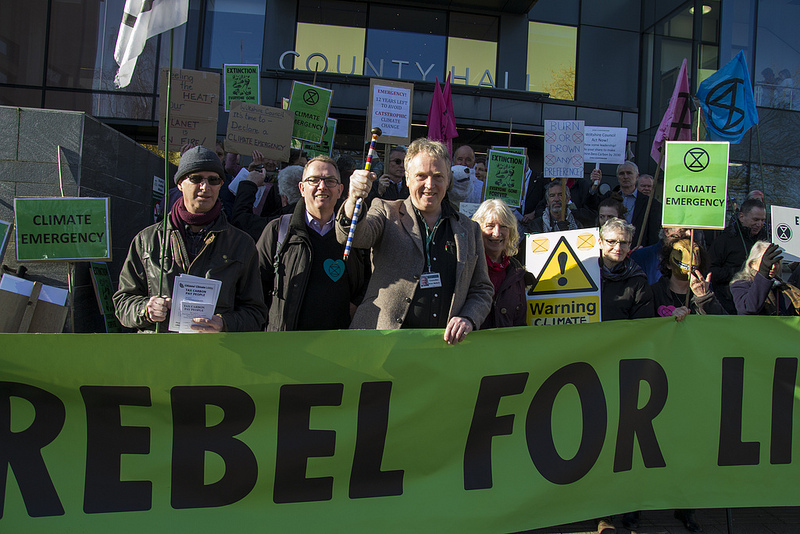
    Demonstrators outside County Hall.
    Demonstrators outside County Hall. Councillor Brian Mathew, who submitted the climate emergency motion to Wiltshre Council, is in the centre. The blog author is to his right.

    Economic activities have now pumped almost as much carbon dioxide into the air as the atmosphere contained, in total, at the start of the Industrial Revolution two centuries ago. Science has known for over 120 years that this should, in theory, cause warming by a few centigrade. Mankind is now testing that theory in the biggest, longest running and most idiotic accidental experiment of all time. Initial results are now in and they confirm the predictions spectacularly well. Detectable climate change is upon us and we have very little time—years not decades—in which to prevent warming from exceeding safe limits.

    This was the context for February 26th’s debate on whether Wiltshire Council should declare a climate emergency. Around 40 local councils across the UK (and approaching 400 world-wide) have now declared a climate emergency as a result of pressure from grass-root movements increasingly frustrated by the inadequate actions of national governments. A motion that Wiltshire should join this movement had been put forward by Liberal Democrats but several Conservative councillors had felt that “climate emergency” was an unnecessarily emotive exaggeration. They responded by putting forward their own motion which supported action but removed that particular phrase. Another area of debate concerned a pledge to become carbon-neutral by 2030; is that really realistic and is it really necessary?

    Let me share my own views. I’ve been a geophysicist for 35 years and I’ve looked carefully at the evidence for manmade climate change and at the counter-claims. In fact, I looked at the data first and only then became a climate activist. In my professional opinion, the evidence that we are heading for dangerous, manmade climate change is overwhelming and the counter-arguments are shockingly weak. The link between human-activities and climate change is to too tight for it to be a coincidence and it simply doesn’t make sense for the link to be backwards (i.e. warming temperatures stimulating economic activity rather than the other way around).

    But how urgent is the need for action? Most of the world’s nations have now pledged to control their emissions but the promises are insufficient even if they are kept. Even with these unenforceable commitments, global annual emissions will rise to about 50 billion tonnes per year of CO2 whilst, to keep temperature rises below 1.5°C, we must not produce more than about another 770 billion tonnes (source, IPCC report on “Global Warming of 1.5 °C”). So, it’s simple arithmetic, 15 years until we bust the budget. The best case scenario is that we start and maintain steady reductions immediately, in that case we could stretch things out and not need to get to zero emissions for another 30 years. Unfortunately, there is no sign whatsoever of national governments getting the ball rolling on that. So, there really is a climate emergency and it is irresponsible to pretend otherwise.

    To my delight, Wiltshire Councillors came to the same conclusion. After a well-informed debate, the Conservative-led Council voted by a narrow margin to accept the Liberal Democrat motion and then, unanimously, to accept the Conservative one. It was a remarkable example of democratic debate in action; one Conservative councillor even announced that he had changed his mind as a result of the debate. Changing your mind in response to arguments is a mark of good science but is not, often, associated with politics. It was a moving moment that gave me some hope for the future.

    And there is hope. There is much that can be done to reduce emissions. We can’t go zero yet but we can buy time; time that will allow us to find permanent solutions. I’ll talk about how we do that in future columns.

    First published in Marlborough News Online