Blog

  • Another fantastic plug for Climate Income from one of our members!

    Another fantastic plug for Climate Income from one of our members!

    Last year Rob Paton and Citizens:MK succeeded in gaining unaminous support for Climate Income from Milton Keynes Council. Rob then went on to write about the campaign in the national Quaker magazine, The Friend.

    Rob has now succeeded in getting a full article published which he has given me permission to reproduce here. I attended a Zoom meeting organised by Rob for a local climate group and was able to see the issues people have with the concept of CI (which it is easy to lose sight of when you have been immersed in the campaign for three years!) which Rob describes – his approach has lessons for us all! Note that ‘testimony’ refers to the Quaker values of equality, peace, truth, justice and simplicity.

    A year of climate campaigning: What Rob Paton learned

    6 Jan 2022 | by Rob Paton

    ‘It’s often the testimony that does it.’
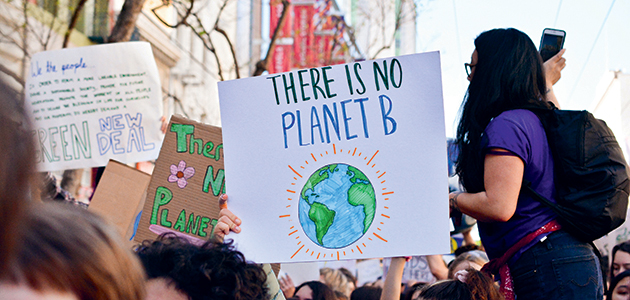
    ‘The alternative is to look for common ground.’ | Photo: by Li-An Lim on Unsplash

    I had been a ‘greenie’ for years, but not heard about Carbon Fee & Dividend (also known as Climate Income) until a Friend told me about it a couple of years ago. I visited the website of Citizens Climate Lobby UK – and wow! So simple. An arrangement that would turbo-charge all other carbon reduction policies, or render them superfluous. A way to make higher carbon prices not just acceptable, but popular. Like every good convert I set off with missionary zeal. At which point things became… interesting.

    Yes, sometimes people ‘got it’ quite quickly. What really struck me, though, was how often people didn’t (or couldn’t?) ‘get it’. For example, when another Friend passed on something I had written to her daughter, active in XR, the daughter was enthused. She shared it in her circle… to no avail whatsoever! Even professional campaigners who knew their economics seemed to ignore carbon pricing. It was the elephant in the room. As for Climate Income, well, on a good day it would be damned with faint praise. I asked several: ‘What should we be asking for at COP26? Wouldn’t it be great if we had one simple, specific “ask” that everyone could get behind, like “Drop the Debt”?’ Everyone liked the question, but their answers were either lengthy, or pithy but plaintive (‘just keep your promises’). No one expressed much interest in Climate Income. Gradually I came to realise – or re-learn – some important lessons.

    If people are not open, or ready, then I was probably wasting my time as well as theirs. It wasn’t just that trying to persuade people seldom helped. Things went better when people were stimulated to find out for themselves. For example, our local Citizens:mk climate campaign asked the leaders of the three main parties on Milton Keynes Council to consider supporting the idea. Initially, all were wary, but they agreed to check it out. When it came to the debate, genuinely enthusiastic speeches in support came from all sides, and the motion passed unanimously. Likewise, when we asked the local Anglican bishop to consider the idea and how he might use his position to promote it, he was sympathetically cautious: he would meet with us but the issues were complicated and he needed to find out more. But then before we knew it he was on board, asking a pointed question in the House of Lords!

    That illustrated another important point: it’s often the testimony that does it. A remarkable teenager in our campaign group had recounted being confronted with the harsh realities of what climate change would mean for her and her generation. She spoke simply, clearly and from the heart. It was moving and memorable in a way that bald facts and reasoning are not.

    I also noticed how widespread adversarial thinking is among green campaigners. The default stance is to campaign against things – and people. When I asked what was needed for a consensus in support of cutting out carbon, the answer was, essentially, for lots more people to care like we do. We have seen the light; we must convert others to our way of thinking. Worse still, I, too, slipped into adversarial thinking. At one point I was seeing the Treasury as a bogeyman. They didn’t like hypothecated taxes and would be bound to resist this idea. But one of the beauties of the arrangement is that it is revenue neutral – it is a transfer rather than a tax. It doesn’t add to government spending. Better still, by turbo-charging the switch to renewables, it reduces the need to subsidise green technologies which are a drain on the exchequer. It also gives a further basis for cutting out those subsidies still being paid to fossil fuel companies.

    The alternative is to look for common ground. Climate income provides such a common ground, securing support for long-term carbon reduction. In Canada, where this ‘fee & dividend’ approach has been adopted, governors of some provinces with high levels of fossil fuel activity thought they might roll back the legislation… until they found how popular it had become with voters.

    What really took me by surprise, though, was the way climate lobbying led into a deep consideration of truth, and our compromised capacity as humans to face it. I joined a Zoom course on how to engage with political leaders on climate issues. At one point the young course leader said words to this effect: ‘Look, we have enough information in this group to plunge half the country into a state of deep clinical depression. It’s just as well that many people are “in denial” – the health services would be overwhelmed if everyone suddenly woke up to what the disaster will mean for them. That wouldn’t do the planet any good.’

    Instead he introduced us to ways of meeting our leaders where they are, helping them recognise their own ambivalences and uncertainties, and helping them find their own safe next steps. This doesn’t mean that we should only engage with the political system in therapeutic mode – listening supportively, asking gentle questions, building trust. As we Quakers know, discernment requires threshing as part of the process. So explanations, facts, clarifications and analysis all have their place, collegially conducted, among those seeking further understanding. Here too I learned lessons.

    I had to treasure the disagreements and challenges I encountered. They were informative about what I had not explained. For example, if someone said, ‘Won’t people just use all their climate income paying for the higher price of fuels?’ I had to be ready to agree: yes, some would, to begin with. It would be their choice. Only then would it be worth my explaining how the steadily-increasing price of carbon (and climate income) would play out over the medium term: the higher the price the more incentive everyone has to switch to green alternatives. Instead of it being against our economic interests to ‘do the right thing’, we become (even) better off by ‘doing the right thing’.

    Another example: one councillor said we shouldn’t increase the price of fossil fuels until the cost of green alternatives had fallen to the level of current fuel prices, otherwise the poorest would be hard hit. This overlooks how climate income protects the least well off. But I sensed something else was confused in this observation, and it took me time to pin it down. In fact, the price of the alternatives will not fall until they are adopted on a large scale. So we need to make the green alternatives cheaper than fossil fuels in order to bring about large scale adoption. This is precisely what steadily increasing the price of carbon makes happen.

    I also came to appreciate the uncertainty in our predicament: no one knows what will be an achievable and sustainable mix of green fuels. The technologies are still a big cloud of unknowing. Some say heat pumps. Some believe hydrogen is the answer. According to others, the future is electric. Some think that Carbon Capture and Storage is crucial. Each of these has its advocates – and, happily, investors willing to back them.

    Finally I have had further lessons in patience and trust. Having been through panics about nuclear war, the scares about the millennium bug, and the fear that oil was running out, it is a little easier to hold my nerve. Yes, I do know about tipping points. The dangers are very, very real. But so are the emerging opportunities with many signs that the tide has turned. And so we choose life, doing what we can where we are.

  • Happy, if slightly belated New Year to all our members!

    Happy, if slightly belated New Year to all our members!

    As the fuel price crisis is on everyone’s minds this January member Darrin Charlesworth tops the Letters page in today’s Guardian Online………..

    John Vidal’s list (It’s the great green reset: 10 things Britain can do now to save the planet, 3 January) seems very achievable, but I would like to add one more to accelerate change: climate income.

    First, introduce a carbon tax across all industries to price emissions into the market, closing a huge economic loophole. By gradually increasing the tax, we not only incentivise lower emissions on the supply side, but we also drive demand for low-carbon alternatives.

    Second, redistribute the revenue equally to all citizens. This protects the most vulnerable consumers, who already have smaller carbon footprints, from fuel poverty. The wealthiest people with the biggest carbon footprints would see their costs rise, but for the majority, costs would be neutral.

    Third, introduce carbon border adjustments. This policy would prevent emissions being transferred offshore, but also protect many UK businesses, especially our vibrant small business community, from competitors in countries without a carbon tax. This policy would help drive many of the others at a time when we need real urgency.
    Darrin Charlesworth
    Citizens’ Climate Lobby UK

    Congratulations Darrin for succinctly and elegantly summarising how Climate Income would enable the true price of carbon to be reached – thus making decarbonisation a no brainer without impoverishing everyone!

  • Further information on the government response to the Zero C petition.

    Further information on the government response to the Zero C petition.

    I have to apologise for being pressed for time yesterday when writing about the parliamentary debate on the Zero C petition. In my haste I failed to take in the fact that the government had produced a briefing on the petition. The briefing states that…..

    The Government response to the petition refers to the UK Emissions Trading Scheme (ETS). The UK ETS sets a limit on emissions from energy generators and energy intensive industries, which incur a cost if limits are exceeded.  The Government response also points to the Government’s intention (set out in the Energy White Paper) to extend the scheme, and to explore expanding the UK ETS to cover two thirds of the UK’s remaining emissions.

    Carbon pricing can take a wide variety of forms. There were some reports that the Government was considering the options for broader carbon taxes or pricing earlier this year, but that it is no longer the case.

    This is very interesting (and disappointing) but it explains why we heard nothing further after the claims that Liz Truss was supporting a Carbon Border Adjustment Mechanism and the July ‘leak’ to the Times about introducing Climate Income based on the Canadian model.

    The government also states that support for poorer households will be targetted capital support from the tax payer, arguing that….

    Given the significant variation within income groups, it will be more effective to focus on individual technology transitions, with taxpayers providing targeted capital support for those low-income groups most acutely affected by a specific technology transition(and in advance of policies that penalise or phase-out use of high carbon technologies), than to consider the transition in aggregate and develop universal and untargeted policies to support households – such as, changes to tax and welfare. This would also mean that low-income groups could benefit sooner from the household savings that arise from a transition.

    It appears that the debate was used by participants to refute these claims rather than debate universal carbon pricing, although Alan Brown did make a strong case for the lost opportunities caused by the lack of tax hypothecation and a sovereign wealth fund.

    The complicated, costly and intrusive ‘targetting’ of support envisaged by the government in its net zero strategy will, it seems to me, not lead to fair and equitable transition. There is still all to play for!

  • How did the debate on carbon emission charges go?

    How did the debate on carbon emission charges go?

    On November 1st the much anticipated debate on the Zero C petition was held in a extremely uncrowded Westminster Hall. Catherine Mckinnell (Newcastle upon Tyne Central, Lab) moved the petition, stating that its aim is  to impose a single carbon price across all sectors. ……

    In its simplest terms, the petition calls for the Government to work towards a single carbon price across almost all sectors. The campaign argues that a single carbon price would amalgamate the many existing price instruments, including the carbon price support and the UK emissions trading scheme—a different form of carbon charging—into a simple, transparent carbon charge. Zero Carbon points out that our current policies cover emissions across only about a third of the economy, giving the biggest polluters free allowances while the consumers are left to pay. I pay tribute to the petition’s creator, Isabella Goldstein, who is the senior campaign manager at the Zero Carbon campaign.

    The theory behind this form of carbon charging is straightforward. If we had, for example, a single carbon price of £75 per tonne of CO2, it would incentivise people and businesses to pursue any methods of emission reduction that cost less than £75. Hon. Members will be aware that we are far from having a single carbon price across sectors. Instead, we have a patchwork of policies that incentivise or disincentivise emissions in ways that are often unclear. While overall they have the effect of, for example, discouraging the burning of fossil fuels, the cost varies hugely depending on the source of the emissions. It is argued that the key benefit of working towards a uniform carbon price is that it avoids a situation where some sectors face higher carbon prices, and must therefore make more expensive carbon reductions, while others could more easily and cheaply reduce their emissions but do not.

    Mckinnell also pointed out that Zero C are asking for the policy to be fair and equitable…

     Alan Brown (Kilmarnock and Loudoun, SNP)……In a similar vein, I represent a former coalfield area. Carbon taxes had been applied to the extraction of coal over the years, but a few years ago, when the open-cast coal industry collapsed in my constituency, it left massive craters that needed reinstatement work at a cost of millions of pounds. Carbon taxes came from my constituency to the Treasury, but they just went into the black hole. When we asked for assistance for restoration work on those abandoned coalmines, the answer that came was, “No. Too bad. That money came in and it has been used. There is no money coming back to your constituency. It doesn’t work that way.” That shows the folly of not ring-fencing a tax for the purpose that it should be ring-fenced for. Again, transparency is utterly critical if we are to go forward.

    Jerome Mayhew (Broadland, Con) argued cogently for a Carbon Border Adjustment Mechanism policy, as he has been championing for a while. There was interest in CBAM earlier this year  but in July the Board of Trade published a report extolling free trade as the answer, the subject is still under review.

    Unfortunately although the speakers all argued that carbon pricing was necessary and should be fair there was no discussion on how to implement it, such as suggesting a solution like Climate Income. The argument for a single uniform carbon price wasn’t really debated, instead the arguments were vague, focussing on stating that the Net Zero Strategy isn’t doing this, that or the other, our party would spend more and be more equitable than the government and when will the ETS net zero consistent cap be announced. 

    This line of arguing therefore enabled the financial secretary to the treasury, Lucy Frazer, to argue that while “The petition specifically calls for a carbon charge to encourage industries and organisations to reduce their carbon emissions” the government is already doing this through the UK ETS scheme and Carbon Price Support, but she didn’t feel the need to address the petition’s main ask as no-one else had been discussing it.

    In summary the gist of the petition, arguing for a single, uniform carbon price seems to have been lost in the discussions about other aspects of the Net Zero Strategy and finance. 

    One has to wonder if the timing of the debate, falling as it did during COP26, inevitably led to the paucity of ideas and discussion, with no-one from the government, for instance, discussing the ideas leaked in July

  • CCL member decides to shake up Woman’s Hour!

    CCL member decides to shake up Woman’s Hour!

    Wiltshire CCL member Jane Renwick recently realised that a hallowed broadcasting institution which likes to think it is ‘cutting edge’ could do with shaking up when it comes to the most important issue of our time!

    But I know that CF&D makes sense and it frustrates me that so few people are talking about making it happen. 

    ” …..My grasp of CF&D is pretty akin to my knowledge of plumbing: I have a gist of an idea of the general principles (and the disasters that can occur if it’s not done properly) but not a lot of confidence when it comes to discussing anything beyond the tap that I’m turning or the chain that I’m flushing. Similarly, my knowledge of the workings of government and politics is weak, as is my understanding of economics, power production and the science of climate change. I do know a lot….. but nothing very relevant to this important issue it seems. 

    Our Parish Magazine carried an article by Rev Michael McHugh quoting James F Byrnes: “Curiosity will conquer fear even more than bravery will.” What an inspiring and liberating thought! So now, instead of thinking that I don’t know enough to join the debate I will think ‘I wonder what would happen if I sent a letter to Woman’s Hour’ or the Women’s Institute or another letter to my MP. What’s to lose? Surely the more people talking about it, the better.

    Dear Woman’s Hour

    Thank you for your recent item about women who are choosing not to have children because of fears about climate change – which illustrates just how much women are worrying about this. It is a HUGE issue for women and families. As a mother I am terrified. Sadly, I think women are struggling to visualise a positive route to addressing climate change that protects their family. 

    I would really like to hear Woman’s Hour address climate change, in a positive way, that presents politically effective family friendly strategies that women can campaign for, to make a real difference (in addition to recycling our clothes, reducing waste, eating less meat etc etc……) 

    For example – ‘Carbon Fee and Dividend’ is an approach that has been recognised by the Government as an effective method of carbon pricing that ‘has merits’ and is being considered as a way forward (The Times, 9 July 2021).

    The principles are simple:

    • Carbon fuels are still being used because they are relatively cheap.
    • If the Government introduced an incrementally rising charge on carbon fuels, industry would be motivated to explore other options quickly.
    • Money raised would be returned to every citizen (adult and child) which offsets rising household fuel bills and benefits those who live a less carbon hungry lifestyle. 
    • This is a fair, effective and free policy which supports families and those most vulnerable in the community.
    • 27 Nobel prize winning economists support CF&D   https://www.econstatement.org , as well as many prominent women in the UK e.g. the successful children’s author illustrator Mini Grey and another successful children’s author Judy Hindley who speaks very articulately on the subject.

    Talking about us all ‘doing our bit’ just isn’t working and women need to feel empowered to push for a change at a much higher level that supports families as well as industry through the tough choices and changes ahead. 

    Please would you consider raising this as a topic on Woman’s Hour – firstly by going on record in declaring a climate emergency and then by raising awareness of strategies such as Carbon Fee and Dividend as a way forward that puts families and the most vulnerable into the solution.

    Yours faithfully

    Jane Renwick

    p.s. A much better explanation than mine can be found at http://citizensclimatelobby.uk/

  • Members respond to the IPPC report – Part 2

    Members respond to the IPPC report – Part 2

    Please note that these essays are not the official view of CCL UK but of some of our members…..

    Carbon Fee and Dividend is structured to provide subsidy to ordinary householders as they begin to confront the costs of transitioning to a net zero carbon economy.  

    In addition, Carbon Fee and Dividend can be expected to accelerate the overdue reallocation of capital towards regenerative enterprise that fossil fuel divestment, by for example pension funds, has already provoked.  For the mainstream of society this is vital, since a transition to a low carbon circular economy based on regeneration and sustainable limits will provide the worthwhile and purposeful new jobs needed.  Hopefully, much of this innovation will be local or even community based and so lead to a multiplier effect as more of the money circulates locally and in turn leads to yet more enterprise and benefits. 

    A capsule of the actual problems lying behind Alok Sharma’s IPPC derived warnings might read: 

    The words assumption, belief, self-interest and delusion are all words that apply to the economic model (Neoliberalism) that has grown ever since money was finally liberated, in 1971, from the limits that being tied to the gold standard imposed.  There were no externality (environmental) costs built in, not least because of lobbying and deception strategies operated by large corporations.

    They appear to overlook that their concept is also the source of inequality; or put another way “too many in Maslow Deficit” (lower 3 tiers) and moreover, that their concept is the source of the debt which begets the growth dependency needed to pay it down.  With externalities largely ignored this all translates into the environmental destruction / climate breakdown that is bringing the world to its knees!   

    Andrew Stott

    On the 9th August 2021, the Intergovernmental Panel on Climate Change (IPCC) released the first part, ‘Working Group I’, of its Sixth Assessment Report. Compiling over 14,000 scientific papers, the work of 234 scientists from 66 different countries, the report outlined and emphasised the need for immediate and drastic action to avoid a rise of over 2°C in the global temperature. A system where fossil fuels are taxed and the money returned to the public is one way to approach this, tackling both the environmental concern and dealing with the required economic traction to get it started. This is known as a carbon fee & dividend (CF&D) scheme.

    The declining cost of renewables

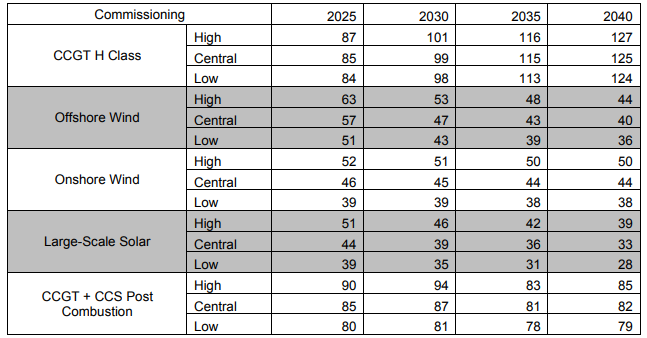
    Renewable energy prices are at the lowest they’ve ever been (according to an analysis by Lazard Ltd.) and the UK government predicts that levelised cost of electricity (LCOE) prices for renewables will drop even further while prices for fossil fuels will largely remain the same. 

    Figure 1 – Table showing LCOE for the next 20 years in £/MWh as predicted by the UK government in their 2020 report on Electricity Generation Costs.

    The earlier a complete change to renewable energy happens, the more money that will be saved in the long run. A myriad of reasons have prevented the switchover to renewables, despite the apparent advantages they currently have over fossil fuels. The associated costs with starting a new energy plant, new fracking technology significantly lowering the cost of natural gas, existing contracts tied up with fossil fuel suppliers, increased electricity bills for the general public and seasonal inconsistencies with renewable electricity generation are just some of the reasons why, initially, a switch to renewables may not be as economically attractive as one first expects. This is why a carbon tax would ‘even the playing field’ so to speak and incentivise investment into renewables.

    The EU ETS and Britain’s departure

    Economic incentives for reducing carbon emissions are not a foreign idea to the UK. The country used to be part of a cap and trade scheme used throughout the EU. The European Union Emission Trading System (EU ETS) is the largest of its kind in the world and consists of a scheme designed to limit the CO2 released into the atmosphere by allocating emissions allowances to member nations. If a country needs to generate more emissions they can trade for these allowances from a country that has successfully reduced its own. Thus, creating an economic incentive for a country to reduce its emissions. 

    Unfortunately, on the 31st January 2020, Britain left the EU and with it the EU ETS. A similar system was designed and incorporated known as the UK ETS. Emissions trading would continue but between the 4 nations of the UK rather than the 27 member nations and 3 trading partners (Norway, Iceland and Liechtenstein) of the EU. However, the Grantham Research Institute on Climate Change and the Environment (GRICCE) indicated in their 2019 study that this would be “suboptimal” and a carbon tax would be more beneficial in reducing carbon emissions. Again, in 2019, the GRICCE theorised that “a tax of £40 per tonne of CO2 equivalent emissions turned into a £1000 annual return for UK households” would be one of the most ideal ways at reaching net zero emissions by 2050. It also recommends the £40 per tonne tax is just a starting point and the price should slowly be increased.

    How will the money be used?

    One of the main arguments against a carbon fee & dividend scheme is that the general public will bear the brunt of the tax and although environmentally beneficial, it will increase the cost of living. To low income families, an increase in the heating or electricity bill every month is very unappealing, especially as they would not experience the immediate benefits of reduced CO2 emissions. However, the scheme ensures that the money is equally distributed to everyone in a monthly dividend.

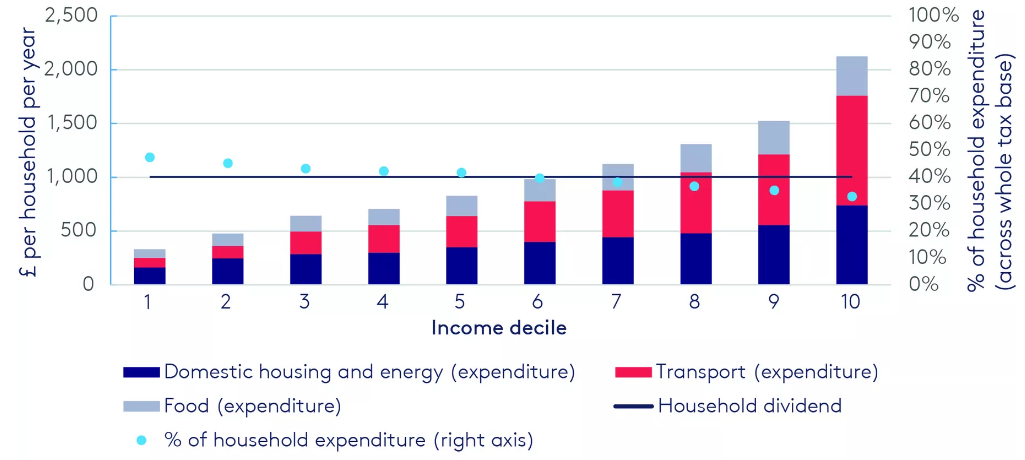
    Figure 2 – Courtesy of the Grantham Research Institute at LSE. Graph showing tax payments and dividend received by income decile.

    Looking at figure 2 we see that the lowest income decile households (1) would be better off with the flat £1000 dividend as it is a larger percentage of their total household expenditure. 

    Canada has a similar system and has been using it since as far back as 2008 (in British Columbia). Helen Mountford of the World Resources Institute states that citizens of Manitoba province, for example, would expect to see a rise of $174 CAD in cost due to the carbon tax. But receive a total rebate of $252 CAD resulting in a net gain of $78 CAD (~£45). Canada may only have a population of just over half of the UK but its CO2  emissions almost treble ours. If an industrial giant like Canada can implement a CF&D scheme and make it work, then so can we.

    The benefits of a CF&D scheme are clear. A switch to a more modern, cheaper and greener economy that will see benefits not only for our children and our children’s children but also us, we who are living currently. Alok Sharma’s warnings, ahead of COP26, are dire and desperately need to be listened to. Change is hard but if we don’t, our planet will.

    Luke Clews

  • The consensus is growing –  what surveys, petitions and the media are saying and what we can do about it…

    The consensus is growing – what surveys, petitions and the media are saying and what we can do about it…

    Reading the daily email alert from Carbon Brief is fascinating and getting more and more time consuming! I have certainly noticed a real shift of media opinion towards the climate emergency over the past year, as the effects of climate change are becoming more and more immediate. There are very few denial editorials these days even if the solutions are still hotly debated.

    The media is reporting growing support for the government to go further and faster such as a Guardian report that ‘Over-50s want climate crisis addressed ‘even if it leads to high prices’. There were also reports in the Independent and Daily Telegraph. It is noteworthy that The Times and Daily Telegraph have written about the threat of famine in Madagascar without disputing the first ‘climate change famine’ description.

    What I found most encouraging in today’s email alert was a report on an editorial entitled ‘Don’t let climate goals be lost in culture wars – cutting emissions means decarbonising the way we live, not giving it up’ which appeared in yesterday’s Financial Times.

    The editorial suggests how politicians and, by implication, campaigners should be approaching the issue of gaining public support for the changes needed to fight climate change now we can no longer rely on the low hanging fruit of removing coal from the energy mix…..

    “…trying to convince everyone they must change their lifestyles radically” in order to tackle climate change is “unlikely to work: demands that essentially put the onus on individuals will alienate too many people in an environment of insufficient knowledge about what net zero means and distrust about the intentions of politicians”..

    Instead, the message politicians must communicate is twofold. First, emphasise the facts: climate change is an urgent threat, it requires all of us to act – but if we act together, the sacrifices are far from prohibitive. Second, acknowledge that people will need help to take the right choices – and ensure that it is forthcoming. A consensus around mass adoption of carbon-reducing technologies can be achieved if adoption is rewarded and costless for those at the bottom. The alternatives – insufficient action, or calls for asceticism — will lead to division and failure.

    If that’s not an endorsement of Climate Income I don’t know what is! I also think it is a very useful hook for an email to a constituency MP, along with mentioning that over 100,000 people signed the ZeroC. petition  and even baby boomers are willing to put their money where their mouth is. (I am afraid I fit in that category but I am sure I am not alone in wanting more support and reassurance before I replace the fairly new gas boiler!)

    The UK has the chance to set an example to the world to make sure there will be no more climate change famines.

    If you email your MP please don’t forget to bcc us/forward to at [email protected].

  • CCL (UK) Members respond to the IPCC report.

    CCL (UK) Members respond to the IPCC report.

    Many thanks to all the members who responded to our request for comments and articles about the benefits of CF+D in relation to the IPCC report. It’s great to see a variety of points of view (remember they are members views and not official CCL policy).

    Here are the first 3……

    In light of the IPCC AR6, urgent action is needed to reduce our nation’s GHG emissions and transition to a carbon neutral economy.

    Why is the Carbon Fee & Dividend the right approach to this goal?

    Primarily, it targets the largest contributors to the climate crisis, the fossil fuel corporations.  The carbon fee will increase the cost of fossil fuel and make future investment into burning fossil fuels less profitable and as such we will incentivize a faster transition to cleaner renewable energy.

    The fee companies will pay a fee which is proportional to the amount of fossil fuels they burn, as a result of this fee the prices of carbon will rise and customers will be encouraged to swap to greener companies.

    CF&D redistributes wealth to all UK citizens, which is especially useful after the economic downturn onset by the pandemic, protecting the people that are most vulnerable during this transitional period.

    Our government can act quickly to address the climate crisis, with COP29 coming at the end of October, now is the perfect time to tackle the monumental challenge of decarbonising our economy.

    Lily Zayli

    Climate Change – A market failure

    November is rapidly approaching, and with it the UN COP26 climate meeting in Glasgow. The incredible sequence of natural disasters this year, including wildfires in the US and flooding in Germany, has only emphasised the need for international agreements to reduce fossil fuel use and prevent catastrophic climate change. And yet, little progress is being made.

    Economists have long agreed that climate change is a market failure: the normally efficient markets have not captured the true social cost of climate change in the price of fossil fuels. Markets instead price fuels at extraction cost, because markets left to themselves focus on costs incurred by buyers and sellers now, not at some future date when the climate has been damaged further. 

    It’s up to governments to create rules which ensure that markets account for future social costs of the carbon dioxide pollution which causes climate change. A carbon tax is the obvious government intervention which would make market economies such as the UK systemically recognise the social costs of burning coal, oil and gas. However, politicians around the world, naturally worried about passing further unpopular taxes, have largely resisted taxing carbon, especially after the French yellow-vest protests against Macron’s fuel tax. 

    Carbon taxes can in fact be made more politically palatable through the “carbon fee and dividend” policy, which would tax all fuels at point of extraction or import, and return the carbon tax revenue to taxpayers as a flat dividend per person. Returning the tax revenue to the public would mean that there would be no net tax burden and no unemployment caused. The flat dividend per taxpayer would also compensate lower income people who might otherwise be forced into “fuel poverty” by higher fuel prices. The higher cost of fossil fuels across the board would encourage their replacement with other energy sources. These benefits are the reason that Citizens Climate Lobby tries to encourage carbon fee and dividend. 

    The UK already has a carbon tax, but has not raised it to the point where fossil fuels are more expensive than renewable or nuclear power, which is the only way that markets will completely replace fossil fuels. The only way such increases in carbon taxes are likely to be acceptable to the public is through a policy of carbon fee and dividend. The UK should immediately take steps to raise its carbon tax through a carbon fee and dividend, and encourage other countries to follow its lead. Otherwise we are like to see in Glasgow yet another failed climate meeting. 

    Zeeshan Hasan

    Carbon fee and dividend and the levelling up agenda.

    In his book Poverty Safari, Darren McGarvey describes in often harrowing detail the experience of life on the Pollok housing estate near Glasgow. McGarvey blends powerful accounts of his emotional experiences with expressions of frustration at attempts by politicians and bureaucrats to address his community’s social deprivation. Some of the experiences McGarvey describes are recognisable from a short period when I lived on the Hulme estate in Manchester in the mid-1990s. I believe that McGarvey’s book is essential reading for those who want to advocate for policies such as Carbon Fee and Dividend. Let me try to explain why.

    The basic message of Poverty Safari is that the two poles of mainstream politics, right and left, have failed communities like Pollok, leaving people alienated and disillusioned. Yet both poles also capture what is best in such communities. On the one hand, the political right emphasises a culture of personal and financial responsibility and respect for people’s property. McGarvey’s father instilled such values in his son, but it is difficult to live up to them when one is struggling financially and when basic services such as schools and libraries barely function, and are often being actively run into the ground. On the other hand, the left emphasises concerns about social justice and solidarity that have a long history in places like Pollok.  However, mainstream left wing policies are often overly bureaucratic: the money invested often goes to paying well-meaning middle-class employees of what McGarvey calls the ‘poverty industry’.

    What does all this have to do with Carbon Fee and Dividend? I believe that, if well-designed and implemented, Carbon Fee and Dividend is a policy that would empower people in communities like Pollok, while addressing the disillusionment and frustration that McGarvey describes. In short, Carbon Fee and Dividend offers direct payments to individuals (the ‘dividend’). These payments are funded by ‘fees’ that are charged directly at the sources of greenhouse gases, such as industries that extract fossil fuels. On the one hand, this policy resonates with the culture of individual responsibility that McGarvey’s father valued: individuals are directly empowered to choose how they use their dividend. On the other hand, it also resonates with the culture of social justice: individuals are not left feeling that the costs of climate policies are being unfairly pushed onto them – and the direct nature of the payments mitigates the need for a bureaucratic ‘poverty industry’ to administer the policy.

    One might assume that issues such as climate change are distant concerns for people faced with the immediate consequences of social deprivation. Yet McGarvey’s description of a 30-year protest against the M77 motorway shows that the environment is an important issue for his community, and that environmental action can be a source of positive activity and a boost to self-esteem. Imagine what could be done if people had the resources and time to make their own choices about environmental issues.

    Of course, a policy like Carbon Fee and Dividend cannot, on its own, address all the issues that communities like Pollok face – and neither is it a single magic bullet solution for climate change. However, the policy is vital as a way to show that climate change policies can be fair and efficient – that they are not just a luxury that only the middle classes can afford. Carbon fee and dividend is a way for politicians who advocate a levelling up agenda to put their money where their mouth is.

    We need to get people in communities like Pollok on board with Carbon Fee and Dividend – and we should embrace the challenges this brings. McGarvey describes an incident in which a visiting politician was so frightened of the people he was talking to that he had to constantly doodle in a notebook to stop his hands from shaking. People in Pollok are not naïve: successfully explaining Carbon Fee and Dividend to them would be one of the best tests of its credibility we could hope for.

    John Pearson

  • What is the IPPR report suggesting?

    What is the IPPR report suggesting?

    In April there was a news report on citizen’s juries which were set up in areas which would be most affected by decarbonisation. Their deliberations fed into a cross party environmental justice commission along with business leaders, union leaders and the Institute for Public Policy Research which produced its report on the 14th July.

    The authors state that the gilets jaunes (yellow vest) protests in France show that fuel tax increases will bring a backlash if they are perceived as unfair. Instead, they cite Canada as an example of redistributing carbon tax revenues among citizens. 

    The report is arguing for grants and support for better ‘well being’ rather than the fair dividend paid to the populace regardless of personal merit or circumstance which Canada has implemented and Citizens Climate Lobby, including Citizens Climate Lobby UK support. 

    The report suggests using the proceeds of a price on carbon and borrowing at current low interest rates to ensure fundamental change in the ‘country’s economic model’.

    The main suggestions are:

    Adding £30bn of public investment each year in a low carbon economy until at least 2030.

    A new £7.5bn-a-year “GreenGO scheme”, which would serve as a financial one-stop shop, akin to the government’s Help to Buy scheme, to help households switch to green alternatives on heating, home insulation and transport.

    Upgrade local public transport and making it free to all users throughout the UK by 2030, with free bus travel by 2025 as a first step.

    Introducing a “3 x 30 x 300” rule for local planning that would ensure at least three natural features are visible from every new home, every neighbourhood has at least 30% tree canopy cover, and no new home is further than 300 metres from an accessible green space.

    Establish a permanent, UK-wide climate and nature assembly, alongside a “wellbeing of future generations” act in England, Scotland and Northern Ireland (Wales already has this) to ensure that all business and policy decisions must take account of their long-term effects.

    Involve communities so policies reflect local priorities. This would include granting local authorities new powers over economic strategy and giving the public a direct say over how local budgets are spent.

    Yes, the proceeds of a price on carbon should go to society rather than into government revenue. This plan however would not directly compensate every household for rising fuel prices evenhandedly. Most of the dividend and borrowed money is intended to benefit people living in certain areas, particularly new developments in urban areas.

     It will not directly combat fuel poverty or support rural communities who may not be considered low income but would be hard hit by rising fuel prices in transport and heating. No free bus service would be able to replace the car for every farm and small village. There is a danger in prioritising certain areas which historically has left more rural counties struggling with less money for education, health, social care etc. Note that under the Canadian plan the Federal Government report states that…

    In recognition of the fact that people who live in small and rural communities have reduced access to cleaner transportation options, a supplementary amount in addition to the baseline Climate Action Incentive payment is provided for eligible individuals and families who live outside a census metropolitan area, as defined by Statistics Canada. This supplement increases the baseline amount by 10%.(p.26). 

    Under the Canadian plan the majority of households are better off, this is a fairer and more politically neutral way to hand out the proceeds of the carbon price.

    Illustration by Mini Grey.

  • If you can’t beat them, join them!

    If you can’t beat them, join them!

    I have just read an article in the Bloomberg Green newsletter which discusses carbon pricing. Indonesia has announced that it will impose a carbon tax of about $5 per ton of emissions in order to raise revenue as well as meet climate goals. Whilst this is about a tenth of the current EU ETS carbon price it will be welcomed by the IMF which recently suggested that low-income emerging markets should aim for a price of $25 a ton by 2030 (with advanced countries at $75). The IEA is also arguing for international carbon pricing, stating that advanced economies should be at $250 a ton and emerging markets $55 a ton by 2050.

    Carbon pricing is often criticised as an own goal – will it lead to importing countries taking advantage with non carbon priced imports? Canada and the EU are in the process of establishing a Carbon Border Adjustment Mechanism (CBAM) so that importing countries will pay higher tariffs or offset them by imposing their own carbon prices.

    The CBAM ‘threat’ is already having an effect, in the process of watching an ERCST (European Roundtable on Climate Change and Sustainable Transition) discussion today I learnt that it is estimated that Turkish exporters would have to pay 580 million euros in CBAM tariffs and lose 1.125 million jobs in the heavy industry sector. Establishing their own ETS system could raise revenue of 13 billion euros. Could the threat of CBAM also be part of the reason for the Chinese ETS system being established?

    In the Bloomberg Green article Akshat Rathi states that carbon pricing doesn’t raise prices as high as critics claim. According to the Energy Transitions Commission (also arguing for international carbon prices)…..Taking into account all the costs for making zero-carbon cement, steel and plastic, for example, only boosts the price of a house by 3%, a car by 1% and a soda bottle by 1%.

    Akshat then goes on to discuss carbon pricing with Sam Fankhauser, professor of climate change economics and policy at Oxford University. Sam points out the need for an economy wide carbon price, especially in developing countries like Indonesia where emissions are more likely to be generated by agriculture than heavy industry.

    Sam then argues for the Climate Income method (he cites British Columbia)……..,

    Taxes aren’t popular. What’s the best way to overcome that perception?

    The argument should be that a carbon tax is about making polluters pay—it’s not simply yet another way for states to extract more money from people and businesses. In Canada’s British Columbia, they’ve found some clever ways to deal with the problem by sending citizens regular checks from the carbon tax revenues raised.

    Note the Canadian federal backstop ‘Climate Action Incentive Payment’, like the British Columbia policy Sam cites, has been used in Ontario, Manitoba, Yukon, and Nunavut since early 2019….The federal carbon pollution pricing system is not about raising revenues. It is about recognizing that pollution has a cost, empowering Canadians, and encouraging cleaner growth and a more sustainable future. Under the federal approach to pricing carbon pollution, all direct proceeds are returned to the province or territory of origin.

    Sam also argues against the claim that taxing carbon will lead to lower economic growth…..

    What about the argument that taxing carbon may lead to lower economic growth?

    Lower relative to what? If it’s relative to other regulations that cut emissions, then a carbon tax is probably cheaper because it can more efficiently reduce emissions across the economy. That’s one of the attractions for a carbon tax. Lower relative to what? If it’s relative to other regulations that cut emissions, then a carbon tax is probably cheaper because it can more efficiently reduce emissions across the economy. That’s one of the attractions for a carbon tax.

    But if it’s relative to a world where there are no carbon regulations, then countries like Indonesia need to ask, why do they want to cut emissions? Would the cost of climate change in the long term be more affordable? That’s unlikely.

    Some of the hits to the economy of a carbon tax are short-term costs that come from structural adjustment, moving an economy from high carbon to low carbon. That’s not easy. But once you come out at the other end, the penalty will disappear.

    His final comment, on the EU’s CBAM policy, is corroborated by what I heard about Turkey …. From a developing country perspective, they might think, why should I let the Europeans tax my industry and keep that revenue when I can do it myself?