Blog

  • Growing interest in the merits of carbon pricing in general and Climate Income in particular as the old arguments against it are losing ground….

    Growing interest in the merits of carbon pricing in general and Climate Income in particular as the old arguments against it are losing ground….

    It seems appropriate to be writing about a blog by an Oxfam researcher on this Jubilee weekend as the biblical purpose of Jubilee years was to release the indebted and restore their land to them. Climate change is a symptom of global economic and social injustice. In the debate about solutions carbon pricing is often criticised as a regressive and ineffectual policy favoured by those who want to keep the economic status quo – of course supporters of Climate Income know better! 

    James Morrissey, Senior Researcher at  Oxfam US recently wrote a blog titled – The best answer to climate change – or a regressive policy set to fail? A guide to the arguments over carbon pricing.  Morrissey has highlighted the issues about current carbon pricing policies which are also acknowledged by proponents of Climate Income…….

     IT’S CLEAR THAT CURRENT CARBON PRICES ARE TOO LOW

    Before we get to the arguments about whether carbon pricing can work, it’s essential to point out that carbon prices are currently inadequate to address climate change. In the vast majority of cases, prices are too low, and not applied to enough of the economy to drive decarbonisation at the rate necessary. The graph below shows how prices are generally below $50 per tonne of CO2 (they need to be closer to $100/tCO2) and only cover 15% of the global economy (they need to be at 100%). Despite these problems, it’s notable that carbon pricing is seeing increasing uptake over time – with more and more countries adopting prices and more of the global economy under a price.

     CARBON PRICING DOES NOT AFFECT EMISSIONS

    First is the argument that placing a price on carbon does not affect emissions. The empirical literature doesn’t support this claim. Numerous empirical studies of carbon pricing, using a variety of methods, demonstrate that carbon pricing has reduced emissions. There is some question over whether the emissions reductions have been large enough, but this really comes down to what you consider “large” and what sort of reductions might be expected at what prices. In general reductions in emissions have been small, but significant, especially considering the low prices in place.

    IT WON’T BE ENOUGH BY ITSELF TO TACKLE CLIMATE CHANGE

    The second argument against carbon pricing’s effectiveness is that alone, it is inadequate to tackle climate change, because consumers don’t behave like economists assume: as rational cost minimisers. For example, people don’t just buy the cheapest car for their needs; they buy cars based on ideas of status and brand loyalty, among others. This is true and uncontroversial, we need more than price signals to move consumers. However, this argument is also something of a straw doll: most of the literature on carbon pricing acknowledges that carbon pricing will need to be complemented with other policies if it is to be effective in averting climate catastrophe. To this end, advocates of a carbon price who suggest it’s the only policy we need should be viewed with scepticism. 

    Note that CCI doesn’t call for Climate Income to be a stand alone policy and it has not been implemented as such in the countries like Canada which have adopted it thus far.

    IT WILL HURT THE POOREST PEOPLE WHEREVER IT’S IMPLEMENTED

    A big concern around carbon pricing is that increasing the cost of energy derived from fossil fuels will drive regressive impacts.

    Since energy is central to the functioning of the global economy, and we currently generate around 83% of primary energy from fossil fuels, a carbon price will make almost all goods in the economy more expensive. Because low-income groups tend to spend a greater portion of their income on energy-intensive goods, a carbon price will have a disproportionately large negative impact on their well-being compared to wealthy households – making the policy notably regressive.

    However, a huge advantage of carbon pricing is that the price also generates revenues. Importantly, wealthy groups tend to consume more energy-intensive goods than low-income groups (even though they spend a smaller proportion of their income on these goods). What this means is that, despite regressive cost-side impacts, you can use the revenues to make carbon pricing substantially progressive. There are a number of ways to do this, but the simplest is to just return all the revenues to everyone, equally (ie on a per capita basis). Doing so would result in low-income populations receiving more than they pay in increased prices, while the opposite would be true for wealthy populations. (My emphasis).

    Morrisey does point out that the policy has to overcome public antipathy to the concept of increasing taxation, which also makes the policy easier for opponents to criticise than less visible regulations and subsidies. He argues, however, that these alternative policies also encounter opposition and are no more capable of solving the problem of climate change on their own than is carbon pricing. He concludes that if there is some momentum for carbon pricing NGOs should support it with the caveats that ….

    The revenues produced by carbon pricing must be used to effectively address all regressive impacts created by the price. Prices must either be set high enough to drive ambitious emissions reductions or, if prices are to start low and increase over time to overcome political opposition, the process for increasing prices needs to be automatic and insulated from political push-back. (My emphasis).

    Carbon pricing can be effective but, by itself, it will not be enough to address climate change. Any carbon price will require complementary policies. The most important will relate to addressing other market failures (such as the need for public investment in research and development) and addressing network problems (such as supporting electric vehicle charging infrastructure), but will also include policies for numerous markets where price signals are insufficient to shift behaviour.  

    Along with the recent reports in Nature and by the Autonomy think tank, this blog and the related Oxfam primer on carbon pricing show growing support for the concept that a Climate Income policy will not only alleviate climate change but also the gross inequalities impeding sustainable development in the Global South. 

    Finally I must mention a very apposite blog by fellow Citizens’ Climate Europe member Brigitte Vangerven about the idea that protecting the climate requires sacrifice. …

    Pricing pollution will make polluting products more expensive than clean products. The price difference will make people and companies choose the clean alternatives. It will greatly accelerate decarbonisation and the widespread deployment of clean alternatives. The proceeds are used to support the people in the energy transition.

    Everybody receives a Climate Income. Most households, especially low and mid incomes are better off or break even through this policy.

    It is simple, transparent, just and effective, and I hope that for many people it will dispel their reservations.

    This makes it possible to implement an ambitious climate policy, that will receive broad support from the people. There is no longer a conflict.


  • Growing support for an international carbon price floor.

    Growing support for an international carbon price floor.

    Last year the IMF called for a globally applied carbon price floor corresponding to a country’s wealth, with a suggested tariff in 2021 of $75 for the wealthiest countries and $25 for less developed countries. Today in the Times (paywall) Mehreen Khan, the economics editor, makes the case for an effective international carbon pricing system rather than occasional windfall taxes…. 

    “One levy notably absent from the present debate is a global carbon tax to provide an incentive for the huge shifts required to hit the global net-zero target. Even in relatively benign times, politicians have taken fright at the idea of taxing carbon use, thinking that it will disadvantage their industry at the expense of foreign rivals…

    Arguments against national carbon taxes wither away if all countries agree to impose a price. The International Monetary Fund has devised an international carbon floor where the price paid corresponds to a country’s wealth. It would mean America, Britain and Europe would use a minimum floor of $75 a tonne, falling to $25 for the poorest. This collective jump into carbon taxation would not disadvantage industries in richer countries, the fund says, and would dramatically reduce emissions.” 

    Citizens Climate International supports a carbon price floor mechanism as a necessary step to the goal of Climate Income….

    We support establishment of a global “price floor”, supported by national policies to impose a steadily intensifying price signal disfavoring climate pollution. As the IEA has reported, “There is no need for investment in new fossil fuel supply…” Pricing systems should effectively and efficiently eliminate climate pollution while building incomes for people and enhancing international cooperation for a zero-emissions future.

    Recent studies such as the report in Nature and the Autonomy report have also suggested how Climate Income could be a game changer for the Global South….

    While countries in South America, Sub-Saharan Africa, South-Asia and many other parts of the Global South would profit immensely, most developed economies would only see proportionally relatively small losses.

    …..As a global policy, it could wipe out extreme poverty and easily dwarf the scope of any existing development aid and debt relief schemes, illustrating that, in this sense, it is the Global North that owes an immense debt to the populations in the Global South, not the other way round. It would also go a long way to alleviate the disastrous impacts the Covid pandemic has had on the world’s poorest and most vulnerable, with for instance an additional 100m children falling into poverty, and prevent global disparities from deepening as richer countries recover while poorer countries fall even further behind (UNICEF 2021b). Such a global carbon dividend scheme could end the bitter reality of mass hunger and destitution and be a key building stone of a fairer, more sustainable and more inclusive post-pandemic economy. (Toll gates and money pumps, Autonomy, p.51)

    It is good to see growing support for a carbon pricing system which would remove the uncertainty and short termism thwarting the rapid decarbonisation which the world needs!

  • ‘Its been a great meeting!’ … as the activist said to the Bishop

    ‘Its been a great meeting!’ … as the activist said to the Bishop

    Rob Paton updates us on the fantastic progress made by Citizens:mk and its future ambitions to go global, or at least England and Wales!

    Last September at the Citizens:mk climate assembly, the Bishop of Oxford agreed to a request for a meeting to discuss Climate Income, and whether he might use his position on the House of Lords Climate & Environment Committee to promote the idea.  He has a very full schedule, so December was the first available date… and then just beforehand, he suffered a nasty bout of Covid!. Finally, in late April, the meeting took place. 

    So what happened?  Lauren Jeffrey presented our first ‘ask’: we wanted to cite him as a supporter of Climate Income and of our campaign, as we took it national through the network of chapters that make up Citizens UK.  Would he consent to this?  The reply was immediate – yes indeed  (and without us needing to clear statements through his office in advance).

    Then our second ‘ask’: would he invite us to the Lords to a meeting, whether formal or informal, as he thought best, to help increase understanding and support for Climate Income among parliamentarians?

    Again he replied positively, though not unconditionally.  Characteristically thoughtful, he said he needed time to consider when and how the meeting could best be ‘anchored’ in the processes of the Lords (and its Climate and Environment committee in particular – of which he is a member).  Then he gave us an important and unexpected bonus  – direct access to his two advisors (both of whom were clearly willing, thoughtful, and very well informed on Parliamentary processes as well as climate issues).

    It was an intense two hours including some lively exchanges around how to bring the need for rising carbon prices into the policy process and public debate.  We left feeling tired but elated. We had an important ally for what we see as our next steps – both locally, and working across the Citizens UK network to spread this word and bring other chapters on board, turning it into a national campaign.   All that is needed is lots more hard work! – if you might like to be involved, please get in touch.

    For more about the meeting, visit http://www.citizensmk.org.uk/2022/05/16/onwards-and-upwards-for-climate-campaign/ 

    To see if there is a Citizens UK chapter in your neck of the woods click here.

    Pictured above:

    Representatives of the Citizens:mk Climate team, L to R: Rev. Catherine Butt (St Frideswides); 

    Rob Paton (MK Quakers); Lauren Jeffrey (Lakes Estate Renewal Forum); Stephanie Laing, Community Organizer.

  • How to ensure private investment companies do the right thing, also known as the Carlsberg solution!

    How to ensure private investment companies do the right thing, also known as the Carlsberg solution!

    The Independent recently reported on a speech by Dr Jean Rogers, head of ESG at global asset management company Blackstone. Speaking at the Dublin Climate Summit on the 12th May, Dr Rogers argued that whilst 90% of the world’s GDP is now covered by climate commitments but still only 20% of the world’s emissions are priced it is difficult for investment companies to avoid putting investor’s money into future stranded assets. The solution, she argued, is a carbon pricing policy like Canada’s, which is predictable and progressively rises…..

    “One thing that can really move the needle is actually pricing carbon and the reason for that is that it then becomes investable – you can take that future liability and turn it into an asset by investing against it now.”

    The fact that the Canadian carbon tax will rise from $50 a tonne now to $170 by 2030 incentivises investors to finance the decarbonisation of the copper mine of which she is a board member…..

    We’d never want to pay a dime against that tax… and that is, I think, a really important mechanism.” 

    The predictability of such a carbon tax would enable the case for investment in decarbonisation to be clearly put across to investors

    “We now need to be talking about long term capital strategies, and we need the tools, but we need the incentives to do that really well,”.

    The article also reported on Mark Carney’s appearance at the Lords Economic Affairs Committee on the 22nd April. Carney was former Governor of the Bank of England and is now special envoy for climate action and finance at the United Nations. The committee was discussing how the financial sector should be regulated to enable the move to net zero whilst preventing fear of stranded assets moving investors away from the regulated market. 

    Carney was asked, ‘Would not this add up to a further case for a carbon tax which would reach part of the financial sector which regulation can’t reach?’ To which he replied, ‘Carlsberg solution, the case is very strong for a carbon price widely applied with maybe an appropriate rebate for less well off households to ensure it is resilient.’ – aka Climate Income!

  • A few thoughts on the British Energy Security Strategy…

    A few thoughts on the British Energy Security Strategy…

    The crisis caused by the war in Ukraine has prompted the Government to rejig its energy policy in order to increase energy security by reducing the need for imported fuel. This rethink could have been an opportunity to move away from the use of gas as our base load fuel and stick to our commitments to achieving NZ by 2050 by not licensing any more oil and gas fields or fracking. 

    The Government could have prioritised increasing onshore wind and solar farms which are the quickest and cheapest ways to increase our low carbon energy supply to the promised 95% by 2030, backed up by a campaign to insulate our poor housing stock to reduce the demand for gas. Although planning rules have been made less restrictive in the strategy, onshore wind and solar will still require unanimous consent, unlike roads and incinerators; it has also been reported that more ambitious plans were watered down the night before the strategy was released.

    The Government has instead decided to launch a new licensing round for oil and gas fields in the autumn. It will take years for these to come onstream and unless rules are changed the fuel will be sold on the international market as now. This  announcement came 3 days after the latest IPCC report had warned that we have reached the now or never moment and have to leave the oil and gas in the ground.

    The Climate Change Committee stated that….“Recognising the difficulties in implementing effective policy quickly, it is still disappointing not to see more on energy efficiency and on supporting households to make changes that can cut their energy bills now. Government has reiterated its commitment to do more and we look forward to seeing details in the coming months” – here’s hoping! 

    Micharl Lewis, CEO E.ON UK was even more forthright….. “Energy efficiency is the fabled ‘silver bullet’ for a future energy system: it cuts bills and carbon emissions today, it creates jobs and it reduces our reliance on foreign gas. By abandoning any extra commitment to helping people to improve their homes, today’s announcement condemns thousands more customers to living in cold and draughty homes, wasting energy and paying more than they need to for their heating”. 

    Now could have been the moment for the Government to look again at the case for Climate Income which it had acknowledged in The Future of UK Carbon Pricing (2020), ideally with the ability to borrow against future dividend payments for investments in energy efficiency and retrofitting.

     Advocates of the approach highlight that a well-designed scheme would have social and environmental benefits, equitably distributing the revenues and stimulating investment in low carbon technologies……..emissions to be reduced in a cost effective and technology-neutral way, while mobilising the private sector to invest in emissions reduction technologies and measures.

  • How Climate Income could transform the world….

    How Climate Income could transform the world….

    The progressive think tank Autonomy, which researches solutions for climate change, the future of work and economic planning published a (very readable) report titled ‘Toll Gates and Money Pumps: Why carbon taxation could be a simple, fair and transformative policy instrument’ on the 21st of March. The report outlines how a globally applied carbon fee and dividend policy would be extremely effective at lifting the poorest countries out of poverty and more than a billion people above the global poverty line, as well as combating climate change. There is an article on the report in the Independent.

    The researchers modelled the global, European and nation state application of the scheme using two carbon prices. The lower carbon price is the current highest carbon tax worldwide, that of Sweden, at $137 per tonne, a price which makes it into the range  indicated by IPCC to be needed by 2030 to stay below 1.5°C-warming. The higher carbon price modelled was $195, this is the rate for advanced economies proposed by the Federal Environment Agency of Germany. It states that the policy is not intended to preclude public spending on decarbonising industry, agriculture, homes and transport and commodities should be clearly labelled with the GHG emissions expended in manufacture. 

    The report states that the (lower) Swedish carbon price, applied globally, would be transformative, raising $2.69tn annually …… 

    While countries in South America, Sub-Saharan Africa, South-Asia and many other parts of the Global South would profit immensely, most developed economies would only see proportionally relatively small losses.

    …..As a global policy, it could wipe out extreme poverty and easily dwarf the scope of any existing development aid and debt relief schemes, illustrating that, in this sense, it is the Global North that owes an immense debt to the populations in the Global South, not the other way round. It would also go a long way to alleviate the disastrous impacts the Covid pandemic has had on the world’s poorest and most vulnerable, with for instance an additional 100m children falling into poverty, and prevent global disparities from deepening as richer countries recover while poorer countries fall even further behind (UNICEF 2021b). Such a global carbon dividend scheme could end the bitter reality of mass hunger and destitution and be a key building stone of a fairer, more sustainable and more inclusive post-pandemic economy. 

    The authors do not address the issue of diminishing returns as the world economy decarbonises but the assumption is that the proceeds of the tax will enable all countries to embrace sustainable and fair economic development. The authors even suggest that the visible benefits of the fair distribution of the dividend could lead to… 

     the introduction of a more comprehensive, far-reaching UBI – implementing a global infrastructure for roll-out and, more importantly, materially recognize and implement the right to equal use of our planet.

    Now that the results of our dependence on fossil fuels are so visible in the war on ‘our doorstep’ the world may be ready to welcome such ideas!

  • The latest IPCC Report and the invasion of Ukraine emphasise why we need to ditch fossil fuels!

    The latest IPCC Report and the invasion of Ukraine emphasise why we need to ditch fossil fuels!

    The latest IPCC Report confirms that the most dire predicted consequences of climate change are happening to our planet right now and will only get worse if we don’t act immediately. There is a useful summary of the key points in this freely accessible Belfast Telegraph article and an in depth Q &A in Carbon Brief. For the Citizens Climate International analysis read here.

    The Russian invasion of Ukraine has also alerted Europe, particularly Germany, to its dangerous dependence on imported fossil fuels; prompting it to aim for an almost 100% renewable energy supply by 2035 rather than the previous vague ‘well before 2040’. Oil companies like BP and Shell are also pulling out their stakes in Russian owned oilfields and the Nordstrom pipeline. 

    Today’s Bloomberg Green newsletter reports that a Russian member of the IPPC research team apologised for the invasion in an UN organised virtual meeting last weekend, responding to this remark by Ukrainian researcher Svitlana Krakovska.

    “Someone could question us that IPCC is not a political body, and should only assess science related to climate change. Let me assure you that this human-induced climate change and war against Ukraine have direct connections and the same roots. They are fossil fuels and humanity’s dependence on them“.

    “While emissions of greenhouse gas have changed the energy balance of the planet, the ease of receiving energy from burning coal, oil and gas has changed the balance of power in the human world. We cannot change laws of the physical world but it is our responsibility to change laws of human civilization towards a climate resilient future“.

    We need to move away from fossil fuels sooner rather than later for the sake of the health of the planet and all its inhabitants. Countries must aim to be no longer beholden to the realpolitick of fossil fuel supply. 

    Climate Income is the most effective way to price fossil fuels out of the market without making life worse for people. 

    Finally this interesting article points out how a worldwide Climate Income could alleviate poverty worldwide

    …..We find that if all countries adopt the necessary uniform global carbon tax and then return the revenues to their citizens on an equal per capita basis, it will be possible to meet a 2 °C target while also increasing wellbeing, reducing inequality and alleviating poverty. These results indicate that it is possible for a society to implement strong climate action without compromising goals for equity and development. (The principle would stand for the new target of 1.5 degrees).  

  • Tackling fuel poverty during the great transition – 7 principles for climate activists

    Tackling fuel poverty during the great transition – 7 principles for climate activists

    CCL member Rob Paton explains how Climate Income can be used as a solution to the fuel price crisis as well as the environmental one.

    The fuel poverty facing many households and the climate crisis facing us all must be tackled in synch. If they are not dealt with together, each problem worsens the other.  Fuel poverty, accentuated by a price spike, has led to calls questioning support for renewable energy and has clear potential for social and political instability. Yet the necessary action on fuel poverty must not be at the expense of the climate.  Households on benefits, or with low and insecure earnings, will be the least able to protect themselves from the consequences of weaker climate policies.  

    Fuel poverty should be addressed primarily by increased income, not reduced fuel prices.  What those in fuel poverty need is more money.  They know their priorities. And it must be money they can rely on – not complicated special payments, or means tested and arriving late to tackle a spike in prices..

    What businesses and our economy need for the transition to zero carbon is an underlying trend of rising carbon prices.  Economists and business federations agree on this. Most businesses can deal with price fluctuations, or are learning how to. Carbon subsidies and tax reliefs are a part of the problem not part of the solution. 

    4   The direction of travel for public finances should be away from the present high degree of carbon reliance and towards sustainable, post-carbon sources of revenue.  An overhaul of the UK’s current mish-mash of fossil fuel taxes and subsidies is long overdue.  A coherent approach would raise more funds, be fairer and simpler, support the drive to carbon neutrality.  This is bound to take time – so the sooner the taxation system starts down this road the better.

    5  Likewise, the direction of travel for income support during the great transition should be from indirect to direct payments. That is, from transfers hidden in a tax or benefits system to discrete, climate-related payments, labelled as such and paid directly. Citizens need to know that they are being supported in tackling the climate crisis, and enabled to play their part.

    6   Consistent policy on carbon pricing, fiscal reform and income support requires a cross-party political consensus.  Surveys have repeatedly shown that the public mood is to find and sustain the common ground, and to get on with the job.  Political contestation on other issues – including other climate and environmental policies – can and should continue, both locally and nationally. But a framework to tackle the great work of this decades-long transition is needed. These are three essential elements for such a framework. 

    Communicate, communicate, communicate. Public trust in politicians needs to be restored if sometimes unpopular policies are to be sustained. A cross-party consensus in Westminster needs the backing of public opinion, and its calls will be taken more seriously by the public than party-political pronouncements. Especially when promised action follows. Nothing is clearer and more convincing than a payment direct to your bank account.  

    Climate income offers a way forward with the clear potential to satisfy all these principles.  It may not be the only one. But it is the only one I am aware of.        

    Rob Paton 02/02/22 

    We are not the only ones with this message, today’s Carbon Brief Daily reports on two interesting reactions to the Levelling Up White Paper (Business Green is paywalled) ..

    Business Green’s James Murray, analysing the paper, writes that “a government that properly prioritised the net-zero transition, rather than treated them as a separate silo, would find it much easier to embed climate action in its response to the gas price crisis.”

    In another comment on levelling up in Business Green, Prof Henrietta Moore writes that “without tax reform, the cost of funding net-zero will fall disproportionately on the shoulders of those least able to afford but most likely to suffer the consequences of a rapidly degrading environment”. 

    Happily the fuel price crisis mitigation measures announced by Rishi Sunak today do not involve tinkering with carbon pricing and leave all to play for!

  • A simple, fair and effective solution to the UK cost of living crisis – Climate Income.

    A simple, fair and effective solution to the UK cost of living crisis – Climate Income.

    I posted this article on the Linked In Citizens’ Climate Europe page on the 22nd January and have been asked to reproduce it here. I hope you find it a helpful ‘take’ on the current crisis.

    The current fuel crisis is creating problems for governments in the UK and Europe. The conundrum is based on the combination of underlying energy costs, environmental taxation, poverty alleviation and climate policy, all overlapping in a complex mix. Finding a solution that keeps advocates of each policy and it’s raison d’etre supportive is challenging. Here we look at how leaving the EU offers the UK a simpler approach. Climate Income can be used to address the short term imperatives of the rising gas prices, “levelling up” the inequality in the UK, provide a clear pathway to NetZero and make the UK economy more competitive.

    Some of the main elements in the mix …

    Gas prices are rising, and will continue for up to 2 years. Average household energy costs are set to rise by around £600 p.a. in 2022. Energy costs impact everyone, but while low and middle income families use less energy it’s a higher proportion of their income, hence why governments implement policies to address this.

    To protect the vulnerable, old and poor, there have been various means tested financial supports introduced roughly every decade: in 1988 Cold Weather Payments; in 1997 Winter Fuel Payments; and in 2011 Warm Home Discounts. All essentially aiming to reduce the number of people suffering from cold or hunger in our first world economy.

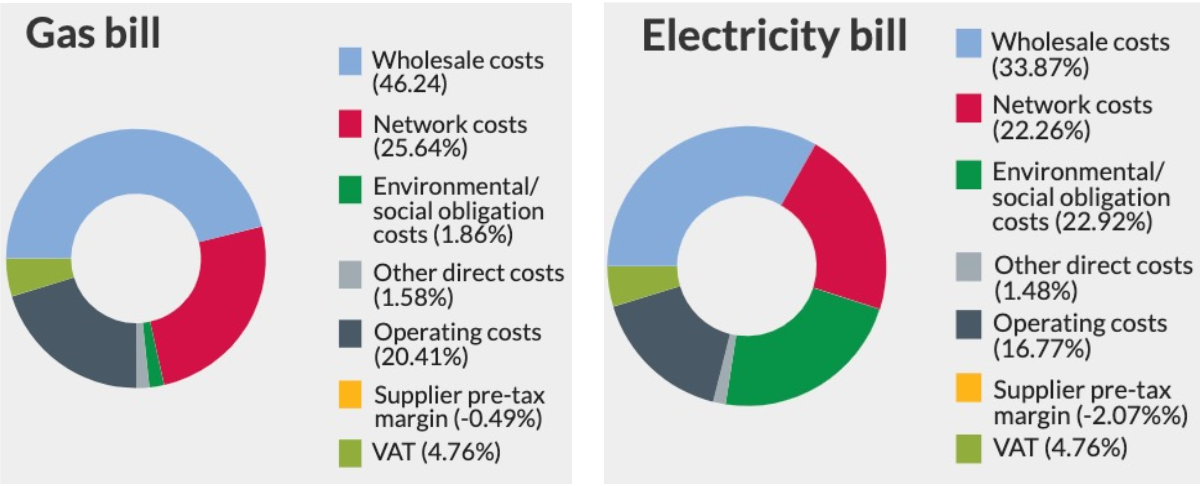
    In 2013 the UK Gov introduced the “Environmental and social levies” to fund energy efficiency, encouraging low carbon generation and reducing fuel poverty. The levies are 10x higher for electricity bills than gas bills. At the time 35% of the UK’s electricity production was from coal, the most harmful fossil fuel for the climate and air quality.

    No alt text provided for this image

    Consequently in 2013 the UK Gov also introduced the Carbon Floor price, initially at £16 (above the EU-ETS at the time) and set to rise to £30 by 2020 (which would now be below the EU-ETS). This has seen Coal reduced to 2% or less (20x smaller) for electricity production. The UK established (EU approved) measures to protect industry and now the EU itself is driving international dialogue on Carbon Border Adjustments.

    Whilst prices fluctuate over time, these policies raise prices for things that pollute (or used to pollute), and at the same time try to alleviate the financial burden on the poorest. The apparently conflicting problems of poverty and climate change. Ironically most of the people living a lifestyle compatible with 1.5ºC are the poorest in society, with the richest 10% causing as much pollution as the other 90% combined.

    Climate Income – the solution?

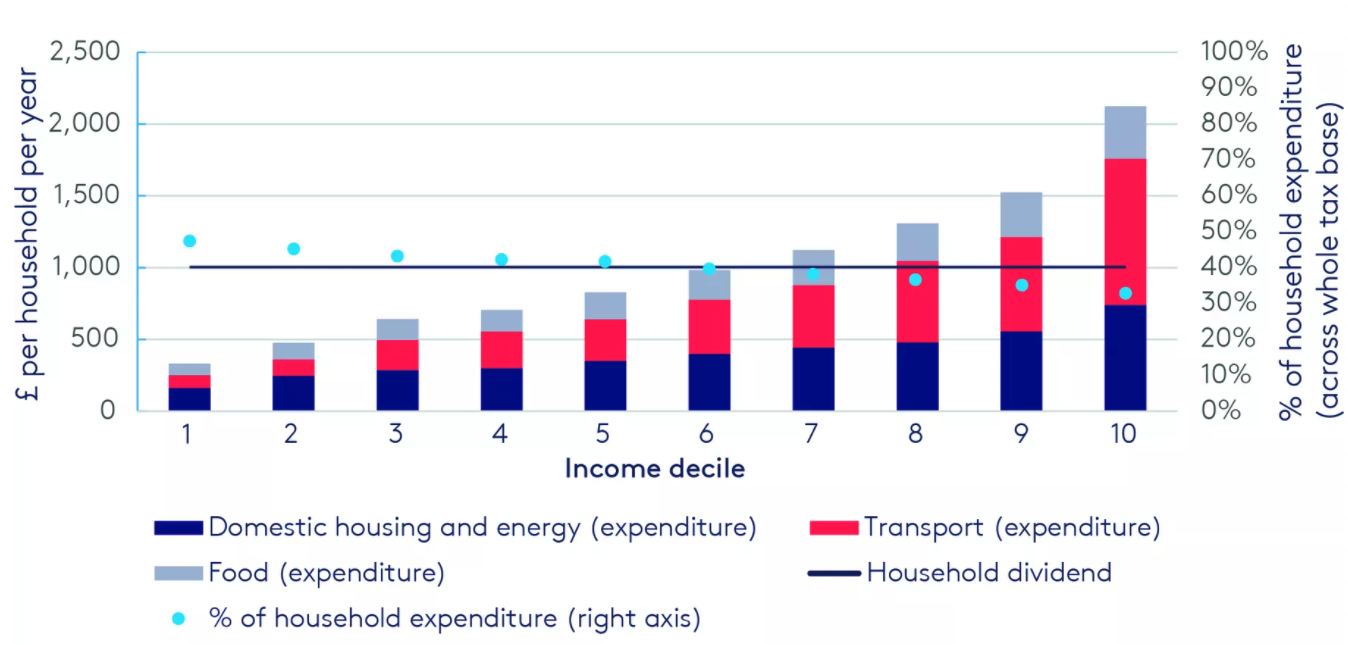
    Climate Income is a revenue neutral, steadily increasing price on pollution fully rebated to all citizens. Revenue neutral means there is no cost to the government, and, significantly, no revenue for the government. The steadily increasing Carbon Price follows the polluter pays principle embedded in UK legislation for nearly 50 years. The key part is returning the money to all citizens equally in a fair monthly payment, much like how child benefits or pensions are paid. Despite the rising costs, the poorest 20% could be £500 better off, enough to match the one of the current UK government suggestions.

    No alt text provided for this image

    London School of Economics data from 2019.

    The rest of society would be proportionally affected depending on the pollution they cause. Once the gas price spike settles over half the population would be better off. The exact amount depends on the level of price introduced. LSE modelled a £40 /tCO2 charge, above the current £18 and the planned £30 level, though significantly below the current UK ETS price circa £75.

    No alt text provided for this image

    This type of approach is intrinsically fair, sharing the responsibility and rewards equally on everyone. In Canada a form of Climate Income has been operational since 2019 and the public increasingly understand and support it, re-electing in 2021 parties in favour.

    Above all, it must be clear to the public that this represents a rebalancing of the tax base, in order to incentivise greener technologies and activities, and not simply a backdoor way of the Treasury taking more cash from their pockets.

    What does this mean for the Net Zero goal?

    A clear path to NetZero is supported by aligning the steadily increasing price to the data from the IPCC 1.5ºC report and the latest International Energy Authority report which suggest most (70%+) of NetZero can be achieved with such pricing. What this illustrates is that the long term NetZero objective actually helps clarify how the UK Gov might proceed with other related policy options currently under discussion. 

    e.g.

    1. Subsuming the current Environmental and social levies – reducing the bias against cleaner electricity and shifting the costs more to polluting gas, whilst delivering on the environmental and social objectives.
    2. Removing VAT from household energy bills would be a cost to the treasury that would enable a higher Carbon price, reinforcing 1 above.
    3. Both above measures reduce pressure on the various means tested support programs over time. As the Carbon price rises each year the policy is increasingly progressive, enabling simplification and reduced bureaucratic burden on people and the state.
    4. Windfall taxes might also reduce the immediate financial burden on the treasury enabling more of the existing carbon price (via the UK ETS) to be returned to citizens.
    5. Rebating the money to citizens gives industry the confidence to pass costs on to consumers regardless of how the price rises domestically.
    6. The ETS (copied from the EU) could be replaced by a simpler and more predictable economy-wide carbon price that allows industry to plan and invest with more certainty.
    7. Such pricing strengthens the UK economy to exploit the international trade advantage that already exists in the eyes of this US assessment as the EU and others pursue Border Carbon Adjustments. It also helps create the investment case for industry in the inevitable green revolution the world needs over the next 30 years.

    It could be argued, however, that the current path, with various different ways to raise energy prices and tax revenue whilst only offering minimal and creeping support for the most vulnerable mirrors exactly what unfolded in France with the Yellow Vest movement. Indeed the parallel is further matched by a spike in prices being the trigger to public discontent to such policy creep. In France it was an oil price spike after 4 years of gradual price increases that drew public anger, today it’s gas.

    So to round up here’s a summary other expert opinions that endorse some or all of what is proposed in Climate Income:

    None of these experts are saying this is a magic bullet that fixes everything. They all broadly agree that it is the single most important tool to address climate change. It can also show us how to navigate the short term energy price spike and re-align our worthy intentions in other areas. As Our World in Data summarises: 

    “What’s frustrating about the challenge of climate change is not that we have no options, but that we do not take the options we have. “

    No alt text provided for this image

  • What lessons should be learnt from the fuel crisis?

    What lessons should be learnt from the fuel crisis?

    The current fuel crisis is creating problems for governments in the UK and Europe. The conundrum is based on the combination of underlying energy costs, environmental taxation, poverty alleviation and climate policy all overlapping in a non-aligned mix. Finding a solution that keeps advocates of each policy and it’s raison d’etre supportive is challenging. Here we look at how Climate Income can be the sword that cuts the Gordian knot.

    First let’s examine some of the main policy elements at play …

    The political pressure is coming from the financial pain faced by families with rapidly rising fuel bills where energy use has already been reduced to a minimum with the bottom 50% of the population using energy consistent with a 1.5ºC pathway! Energy costs impact everyone, but low and middle income groups spend a higher proportion of their income on transport and household energy needs than the better paid.

    The main carbon pricing mechanism in the EU and UK is the Emissions Trading Scheme (ETS). The UK left the EU ETS and established an independent ETS which began in January 2021. ETS is considered to be a revenue raising mechanism (tax) as well as a carbon pricing tool. The revenue should be used for appropriate purposes but it is not used as a dividend to the householder to mitigate and thus enable a predictably rising carbon fee as with Climate Income. 

    The UK government has also historically put the burden of paying for the move to renewable electricity onto electricity bills, making this fuel, though increasingly greener than gas, considerably more expensive and adding about £200 to fuel bills. Environmental levies include the Renewable Obligation and the Contracts for Difference, which incentive and support renewable electricity generation, the Feed in Tariff to support solar panel installations, and the Energy Company Obligation, which has provided energy efficiency measures to more than two million households. EPC certificates have also compounded the injustice by rewarding the gas heating home owner over the electric heating owner!

    The government does need to mitigate the effect of rising fuel costs this winter. It refused to implement a post Brexit VAT cut on fuel, claimed to be too much of a ‘blunt instrument’ – although is it fair to just help the very poorest households and not the struggling middle classes? Even if implemented however, 5% of the projected £700 bill rise amounts to a mere £35 and the saving on the average dual fuel bill is estimated to be around £89. Removing the VAT may be a fair and wise move because of what it represents politically but it is not a solution to the underlying problems in our current carbon pricing policies.

    The suggested Warm Home Discount expansion will only target the very poorest and there are logistical problems in applying for the WHD –  meanwhile a targeted home upgrade grant for fuel-poor homes had been halved in the autumn budget! 

    A windfall tax as proposed by the opposition parties looks like an easy solution but it would be hard to implement and it would only cover the oil and gas we produce ourselves (only 40% of our gas is domestic and we imported 20 million tonnes of oil in 2020). It has also been argued that the perceived punitive nature of the tax could be used as a reason for reducing investment in carbon capture and more renewables. Like the other solutions it would be short term and not contribute much to the real solution – more renewables and the price of fossil fuels reliably reflecting their true price to society.

    The carbon price in the ETS (Emissions Trading Scheme) which is the main carbon pricing mechanism in the UK and EU is determined by the market, this led to it being too low to be effective during the recession and now so high that ‘Cost Containment Mechanisms’ has been and may be used to mitigate the immediate effects on industry. Cost Containment not only negates the claim that ETS is market driven rather than part of a command economy but also negates the effectiveness of ETS in encouraging decarbonisation. Under Climate Income Schemes the carbon price is designed to rise but in a predictable way which businesses can plan for.

    The Government had proposed last year that the ETS scheme would be extended to cover the other ⅔ of emissions including building and transport. This was similar to the proposed EU Building and Transport ETS which is meeting resistance in the countries historically dependent on coal (and colder!) such as Poland. The UK proposal was watered down (2nd item) through fear ‘it could trigger a political storm’ in November 2021 and it is no longer described as being about to be ‘radically’ expanded. (Marine and waste incineration emissions are still being considered with the possibility of agricultural emissions in the future).

    The Government had said it wouldn’t have a universal carbon fee back in February because it would raise the price of cheese and meat even though a universal carbon price would send a clear message on all products and eradicate most of the disincentives to electric heating and vehicles. In July the government seemed to be considering CI, which would of course offset the rising price of carbon dependent products while householders and manufacturers adjust, thus mitigating the problem of rising cheese and meat prices! In November at the debate prompted by the Zero C petition its briefing (current carbon charges 2nd para) referred not to the July proposals but back to the February statement on carbon pricing. That debate also took place when it had been decided to scale back the ETS extension but the briefing and government response doesn’t reflect that decision.  Please see Further information on the government response to the Zero C petition for a link to the government response to the petition.

    The government decided against a universal carbon price because of the costs to the householder. The preferred carbon pricing policies however are proving equally unpopular – especially the tariffs on electricity bills to pay for renewables and the VAT on fuel even though the low rate could be considered to be a hidden fossil fuel subsidy like frozen fuel duty. ETS is less visible at the moment – but would have been about to become extremely visible if the government hadn’t scrapped the extension to buildings and transport because of its likely unpopularity! As it is the government uses Cost Containment, whenever the carbon price seems to get too high for comfort – thus rendering ETS far less effective. 

    ETS  in its current form (without CI) can’t be effective without creating further problems for consumers, unpredictability for businesses and future short term cutting of the carbon price every time there is a fuel market crisis.

    Climate Income would mitigate the costs of rising fuel prices without the need to cut the carbon price (and thus reduce incentives to decarbonise) every time the market spikes. The predictably rising price would also allow businesses and households to plan ahead to decarbonise, especially if future carbon dividend payments could be offered as loans for retrofitting and industries could, among other tactics, have fees offset against carbon capture, usage and storage.

    It is unlikely that this current fuel price crisis is a one off – we need a carbon pricing policy which can weather this and future storms without having to be watered down each time. Climate Income is the answer!

    Catherine Dawson and James Collis