Tag: Climate emergency

  • National Emergency Briefing

    On November 27th, last year, I was privileged to attend the National Emergency Briefing at Central Hall, Westminster. The briefing was primarily aimed at MPs and Peers but was also attended by around 2000 invited members of the public from climate campaigners to celebrities.

    The queue, when I arrived, stretched around the block but the organisers got us in efficiently and I found myself sitting next to the sustainability manager of Sainsbury’s. However, there wasn’t much time to chat as the talks started. We kicked off with an introduction from Chris Packham and a preview of what to expect from the main meeting organiser, Pofessor Mike Berners-Lee of “How Bad are Bananas?” fame. Then we were into the main part of the meeting, a series of 15 minute talks from some of the UK’s most eminent experts on the impacts of climate change from Health, to National Security and Economics as well as several talks on the science of climate itself.

    I’ve waited until now, to write this blog, because I didn’t want to be writing a long boring description of each talk. Instead, the talks are now all available on-line for you to watch for yourself. Go to https://www.nebriefing.org/ and select each of the talks under “Expert Briefings”. I really can’t recommend these talks highly enough.

    The main message I took away from the meeting is perhaps summed up by a sentence from Lt Gen Richard Nugee’s talk on National Security. In that context he stated that “the threat position is changing faster than expected”. This is true of all the aspects covered by the speakers.

    Another reason for wanting you to go to the NEB website itself is that you can then sign the open letter to Keir Starmer calling for a televised emergency briefing. Please all sign up.

  • How to respond to spouters of ‘Net Zero stupid’

    The Citizens’ Climate Lobby is all about solutions. It’s about how society can make the changes needed, to avoid climate catastrophe, as rapidly and equitably as possible. Our starting point is that global warming is real, dangerous and caused by humans.

    This approach made a lot of sense until recently. There was broad political consensus that climate change was a serious issue and that the UK should aim to get its net emissions down to zero by 2050. Our politicians were proud to be world-leaders in this endeavour.

    Unfortunately, that has changed. We now have anti-science politicians in the UK, and elsewhere, who openly dispute the need for net-zero. Instead, they champion a cynical philosophy in which every country pursues its own, blinkered self-interest even though this is a proven route to a poorer world for everyone.

    As the impacts of climate change become ever more obvious, these short-sighted politicians will change their direction when it suits them to do so. But, in the meantime, when discussing CCL-UK policies we may find ourselves increasingly encountering push-back on whether greenhouse gas emission reductions are necessary at all.

    The problem is anti-net-zero soundbites that have been well crafted to sound plausible even though they disintegrate on closer inspection. Examples I’ve heard, recently, from senior politicians include “2050 is an arbitrary target” and “We can’t afford net-zero”.

    To counter these. I’ve set up a new website (netstupidzero.org) that takes these soundbites and explains, in simple terms, why they’re misleading. You may notice that the site name, itself, is a direct quote from the Reform Party’s Richard Tice who is, perhaps, the most prominent promoter, in the UK, of anti-science disinformation.

    In my website I’ve tried to use common-sense rather than go into detailed scientific explanations. My aim is just to make it easy for anyone to counter anti-net-zero propaganda whenever and wherever it’s used. I hope you find it illuminating and useful.

  • What happened at COP28?

    What happened at COP28?

    This is an extract from the slideshow delivered by Cathy Orlando, CCI program director on the 20th December 2023 giving the CCI analysis of the outcome of COP28. The worst case scenario – that fossil fuels would get a free pass and the pledge to work to keep temperature rises within 1.5 Celsius would be dropped, was averted.

    CCI applauds the eventual operationalisation of the Loss and Damage Fund, the declarations on tripling renewables and doubling energy efficiency, and tackling the fossil fuel subsidy issue. Highlighting the role of agricultural systems and the effects of climate change on human health and the natural world as well as the need for the transition to be just were also welcome signs of progress and proof that COP conferences, while not perfect, are important and necessary.

    CCL UK agrees that COP28 confirms that CCI’s campaigning for the reform of financial systems is the path forward.

    Governments’ 2030 targets will lead to 2.5°C of warming by the end of the century: 0.1°C higher than last year. This change is due to weak existing targets rather than any major shifts in new NDC updates: we take the level of emissions anticipated under current policies for those countries that we expect to overachieve their weak 2030 targets.

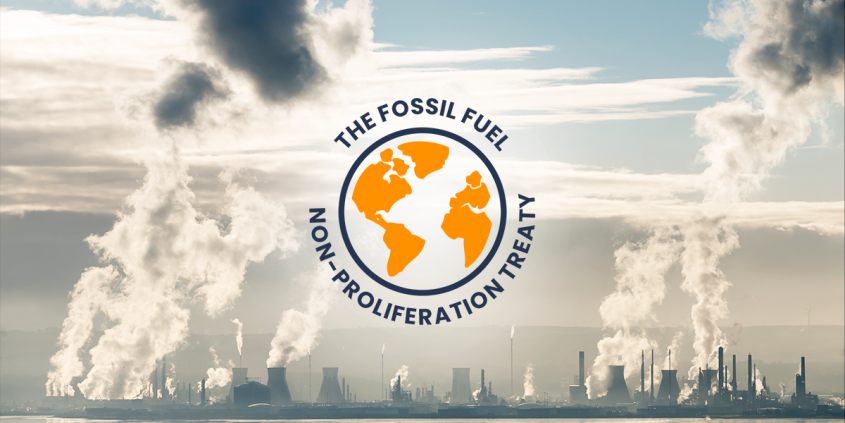
    Since COP28 the FFNPT now has 12 nation states signed up, in September the State of California became the largest economy to endorse the call (the 5th largest economy in the world and the largest sub-national economy)…… California Senate Majority Whip Senator Lena A Gonzalez (D – Long Beach), said: “It is essential that we commit once and for all to ending our reliance on fossil fuels. People around the world, especially low-income people of color, are suffering the adverse health impacts of fossil fuel pollution, from asthma to cancer. The recent devastating fires and hurricanes emphasize the urgency of taking action, to prevent further extreme weather changes. The science has been clear for decades—fossil fuels are responsible for the climate crisis. We can prevent further harm to our communities, and that is why I am proud that California has now been added to the growing list of governments endorsing the Fossil Fuel Non-Proliferation Treaty. It is time for our nation to be a part of the solution, to forge strong unity and commitment to phasing out the use of fossil fuels.

    France and Kenya formally launched the ‘Taskforce on International Taxation to Scale Up Development, Climate, and Nature Action‘ with Barbados, Antigua, Barbuda, and Spain signing on as members.

    CCI and CCL UK members will continue to educate and campaign for the solutions that will enable the world’s financial resources to be unlocked to ensure a liveable future in 2024.

  • Fiddling while Rhodes burns, we can remind politicians there is a fair and just way to decarbonise….

    Fiddling while Rhodes burns, we can remind politicians there is a fair and just way to decarbonise….

    Both Labour and Conservative politicians have been spooked by the narrow by-election win in Uxbridge which has been squarely attributed to campaigning on the proposed extension of the Ulez scheme. Few commentators pointed out that Manchester, Bristol, Birmingham and Bradford received a combined £230m in Government funding for their scrappage schemes, but London and the South East have received none.

    Press coverage has rightly pointed out that people should not be made poorer by ill thought out schemes which could be said to put the cart before the horse. There are politicians in both parties who are calling for unpopular policies to be dropped or postponed but neither party is denying the need to reach net zero.

    Sam Hall, director of the Conservative Environment Network, told The Observer that …“Environmental policies are an electoral asset when they are fair, affordable, and deliver for people and their communities. I’d warn Conservatives against listening to calls to ditch environmental commitments following the Uxbridge result. Insulating people’s homes, building more renewables, and attracting investment into new clean industries are popular, bill-cutting and job-creating.” 

    A blog he wrote for CEN points out thatThe Conservatives secured a victory against the odds by focusing the campaign on ULEZ expansion. They effectively pulled off a protest vote against an unpopular mayor instead of the usual dynamic of voters protesting the government. This strategy won’t work at a general election, when the party will be asking for a fifth term in government. Senior Conservatives must resist calls to ditch conservative environmental policies. (Over 150 MPs and Peers have signed up to the CEN).

    What the by-election shows is that policies which create financial hardship won’t work and in fact will be as counter productive as the tax imposed in France which led to the Gilet Jaunes revolt. Climate Income along with grants or loans based on future carbon dividend payments would go a long way to achieving the decarbonisation of the economy without penalising most people (as outlined in our report published last October). 

    Whilst not asking directly for Climate Income the Times editorial today puts the case for a Carbon Tax…..The message from policymakers must be that mitigating climate change can best be tackled through the continual innovations that are characteristic of market economies. And that doing so, using the price mechanism to encourage new technologies, is practical. It is widely understood that a carbon tax would be highly effective in persuading consumers and businesses to switch their energy consumption and behaviour. This would need to apply to carbon consumption and not only production, lest richer countries merely outsource their production to poorer economies. Revenues from a carbon tax could be used to subsidise renewable sources of energy and thereby encourage their wide adoption.

    Update 25/7/23

    Today Lord Deben (outgoing Chair of the CCC) has asked that parties build a cross party consensus on tackling climate change and getting to net zero, based on the recommendation of Chris Skidmore’s UK Net Zero Review. ….“If I were leader of the Labour party at this moment, I know exactly what I’d do,” said Deben. “I would say to the current government: ‘Here is Mr Skidmore’s report, he is a Conservative ex-minister, he was asked to do this report to show how best to deliver net zero by Liz Truss. Now we will accept, if you put it forward, we will do the following basic things [acting on the report’s recommendations]. We will do that. We won’t oppose it. You put them forward, we’ll back it.’” ………..There are those who don’t really take onboard the urgency of climate change, and they are in all political parties.”

    Let’s remind our politicians that there is not only no justification for dropping commitments to net zero while Rhodes burns and people die, but also no need!

     Tomorrow’s national meeting will be dedicated to this action

  • A message of hope from Citizen Climate International….

    A message of hope from Citizen Climate International….

    The outcome of COP 27 in Sharm El Sheikh treated the consequences – loss & damage, but not the cause – fossil fuels.  It was a huge victory to get loss and damage funding. This is to be celebrated.

    We cannot rest yet. There is no mention of oil and gas in the COP 27 outcome. The math is simple: more fossil fuels burned means more adaptation and loss and damage costs. This victory is unbalanced.  Anything that is unbalanced is doomed.

    We have hope because it’s not the COP sessions that change the world, it’s the actual work that goes on after governments have made those promises.  We have hope because we have been working behind the scenes and monitoring progress at the G7, G20, the United Nations, the World Bank and the IMF for several years now. We have hope because our volunteers are doing fantastic work around the world. We have hope because we know that the tracks have been laid for a resilient and equitable future and the train is about to leave the station. Consequently, we have hope because we know that the transformation of the economy will not be linear.  

    Change is coming. Find out how you can help and spread hope.

    Hope

     And an added thought for fun. We need to name if we are to tame it:

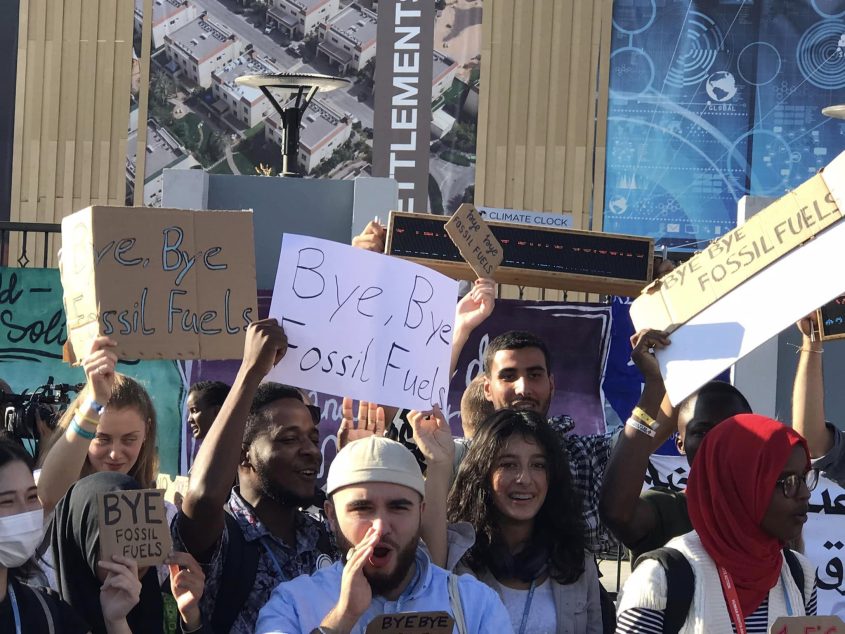
    Bye bye fossil fuels

  • Members of the European Parliament called for a European Fossil Fuel Non-Proliferation Treaty today.

    Members of the European Parliament called for a European Fossil Fuel Non-Proliferation Treaty today.

    In an amendment to the European Parliament Resolution on COP27  today EU members of Parliamentarians Call for a Fossil Fuel Free Future asked European states to work on developing a Fossil Fuel Non-Proliferation Treaty. They are calling for European states to:

     End expansion of new fossil fuels projects

     Phase out current production in line with 1.5ºC

      Enable a global just transition for every worker, community & country.

    and:

    “phase out fossil fuels as soon as possible”

    “halt all new investments in fossil fuel extraction”

    “end fossil fuel subsidies”

    Parliamentarians Call for a Fossil Free Future is a global network of close to 500 legislators from every continent (including the UK) who have called for “new international commitments and treaties, complementing the Paris Agreement, to address the urgency of a swift and just transition away from fossil fuel energy”

    Marie Toussaint, French Member of the European Parliament said….

    “It was absolutely crucial, ahead of the COP27, to remind European leaders that they cannot use the ongoing energy crisis as an excuse to deepen our dependency on fossil fuels. The call made today by the European Parliament to adopt a Fossil Fuel Non-Proliferation Treaty and phase out all direct and indirect fossil fuel subsidies by 2025 must now be heard by the European Commission and Member States. The EU must also acknowledge its climate debt, and the fact it has been a major polluter, responsible for greenhouse gas emissions over centuries. We have to find ways, within this non proliferation treaty, to ensure justice at global level for those who won’t earn the money they could through fossil fuel extraction.”

    Risa Honiveros, Senator of the Philippines and initiator of the Parliamentarians’ Call for a Fossil Fuel Free Future , stated

    “In recent months, parliamentarians on every continent have called for new international commitments and treaties to address the urgency of a swift and just transition away from fossil fuel energy. It is great to see this gaining momentum with the proposed Fossil Fuel Non-Proliferation Treaty which has now been called for by the President of Vanuatu, the President of Timor-Leste, the Vatican and now the European Parliament.”

    The main European Parliament resolution on COP27 also stated that it …

    Welcomes the fact that several EU trading partners have introduced carbon trading or other carbon pricing mechanisms and invites the Commission to further promote this and similar policies on the global scale; looks forward to a speedy agreement with the Council on the proposal for a socially just EU carbon border adjustment mechanism that includes an effective carbon leakage mechanism and to its effect of pushing a global carbon price, which will contribute to reducing global carbon emissions and to the achievement of the Paris Agreement goals;

    It also acknowledged the need for Loss and Damage finance….

    Welcomes the fact that the Glasgow Climate Pact underlines the importance of adaptation and the need to scale up action to enhance adaptive capacity, strengthen resilience and reduce vulnerability to climate change; notes in this regard that 47 countries submitted Adaptation Communications or National Adaptation Plans in the last year, and expects other countries to submit their Communications in line with the Paris Agreement; welcomes the creation of a new Glasgow Dialogue on Loss and Damage which should focus on funding arrangements to avert, minimise and address loss and damage associated with the adverse impacts of climate change;

    Citizens’ Climate International has welcomed the Fossil Fuel Non-Proliferation Treaty initiative which was launched on September 2020 and has been working with them since 2021.

  • The IMF says that the world needs to mitigate climate change now using a form of Climate Income, the cost of procrastination will only get higher…

    The IMF says that the world needs to mitigate climate change now using a form of Climate Income, the cost of procrastination will only get higher…

    A Guardian report on the 5th October examines the predictions of a chapter in the current IMF half yearly World Economic Outlook report. It  has a chapter titled Near-Term Macroeconomic Impact of Decarbonization Policies. The chapter models the cost of delaying the tackling of climate change until ‘conditions are right’ and current global inflation has lowered; an IMF blog about it is titled.. ‘Further Delaying Climate Policies Will Hurt Economic Growth…The transition to a greener future has a price—but the longer countries wait to make the shift, the larger the costs’. 

    The blog argues that concerns about current cost have been perceived to be more real than the nebulous future threat of climate change, causing decades long procrastination …’despite overwhelming evidence that any short-term costs will be dwarfed by the long-term benefits (with respect to output, financial stability, health) of arresting climate change (October 2020 World Economic Outlook; IPCC 2022).  

    The current crisis has heightened the fear that climate mitigation would just raise inflation further and led to the claim that we need to double down on fossil fuels for energy security (as in the UK). Concurrently a Global Energy Monitor report states that…

    New oil and gas development in the North Sea could produce up to 984 megatonnes of CO2 equivalent and contribute to the United Kingdom exceeding its carbon budget for 2023-2037 by a factor of two.

    The IMF’s modelling uses the revenue from gradually rising greenhouse gas taxes returned in part to households to drive the transition….

    To assess the short-term impact of transitioning to renewables, we developed a model that splits countries into four regions—China, the euro area, the United States, and a block representing the rest of the world. We assume that each region introduces budget-neutral policies that include greenhouse gas taxes, which are increased gradually to achieve a 25 percent reduction in emissions by 2030, combined with transfers to households, subsidies to low-emitting technologies, and labor tax cuts.

    It argues that the policy, if started now would have a modest decline in GDP and rise in inflation, slowing global economic growth by 0.15 to 0.25% and rising inflation by 0.1 to 0.45; but if delayed until 2027 with the rationale of waiting until inflation is down the effect on the global economy would be worse….

    Is it reasonable to wait—as some have proposed—until inflation is down before implementing climate mitigation policies? We ran a scenario delaying implementation until 2027 that still achieves the same reduction in cumulative emissions in the long term. The delayed package is phased in more rapidly and requires a higher greenhouse gas tax, since a steeper decline in emissions is necessary to offset the accumulation of emissions from 2023 to 2026.

    The results are striking. Even in the most favorable circumstances when monetary policy is credible and the transition to decarbonized electricity is rapid, the output-inflation trade-off would rise significantly; GDP would have to drop by 1.5 percent below baseline over four years to drive inflation back to target. Delay beyond 2027 would require an even more rushed transition in which inflation can be contained only at significant cost to real GDP. The longer we wait, the worse the trade-off.

    The take home message? ….if the right measures are implemented immediately and phased in gradually over the next eight years, the costs will remain manageable and are dwarfed by the innumerable long-term costs of inaction.

    .

  • UN General Assembly to discuss a just solution to Loss and Damage reparations.

    UN General Assembly to discuss a just solution to Loss and Damage reparations.

    Worldwide adverse weather events this summer have reinforced the moral imperative of Loss and Damage funding, in particular the damage caused by flooding in Pakistan, a nation which contributes less than 1% of worldwide greenhouse gas emissions.

    Last year there were several papers which argued for the solution of a global Climate Income policy to level the playing field between those who have historically benefited from fossil fuels and the global south. Oxfam is also interested in the concept. On Monday the 19th September the Guardian reported that a discussion paper has been prepared for the UN General Assembly meeting this week to ask for a ‘climate related and justice-based global tax’, possibly raised by a global carbon tax.

    Antigua and Barbuda have also submitted a discussion paper to the Assembly, warning that increasing sea and air temperatures in the Caribbean could create a superstorm within years that would wreak £7.9bn of damage in the island nation alone, six times its annual GDP. Walton Webson, Antigua and Barbuda’s ambassador to the UN and chair of the Alliance of Small Island States, said: “[We] deserve to live without the looming fear of debt and destruction. Our islands are bearing the heaviest burden of a crisis we did not cause, and the urgent establishment of a dedicated loss and damage response fund is key to sustainable recovery. We are experiencing climate impacts that become more and more extreme with each passing year.”

    Here’s hoping that the discussions will be productive; at the very least that an agreed framework for the delivery of Loss and Damage funding can be agreed at COP27, if not sooner, and ideally that the case for a socially just global carbon price will be heard and agreed!

  • Three former UNFCCC Executive Secretaries speak out.

    Three former UNFCCC Executive Secretaries speak out.

    On the 1st June three former UN climate chiefs, Christian Figueres (2010-16), Yvo de Beor (2006-10) and Michael Zammit Cutajar (1991-2002) wrote a joint article in the Guardian. They state that in February the world’s governments endorsed the IPPC report on Impacts, Adaptation and Vulnerability and thus the statement that…

    “The cumulative scientific evidence is unequivocal: Climate change is a threat to human wellbeing and planetary health…. Any further delay in concerted anticipatory global action on adaptation and mitigation will miss a brief and rapidly closing window of opportunity to secure a liveable and sustainable future for all.” 

    Despite this the trajectory of current worldwide climate policies would lead to a temperature rise of between 2.7C and a catastrophic 3.6C above pre-industrial levels. Governments can’t act as if other crises such as health, poverty and security can be tackled whilst ignoring the climate crisis, they are interlinked. Perhaps, they argue… 

    If science has not persuaded most governments to act, perhaps economics will. The IPCC provides clear evidence that societies will be more prosperous in a world where climate change is constrained, than in one left to burn. In the energy sector, evidence of the zero-carbon transition is all around us. Wind and solar generation shows compound growth of about 20% a year and is cheaper almost everywhere than the alternatives. Electric car sales doubled between 2020 and 2021.

    Unless one is invested in fossil fuels, there is now no reason not to take the clean energy path. Many corporate actors understand the need for early action on this front. But governments still need to incentivise the transition. The evolving Just Energy Transition packages may yet offer an investment pathway that can accelerate deployment in emerging and developing countries. Corporate action towards other targets such as reduction of methane emissions, also needs to be encouraged.

    Carbon pricing, we might add, would reinforce the argument for decarbonisation if it applied in a way that enables forward planning and enhances the economic well being of the majority of people, as with Climate Income.

  • Growing interest in the merits of carbon pricing in general and Climate Income in particular as the old arguments against it are losing ground….

    Growing interest in the merits of carbon pricing in general and Climate Income in particular as the old arguments against it are losing ground….

    It seems appropriate to be writing about a blog by an Oxfam researcher on this Jubilee weekend as the biblical purpose of Jubilee years was to release the indebted and restore their land to them. Climate change is a symptom of global economic and social injustice. In the debate about solutions carbon pricing is often criticised as a regressive and ineffectual policy favoured by those who want to keep the economic status quo – of course supporters of Climate Income know better! 

    James Morrissey, Senior Researcher at  Oxfam US recently wrote a blog titled – The best answer to climate change – or a regressive policy set to fail? A guide to the arguments over carbon pricing.  Morrissey has highlighted the issues about current carbon pricing policies which are also acknowledged by proponents of Climate Income…….

     IT’S CLEAR THAT CURRENT CARBON PRICES ARE TOO LOW

    Before we get to the arguments about whether carbon pricing can work, it’s essential to point out that carbon prices are currently inadequate to address climate change. In the vast majority of cases, prices are too low, and not applied to enough of the economy to drive decarbonisation at the rate necessary. The graph below shows how prices are generally below $50 per tonne of CO2 (they need to be closer to $100/tCO2) and only cover 15% of the global economy (they need to be at 100%). Despite these problems, it’s notable that carbon pricing is seeing increasing uptake over time – with more and more countries adopting prices and more of the global economy under a price.

     CARBON PRICING DOES NOT AFFECT EMISSIONS

    First is the argument that placing a price on carbon does not affect emissions. The empirical literature doesn’t support this claim. Numerous empirical studies of carbon pricing, using a variety of methods, demonstrate that carbon pricing has reduced emissions. There is some question over whether the emissions reductions have been large enough, but this really comes down to what you consider “large” and what sort of reductions might be expected at what prices. In general reductions in emissions have been small, but significant, especially considering the low prices in place.

    IT WON’T BE ENOUGH BY ITSELF TO TACKLE CLIMATE CHANGE

    The second argument against carbon pricing’s effectiveness is that alone, it is inadequate to tackle climate change, because consumers don’t behave like economists assume: as rational cost minimisers. For example, people don’t just buy the cheapest car for their needs; they buy cars based on ideas of status and brand loyalty, among others. This is true and uncontroversial, we need more than price signals to move consumers. However, this argument is also something of a straw doll: most of the literature on carbon pricing acknowledges that carbon pricing will need to be complemented with other policies if it is to be effective in averting climate catastrophe. To this end, advocates of a carbon price who suggest it’s the only policy we need should be viewed with scepticism. 

    Note that CCI doesn’t call for Climate Income to be a stand alone policy and it has not been implemented as such in the countries like Canada which have adopted it thus far.

    IT WILL HURT THE POOREST PEOPLE WHEREVER IT’S IMPLEMENTED

    A big concern around carbon pricing is that increasing the cost of energy derived from fossil fuels will drive regressive impacts.

    Since energy is central to the functioning of the global economy, and we currently generate around 83% of primary energy from fossil fuels, a carbon price will make almost all goods in the economy more expensive. Because low-income groups tend to spend a greater portion of their income on energy-intensive goods, a carbon price will have a disproportionately large negative impact on their well-being compared to wealthy households – making the policy notably regressive.

    However, a huge advantage of carbon pricing is that the price also generates revenues. Importantly, wealthy groups tend to consume more energy-intensive goods than low-income groups (even though they spend a smaller proportion of their income on these goods). What this means is that, despite regressive cost-side impacts, you can use the revenues to make carbon pricing substantially progressive. There are a number of ways to do this, but the simplest is to just return all the revenues to everyone, equally (ie on a per capita basis). Doing so would result in low-income populations receiving more than they pay in increased prices, while the opposite would be true for wealthy populations. (My emphasis).

    Morrisey does point out that the policy has to overcome public antipathy to the concept of increasing taxation, which also makes the policy easier for opponents to criticise than less visible regulations and subsidies. He argues, however, that these alternative policies also encounter opposition and are no more capable of solving the problem of climate change on their own than is carbon pricing. He concludes that if there is some momentum for carbon pricing NGOs should support it with the caveats that ….

    The revenues produced by carbon pricing must be used to effectively address all regressive impacts created by the price. Prices must either be set high enough to drive ambitious emissions reductions or, if prices are to start low and increase over time to overcome political opposition, the process for increasing prices needs to be automatic and insulated from political push-back. (My emphasis).

    Carbon pricing can be effective but, by itself, it will not be enough to address climate change. Any carbon price will require complementary policies. The most important will relate to addressing other market failures (such as the need for public investment in research and development) and addressing network problems (such as supporting electric vehicle charging infrastructure), but will also include policies for numerous markets where price signals are insufficient to shift behaviour.  

    Along with the recent reports in Nature and by the Autonomy think tank, this blog and the related Oxfam primer on carbon pricing show growing support for the concept that a Climate Income policy will not only alleviate climate change but also the gross inequalities impeding sustainable development in the Global South. 

    Finally I must mention a very apposite blog by fellow Citizens’ Climate Europe member Brigitte Vangerven about the idea that protecting the climate requires sacrifice. …

    Pricing pollution will make polluting products more expensive than clean products. The price difference will make people and companies choose the clean alternatives. It will greatly accelerate decarbonisation and the widespread deployment of clean alternatives. The proceeds are used to support the people in the energy transition.

    Everybody receives a Climate Income. Most households, especially low and mid incomes are better off or break even through this policy.

    It is simple, transparent, just and effective, and I hope that for many people it will dispel their reservations.

    This makes it possible to implement an ambitious climate policy, that will receive broad support from the people. There is no longer a conflict.