Tag: carbon fee and dividend

  • What lessons should be learnt from the fuel crisis?

    What lessons should be learnt from the fuel crisis?

    The current fuel crisis is creating problems for governments in the UK and Europe. The conundrum is based on the combination of underlying energy costs, environmental taxation, poverty alleviation and climate policy all overlapping in a non-aligned mix. Finding a solution that keeps advocates of each policy and it’s raison d’etre supportive is challenging. Here we look at how Climate Income can be the sword that cuts the Gordian knot.

    First let’s examine some of the main policy elements at play …

    The political pressure is coming from the financial pain faced by families with rapidly rising fuel bills where energy use has already been reduced to a minimum with the bottom 50% of the population using energy consistent with a 1.5ºC pathway! Energy costs impact everyone, but low and middle income groups spend a higher proportion of their income on transport and household energy needs than the better paid.

    The main carbon pricing mechanism in the EU and UK is the Emissions Trading Scheme (ETS). The UK left the EU ETS and established an independent ETS which began in January 2021. ETS is considered to be a revenue raising mechanism (tax) as well as a carbon pricing tool. The revenue should be used for appropriate purposes but it is not used as a dividend to the householder to mitigate and thus enable a predictably rising carbon fee as with Climate Income. 

    The UK government has also historically put the burden of paying for the move to renewable electricity onto electricity bills, making this fuel, though increasingly greener than gas, considerably more expensive and adding about £200 to fuel bills. Environmental levies include the Renewable Obligation and the Contracts for Difference, which incentive and support renewable electricity generation, the Feed in Tariff to support solar panel installations, and the Energy Company Obligation, which has provided energy efficiency measures to more than two million households. EPC certificates have also compounded the injustice by rewarding the gas heating home owner over the electric heating owner!

    The government does need to mitigate the effect of rising fuel costs this winter. It refused to implement a post Brexit VAT cut on fuel, claimed to be too much of a ‘blunt instrument’ – although is it fair to just help the very poorest households and not the struggling middle classes? Even if implemented however, 5% of the projected £700 bill rise amounts to a mere £35 and the saving on the average dual fuel bill is estimated to be around £89. Removing the VAT may be a fair and wise move because of what it represents politically but it is not a solution to the underlying problems in our current carbon pricing policies.

    The suggested Warm Home Discount expansion will only target the very poorest and there are logistical problems in applying for the WHD –  meanwhile a targeted home upgrade grant for fuel-poor homes had been halved in the autumn budget! 

    A windfall tax as proposed by the opposition parties looks like an easy solution but it would be hard to implement and it would only cover the oil and gas we produce ourselves (only 40% of our gas is domestic and we imported 20 million tonnes of oil in 2020). It has also been argued that the perceived punitive nature of the tax could be used as a reason for reducing investment in carbon capture and more renewables. Like the other solutions it would be short term and not contribute much to the real solution – more renewables and the price of fossil fuels reliably reflecting their true price to society.

    The carbon price in the ETS (Emissions Trading Scheme) which is the main carbon pricing mechanism in the UK and EU is determined by the market, this led to it being too low to be effective during the recession and now so high that ‘Cost Containment Mechanisms’ has been and may be used to mitigate the immediate effects on industry. Cost Containment not only negates the claim that ETS is market driven rather than part of a command economy but also negates the effectiveness of ETS in encouraging decarbonisation. Under Climate Income Schemes the carbon price is designed to rise but in a predictable way which businesses can plan for.

    The Government had proposed last year that the ETS scheme would be extended to cover the other ⅔ of emissions including building and transport. This was similar to the proposed EU Building and Transport ETS which is meeting resistance in the countries historically dependent on coal (and colder!) such as Poland. The UK proposal was watered down (2nd item) through fear ‘it could trigger a political storm’ in November 2021 and it is no longer described as being about to be ‘radically’ expanded. (Marine and waste incineration emissions are still being considered with the possibility of agricultural emissions in the future).

    The Government had said it wouldn’t have a universal carbon fee back in February because it would raise the price of cheese and meat even though a universal carbon price would send a clear message on all products and eradicate most of the disincentives to electric heating and vehicles. In July the government seemed to be considering CI, which would of course offset the rising price of carbon dependent products while householders and manufacturers adjust, thus mitigating the problem of rising cheese and meat prices! In November at the debate prompted by the Zero C petition its briefing (current carbon charges 2nd para) referred not to the July proposals but back to the February statement on carbon pricing. That debate also took place when it had been decided to scale back the ETS extension but the briefing and government response doesn’t reflect that decision.  Please see Further information on the government response to the Zero C petition for a link to the government response to the petition.

    The government decided against a universal carbon price because of the costs to the householder. The preferred carbon pricing policies however are proving equally unpopular – especially the tariffs on electricity bills to pay for renewables and the VAT on fuel even though the low rate could be considered to be a hidden fossil fuel subsidy like frozen fuel duty. ETS is less visible at the moment – but would have been about to become extremely visible if the government hadn’t scrapped the extension to buildings and transport because of its likely unpopularity! As it is the government uses Cost Containment, whenever the carbon price seems to get too high for comfort – thus rendering ETS far less effective. 

    ETS  in its current form (without CI) can’t be effective without creating further problems for consumers, unpredictability for businesses and future short term cutting of the carbon price every time there is a fuel market crisis.

    Climate Income would mitigate the costs of rising fuel prices without the need to cut the carbon price (and thus reduce incentives to decarbonise) every time the market spikes. The predictably rising price would also allow businesses and households to plan ahead to decarbonise, especially if future carbon dividend payments could be offered as loans for retrofitting and industries could, among other tactics, have fees offset against carbon capture, usage and storage.

    It is unlikely that this current fuel price crisis is a one off – we need a carbon pricing policy which can weather this and future storms without having to be watered down each time. Climate Income is the answer!

    Catherine Dawson and James Collis

  • Another fantastic plug for Climate Income from one of our members!

    Another fantastic plug for Climate Income from one of our members!

    Last year Rob Paton and Citizens:MK succeeded in gaining unaminous support for Climate Income from Milton Keynes Council. Rob then went on to write about the campaign in the national Quaker magazine, The Friend.

    Rob has now succeeded in getting a full article published which he has given me permission to reproduce here. I attended a Zoom meeting organised by Rob for a local climate group and was able to see the issues people have with the concept of CI (which it is easy to lose sight of when you have been immersed in the campaign for three years!) which Rob describes – his approach has lessons for us all! Note that ‘testimony’ refers to the Quaker values of equality, peace, truth, justice and simplicity.

    A year of climate campaigning: What Rob Paton learned

    6 Jan 2022 | by Rob Paton

    ‘It’s often the testimony that does it.’

    ‘The alternative is to look for common ground.’ | Photo: by Li-An Lim on Unsplash

    I had been a ‘greenie’ for years, but not heard about Carbon Fee & Dividend (also known as Climate Income) until a Friend told me about it a couple of years ago. I visited the website of Citizens Climate Lobby UK – and wow! So simple. An arrangement that would turbo-charge all other carbon reduction policies, or render them superfluous. A way to make higher carbon prices not just acceptable, but popular. Like every good convert I set off with missionary zeal. At which point things became… interesting.

    Yes, sometimes people ‘got it’ quite quickly. What really struck me, though, was how often people didn’t (or couldn’t?) ‘get it’. For example, when another Friend passed on something I had written to her daughter, active in XR, the daughter was enthused. She shared it in her circle… to no avail whatsoever! Even professional campaigners who knew their economics seemed to ignore carbon pricing. It was the elephant in the room. As for Climate Income, well, on a good day it would be damned with faint praise. I asked several: ‘What should we be asking for at COP26? Wouldn’t it be great if we had one simple, specific “ask” that everyone could get behind, like “Drop the Debt”?’ Everyone liked the question, but their answers were either lengthy, or pithy but plaintive (‘just keep your promises’). No one expressed much interest in Climate Income. Gradually I came to realise – or re-learn – some important lessons.

    If people are not open, or ready, then I was probably wasting my time as well as theirs. It wasn’t just that trying to persuade people seldom helped. Things went better when people were stimulated to find out for themselves. For example, our local Citizens:mk climate campaign asked the leaders of the three main parties on Milton Keynes Council to consider supporting the idea. Initially, all were wary, but they agreed to check it out. When it came to the debate, genuinely enthusiastic speeches in support came from all sides, and the motion passed unanimously. Likewise, when we asked the local Anglican bishop to consider the idea and how he might use his position to promote it, he was sympathetically cautious: he would meet with us but the issues were complicated and he needed to find out more. But then before we knew it he was on board, asking a pointed question in the House of Lords!

    That illustrated another important point: it’s often the testimony that does it. A remarkable teenager in our campaign group had recounted being confronted with the harsh realities of what climate change would mean for her and her generation. She spoke simply, clearly and from the heart. It was moving and memorable in a way that bald facts and reasoning are not.

    I also noticed how widespread adversarial thinking is among green campaigners. The default stance is to campaign against things – and people. When I asked what was needed for a consensus in support of cutting out carbon, the answer was, essentially, for lots more people to care like we do. We have seen the light; we must convert others to our way of thinking. Worse still, I, too, slipped into adversarial thinking. At one point I was seeing the Treasury as a bogeyman. They didn’t like hypothecated taxes and would be bound to resist this idea. But one of the beauties of the arrangement is that it is revenue neutral – it is a transfer rather than a tax. It doesn’t add to government spending. Better still, by turbo-charging the switch to renewables, it reduces the need to subsidise green technologies which are a drain on the exchequer. It also gives a further basis for cutting out those subsidies still being paid to fossil fuel companies.

    The alternative is to look for common ground. Climate income provides such a common ground, securing support for long-term carbon reduction. In Canada, where this ‘fee & dividend’ approach has been adopted, governors of some provinces with high levels of fossil fuel activity thought they might roll back the legislation… until they found how popular it had become with voters.

    What really took me by surprise, though, was the way climate lobbying led into a deep consideration of truth, and our compromised capacity as humans to face it. I joined a Zoom course on how to engage with political leaders on climate issues. At one point the young course leader said words to this effect: ‘Look, we have enough information in this group to plunge half the country into a state of deep clinical depression. It’s just as well that many people are “in denial” – the health services would be overwhelmed if everyone suddenly woke up to what the disaster will mean for them. That wouldn’t do the planet any good.’

    Instead he introduced us to ways of meeting our leaders where they are, helping them recognise their own ambivalences and uncertainties, and helping them find their own safe next steps. This doesn’t mean that we should only engage with the political system in therapeutic mode – listening supportively, asking gentle questions, building trust. As we Quakers know, discernment requires threshing as part of the process. So explanations, facts, clarifications and analysis all have their place, collegially conducted, among those seeking further understanding. Here too I learned lessons.

    I had to treasure the disagreements and challenges I encountered. They were informative about what I had not explained. For example, if someone said, ‘Won’t people just use all their climate income paying for the higher price of fuels?’ I had to be ready to agree: yes, some would, to begin with. It would be their choice. Only then would it be worth my explaining how the steadily-increasing price of carbon (and climate income) would play out over the medium term: the higher the price the more incentive everyone has to switch to green alternatives. Instead of it being against our economic interests to ‘do the right thing’, we become (even) better off by ‘doing the right thing’.

    Another example: one councillor said we shouldn’t increase the price of fossil fuels until the cost of green alternatives had fallen to the level of current fuel prices, otherwise the poorest would be hard hit. This overlooks how climate income protects the least well off. But I sensed something else was confused in this observation, and it took me time to pin it down. In fact, the price of the alternatives will not fall until they are adopted on a large scale. So we need to make the green alternatives cheaper than fossil fuels in order to bring about large scale adoption. This is precisely what steadily increasing the price of carbon makes happen.

    I also came to appreciate the uncertainty in our predicament: no one knows what will be an achievable and sustainable mix of green fuels. The technologies are still a big cloud of unknowing. Some say heat pumps. Some believe hydrogen is the answer. According to others, the future is electric. Some think that Carbon Capture and Storage is crucial. Each of these has its advocates – and, happily, investors willing to back them.

    Finally I have had further lessons in patience and trust. Having been through panics about nuclear war, the scares about the millennium bug, and the fear that oil was running out, it is a little easier to hold my nerve. Yes, I do know about tipping points. The dangers are very, very real. But so are the emerging opportunities with many signs that the tide has turned. And so we choose life, doing what we can where we are.

  • Happy, if slightly belated New Year to all our members!

    Happy, if slightly belated New Year to all our members!

    As the fuel price crisis is on everyone’s minds this January member Darrin Charlesworth tops the Letters page in today’s Guardian Online………..

    John Vidal’s list (It’s the great green reset: 10 things Britain can do now to save the planet, 3 January) seems very achievable, but I would like to add one more to accelerate change: climate income.

    First, introduce a carbon tax across all industries to price emissions into the market, closing a huge economic loophole. By gradually increasing the tax, we not only incentivise lower emissions on the supply side, but we also drive demand for low-carbon alternatives.

    Second, redistribute the revenue equally to all citizens. This protects the most vulnerable consumers, who already have smaller carbon footprints, from fuel poverty. The wealthiest people with the biggest carbon footprints would see their costs rise, but for the majority, costs would be neutral.

    Third, introduce carbon border adjustments. This policy would prevent emissions being transferred offshore, but also protect many UK businesses, especially our vibrant small business community, from competitors in countries without a carbon tax. This policy would help drive many of the others at a time when we need real urgency.
    Darrin Charlesworth
    Citizens’ Climate Lobby UK

    Congratulations Darrin for succinctly and elegantly summarising how Climate Income would enable the true price of carbon to be reached – thus making decarbonisation a no brainer without impoverishing everyone!

  • COP 25 and a future for an international carbon market

    COP 25 and a future for an international carbon market

    Under the 1992 United Nations Framework Convention on Climate Change (UNFCCC), most countries are treaty-bound to avoid “dangerous climate change”. Countries who signed and ratified the 2015 Paris Accord then had to produce nationally defined contributions (NDCs) to meet the decarbonisation targets.

    As the twenty-fifth annual UN Conference of the Parties (COP) begins in Madrid, attention has been focused on Article 6 of the Paris Accord and how this may shape global carbon markets.

    Article 6 of the Paris Accord lays out an opportunity to implement the NDCs through cooperation mechanisms. These mechanisms seek to assist the existing targets and raise the ambition of future targets and forms the legal framework to allow market-based solutions, with an option for a common, cross-border carbon market potentially also linked to existing schemes such as the EU emissions trading system (ETS). This could be de-centralised through bi-lateral cooperation or centralised through an international body designated by COP. And another sub-section in Article 6 leaves the door open for non-market-based approaches although this has yet to be defined. The best way to proceed and enact this Article is to be decided at this year’s COP.

    This is in response to the virtual collapse of the previous regime- the clean development mechanism (CDM). This was the world’s only global system for trading carbon which was designed to allow developed countries to achieve compliance through purchasing offsets from CDM projects in developing countries. This collapse was brought about by a myriad of factors coming together, such as the US’ refusal to ratify Kyoto; emerging economies classified as developing, such as China and India, meaning they have no emission reduction targets; and the recession and Eurozone crisis throughout Europe.

    Eighty-eight of the countries that have continued to commit to the Paris Accord, representing more than half of global emissions, have stated that they plan to use or are using carbon pricing as a tool.

    Now, the question is whether the tool will be fit-for-purpose and be all-encompassing. There is potential to create a sensible international carbon trading market that is fair for all countries- whether their economies are developing or developed. The simplest, transparent and most complete solution is the Climate Income from the Citizens’ Climate Lobby.

    The UK is a successful case-study in implementing a carbon price that has the desired effect. The carbon price floor (CPF) policy was initiated to support the ETS in 2013 and since then electricity generation using coal has decreased to almost zero. However, the CPF only covers electricity generation, which is not the largest sector of emissions, and the pound per tonne of carbon dioxide (£/tCO2) was frozen at £18/tCO2 in 2016. Although the CPF worked as designed it could be more ambitious by targeting all sectors equally; using  pound per tonne of carbon dioxide equivalent (£/tCO2e) to also capture methane emissions and other greenhouse gases; and not allowing a freeze on the price, instead investing more into the alternatives that mature or returning the revenue collected to the public, such as the Climate Income.

    Climate Income works by, through new legislation, charging the businesses that extract or import fossil fuels, according to the amount they burn (£/CO2e). Import fees are levied on products imported from countries without a price on carbon along with rebates to UK industries exporting to those countries, discouraging businesses from relocating where they can emit more greenhouse gases.

    So, a global carbon market that encourages participation across all countries, taxes the emitters at source, gives the revenue back to the citizens of the country from which the tax was collected, and accounts for importing or exporting sources of emissions sounds like the way forward and hopefully this will be discussed and realised at COP 25 with a commitment to implement this essential global carbon market.

  • The Myth that Carbon Taxes hurt the Poor

    The Myth that Carbon Taxes hurt the Poor

    Carbon taxes are a much discussed mechanism for using market mechanisms to incentivise a transition to a zero-carbon energy from fossil fuels, exploiting the innovation and flexibility that markets can provide.

    However, detractors cite potential economic harm to those on low and middle incomes as a reason to avoid such action. Many such detractors turn out to be straight-up fossil fuel shills with no care whatsoever for the poor but who will use any arguments that come to hand to deflect policy makers from adopting a robust carbon tax.

    A Carbon Fee and Dividend policy directly answers any such concerns, real or disingenuous, by turning carbon taxation into a progressive policy that actually redistributes wealth from the richest 20% to the poorest 40% while leaving the middle classes broadly unaffected.

    Carbon taxes win Nobel Prizes

    Carbon taxes have been found to be a highly effective and efficient way of driving the economy to adopt alternatives to fossil fuel energy. Notably, William Nordhaus of Yale University was been jointly awarded the 2018 Nobel Prize in Economic Sciences with Paul Romer for ‘integrating climate change into long-run macroeconomic analysis’.

    Nordhaus has proved prescient on the progress of CO2 emissions, writing in 1974, :

    I have performed a rough calculation of the atmospheric concentration of carbon dioxide… Assuming that 10% of the atmospheric carbon dioxide is absorbed annually (G. Skirrow), the concentration would be expected to rise from 340 ppm [parts per million] in 1970 to 487 ppm in 2030 – a 43% increase. Although this is below the fateful doubling of carbon dioxide concentration, it may well be too close for comfort.

    It turns out we are right on track to hit 487 ppm of carbon dioxide in 2030. In two papers (Nordhaus 1975, 1977), he laid the groundwork for what is now an entire field on the economics of climate change.

    Now, there is certainly valid criticism to be made at where Nordhaus and others would set carbon taxes to maximise global growth. Many believe that there is insufficient weight given to factors such as warming feedback and the fate of the poor global south and these are certainly issues of concern. Such concerns would lead to carbon taxes well above the $30/tCO2 that Nordhaus originally proposed. However, there is no doubt that Nordhaus has established carbon taxes as a powerful tool in how we re-shape the economy to prevent climate change.

    Clutching at straws and crocodile tears

    Of the various stages of climate change denial and resistance to action, one of the later symptoms is an unconvincing concern among opponents that imposing a carbon tax will hurt the poor.

    Such attacks coincidentally always seem to come from politicians and lobbying groups closely aligned with the fossil fuel industry and with a long history of denying the existence or risk of climate change in the first place. Such people rarely have a track record of championing high taxes or corporate regulation or social policy that could benefit the poor in other contexts so their concern here is somewhat uncharacteristic.

    But if we were to take their challenge seriously, do they have a point? Are carbon taxes bound to condemn the poor to further hardship?

    Well, unsurprisingly, it turns out the answer is no.

    Carbon Fee and Dividend is a progressive, redistributive policy

    The Carbon Fee and Dividend policy has 3 central features:

    1. Tax carbon on fossil fuels as they are sold into the economy
    2. Implement a border adjustment tax system to impose tariffs on imported goods that didn’t bear comparable carbon pricing
    3. Pay the revenues back to citizens as a flat per-head dividend

    Imposing a carbon fee and border adjustment tax does raise prices, especially for fossil fuel energy. According to a review of the policy (as proposed by CCL) by Wharton School Public Policy initiative:

    For the first year that a $15 per metric ton of CO2 carbon tax is implemented, the cost of gasoline would go up by 16 cents per gallon, natural gas by 19 cents per therm (a 7.4 percent increase), and electricity by 0.6 to 1.1 cents per kilowatt-hour (kWh), depending on whether its source is coal or natural gas.

    Seeing the whole picture

    So looking at this effect alone, you could be forgiven for imagining the poor suffering further under such a policy. But that’s before you apply a dividend. This is the secret sauce that turns the entire picture around, to the point that the poor become the main beneficiaries of the policy.

    According to a comprehensive study carried out by the International Institute for Applied Systems Analysis to model the effects of a carbon fee and dividend policy:

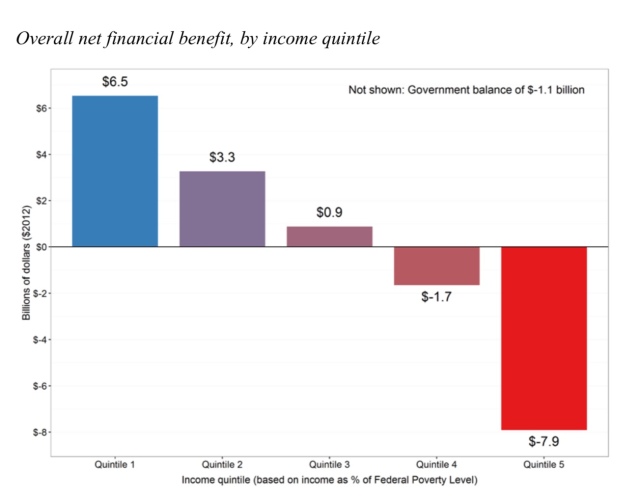
    Given these assumptions, the policy confers a net financial benefit on 54% of households nationwide (59% of individuals). The distributional effects are highly progressive. Ninety percent of households living below the Federal Poverty Level are benefited by the policy. The average net benefit in this group is $342 per household, equivalent to nearly 3% of pre-tax income. Overall, the primary distributional effect is to shift purchasing power from the top quintile to the bottom two quintiles of the income distribution

    This picture perhaps provides more instruction as to the motivation of rich, conservative fossil fuel lobbyists that oppose such a policy. Using the plight of the poor is nothing more that a disingenuous tactic designed to smear a progressive policy. For all those engaged in an honest debate, the facts are clear.

    Only the top 20% by income (those best placed to deal with it) experience a significant net cost from the Carbon Fee and Dividend, leaving the middle class broadly unaffected, while those on low incomes are net beneficiaries.

    A Carbon Fee and Dividend is therefore highly effective at mitigating entrenched inequality in society and gives the large majority of citizens a valuable stake in a fossil-fuel free future.

  • Show the Love!

    Show the Love!

    show the love badges
    Download badges and heartfelt climate conversations

    Valentine’s Day 2018, CCL UK is taking part in Show the Love, an initiative by the Climate Coalition, with our own version of the green hearts.

    There are plenty of ways for you to join in, not just to show the love for our climate and planet, but also to have a conversation with family, friend, colleague or MP about our workable solution, Carbon Fee and Dividend:

    Heartfelt Climate Conversation

    You can download a sheet with both badges and the following conversation points, so you can keep them handy on Feb 14th:

    • Are you concerned about climate change and air pollution?
    • Do you know the main causes? (Answer: carbon dioxide, and other gases and particulates from the burning of fossil fuels)
    • Did you know there’s a solution that will pay us for burning fewer fossil fuels?
      Individual action won’t work fast enough to combat climate change.
      Citizens’ Climate Lobby UK proposes a fee placed on fossil fuels when they enter the country, whether through import or extraction. This would encourage more investment into future clean energy available to everyone.
      The money raised by this fee would be divided equally between UK citizens, which means that those who use alternatives to fossil fuels would come out ahead.

      CCL UK members lobby our Government to adopt this Carbon Fee and Dividend.
      There’s more information on citizensclimatelobby.uk

    Have fun and let us know how you get on.

  • October Campaign – results!

    October Campaign – results!

    MP letter
    Scottish MP Stephen Gethins reply to CCLUKer Charlie Webb

    Our campaign to galvanize Parliament in advance of the recent UN climate negotiations (COP 23) in Bonn – which has just ended – has resulted in a surge of action and some splendid results.

    The numbers tell just a small part of the story. CCLUK members have been talking up our policy up and down the country, sharing it with friends and family, posting it (in many imaginative ways) on Facebook, generally spreading the word.

    How many conversations did you find yourself taking part in? One volunteer signed up 21 letter-writers. Only seven of them actually produced the letters…But that was 21 conversations that wouldn’t have happened otherwise.  Experience has shown what a difference that can make. ( I’ve had people come back to me after a year to say, “Ah! Now I get it!”) (more…)

  • Renewable power set to be cheaper by 2020

    Renewable power set to be cheaper by 2020


    Investment company, Goldman Sachs’ recent research forecasts renewable energy to be cheaper than other forms of power by 2020.

    Alberto Gandolfi, from Goldman Sachs Research said,

    What started as a decarbonisation process – thanks to better technology – is about to become a process driven by costs and the economics.

    This sounds like more proof that Carbon Fee and Dividend will work. CF&D would drive up the price of fossil fuel and their products and speed up the consumer switch to clean – and now cheaper – alternatives.

    It would also give investors confidence that divesting in fossil fuel and investing in the alternatives is the clever move.

    The resulting fall in carbon dioxide levels would be a big win for the climate and our planet.

    Which begs another question: why is the UK forging ahead with a new nuclear reactor when the cost of renewable power is falling and the technology is coming on in leaps and bounds?

    Written by Louisa Davison, 29 August 2017
    Views expressed here not necessarily shared by Citizens Climate Lobby.