In a new paper the IMF estimates
(more…)global subsidies for fossil fuel energy implied by the underpricing of supply and environmental costs at a staggering $5.2 trillion in 2017, or 6.5 percent of world GDP


That may sound like a stupid question, but when governments are failing to price carbon pollution at anywhere near the cost of the damage caused to society, it’s a question worth asking, though maybe it would be better to ask the reverse question: why aren’t we are pricing carbon? Why are we effectively subsidising fossil fuels?
(more…)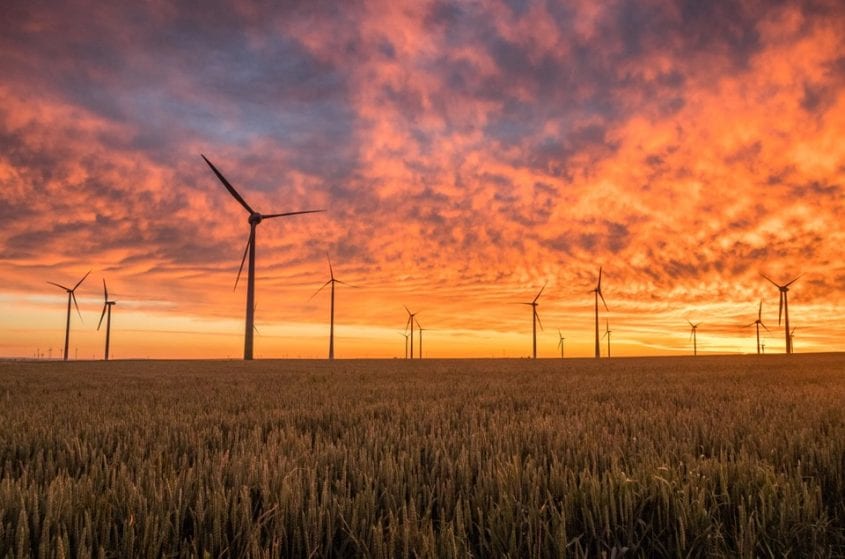
Wiltshire produces more solar-electricity than any other county in the UK but we’re joint 190th for wind energy. In fact, we produce about 6000 times more energy from the Sun than we do from the wind. That’s quite a contrast and we could do better.
Of course, many people find wind farms ugly and don’t want them spoiling the view. That’s a valid opinion but, personally, I think wind turbines are rather beautiful and I’d love to see some on the Wiltshire Downs—a stone circle for the 21st century in the county of Stonehenge and Avebury!
There are good reasons for expanding onshore wind farms. According to the UK government’s Department for Business, Energy and Industrial Strategy, the cheapest gas-generated energy is a third more expensive than onshore wind. Alternate low-carbon options such as offshore wind or nuclear power are even more expensive. Solar energy is the only technology that comes close to being as cheap as the wind!
Increasing the amount of clean energy we generate would make a big difference to climate change. Most activities that produce greenhouse gasses could be run on electricity so that, at a stroke, emissions would be drastically cut. There’d still be some troublesome gasses generated by flying and by agriculture but there are solutions to those too (as I’ll discuss in a later column). So, problem solved? Not quite!
There’s also the issue of intermittency—the facts that there’s no daylight at night and the wind doesn’t always blow. Solving this requires effective, large-scale storage of electricity and the world simply doesn’t produce enough batteries for this. We need another way forward.
One possibility is pumped-water storage in which water is pumped from a low reservoir to a higher one, when electricity is plentiful, and is then allowed to run down from the high reservoir to the low—generating electricity as it does so—when demand exceeds supply. In effect, it’s a giant rechargeable battery.
This is a well-tested solution which wastes little energy and has been used, on a small scale, for a hundred years. We just need to scale it up. That’s now happening. One scheme, at Coire Glas in the Scottish Highlands, will be able to store 30 GWh of electricity if approved. That’s about the same as a small nuclear power station generates in a day but this is dwarfed by the Fengning-2 plant in China which will have the capacity to store 4.6 TWh—enough to supply the entire UK continuously for 5 days.
That’s the kind of storage capacity we need to think about building in the UK too. It simply can’t be done using batteries because matching the Fengning-2 capacity would require 21 years-worth of the world’s entire rechargeable-battery manufacturing output.
The message here is that we know how to make (and store) enough affordable, clean energy to satisfy our needs and it could be done within 10-20 years. This change—in combination with electric vehicles, heat pumps and other ways of switching from fossil-fuels to electricity—could reduce emissions by 90%. We just need to get on with it.
First published in Marlborough.news
Photo credit: Karsten Würth
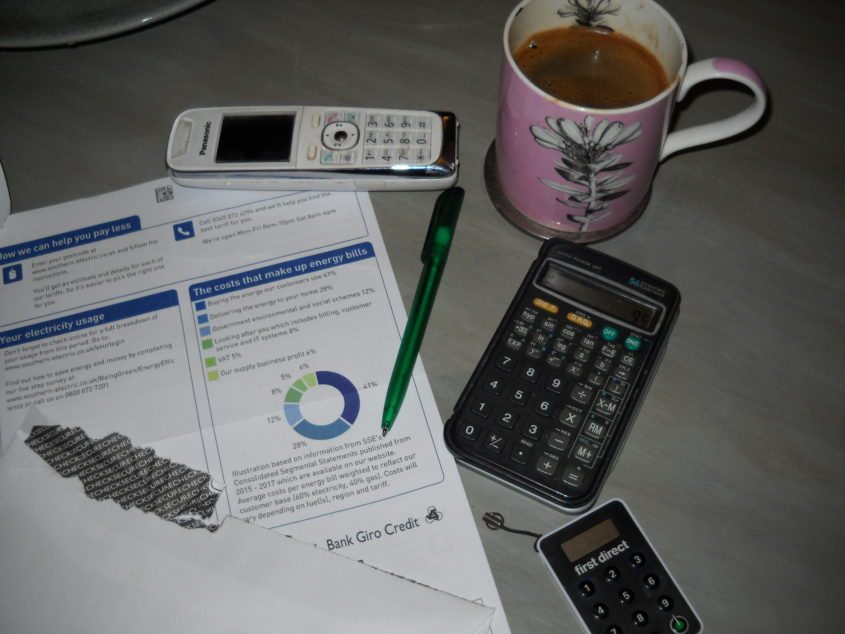
I was looking at my electricity bill the other day and I noticed how little of it was paying for actual energy. In fact only 41% of what SSE charged me went to
Buying the energy our customers use
It is mostly admin, distribution, profit and tax or quasi-tax (5% VAT and 12% government ‘schemes’). It made me wonder how much of the money I pay for electricity gets spent on fuel and how much on everything else. I chose the worst polluting fuel source from the point of view of climate change – coal. If all my electricity came from coal, how much of the 15.77p per kWh that SSE charges me is to pay for the coal needed? I give the calculation and my sources below*, it comes to a meagre 10% of the cost. That is not much more than the SSE profits of 6% and a lot less than the 17p going to government.
So when I buy electricity I am not buying the energy so much as the cost of converting the energy into electricity and delivering it to my home. Like when I buy a sculpture I am not really buying the marble but what people do with it.
Now having bought our electricity how expensive really is it? Let’s take a villain-of-the-piece for many green minded people – the tumble dryer. Imagine a single parent struggling with both time and money. Even if they efficiently hang out their washing and retrieve it without having to dodge showers, then it will still take, say, a quarter of an hour to process the equivalent of one load in a tumble dryer. And even if they are on a salary as low as the National Minimum Wage (£7.83 per hour from 1.4.18) their cost in terms of time is roughly £2. So that is a minimum for the cost of the clothes line. If they already have a tumble dryer, say it came with the flat they are renting, what is the cost of using it instead? This helpful website gives the cost and carbon footprint of such things. It comes to about 40p. So should they lose the £2’s worth of their stretched time or spend 40p? The low price of electricity massively incentivises them to use the tumble dryer.

In terms of the overall economy, we can consider the price of the actual energy here, i.e. the coal needed to dry the clothes. That comes to only 10% of the 40p, or 4p. So it is 4p against £2. That is why we rely on energy so much, it is so amazingly cheap. It is one reason why global CO2 emissions are relentlessly rising, as we find new ways and people to use energy we find that the cost of the fuel is often a minor factor. Imagine if we decided to increase the cost of the coal to the level required to make the washing line equivalent to the tumble dryer? We’d need to add £1.60 to the cost of the coal which is a 4000% increase from the 4p.
I found another example when I looked at my water bill. Thames Water charge me £2.08 to supply me with 1m3 of water and then clean it up again after I’ve used it. Surely that is a tiny cost compared against the cost of heating up the water to bath or shower temperature? I did a quick calculation and actually, No, the costs are only another £2, about the same.
So the cost of the energy seems to be a problem for addressing climate change. Is it also an opportunity? It certainly is in this respect, the change from fossil fuels to other energy sources may cause some energy price increases, which is a reason why politicians are worried about implementing the severe changes required. But a significant increase in energy price leads to only a small increase in the price of goods and services. Even if the 4p coal cost imbedded in the tumble dryer example was doubled to 8p, it would still be small compared against the 40p electricity cost and extremely small compared against the £2 in labour.
Let’s see how this impacts on coal because it is such a large contributor to CO2 emissions. The problem is that nearly all the energy in coal is released by combining carbon atoms with oxygen atoms to make CO2, while for gas there are up to 4 hydrogen atoms with each carbon atom, and these release energy making benign H2O. So anything to de-incentivise coal will be a quick hit on global CO2 emissions. As recently as 2013 about 85% of the CO2 emissions associated with electricity generation in the UK was due to burning coal. But coal was only 40% of sector. A doubling of the cost of coal has a large impact on driving out this harmful fuel and yet that would not strongly affect even the struggling parent using his tumble dryer, and that is the opportunity.

The Citizens’ Climate Lobby’s policy of a rising fee and dividend is perfectly matched to this opportunity. In contrast to the taxes on my SSE bill, the fee is on carbon, not on electricity. The Fee is targeted at precisely the problem. Gas, with its lower carbon impact, will be taxed at less than a third of the rate and initially will take over from coal even at the low levels of the Fee in the early years. This will lead to enormous and early carbon reductions. Later, as the fee increases, gas will become uneconomic compared to carbon free energy and even gas will be driven out of electricity production. All the while the impact on my electricity bill will be relatively modest and energy overall will remain cheap. Meanwhile, the dividend may well more than compensate for slight increases. Studies have shown that the poorest 2/3 of us will be equally or better off under the new system.
Another opportunity is the current tax on my electricity, a total of 17% of my bill is passed to the government. If the tax was targeted at the carbon as CCL advocate, rather than the electricity, the impact would be huge.
 Imagine there was a need to preserve marble, would you tax all sculpture whatever it is made from, or put a fee on marble?
As I close here is a surprising epilogue: in the UK what I have just been discussing has already happened. Coal use in the UK has plummeted since 2013 and now accounts for less than 10% of electricity and is still falling. And what is more, the major cause was a carbon tax: the “the carbon floor price” moved from £8 to £18 and made the economics of coal “terrible”. Surely grist for another blog in this series.
So my estimate of 10.3% of my electricity cost is if anything an overestimate.

There’s a budget tomorrow, and as we reported recently, some energy companies have been putting pressure on the chancellor to increase the carbon price floor, the UK’s carbon tax, currently set at £18 per tonne, which has helped us reduce the proportion of our electricity we get from burning coal, the dirtiest fossil fuel of them all, though if we want to completely phase out coal burning by 2025, something the government has pledged to do, then, according to analysis from Aurora Energy Research, we’re going to need to be putting a higher price on our carbon.
Maintaining the UK carbon price at the current level risks a revival of coal generation in the early 2020s. The competitiveness of coal generation is expected to improve post 2020 relative to gas – as recent restrictions on coal production in China are eased, and the current global glut of LNG gas clears.
If we’re to hit our 2025 coal phase out target, we’re going to need to raise the carbon price to around £40 per tonne, more than double what it is now. As well as driving down coal burning, this higher price would drive investment into our low carbon energy sector.
However, the report suggests increasing the carbon tax to £40 would not result in increased tax revenue for the government, since the higher tax take would be offset by the loss of tax revenue from coal generation.
But what if Hammond decides to scrap the floor price altogether?
That’s what some in our more energy-intensive industries would like to see. According to Aurora’s analysis, this would lead to a surge in coal generation and would make the already tough job of hitting our decarbonisation targets even tougher.
The way to have a carbon tax set at a meaningful rate without harming our own energy-intensive industries would be to apply border adjustments, or tariffs effectively, so imports would be taxed based on their carbon content and on whether that carbon content has already been taxed and exports going from the UK to regions with low or no carbon tax would receive a rebate, thus allowing UK businesses to compete on a level playing field. Such environmental tariffs are allowed by WTO rules, and they may also be allowed by EU rules since they would not be discriminatory but would be applying the same tax equally to domestic and foreign businesses.
Another issue with increasing the carbon tax is that it would raise gas and electricity bills, and since just about everything requires energy in its production or delivery, it would result in prices going up. At the levels we’ve talking about at the moment, these price rises would be minimal, but if we’re serious about hitting our 2050 decarbonisation target, as required by the Climate Change Act, then we’re going to need a steadily rising price on carbon and people are going to need help bearing the costs of the transition to a low carbon economy.
The solution then is to rebate the revenue from the tax back to the public. All of it. The whole bloody lot. Every single penny. 100%. A carbon tax should not be a revenue raising tax, and it doesn’t need to be. We have plenty of other taxes for raising revenue, and it’s because it’s not revenue raising that we in CCL tend to refer to it as a fee rather than a tax.
The purpose of a carbon tax is to correct a flaw in the market, known as a negative externality, that means the costs of the damage caused by burning fossil fuels are not borne by the producer or the consumer but instead are passed onto third parties, who, in this case, are those having to deal with the impacts of climate change and for the most part they are the people with the smallest carbon footprints.