Category: Economics

  • Tackling fuel poverty during the great transition – 7 principles for climate activists

    Tackling fuel poverty during the great transition – 7 principles for climate activists

    CCL member Rob Paton explains how Climate Income can be used as a solution to the fuel price crisis as well as the environmental one.

    The fuel poverty facing many households and the climate crisis facing us all must be tackled in synch. If they are not dealt with together, each problem worsens the other.  Fuel poverty, accentuated by a price spike, has led to calls questioning support for renewable energy and has clear potential for social and political instability. Yet the necessary action on fuel poverty must not be at the expense of the climate.  Households on benefits, or with low and insecure earnings, will be the least able to protect themselves from the consequences of weaker climate policies.  

    Fuel poverty should be addressed primarily by increased income, not reduced fuel prices.  What those in fuel poverty need is more money.  They know their priorities. And it must be money they can rely on – not complicated special payments, or means tested and arriving late to tackle a spike in prices..

    What businesses and our economy need for the transition to zero carbon is an underlying trend of rising carbon prices.  Economists and business federations agree on this. Most businesses can deal with price fluctuations, or are learning how to. Carbon subsidies and tax reliefs are a part of the problem not part of the solution. 

    4   The direction of travel for public finances should be away from the present high degree of carbon reliance and towards sustainable, post-carbon sources of revenue.  An overhaul of the UK’s current mish-mash of fossil fuel taxes and subsidies is long overdue.  A coherent approach would raise more funds, be fairer and simpler, support the drive to carbon neutrality.  This is bound to take time – so the sooner the taxation system starts down this road the better.

    5  Likewise, the direction of travel for income support during the great transition should be from indirect to direct payments. That is, from transfers hidden in a tax or benefits system to discrete, climate-related payments, labelled as such and paid directly. Citizens need to know that they are being supported in tackling the climate crisis, and enabled to play their part.

    6   Consistent policy on carbon pricing, fiscal reform and income support requires a cross-party political consensus.  Surveys have repeatedly shown that the public mood is to find and sustain the common ground, and to get on with the job.  Political contestation on other issues – including other climate and environmental policies – can and should continue, both locally and nationally. But a framework to tackle the great work of this decades-long transition is needed. These are three essential elements for such a framework. 

    Communicate, communicate, communicate. Public trust in politicians needs to be restored if sometimes unpopular policies are to be sustained. A cross-party consensus in Westminster needs the backing of public opinion, and its calls will be taken more seriously by the public than party-political pronouncements. Especially when promised action follows. Nothing is clearer and more convincing than a payment direct to your bank account.  

    Climate income offers a way forward with the clear potential to satisfy all these principles.  It may not be the only one. But it is the only one I am aware of.        

    Rob Paton 02/02/22 

    We are not the only ones with this message, today’s Carbon Brief Daily reports on two interesting reactions to the Levelling Up White Paper (Business Green is paywalled) ..

    Business Green’s James Murray, analysing the paper, writes that “a government that properly prioritised the net-zero transition, rather than treated them as a separate silo, would find it much easier to embed climate action in its response to the gas price crisis.”

    In another comment on levelling up in Business Green, Prof Henrietta Moore writes that “without tax reform, the cost of funding net-zero will fall disproportionately on the shoulders of those least able to afford but most likely to suffer the consequences of a rapidly degrading environment”. 

    Happily the fuel price crisis mitigation measures announced by Rishi Sunak today do not involve tinkering with carbon pricing and leave all to play for!
  • A simple, fair and effective solution to the UK cost of living crisis – Climate Income.

    A simple, fair and effective solution to the UK cost of living crisis – Climate Income.

    I posted this article on the Linked In Citizens’ Climate Europe page on the 22nd January and have been asked to reproduce it here. I hope you find it a helpful ‘take’ on the current crisis.

    The current fuel crisis is creating problems for governments in the UK and Europe. The conundrum is based on the combination of underlying energy costs, environmental taxation, poverty alleviation and climate policy, all overlapping in a complex mix. Finding a solution that keeps advocates of each policy and it’s raison d’etre supportive is challenging. Here we look at how leaving the EU offers the UK a simpler approach. Climate Income can be used to address the short term imperatives of the rising gas prices, “levelling up” the inequality in the UK, provide a clear pathway to NetZero and make the UK economy more competitive.

    Some of the main elements in the mix …

    Gas prices are rising, and will continue for up to 2 years. Average household energy costs are set to rise by around £600 p.a. in 2022. Energy costs impact everyone, but while low and middle income families use less energy it’s a higher proportion of their income, hence why governments implement policies to address this.

    To protect the vulnerable, old and poor, there have been various means tested financial supports introduced roughly every decade: in 1988 Cold Weather Payments; in 1997 Winter Fuel Payments; and in 2011 Warm Home Discounts. All essentially aiming to reduce the number of people suffering from cold or hunger in our first world economy.

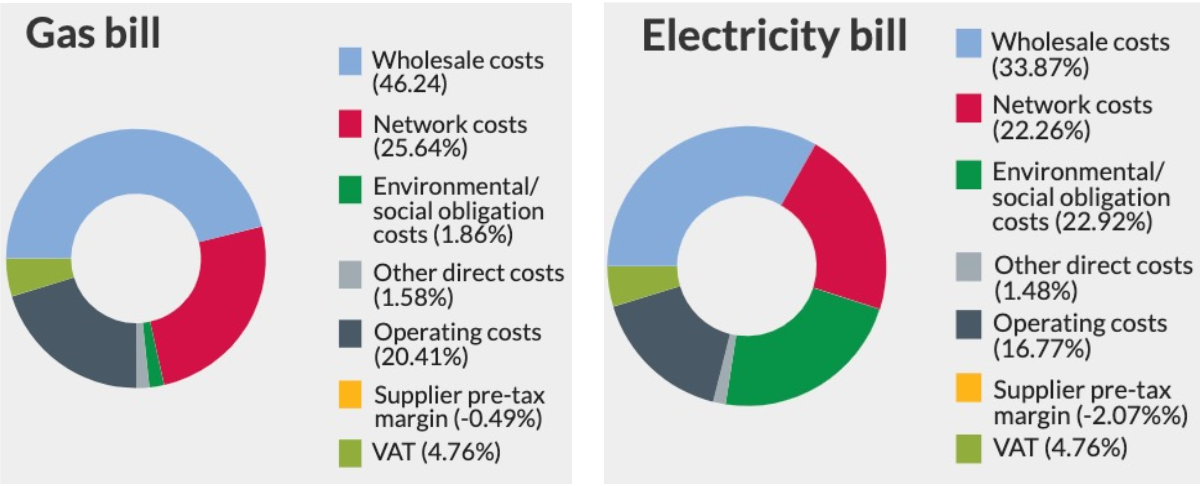
    In 2013 the UK Gov introduced the “Environmental and social levies” to fund energy efficiency, encouraging low carbon generation and reducing fuel poverty. The levies are 10x higher for electricity bills than gas bills. At the time 35% of the UK’s electricity production was from coal, the most harmful fossil fuel for the climate and air quality.

    No alt text provided for this image

    Consequently in 2013 the UK Gov also introduced the Carbon Floor price, initially at £16 (above the EU-ETS at the time) and set to rise to £30 by 2020 (which would now be below the EU-ETS). This has seen Coal reduced to 2% or less (20x smaller) for electricity production. The UK established (EU approved) measures to protect industry and now the EU itself is driving international dialogue on Carbon Border Adjustments.

    Whilst prices fluctuate over time, these policies raise prices for things that pollute (or used to pollute), and at the same time try to alleviate the financial burden on the poorest. The apparently conflicting problems of poverty and climate change. Ironically most of the people living a lifestyle compatible with 1.5ºC are the poorest in society, with the richest 10% causing as much pollution as the other 90% combined.

    Climate Income – the solution?

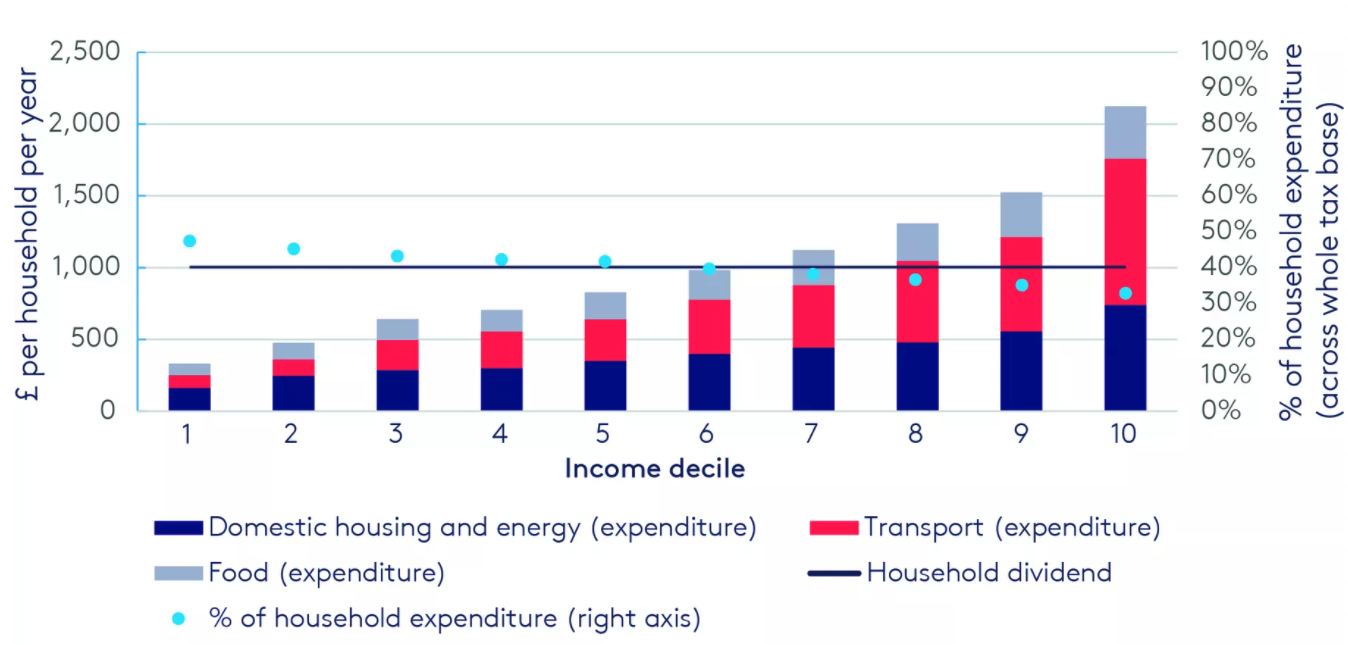
    Climate Income is a revenue neutral, steadily increasing price on pollution fully rebated to all citizens. Revenue neutral means there is no cost to the government, and, significantly, no revenue for the government. The steadily increasing Carbon Price follows the polluter pays principle embedded in UK legislation for nearly 50 years. The key part is returning the money to all citizens equally in a fair monthly payment, much like how child benefits or pensions are paid. Despite the rising costs, the poorest 20% could be £500 better off, enough to match the one of the current UK government suggestions.

    No alt text provided for this image

    London School of Economics data from 2019.

    The rest of society would be proportionally affected depending on the pollution they cause. Once the gas price spike settles over half the population would be better off. The exact amount depends on the level of price introduced. LSE modelled a £40 /tCO2 charge, above the current £18 and the planned £30 level, though significantly below the current UK ETS price circa £75.

    No alt text provided for this image

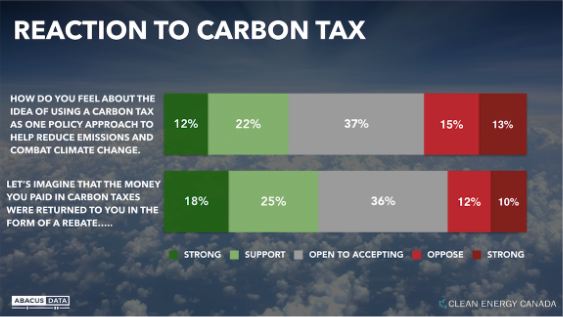
    This type of approach is intrinsically fair, sharing the responsibility and rewards equally on everyone. In Canada a form of Climate Income has been operational since 2019 and the public increasingly understand and support it, re-electing in 2021 parties in favour.

    Above all, it must be clear to the public that this represents a rebalancing of the tax base, in order to incentivise greener technologies and activities, and not simply a backdoor way of the Treasury taking more cash from their pockets.

    What does this mean for the Net Zero goal?

    A clear path to NetZero is supported by aligning the steadily increasing price to the data from the IPCC 1.5ºC report and the latest International Energy Authority report which suggest most (70%+) of NetZero can be achieved with such pricing. What this illustrates is that the long term NetZero objective actually helps clarify how the UK Gov might proceed with other related policy options currently under discussion. 

    e.g.

    1. Subsuming the current Environmental and social levies – reducing the bias against cleaner electricity and shifting the costs more to polluting gas, whilst delivering on the environmental and social objectives.
    2. Removing VAT from household energy bills would be a cost to the treasury that would enable a higher Carbon price, reinforcing 1 above.
    3. Both above measures reduce pressure on the various means tested support programs over time. As the Carbon price rises each year the policy is increasingly progressive, enabling simplification and reduced bureaucratic burden on people and the state.
    4. Windfall taxes might also reduce the immediate financial burden on the treasury enabling more of the existing carbon price (via the UK ETS) to be returned to citizens.
    5. Rebating the money to citizens gives industry the confidence to pass costs on to consumers regardless of how the price rises domestically.
    6. The ETS (copied from the EU) could be replaced by a simpler and more predictable economy-wide carbon price that allows industry to plan and invest with more certainty.
    7. Such pricing strengthens the UK economy to exploit the international trade advantage that already exists in the eyes of this US assessment as the EU and others pursue Border Carbon Adjustments. It also helps create the investment case for industry in the inevitable green revolution the world needs over the next 30 years.

    It could be argued, however, that the current path, with various different ways to raise energy prices and tax revenue whilst only offering minimal and creeping support for the most vulnerable mirrors exactly what unfolded in France with the Yellow Vest movement. Indeed the parallel is further matched by a spike in prices being the trigger to public discontent to such policy creep. In France it was an oil price spike after 4 years of gradual price increases that drew public anger, today it’s gas.

    So to round up here’s a summary other expert opinions that endorse some or all of what is proposed in Climate Income:

    None of these experts are saying this is a magic bullet that fixes everything. They all broadly agree that it is the single most important tool to address climate change. It can also show us how to navigate the short term energy price spike and re-align our worthy intentions in other areas. As Our World in Data summarises: 

    “What’s frustrating about the challenge of climate change is not that we have no options, but that we do not take the options we have. “

    No alt text provided for this image

  • What lessons should be learnt from the fuel crisis?

    What lessons should be learnt from the fuel crisis?

    The current fuel crisis is creating problems for governments in the UK and Europe. The conundrum is based on the combination of underlying energy costs, environmental taxation, poverty alleviation and climate policy all overlapping in a non-aligned mix. Finding a solution that keeps advocates of each policy and it’s raison d’etre supportive is challenging. Here we look at how Climate Income can be the sword that cuts the Gordian knot.

    First let’s examine some of the main policy elements at play …

    The political pressure is coming from the financial pain faced by families with rapidly rising fuel bills where energy use has already been reduced to a minimum with the bottom 50% of the population using energy consistent with a 1.5ºC pathway! Energy costs impact everyone, but low and middle income groups spend a higher proportion of their income on transport and household energy needs than the better paid.

    The main carbon pricing mechanism in the EU and UK is the Emissions Trading Scheme (ETS). The UK left the EU ETS and established an independent ETS which began in January 2021. ETS is considered to be a revenue raising mechanism (tax) as well as a carbon pricing tool. The revenue should be used for appropriate purposes but it is not used as a dividend to the householder to mitigate and thus enable a predictably rising carbon fee as with Climate Income. 

    The UK government has also historically put the burden of paying for the move to renewable electricity onto electricity bills, making this fuel, though increasingly greener than gas, considerably more expensive and adding about £200 to fuel bills. Environmental levies include the Renewable Obligation and the Contracts for Difference, which incentive and support renewable electricity generation, the Feed in Tariff to support solar panel installations, and the Energy Company Obligation, which has provided energy efficiency measures to more than two million households. EPC certificates have also compounded the injustice by rewarding the gas heating home owner over the electric heating owner!

    The government does need to mitigate the effect of rising fuel costs this winter. It refused to implement a post Brexit VAT cut on fuel, claimed to be too much of a ‘blunt instrument’ – although is it fair to just help the very poorest households and not the struggling middle classes? Even if implemented however, 5% of the projected £700 bill rise amounts to a mere £35 and the saving on the average dual fuel bill is estimated to be around £89. Removing the VAT may be a fair and wise move because of what it represents politically but it is not a solution to the underlying problems in our current carbon pricing policies.

    The suggested Warm Home Discount expansion will only target the very poorest and there are logistical problems in applying for the WHD –  meanwhile a targeted home upgrade grant for fuel-poor homes had been halved in the autumn budget! 

    A windfall tax as proposed by the opposition parties looks like an easy solution but it would be hard to implement and it would only cover the oil and gas we produce ourselves (only 40% of our gas is domestic and we imported 20 million tonnes of oil in 2020). It has also been argued that the perceived punitive nature of the tax could be used as a reason for reducing investment in carbon capture and more renewables. Like the other solutions it would be short term and not contribute much to the real solution – more renewables and the price of fossil fuels reliably reflecting their true price to society.

    The carbon price in the ETS (Emissions Trading Scheme) which is the main carbon pricing mechanism in the UK and EU is determined by the market, this led to it being too low to be effective during the recession and now so high that ‘Cost Containment Mechanisms’ has been and may be used to mitigate the immediate effects on industry. Cost Containment not only negates the claim that ETS is market driven rather than part of a command economy but also negates the effectiveness of ETS in encouraging decarbonisation. Under Climate Income Schemes the carbon price is designed to rise but in a predictable way which businesses can plan for.

    The Government had proposed last year that the ETS scheme would be extended to cover the other ⅔ of emissions including building and transport. This was similar to the proposed EU Building and Transport ETS which is meeting resistance in the countries historically dependent on coal (and colder!) such as Poland. The UK proposal was watered down (2nd item) through fear ‘it could trigger a political storm’ in November 2021 and it is no longer described as being about to be ‘radically’ expanded. (Marine and waste incineration emissions are still being considered with the possibility of agricultural emissions in the future).

    The Government had said it wouldn’t have a universal carbon fee back in February because it would raise the price of cheese and meat even though a universal carbon price would send a clear message on all products and eradicate most of the disincentives to electric heating and vehicles. In July the government seemed to be considering CI, which would of course offset the rising price of carbon dependent products while householders and manufacturers adjust, thus mitigating the problem of rising cheese and meat prices! In November at the debate prompted by the Zero C petition its briefing (current carbon charges 2nd para) referred not to the July proposals but back to the February statement on carbon pricing. That debate also took place when it had been decided to scale back the ETS extension but the briefing and government response doesn’t reflect that decision.  Please see Further information on the government response to the Zero C petition for a link to the government response to the petition.

    The government decided against a universal carbon price because of the costs to the householder. The preferred carbon pricing policies however are proving equally unpopular – especially the tariffs on electricity bills to pay for renewables and the VAT on fuel even though the low rate could be considered to be a hidden fossil fuel subsidy like frozen fuel duty. ETS is less visible at the moment – but would have been about to become extremely visible if the government hadn’t scrapped the extension to buildings and transport because of its likely unpopularity! As it is the government uses Cost Containment, whenever the carbon price seems to get too high for comfort – thus rendering ETS far less effective. 

    ETS  in its current form (without CI) can’t be effective without creating further problems for consumers, unpredictability for businesses and future short term cutting of the carbon price every time there is a fuel market crisis.

    Climate Income would mitigate the costs of rising fuel prices without the need to cut the carbon price (and thus reduce incentives to decarbonise) every time the market spikes. The predictably rising price would also allow businesses and households to plan ahead to decarbonise, especially if future carbon dividend payments could be offered as loans for retrofitting and industries could, among other tactics, have fees offset against carbon capture, usage and storage.

    It is unlikely that this current fuel price crisis is a one off – we need a carbon pricing policy which can weather this and future storms without having to be watered down each time. Climate Income is the answer!

    Catherine Dawson and James Collis

  • Happy, if slightly belated New Year to all our members!

    Happy, if slightly belated New Year to all our members!

    As the fuel price crisis is on everyone’s minds this January member Darrin Charlesworth tops the Letters page in today’s Guardian Online………..

    John Vidal’s list (It’s the great green reset: 10 things Britain can do now to save the planet, 3 January) seems very achievable, but I would like to add one more to accelerate change: climate income.

    First, introduce a carbon tax across all industries to price emissions into the market, closing a huge economic loophole. By gradually increasing the tax, we not only incentivise lower emissions on the supply side, but we also drive demand for low-carbon alternatives.

    Second, redistribute the revenue equally to all citizens. This protects the most vulnerable consumers, who already have smaller carbon footprints, from fuel poverty. The wealthiest people with the biggest carbon footprints would see their costs rise, but for the majority, costs would be neutral.

    Third, introduce carbon border adjustments. This policy would prevent emissions being transferred offshore, but also protect many UK businesses, especially our vibrant small business community, from competitors in countries without a carbon tax. This policy would help drive many of the others at a time when we need real urgency.
    Darrin Charlesworth
    Citizens’ Climate Lobby UK

    Congratulations Darrin for succinctly and elegantly summarising how Climate Income would enable the true price of carbon to be reached – thus making decarbonisation a no brainer without impoverishing everyone!

  • Damning report by the Public Accounts Committee….

    Damning report by the Public Accounts Committee….

    The House of Commons Committee of Public Accounts report, Environmental Tax Measures, published today, is savage in its condemnation of the failure of the Government to align its environmental ambitions with the means to achieve them through its fiscal policy:

    Tax is an important instrument for pursuing government’s environmental goals, particularly getting to net zero greenhouse gas emissions by 2050. The potential of the tax system in this respect has long been recognised by government, academics and stakeholders, notably the Institute for Fiscal Studies in the Mirrlees Review published in 2011 and more recently the Climate Change Committee. We were therefore concerned that HM Treasury and HM Revenue & Customs (HMRC)—the departments responsible for the strategic oversight and administration of the tax system—have taken a very limited view of the role of tax so far. They could not explain clearly to us how the tax system is used in achieving the government’s environmental goals.

    At present HMRC and HM Treasury only recognise four environmental taxes as these are the only ones with specific environmental objectives. They have limited understanding of the environmental impact of these taxes because their management has focussed on the revenue these taxes raise. The departments have not kept track of the impact of other tax measures with environmental objectives, such as tax reliefs to support energy saving and clean technologies, or the impact of tax measures affecting the consumption of fossil fuels. We were encouraged to hear that the departments have started to assess the impact of fuel duty freezes on the environment, but environmental assessments should be made for all taxes.

    We see a lack of leadership and coordination, which mirrors findings in our recent reports on Achieving government’s long-term environmental goals and Achieving net zero. The tax system interacts with environmental policy areas which are the responsibility of other government departments. These interactions risk being overlooked without greater monitoring and transparency of tax measures affecting the environment. Given HM Treasury’s cross-government remit, it is disappointing to see silo thinking, which we often see in other Whitehall departments, extending to the Treasury itself. HM Treasury is still considering how tax should fit within a comprehensive programme for funding net zero. It acknowledges that further action is needed to hit the 2050 target.

    Given the scale of the climate emergency, HM Treasury and HMRC need to act now. We are concerned that the departments have yet to plan for the impact of the government’s environmental ambitions on tax revenues, including on fuel duty which raised £28 billion in 2019–20 but will decline as people change to electric vehicles. The two departments need to be clear and transparent on the role that tax will play so that: taxpayers can make informed decisions; other government departments can plan; and Parliament has the information it needs to hold government to account. With the UK hosting the UN Climate Change Conference in November 2021 we look to HM treasury to lead by example.

    Analysis of press coverage is available here, including the comment by Labour peer Lord Triesman that:  

    “Government and regulators now need to create an environment where investors and lenders are rewarded for taking the long-term view. What will ultimately bring down green financing costs is longevity and pipeline security.” Interestingly this echoes comments on the similar gap in climate change mitigation plans across the pond:

    An editorial in the Washington Post says of the expected new US climate pledge to cut emissions 50% below 2005 levels by 2030: “Such promises are easy. Making good on them, and on this one in particular, is hard.” Like another recent editorial from the paper, the piece argues for a carbon tax: “What’s missing [from Biden’s proposals] is an economy-wide policy that would cut demand for fossil fuels in every industry in every state. A substantial, steadily rising carbon tax would ensure emissions reductions happened even if some of Mr. Biden’s government-funded green projects failed because it would dampen underlying demand for fossil fuels.”

    The publication of this report offers another very targeted opportunity to write to your MP, especially if they are members of the Public Accounts Committee. You could point out how Climate Income with Border Carbon Adjustments would be the ideal fiscal policy to send the right message to producers and consumers on the needed direction of travel and make investment in low emission technology so much more attractive, as the Government has acknowledged:

    Placing a price on carbon creates the incentive for emissions to be reduced in a cost effective and technology-neutral way, while mobilising the private sector to invest in emissions reduction technologies and measures. While we recognise the merits of a Carbon Fee and Dividend policy, we do not propose to adopt it at this time.

    * Committee of Public Accounts members

    Name /Party /Constituency
    Meg Hillier MP Labour Hackney South and Shoreditch, Chair
    Gareth Bacon MP Conservative Orpington
    Kemi Badenoch MP Conservative Saffron Walden
    Shaun Bailey MP Conservative West Bromwich West
    Olivia Blake MP Labour Sheffield, Hallam
    Dan Carden MP Labour Liverpool, Walton
    Sir Geoffrey Clifton-Brown MP Conservative The Cotswolds
    Barry Gardiner MP Labour Brent North
    Peter Grant MP Scottish National Party Glenrothes

  • Jim Hansen’s Letter to the PM

    I hope many of you caught the news of top climate scientist, Jim Hansen, and his letter to Boris. I’m reposting it in this blog with Jim’s permission but without further comment except to say that much of the, unreported, segment concerns carbon fee and dividend with CCL-UK being recommended as Boris’s next port of call!

  • A wise comment from The Wall Street Journal

    A wise comment from The Wall Street Journal

    I have rather belatedly succumbed to subscribing to Carbon Brief Daily (weekly is also an option) it is a very useful and free way to find out what is been reported about climate policy…….

    Carbon Brief is a UK based website covering the latest developments in climate science, climate policy and energy policy. We specialise in clear, data-driven articles and graphics to help improve the understanding of climate change, both in terms of the science and the policy response. We publish a wide range of content, including science explainers, interviews, analysis and factchecks, as well as daily and weekly email summaries of newspaper and online coverage.

    Amidst all the deservedly jubilant comments about Biden’s decisive U turn on Trump’s denialism, deregulation and support of fossil fuels there is a note of caution…..

    Holman W Jenkins Jr, a Wall Street Journal columnist writing in an article titled “Biden’s age of climate decadence”, (26/01/21) takes a negative look at the president’s actions. He writes that “no ideas are present in the climate spasms of the Biden administration, just a doubled helping of patronage handouts to established interest groups”. He continues: “Suppose you actually cared about climate change. You would not throw episodic subsidies at things that can survive only as long as you are subsidising them. You would try to set in motion long-term trends that have the advantage of being in accordance with existing trends”. Central to his suggestions is a carbon tax which would “spread a low-carbon incentive through every transaction in the economy”.

    Jenkins explains that Obama and Gore didn’t feel the need to use ‘unpopular’ carbon taxes as public opinion enabled the administration to support decarbonisation through subsidies and regulations. I would guess that had they gone down the carbon tax route and it had proved popular Trump wouldn’t have been able to have such a field day!

    At the moment our Government also seems set on using subsidy and regulation despite acknowledging in The Future of Carbon Pricing in the UK that….

    Placing a price on carbon creates the incentive for emissions to be reduced in a cost effective and technology-neutral way, while mobilising the private sector to invest in emissions reduction technologies and measures. While we recognise the merits of a Carbon Fee and Dividend policy, we do not propose to adopt it at this time.

    CCL US is working hard to lobby the US government to see the benefits of carbon pricing with some regulations, lobbying for the Energy Innovation and Carbon Dividend Act. Some regulation and subsidisation will be necessary where cost benefits of the greener option will not be adequate to encourage change (as with cars), but it works best in conjunction with carbon pricing.

    So keep in mind that we are campaigning for a sensible and tested solution which does not require complete societal and economic overhaul, is well regarded by economists and that carbon pricing in general is the preferred solution of the IMF and UN!

    PS On February 2nd an editorial in The Financial Times (paywall) reiterates this point: “conspicuous omissions that underline the vast political effort that will be required to turn policy into reality”. These include the order to pause new oil and gas leases that apply to federal land only, and his “failure to set out a detailed national plan for pricing carbon

    It is encouraging that the most respected mainstream financial media are making the same point!

  • Encouraging article on CF&D in The Guardian.

    Encouraging article on CF&D in The Guardian.

    Today, the 5th January 2021, there is an article in The Guardian endorsing CF&D as the best way to tax carbon, promote decarbonisation and create a fairer post pandemic world! It will be interesting to see the reaction to this article, it may signal wider acceptance of the benefits of CF&D across the political spectrum.

    In the article in the Opinion section of the Guardian Online (5/1/2021), Henry D Jacoby, Emiritus Professor of Management at MIT and former co-director of the MIT joint program on the science and policy of global change, gives an good summary of the CF&D policy, which he calls

    “so elegant that it seems too good to be true”. 

    Jacoby also discusses the main stumbling block for the promotion of CF&D, namely the public and governmental perception of the role of taxation. However he argues that, as governments are all having to go outside their policy comfort zones to mitigate the effects of the pandemic, now may be the best time for a radical new approach to carbon taxation….

    But if now isn’t the time to try bold new solutions – when we’ve seen that governments can move mountains in the right circumstances – then when is? And though it looks radical, the dividend really is just a rather elegant solution to a major problem, which neatly circumvents many of the usual political objections to increased taxation. It might even be the first highly popular tax.

    Happily I managed to get a letter about this article published in the Guardian on the 7th January, despite the tumultuous events over the pond!..

    In his article “There’s a simple way to green the economy – and it involves cash prizes for all (5/1/21)”Harold D Jacoby gives a brilliant analysis of the benefits of a Carbon Fee or Dividend (or Climate Income) carbon pricing policy and why there are some psychological barriers to its wider adoption. Citizens Climate Lobby is an international grassroots environmental group which has been respectfully encouraging politicians to consider adopting Carbon Fee and Dividend since 2007. 

    CF&D has successfully been adapted in Canada and Switzerland (although Switzerland does not currently tax fuel for energy while it moves towards the development of more renewable energy systems). Canadians could have replaced its implementer, Trudeau, last year and ditch the policy, they didn’t…. 

    Our Government acknowledged the merits of the tax in its recent Carbon Pricing Report but there is a psychological barrier as Jacoby points out…  Treasury doesn’t like hypothecated taxes or dividends! We at Citizens Climate Lobby UK are working hard to change their mind!. Do take a look at our website and consider supporting us.

    Catherine Dawson,

    Citizens Climate Lobby UK

  • The $5,000,000,000,000 Lie……Stephen Fry talks about the errors in the Michael Moore film, Planet of the Humans, and says not taxing carbon is a ‘much larger cover up’.

    The $5,000,000,000,000 Lie……Stephen Fry talks about the errors in the Michael Moore film, Planet of the Humans, and says not taxing carbon is a ‘much larger cover up’.

    This 15 minute You Tube film is a brilliant endorsement of carbon taxation in general and CF&D in particular (although Stephen Fry doesn’t name the policy as such). He points out that 97% of scientists agree that climate change is caused by humans and the IMF states that a 75$per tonne tax on carbon would keep global warming at under 2 degrees! He states that the IMF also claimed that if prices had been corrected in 2015, global carbon dioxide emissions would be 28% lower the same affect of removing all transport emissions, the economy would have grown faster and the death rate would have been halved!

    A great You Tube film to watch and good ammo for the climate deniers in your life! Do add a comment as this is an easy way to make people aware of CCL as an example I have posted this in response to……


    Any carbon tax is a direct tax on the working class make no mistake….

    Carbon Fee and Dividend or Climate Income taxes carbon production at source, it gradually increases so it becomes cheaper to develop renewables. The tax goes back to the citizen as a dividend which offsets the rising price of carbon in the interim. This is the policy Canada and Switzerland use. Unlike current green tariffs it doesn’t penalise the consumer and would make electricity cheaper than gas, thus, for example benefiting people having to use expensive electricity in UK social housing as well as being a market led method of encouraging decarbonisation and making carbon capture cost effective. Please see websites by Citizen’s Climate Lobbies such as https://test.citizensclimatelobby.uk/

    Show less

  • Very cogent argument for CF&D by a member of the centre-right think tank, Centre for Policy Studies. Useful information if you plan to lobby a Conservative MP!

    Very cogent argument for CF&D by a member of the centre-right think tank, Centre for Policy Studies. Useful information if you plan to lobby a Conservative MP!

    This article comes from a centre-right website CapX which…

    was founded to make the case for popular capitalism: now more than ever, it is vital that the case is made for markets, innovation and competition, and for policies that deliver for the masses as well as the elites.

    To that end, our team monitors thousands of news sources, blogs, academic papers and think tank publications to find the day’s most interesting ideas and most important facts and trends. We also commission opinion and analysis pieces by leading experts – though the views contained in any such article are entirely the author’s own.

    The author, Eamonn Ives, is a member of the centre right think tank the Centre for Policy Studies, specialising in energy and environmental policy. He also sits on the advisory board of Climate Assembly UK, and previously worked as a Researcher for Bright Blue, where he authored five publications.

    Eamonn adopts a techno-optimist approach to environmental issues, grounded in laissez faire economics twinned with proportionate government intervention to overcome challenges such as climate change, air pollution, and resource use. He is also interested in transport policy, urbanism, and innovation.

    Eamonn writes that….

    As temperatures outside begin to fall, the Prime Minister has detailed how Britain will help stop them heating up on a global scale. Yes, the long awaited ten-point climate plan is with us at long last – mapping out both policies and funding pots to limit the nation’s greenhouse gas emissions.

    Much of what it said was nothing new – we already knew what the plan’s broad-brush strokes would be thanks to plenty of pre-briefing in the media and other channels.

    To further decarbonise power, a big push is to be made on offshore wind, quadrupling how much electricity we produce via maritime turbines to 40GW by 2030. Support is coming for nuclear power, with a particular focus on developing advanced reactors and smaller, cheaper, modular units. Efficiency upgrades for public sector buildings and domestic properties, meanwhile, will limit the amount of energy we need to produce in the first place.

    To clean up transport, the big news was that 2030 will indeed mark the end of the road for sales of new petrol and diesel cars and vans (with sales of the best hybrid models ending in 2035). Money has been made available to improve public transport, get more of us walking and cycling, and for research into cutting emissions in hard-to-reach transport modes, such as shipping and aviation.

    To green our industrial processes, investments will be made in hydrogen – which will also be deployed in domestic heating and heavy transport. R&D funding for carbon capture and storage technologies should help address emissions in the thorniest industries, such as cement and chemicals production.

    Plans to plant 30,000 hectares of tress every year will lock up more of the carbon already in the atmosphere while providing other benefits like habitat restoration and flood defences. Finally, the Government hopes that new rules will make the City of London the global centre for green finance and carbon offsetting markets.

    One cannot knock the Government’s ambition – the plan looks across the board and leaves little out of its scope. The money, regulatory provisions, and redoubled Government energy behind tackling climate change should all combine to getting the UK closer to its net zero goal – which it legislated for last year.

    But amid the flurry of spending promises and new targets, it was one seemingly unassuming line in the PM’s FT article – where the plan was first released – which piqued my attention. A cursory mention is given to the “carbon prices we will put on emissions”. If we assume this to mean further work is in the pipeline for carbon pricing across the economy, that could spell very good news indeed.

    As Rachel Wolf – co-author of the Government’s 2019 election winning manifesto – has discussed elsewhere on this website, carbon pricing makes those who bring carbon into the economy financially responsible for the damage it does to our climate. Simply put, carbon pricing would mean fossil fuel companies face a per tonne charge on the carbon dioxide their products will eventually release.

    We already have some carbon pricing – either explicitly, such as on electricity, or via rough proxies, such as fuel duty. But the current framework is confused – pockmarked by exemptions like different rates depending on where the carbon is emitted.

    This is regrettable, because as countless eminent economists and climate campaigners will attest, carbon pricing is conceivably the single best way of cracking down on emissions. Importantly, it does so in a way which is economically efficient, steering people towards addressing the most solvable problems first for the lowest cost, and then working towards tackling more complicated matters. It takes power away from vested interests who lobby politicians and civil servants to favour their clients’ pet projects over genuine climate solutions. If the revenues of carbon pricing were recycled back to citizens, it could be made socially progressive, and ensure that climate action is not shouldered by those with the least ability to bear it.

    Without a robust, simplified, and comprehensive price on carbon, the Government is depriving itself of a powerful tool to mitigate climate change – binding its hands and instead opting for more expensive, less effective policies.

    An 11-point plan might not be as media friendly, but bringing carbon pricing into the fold could take the PM’s strategy up a notch. The Government should waste no time in doing just that.