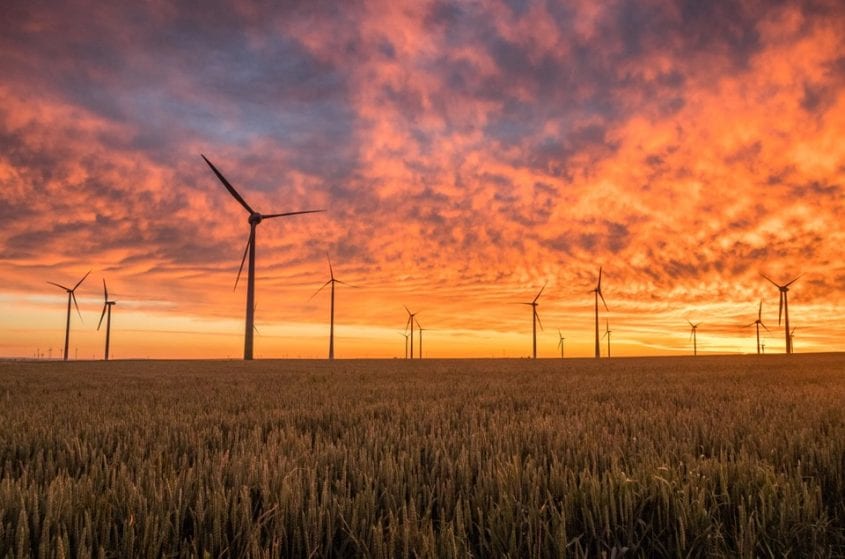
Wiltshire produces more solar-electricity than any other county in the UK but we’re joint 190th for wind energy. In fact, we produce about 6000 times more energy from the Sun than we do from the wind. That’s quite a contrast and we could do better.
Of course, many people find wind farms ugly and don’t want them spoiling the view. That’s a valid opinion but, personally, I think wind turbines are rather beautiful and I’d love to see some on the Wiltshire Downs—a stone circle for the 21st century in the county of Stonehenge and Avebury!
There are good reasons for expanding onshore wind farms. According to the UK government’s Department for Business, Energy and Industrial Strategy, the cheapest gas-generated energy is a third more expensive than onshore wind. Alternate low-carbon options such as offshore wind or nuclear power are even more expensive. Solar energy is the only technology that comes close to being as cheap as the wind!
Increasing the amount of clean energy we generate would make a big difference to climate change. Most activities that produce greenhouse gasses could be run on electricity so that, at a stroke, emissions would be drastically cut. There’d still be some troublesome gasses generated by flying and by agriculture but there are solutions to those too (as I’ll discuss in a later column). So, problem solved? Not quite!
There’s also the issue of intermittency—the facts that there’s no daylight at night and the wind doesn’t always blow. Solving this requires effective, large-scale storage of electricity and the world simply doesn’t produce enough batteries for this. We need another way forward.
One possibility is pumped-water storage in which water is pumped from a low reservoir to a higher one, when electricity is plentiful, and is then allowed to run down from the high reservoir to the low—generating electricity as it does so—when demand exceeds supply. In effect, it’s a giant rechargeable battery.
This is a well-tested solution which wastes little energy and has been used, on a small scale, for a hundred years. We just need to scale it up. That’s now happening. One scheme, at Coire Glas in the Scottish Highlands, will be able to store 30 GWh of electricity if approved. That’s about the same as a small nuclear power station generates in a day but this is dwarfed by the Fengning-2 plant in China which will have the capacity to store 4.6 TWh—enough to supply the entire UK continuously for 5 days.
That’s the kind of storage capacity we need to think about building in the UK too. It simply can’t be done using batteries because matching the Fengning-2 capacity would require 21 years-worth of the world’s entire rechargeable-battery manufacturing output.
The message here is that we know how to make (and store) enough affordable, clean energy to satisfy our needs and it could be done within 10-20 years. This change—in combination with electric vehicles, heat pumps and other ways of switching from fossil-fuels to electricity—could reduce emissions by 90%. We just need to get on with it.
First published in Marlborough.news
Photo credit: Karsten Würth