The crisis caused by the war in Ukraine has prompted the Government to rejig its energy policy in order to increase energy security by reducing the need for imported fuel. This rethink could have been an opportunity to move away from the use of gas as our base load fuel and stick to our commitments to achieving NZ by 2050 by not licensing any more oil and gas fields or fracking.
The Government could have prioritised increasing onshore wind and solar farms which are the quickest and cheapest ways to increase our low carbon energy supply to the promised 95% by 2030, backed up by a campaign to insulate our poor housing stock to reduce the demand for gas. Although planning rules have been made less restrictive in the strategy, onshore wind and solar will still require unanimous consent, unlike roads and incinerators; it has also been reported that more ambitious plans were watered down the night before the strategy was released.
The Government has instead decided to launch a new licensing round for oil and gas fields in the autumn. It will take years for these to come onstream and unless rules are changed the fuel will be sold on the international market as now. This announcement came 3 days after the latest IPCC report had warned that we have reached the now or never moment and have to leave the oil and gas in the ground.
The Climate Change Committee stated that….“Recognising the difficulties in implementing effective policy quickly, it is still disappointing not to see more on energy efficiency and on supporting households to make changes that can cut their energy bills now. Government has reiterated its commitment to do more and we look forward to seeing details in the coming months” – here’s hoping!
Micharl Lewis, CEO E.ON UK was even moreforthright….. “Energy efficiency is the fabled ‘silver bullet’ for a future energy system: it cuts bills and carbon emissions today, it creates jobs and it reduces our reliance on foreign gas. By abandoning any extra commitment to helping people to improve their homes, today’s announcement condemns thousands more customers to living in cold and draughty homes, wasting energy and paying more than they need to for their heating”.
Now could have been the moment for the Government to look again at the case for Climate Income which it had acknowledged in The Future of UK CarbonPricing (2020), ideally with the ability to borrow against future dividend payments for investments in energy efficiency and retrofitting.
Advocates of the approach highlight that a well-designed scheme would have social and environmental benefits, equitably distributing the revenues and stimulating investment in low carbon technologies……..emissions to be reduced in a cost effective and technology-neutral way, while mobilising the private sector to invest in emissions reduction technologies and measures.
CCL member Rob Paton explains how Climate Income can be used as a solution to the fuel price crisis as well as the environmental one.
1 The fuel poverty facing many households and the climate crisis facing us all must be tackled in synch. If they are not dealt with together, each problem worsens the other. Fuel poverty, accentuated by a price spike, has led to calls questioning support for renewable energy and has clear potential for social and political instability. Yet the necessary action on fuel poverty must not be at the expense of the climate. Households on benefits, or with low and insecure earnings, will be the least able to protect themselves from the consequences of weaker climate policies.
2 Fuel poverty should be addressed primarily by increased income, not reduced fuel prices. What those in fuel poverty need is more money. They know their priorities. And it must be money they can rely on – not complicated special payments, or means tested and arriving late to tackle a spike in prices..
3 What businesses and our economy need for the transition to zero carbon is an underlying trend of rising carbon prices. Economists and business federations agree on this. Most businesses can deal with price fluctuations, or are learning how to. Carbon subsidies and tax reliefs are a part of the problem not part of the solution.
4 The direction of travel for public finances should be away from the present high degree of carbon reliance and towards sustainable, post-carbon sources of revenue. An overhaul of the UK’s current mish-mash of fossil fuel taxes and subsidies is long overdue. A coherent approach would raise more funds, be fairer and simpler, support the drive to carbon neutrality. This is bound to take time – so the sooner the taxation system starts down this road the better.
5 Likewise, the direction of travel for income support during the great transition should be from indirect to direct payments. That is, from transfers hidden in a tax or benefits system to discrete, climate-related payments, labelled as such and paid directly. Citizens need to know that they are being supported in tackling the climate crisis, and enabled to play their part.
6 Consistent policy on carbon pricing, fiscal reform and income support requires a cross-party political consensus. Surveys have repeatedly shown that the public mood is to find and sustain the common ground, and to get on with the job. Political contestation on other issues – including other climate and environmental policies – can and should continue, both locally and nationally. But a framework to tackle the great work of this decades-long transition is needed. These are three essential elements for such a framework.
7 Communicate, communicate, communicate. Public trust in politicians needs to be restored if sometimes unpopular policies are to be sustained. A cross-party consensus in Westminster needs the backing of public opinion, and its calls will be taken more seriously by the public than party-political pronouncements. Especially when promised action follows. Nothing is clearer and more convincing than a payment direct to your bank account.
Climate income offers a way forward with the clear potential to satisfy all these principles. It may not be the only one. But it is the only one I am aware of.
Rob Paton 02/02/22
We are not the only ones with this message, today’s Carbon Brief Daily reports on two interesting reactions to the Levelling Up White Paper (Business Green is paywalled) ..
Business Green’s James Murray, analysing the paper, writes that “a government that properly prioritised the net-zero transition, rather than treated them as a separate silo, would find it much easier to embed climate action in its response to the gas price crisis.”
In another comment on levelling up in Business Green, Prof Henrietta Moore writes that “without tax reform, the cost of funding net-zero will fall disproportionately on the shoulders of those least able to afford but most likely to suffer the consequences of a rapidly degrading environment”.
Happily the fuel price crisis mitigation measures announced by Rishi Sunak today do not involve tinkering with carbon pricing and leave all to play for!
I posted this article on the Linked In Citizens’ Climate Europe page on the 22nd January and have been asked to reproduce it here. I hope you find it a helpful ‘take’ on the current crisis.
The current fuel crisis is creating problems for governments in the UK and Europe. The conundrum is based on the combination of underlying energy costs, environmental taxation, poverty alleviation and climate policy, all overlapping in a complex mix. Finding a solution that keeps advocates of each policy and it’s raison d’etre supportive is challenging. Here we look at how leaving the EU offers the UK a simpler approach. Climate Income can be used to address the short term imperatives of the rising gas prices, “levelling up” the inequality in the UK, provide a clear pathway to NetZero and make the UK economy more competitive.
Some of the main elements in the mix …
Gas prices are rising, and will continue for up to 2 years. Average household energy costs are set to rise by around £600 p.a. in 2022. Energy costs impact everyone, but while low and middle income families use less energy it’s a higher proportion of their income, hence why governments implement policies to address this.
To protect the vulnerable, old and poor, there have been various means tested financial supports introduced roughly every decade: in 1988 Cold Weather Payments; in 1997 Winter Fuel Payments; and in 2011 Warm Home Discounts. All essentially aiming to reduce the number of people suffering from cold or hunger in our first world economy.
Consequently in 2013 the UK Gov also introduced the Carbon Floor price, initially at £16 (above the EU-ETS at the time) and set to rise to £30 by 2020 (which would now be below the EU-ETS). This has seen Coal reduced to 2% or less (20x smaller) for electricity production. The UK established (EU approved) measures to protect industry and now the EU itself is driving international dialogue on Carbon Border Adjustments.
Whilst prices fluctuate over time, these policies raise prices for things that pollute (or used to pollute), and at the same time try to alleviate the financial burden on the poorest. The apparently conflicting problems of poverty and climate change. Ironically most of the people living a lifestyle compatible with 1.5ºC are the poorest in society, with the richest 10% causing as much pollution as the other 90% combined.
Climate Income – the solution?
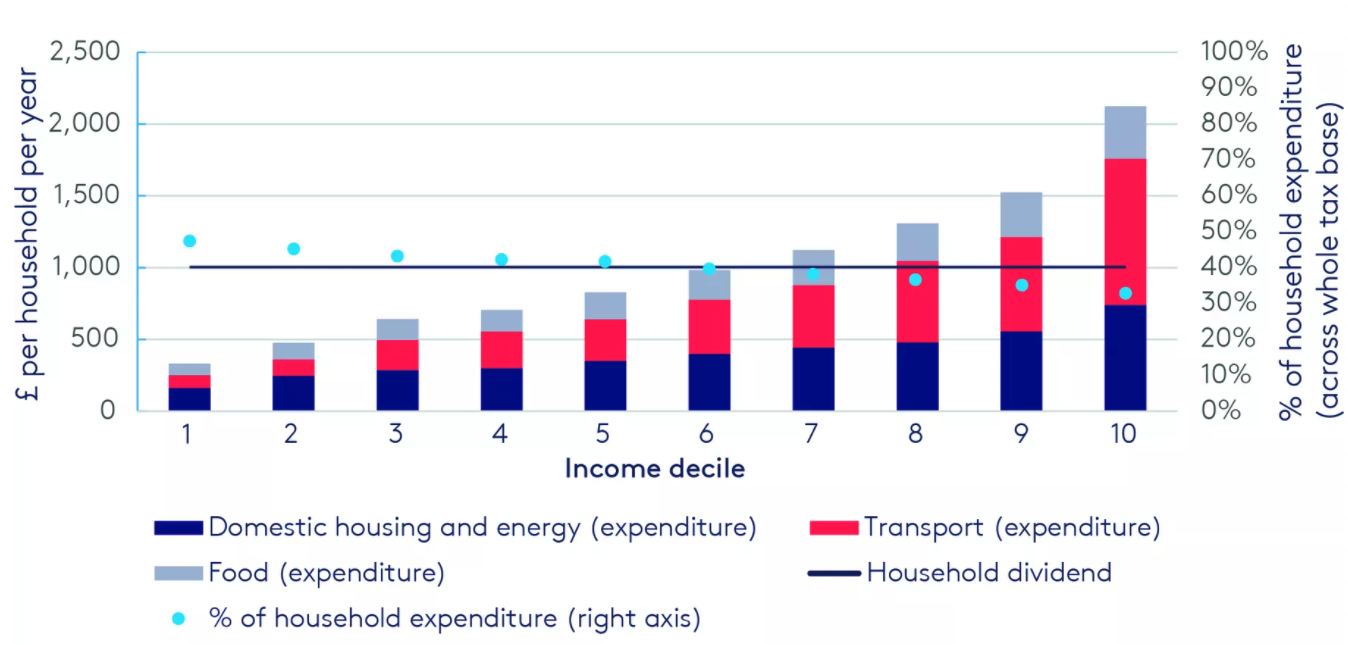
Climate Income is a revenue neutral, steadily increasing price on pollution fully rebated to all citizens. Revenue neutral means there is no cost to the government, and, significantly, no revenue for the government. The steadily increasing Carbon Price follows the polluter pays principle embedded in UK legislation for nearly 50 years. The key part is returning the money to all citizens equally in a fair monthly payment, much like how child benefits or pensions are paid. Despite the rising costs, the poorest 20% could be £500 better off, enough to match the one of the current UK government suggestions.
London School of Economics data from 2019.
The rest of society would be proportionally affected depending on the pollution they cause. Once the gas price spike settles over half the population would be better off. The exact amount depends on the level of price introduced. LSE modelled a £40 /tCO2 charge, above the current £18 and the planned £30 level, though significantly below the current UK ETS price circa £75.
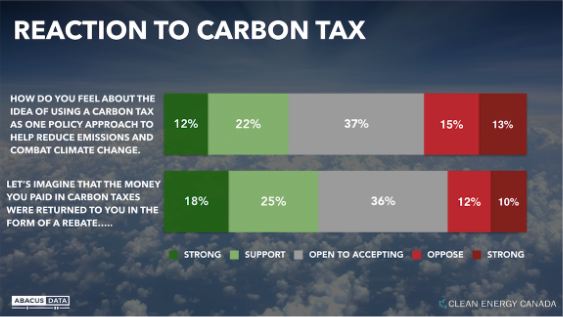
This type of approach is intrinsically fair, sharing the responsibility and rewards equally on everyone. In Canada a form of Climate Income has been operational since 2019 and the public increasingly understand and support it, re-electing in 2021 parties in favour.
Above all, it must be clear to the public that this represents a rebalancing of the tax base, in order to incentivise greener technologies and activities, and not simply a backdoor way of the Treasury taking more cash from their pockets.
What does this mean for the Net Zero goal?
A clear path to NetZero is supported by aligning the steadily increasing price to the data from the IPCC 1.5ºC report and the latest International Energy Authority report which suggest most (70%+) of NetZero can be achieved with such pricing. What this illustrates is that the long term NetZero objective actually helps clarify how the UK Gov might proceed with other related policy options currently under discussion.
e.g.
Subsuming the current Environmental and social levies – reducing the bias against cleaner electricity and shifting the costs more to polluting gas, whilst delivering on the environmental and social objectives.
Removing VAT from household energy bills would be a cost to the treasury that would enable a higher Carbon price, reinforcing 1 above.
Both above measures reduce pressure on the various means tested support programs over time. As the Carbon price rises each year the policy is increasingly progressive, enabling simplification and reduced bureaucratic burden on people and the state.
Windfall taxes might also reduce the immediate financial burden on the treasury enabling more of the existing carbon price (via the UK ETS) to be returned to citizens.
Rebating the money to citizens gives industry the confidence to pass costs on to consumers regardless of how the price rises domestically.
The ETS (copied from the EU) could be replaced by a simpler and more predictable economy-wide carbon price that allows industry to plan and invest with more certainty.
Such pricing strengthens the UK economy to exploit the international trade advantage that already exists in the eyes of this US assessment as the EU and others pursue Border Carbon Adjustments. It also helps create the investment case for industry in the inevitable green revolution the world needs over the next 30 years.
It could be argued, however, that the current path, with various different ways to raise energy prices and tax revenue whilst only offering minimal and creeping support for the most vulnerable mirrors exactly what unfolded in France with the Yellow Vest movement. Indeed the parallel is further matched by a spike in prices being the trigger to public discontent to such policy creep. In France it was an oil price spike after 4 years of gradual price increases that drew public anger, today it’s gas.
So to round up here’s a summary other expert opinions that endorse some or all of what is proposed in Climate Income:
None of these experts are saying this is a magic bullet that fixes everything. They all broadly agree that it is the single most important tool to address climate change. It can also show us how to navigate the short term energy price spike and re-align our worthy intentions in other areas. As Our World in Data summarises:
“What’s frustrating about the challenge of climate change is not that we have no options, but that we do not take the options we have. “
The current fuel crisis is creating problems for governments in the UK and Europe. The conundrum is based on the combination of underlying energy costs, environmental taxation, poverty alleviation and climate policy all overlapping in a non-aligned mix. Finding a solution that keeps advocates of each policy and it’s raison d’etre supportive is challenging. Here we look at how Climate Income can be the sword that cuts the Gordian knot.
First let’s examine some of the main policy elements at play …
The political pressure is coming from the financial pain faced by families with rapidly rising fuel bills where energy use has already been reduced to a minimum with the bottom 50% of the population using energy consistent with a 1.5ºC pathway! Energy costs impact everyone, but low and middle income groups spend a higher proportion of their income on transport and household energy needs than the better paid.
The main carbon pricing mechanism in the EU and UK is the Emissions Trading Scheme (ETS). The UK left the EU ETS and established an independent ETS which began in January 2021. ETS is considered to be a revenue raising mechanism (tax) as well as a carbon pricing tool. The revenue should be used for appropriate purposes but it is not used as a dividend to the householder to mitigate and thus enable a predictably rising carbon fee as with Climate Income.
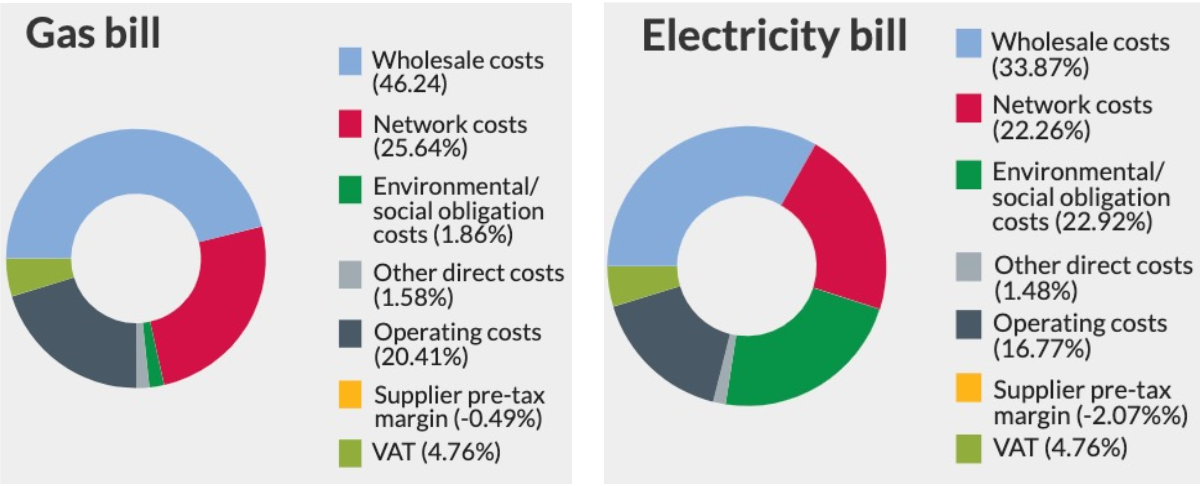
The UK government has also historically put the burden of paying for the move to renewable electricity onto electricity bills, making this fuel, though increasingly greener than gas, considerably more expensive and adding about £200 to fuel bills. Environmental levies include the Renewable Obligation and the Contracts for Difference, which incentive and support renewable electricity generation, the Feed in Tariff to support solar panel installations, and the Energy Company Obligation, which has provided energy efficiency measures to more than two million households. EPC certificates have also compounded the injustice by rewarding the gas heating home owner over the electric heating owner!
The government does need to mitigate the effect of rising fuel costs this winter. It refused to implement a post Brexit VAT cut on fuel, claimed to be too much of a ‘blunt instrument’ – although is it fair to just help the very poorest households and not the struggling middle classes? Even if implemented however, 5% of the projected £700 bill rise amounts to a mere £35 and the saving on the average dual fuel bill is estimated to be around £89. Removing the VAT may be a fair and wise move because of what it represents politically but it is not a solution to the underlying problems in our current carbon pricing policies.
The suggested Warm Home Discount expansion will only target the very poorest and there are logistical problems in applying for the WHD – meanwhile a targeted home upgrade grant for fuel-poor homes had been halved in the autumn budget!
A windfall tax as proposed by the opposition parties looks like an easy solution but it would be hard to implement and it would only cover the oil and gas we produce ourselves (only 40% of our gas is domestic and we imported 20 million tonnes of oil in 2020). It has also been argued that the perceived punitive nature of the tax could be used as a reason for reducing investment in carbon capture and more renewables. Like the other solutions it would be short term and not contribute much to the real solution – more renewables and the price of fossil fuels reliably reflecting their true price to society.
The carbon price in the ETS (Emissions Trading Scheme) which is the main carbon pricing mechanism in the UK and EU is determined by the market, this led to it being too low to be effective during the recession and now so high that ‘Cost Containment Mechanisms’ has been and may be used to mitigate the immediate effects on industry. Cost Containment not only negates the claim that ETS is market driven rather than part of a command economy but also negates the effectiveness of ETS in encouraging decarbonisation. Under Climate Income Schemes the carbon price is designed to rise but in a predictable way which businesses can plan for.
The Government had proposed last year that the ETS scheme would be extended to cover the other ⅔ of emissions including building and transport. This was similar to the proposed EU Building and Transport ETS which is meeting resistance in the countries historically dependent on coal (and colder!) such as Poland. The UK proposal waswatered down (2nd item) through fear ‘it could trigger a political storm’ in November 2021 and it is no longer described as being about to be ‘radically’ expanded. (Marine and waste incineration emissions are still being considered with the possibility of agricultural emissions in the future).
The Government had said it wouldn’t have a universal carbon fee back in February because it would raise the price of cheese and meat even though a universal carbon price would send a clear message on all products and eradicate most of the disincentives to electric heating and vehicles. In July the government seemed to be considering CI, which would of course offset the rising price of carbon dependent products while householders and manufacturers adjust, thus mitigating the problem of rising cheese and meat prices! In November at the debate prompted by the Zero C petition its briefing (current carbon charges 2nd para) referred not to the July proposals but back to the February statement on carbon pricing. That debate also took place when it had been decided to scale back the ETS extension but the briefing and government response doesn’t reflect that decision. Please see Further information on the government response to the Zero C petition for a link to the government response to the petition.
The government decided against a universal carbon price because of the costs to the householder. The preferred carbon pricing policies however are proving equally unpopular – especially the tariffs on electricity bills to pay for renewables and the VAT on fuel even though the low rate could be considered to be a hidden fossil fuel subsidy like frozen fuel duty. ETS is less visible at the moment – but would have been about to become extremely visible if the government hadn’t scrapped the extension to buildings and transport because of its likely unpopularity! As it is the government uses Cost Containment, whenever the carbon price seems to get too high for comfort – thus rendering ETS far less effective.
ETS in its current form (without CI) can’t be effective without creating further problems for consumers, unpredictability for businesses and future short term cutting of the carbon price every time there is a fuel market crisis.
Climate Income would mitigate the costs of rising fuel prices without the need to cut the carbon price (and thus reduce incentives to decarbonise) every time the market spikes. The predictably rising price would also allow businesses and households to plan ahead to decarbonise, especially if future carbon dividend payments could be offered as loans for retrofitting and industries could, among other tactics, have fees offset against carbon capture, usage and storage.
It is unlikely that this current fuel price crisis is a one off – we need a carbon pricing policy which can weather this and future storms without having to be watered down each time. Climate Income is the answer!