Tag: fossil fuels

  • What happened at COP28?

    What happened at COP28?

    This is an extract from the slideshow delivered by Cathy Orlando, CCI program director on the 20th December 2023 giving the CCI analysis of the outcome of COP28. The worst case scenario – that fossil fuels would get a free pass and the pledge to work to keep temperature rises within 1.5 Celsius would be dropped, was averted.

    CCI applauds the eventual operationalisation of the Loss and Damage Fund, the declarations on tripling renewables and doubling energy efficiency, and tackling the fossil fuel subsidy issue. Highlighting the role of agricultural systems and the effects of climate change on human health and the natural world as well as the need for the transition to be just were also welcome signs of progress and proof that COP conferences, while not perfect, are important and necessary.

    CCL UK agrees that COP28 confirms that CCI’s campaigning for the reform of financial systems is the path forward.

    Governments’ 2030 targets will lead to 2.5°C of warming by the end of the century: 0.1°C higher than last year. This change is due to weak existing targets rather than any major shifts in new NDC updates: we take the level of emissions anticipated under current policies for those countries that we expect to overachieve their weak 2030 targets.

    Since COP28 the FFNPT now has 12 nation states signed up, in September the State of California became the largest economy to endorse the call (the 5th largest economy in the world and the largest sub-national economy)…… California Senate Majority Whip Senator Lena A Gonzalez (D – Long Beach), said: “It is essential that we commit once and for all to ending our reliance on fossil fuels. People around the world, especially low-income people of color, are suffering the adverse health impacts of fossil fuel pollution, from asthma to cancer. The recent devastating fires and hurricanes emphasize the urgency of taking action, to prevent further extreme weather changes. The science has been clear for decades—fossil fuels are responsible for the climate crisis. We can prevent further harm to our communities, and that is why I am proud that California has now been added to the growing list of governments endorsing the Fossil Fuel Non-Proliferation Treaty. It is time for our nation to be a part of the solution, to forge strong unity and commitment to phasing out the use of fossil fuels.

    France and Kenya formally launched the ‘Taskforce on International Taxation to Scale Up Development, Climate, and Nature Action‘ with Barbados, Antigua, Barbuda, and Spain signing on as members.

    CCI and CCL UK members will continue to educate and campaign for the solutions that will enable the world’s financial resources to be unlocked to ensure a liveable future in 2024.
  • When they say we need fossil fuels…Citizens’ Climate International Laser Talk, November 2023

    When they say we need fossil fuels…….The primary driver of inflation around the world is fossil fuels.  Economies are addicted to fossil fuels at every level: mobility, energy production, agriculture and goods production. When the prices of oil and gas go up, every other price tends to go up. Actually, high fossil fuel prices are historically inseparable from inflation and economic crises. Mark Zandi, chief economist at credit rating agency Moody’s, said in an article for Vox that “every recession since World War II has been preceded by a jump in oil prices”. And there is a term for it: fossilflation.

    Factors driving fossil fuel prices are many, and diverse. Most of the time, though, these come directly from producing countries, which raise and lower production, thus flooding or drying up the market. This is often used as a political tool, driving millions of people into despair. Here is just a sample of the many ways of how fossilflation happens:

    1. The market-rigging actions of the OPEC Plus cartel (including Russia);
    2. Profiteering on energy supply disruptions due to Russia’s invasion of Ukraine;
    3. Climate damages (a.k.a. climateflation) Extreme weather, climate and water-related events caused almost $1.5 trillion of economic losses in the decade to 2019, up from $184 billion in the 1970s, according to a World Meteorological Organization (WMO) report.
    4. Embedded energy costs across all classes of consumer products and business services;
    5. Food system effects including embedded fossil fuel costs and climate damage;
    6. Embedded climate risk and liability costs;
    7. Sovereign debt stresses driven by fossil fuels, including:
      a. Public spending and sovereign debt burdens resulting from disaster response;
      b. Direct spending on disaster response;
      c. Extremely high, punishing interest rates linked to that spending compelled by actions a country did not initiate or decide;
      d. All-time record fossil fuel subsidies ($7 trillion), linked to rigged fossil fuel price spikes;
      e. Public spending to compensate consumers for unaffordable price shocks linked to higher embedded energy costs.

    There is one solution: move away from fossil fuels. We need to do it fast, and we need to do it fairly. That is why at COP 28, Citizens’ Climate International is linking arms with many organisations and calling for a fossil fuel phaseout.

    By breaking free of coal, oil and gas, and replacing them with renewable energy sources, we will protect our planet and our economy.

    Summary

    The primary driver of inflation around the world is fossil fuels. In fact there is a term for it: fossilflation. There is a simple solution: move away from fossil fuels. We need to do it fast, and we need to do it fairly.

    That is why at COP 28, Citizens’ Climate International is linking arms with many organisations and calling for a fossil fuel phaseout. By breaking free of coal, oil and gas, and replacing them by renewable energy sources, we will protect our planet and our economy.

  • Citizen Climate International’s summary of the truth about fossil fuel subsidies and the fossil fuel industry’s decades long disinformation campaign!

    Citizen Climate International’s summary of the truth about fossil fuel subsidies and the fossil fuel industry’s decades long disinformation campaign!

    The IMF, Carbon Pricing and Explicit and Implicit Fossil Fuels Subsidies

    Here are two terms that anyone who wants to preserve a stable climate needs to know: explicit fossil fuel subsidies and implicit fossil fuel subsidies.

    Explicit fossil fuel subsidies from governments directly reduce the price of fossil fuels, thus making it attractive to investors and consumers to buy. Implicit fossil fuel subsidies are the costs taxpayers and insurance are paying for the air pollution and climate impacts experienced because of dirty fossil fuels.

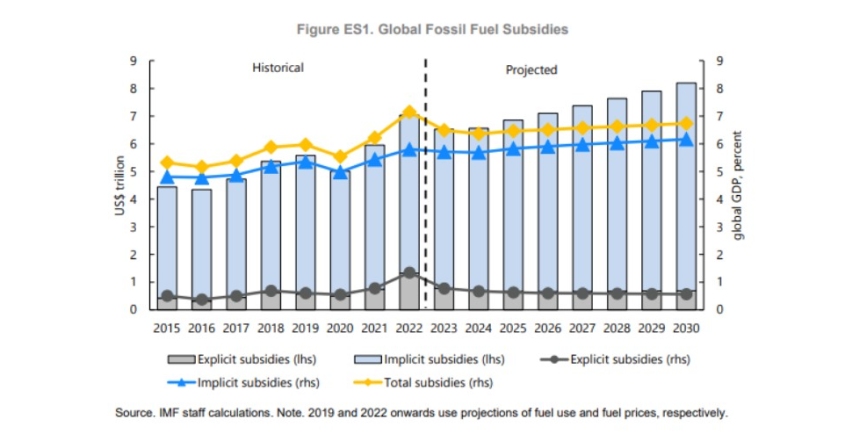
    On August 24, 2023, the International Monetary Fund (IMF) released a report. The conclusion of this report was that subsidies for oil, coal, and natural gas cost the equivalent of 7.1%  of global gross domestic product.

    Explicit subsidies have more than doubled since 2020 but are still only 18% of the total subsidy amount, while nearly 60% is due to implicit subsidies.

    Here is a hopeful conclusion from the report: “Full fossil fuel price reform would reduce global carbon dioxide emissions to an estimated 43 percent below baseline levels in 2030 (in line with keeping global warming to 1.5-2C), while raising revenues worth 3.6 % of global GDP and preventing 1.6 million local air pollution deaths per year.”

    Making polluters pay (a.k.a carbon pricing) offers us the exact tool needed to ensure this price reform. In fact, the IMF Managing Director Kristalina Georgieva at the Paris Summit in June said, “Our analysis shows that without a carbon price, there is no chance that we will meet the 1.5 degrees Celsius target by 2030. We will miss it.”

    Our only home, Earth, has just passed through the hottest three months on record. With the fires, floods, horrendous storms, cryosphere melting and the threats to the Gulf Stream, it is obvious that the impacts of climate change are no longer just a concern for future generations, but are a very real threat at our doorstep. We must listen to the experts and cooperate to enact or strengthen our essential climate policies such as carbon pricing going forward. Happily there are 70 carbon pricing initiatives world wide and the African Summit issued a unanimous call for world leaders to support global price on carbon pollution on September 6, 2023.

    IMF Subsidies Report August 2023

    The Fossil Fuel Industry Funded Climate Disinformation for Decades

    Even to this day, there are individuals who deny or downplay the link between the burning of fossil fuels and the impacts that pollution has on our climate and health. How did this happen?

    Key players in the fossil fuel industry knew decades ago that burning coal, oil, and methane gas to warm our homes, power our cars, and generate electricity was warming the planet. Instead of acting on the knowledge, they began financing a massive disinformation campaign. Now, as a consequence, youth are having to fight for their inalienable right to have a safe and liveable future.

    Happily, when you inform people that the fossil fuel industry funded a climate disinformation campaign for decades, people are more likely to believe you when you present solutions.

    Suggested readings:

  • Why Labour is right to stop future UK oil and gas development

    Why Labour is right to stop future UK oil and gas development

    The Labour Party has announced that it intends to stop the development of any new oil and gas fields in UK territory if it forms the next government.

    The move will have far-reaching consequences, leading to a rapid contraction of the UK’s oil and gas industry over the next decade. So it’s no surprise that much of the reaction from newspapers, businesses and trade unions has been very negative. The current prime minister, Rishi Sunak, has gone so far as to call Labour’s proposed policy “bizarre” and the product of “eco-zealots”.

    But Labour is currently well ahead in the polls, and with an election due by early 2025, there’s a real possibility that banning further fossil fuel development could become official UK government policy within the next two years.

    So, it’s important to know if Sunak is right. Is Labour’s vow to halt new oil and gas fields ill-advised and even “bizarre”?

    In fact, according to my calculations, burning all the UK’s existing oil and gas reserves will already produce more than the UK’s fair share of greenhouse gas emissions under the 2015 Paris Climate Agreement – so suggesting we look for more seems bizarre to me.

    It only makes sense if the people making such decisions have no intention of sticking to the UK’s international obligations to tackle climate change.

    Limiting temperature rise

    Under the Paris Agreement, nearly every country in the world is legally obliged to prevent dangerous climate change. Signatories are committed to pursuing efforts to limit global heating to 1.5℃ above pre-industrial levels.

    Recent estimates suggest that in order to meet this target, we must emit no more than the equivalent of 250 billion tonnes (250 gigatonnes) of CO₂ globally. To put this in context, we’ve already emitted 1,500 gigatonnes of CO₂ since the industrial revolution, meaning about 86% of all the emissions we can get away with have already been released into the atmosphere.

    The consequences of exceeding 1.5℃ of global warming will be severe. Temperatures have already risen 1.2℃ above pre-industrial times, and at this level of heating, we are seeing increasingly frequent and intense heat, precipitation, droughts, hurricanes and glacier loss. So, even 1.5℃ of global warming may be too much.

    Emissions from existing reserves

    If the global budget of emissions for keeping temperature rise below 1.5℃ is shared equally across the world’s population, then the UK should contribute no more than 2.5 gigatonnes. Yet 43% of our emissions are “embedded”, meaning they are produced when the goods we buy are manufactured abroad. Our domestic emissions should therefore be no more than the remaining 57% – that’s just 1.4 gigatonnes.

    How does this stack up against the future emissions from the UK’s oil and gas reserves?

    The UK government’s own estimate of reserves (oil and gas remaining in existing fields and likely developments of them) is around 4 billion barrels. A barrel is the oil industry’s rather odd way to measure volume (it equates to about 160 litres). Setting fire to a barrel of oil releases roughly 430 kg of CO₂ into the atmosphere.

    Taking this figure into account, 1.7 gigatonnes of CO₂ would be released into the atmosphere if all of the UK’s reserves were extracted and burned. That’s 300,000 tonnes more than the UK’s remaining emissions budget.

    Stop fossil fuel exploration

    The message is clear: in the UK, we cannot safely burn all of the oil and gas reserves we already have. So, it make no sense to invest money and jeopardise our collective futures by developing new fields.

    Doing so will result in two unfavourable scenarios. Either we will be left with hydrocarbons that we cannot sell as the world transitions to alternative energy sources, or we will burn it anyway and disregard the climate consequences.

    That’s why, in my opinion, it’s “bizarre” to develop new fields. And I’m someone who has spent 40 years working in or with the hydrocarbon exploration industry. Simple arithmetic tells us we have to stop, but it’s arithmetic that many of our political leaders have yet to grasp.

    The same is true on a global scale. The world’s oil reserves are still going up because, every year, we find more oil than we use.

    The latest estimate of global reserves stands at 1,757 billion barrels. Following the same calculations as before, these reserves would generate the equivalent of 760 gigatonnes of CO₂ when burned. That’s three times the world’s safe emissions limit.

    If released, these CO₂ emissions would take global temperatures over 2℃ above the pre-industrial level – a clear breach of the Paris agreement.

    I’m not the first person to point this out. In fact, the International Energy Agency (a multi-government organisation set up in 1974 to promote the security of oil supplies) stated last year that “there is no need for investment in new fossil fuel supply in our net zero pathway”.

    If the International Energy Agency says we should stop developing new fields, then perhaps we should listen. Several nations, including Denmark, Ireland, France and Costa Rica, paid attention and have announced they will discourage continued investment in increasing the production of oil and natural gas. It’s time the UK joined them.

    This article is republished from The Conversation under a Creative Commons license. Read the original article.

  • A message of hope from Citizen Climate International….

    A message of hope from Citizen Climate International….

    The outcome of COP 27 in Sharm El Sheikh treated the consequences – loss & damage, but not the cause – fossil fuels.  It was a huge victory to get loss and damage funding. This is to be celebrated.

    We cannot rest yet. There is no mention of oil and gas in the COP 27 outcome. The math is simple: more fossil fuels burned means more adaptation and loss and damage costs. This victory is unbalanced.  Anything that is unbalanced is doomed.

    We have hope because it’s not the COP sessions that change the world, it’s the actual work that goes on after governments have made those promises.  We have hope because we have been working behind the scenes and monitoring progress at the G7, G20, the United Nations, the World Bank and the IMF for several years now. We have hope because our volunteers are doing fantastic work around the world. We have hope because we know that the tracks have been laid for a resilient and equitable future and the train is about to leave the station. Consequently, we have hope because we know that the transformation of the economy will not be linear.  

    Change is coming. Find out how you can help and spread hope.

    Hope

     And an added thought for fun. We need to name if we are to tame it:

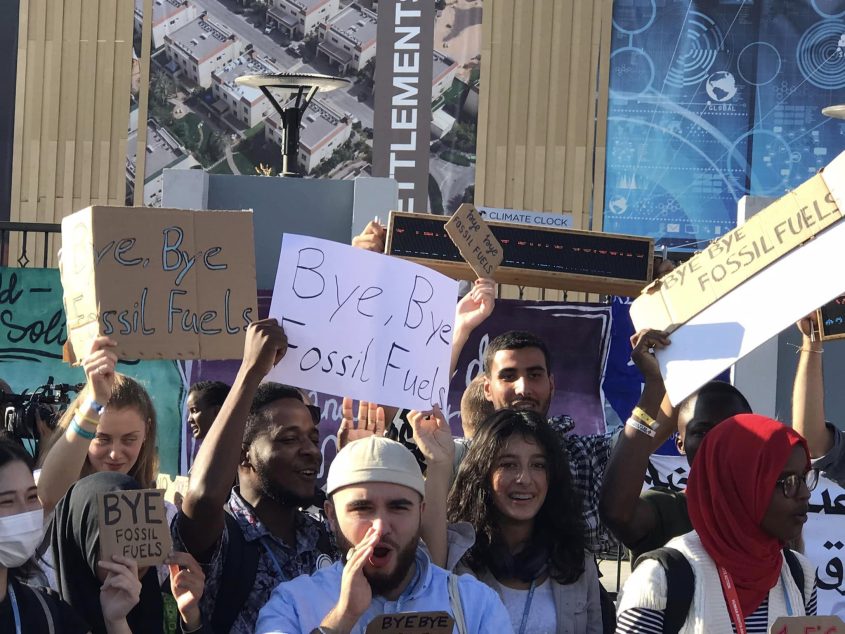
    Bye bye fossil fuels

  • Heartening news from the UN General Assembly -Vanuatu leads the way in signing the Fossil Fuel Non-Proliferation Treaty

    Heartening news from the UN General Assembly -Vanuatu leads the way in signing the Fossil Fuel Non-Proliferation Treaty

    Despite the General Assembly being preoccupied with the war in Ukraine there was a groundbreaking moment when Vanuatu became the first nation state to sign the Fossil Fuel Non Proliferation Treaty.

    Press Release from the Fossil Fuel Non-Proliferation Treaty Organisation.

    NEW YORK CITY – 23 September 2022

    Today, Vanuatu called on other nations to join them in establishing a Fossil Fuel Non-Proliferation Treaty, a proposed international mechanism that aims to explicitly address the source of 86% of CO2 emissions that cause climate change: fossil fuels. 

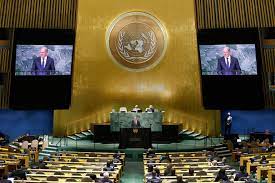
    The President of Vanuatu His Excellency Nikenike Vurobaravu made the historic call on the floor of the UN General Assembly, making Vanuatu the first nation-state to call for an international mechanism to stop the expansion of all new fossil fuel projects, and manage a global just transition away from coal, oil and gas. The President of Vanuatu will also launch their call for a Treaty to phase out fossil fuels on stage at the 2022 Global Citizen Festival in Central Park this Saturday.

    In his speech, President Nikenike Vurobaravu said: “Every day we are experiencing more debilitating consequences of the climate crisis. Fundamental human rights are being violated, and we are measuring climate change not in degrees of Celsius or tons of carbon, but in human lives. This emergency is of our own making. Our youth are terrified of the future world we are handing to them through expanding fossil fuel dependency, compromising intergenerational trust and equity. We call for the development of a Fossil Fuel Non-Proliferation Treaty to phase down coal, oil and gas production in line with 1.5ºC, and enable a global just transition for every worker, community and nation with fossil fuel dependence.”

    The call for a Fossil Fuel Treaty has already been endorsed by more than 65 cities and subnational governments around the globe, including London, Lima, Los Angeles, Kolkata, Paris and the Hawai’i State Legislature. Recently the proposal has also been supported by the Vatican and the World Health Organisation.

    Significant momentum has built behind the proposal in recent months and Vanuatu’s call for a Fossil Fuel Non-Proliferation Treaty is a pivotal step toward building formal diplomatic support for the proposal. Similar moments were pivotal in the legal pathway toward treaties to manage the threats of nuclear weapons and landmines.

    This historic call doubles down on Vanuatu’s commitment to climate action, following their submission earlier this month of one of the world’s most comprehensive climate targets under the UN. Vanuatu has also been leading a campaign to have the International Court of Justice issue an opinion on climate justice and human rights, which paves the way for a new era of international climate policy focused on equity and justice and addressing the biggest drivers of the climate crisis – coal, oil, and gas.

    Vanuatu, an already carbon-negative country that absorbs more emissions than it produces, is rated the country most at risk of natural disasters according to the United Nations. Countries on the frontlines of this crisis have been calling for urgent, tangible action on climate as they face the impacts of climate change and sea level rise in real-time. 

    Brianna Fruean, a Pacific Climate Warrior and 2022 Global Citizen Prize Winner said: “Vanuatu’s call today is a vital investment in our future. They’ve heard the call from our youth that there’s no future for us in fossil fuels and listened. It’s time for other world leaders to do the same”

    Pacific leadership has been essential to the international approach to climate change. Vanuatu’s call for an international framework to manage a just transition away from fossil fuel production sends a very strong message of hope, determination and urgency, both globally and regionally to Australia and New Zealand. 

    Kalo Afeaki, Pacific Climate Warrior from the Kingdom of Tonga, said: “Fossil fuels did this, and if we continue to burn them, we will see more islands in the Pacific, islands like my home of Tonga disappear. We need countries to be bold, because we have run out of time. The future scares me – we need to phase out fossil fuels, we need countries to endorse the Fossil Fuel Non-Proliferation Treaty and we need them to do so now.”

    Mary Gafaomalietoa Sapati Moeono-Kolio, Pacific Treaty Champion, New Zealand Climate Action Network Board said: “By calling for a Fossil Fuel Non Proliferation Treaty, Vanuatu has once again showed the world the Pacific’s climate leadership. The treaty will be a way forward and will complement the goals of Paris to limit emissions by cutting off supply and accelerating the Just Transition. There is no other way to 1.5 – the world must now respond.” 

    This historic first call reinforces the global momentum around the proposed Fossil Fuel Non-Proliferation Treaty. For the past two years, the proposed Fossil Fuel Treaty has gained support from thousands of civil society organisations, major cities, hundreds of Parliamentarians, Nobel Laureates, Indigenous peoples, trade unions, faith leaders, youth activists and health professionals. Now the proposal has been made by Vanuatu within the international policy arena.

    Here’s hoping the call to other states to follow will be heeded, hopefully supported by carbon pricing policies which make decarbonisation the logical path.

  • Avoiding a shock to the system

    Avoiding a shock to the system

    No system is perfect. Corvid-19 has shown us that. As Britain grinds to a halt, what would have happened if we had tried to carry on as normal as the work dried up, employees laid off with no pay, companies went bust, and no benefits or sick pay for days? Our High Streets could close for good during a terrible recession, led by the biggest fall on the stock markets since 1987. 

    And, thank goodness, despite that we have a government traditionally of low taxation and a small welfare state, there was a quick realisation that our free market economy – which has given us a safe, stable country – could not cope. It was time to throw in a lifebelt and shore up the weaknesses of the system: relaxing benefit rules, paying salaries.

    From a fiscally-Conservative point of view it works because people still have jobs and money to spend which protects growth.

    From a socialist or populist-Conservative point-of-view it works because it looks after people.

    Now, think about something else that’s killed millions of people, not only those with underlying health conditions but, in fact, has given people underlying health conditions.

    Of course I’m talking climate change and air pollution. These are caused by another failure of the system: encouraging that which creates monetary wealth irrespective of the poverty it causes to the environment and climate.

    To abate this problem, we could simply stop burning fossil fuels (and meat farming).

    But the Coronavirus crisis has shown that putting the brakes on the usual run of things shocks the market and throws it under a bus. You save the climate but chuck the world into chaos. People lose their livelihoods. Anxiety and poverty is rife. And the effect would quickly be temporary.

    So we can’t ban burning fossil fuels overnight, even though that may feel the obvious solution to desperate times. We need to make them redundant, make them a bad investment by easing them out of our economy and giving the market fair warning. Prices will go up so people need a financial cushion before more cheap clean energy comes online. And the fix would stick.

    It works because it protects the economy, it protects jobs and the people the economy is there to serve.

    This is the beauty of a Climate Income.