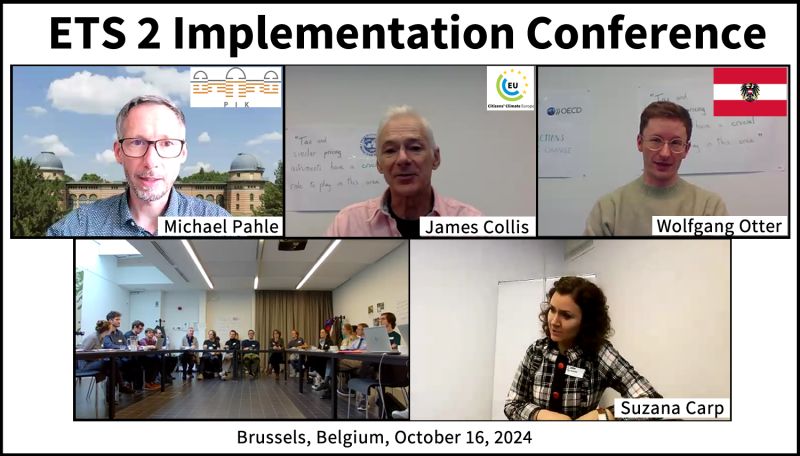
At the beginning of 2027, the European ETS2, which aims to successively eliminate 40% of EU greenhouse gas emissions through higher fuel prices, will be launched. This July the European Commission already firmly reminded member states (except Austria) to implement ETS2 in national law. At the same time, uncertainties about future prices are high and governments seem unprepared to react to this uncertainty and ensure public support for ETS2. Enough reasons for Citizens’ Climate Europe to bring together a range of perspectives on possible solutions in a hybrid event (in Brussels and online) on 16th October.
We first heard from Michael Pahle, Head of Working Group “Climate & Energy” at @Potsdam Institut für Klimafolgenforschung, about ETS2 price evolution and the potential of rebates to cushion excessive increases. After a brief explanation on what sets prices, he showed scenarios (not predictions!) of prices ranging from EUR 71 to 261 per ton CO2 in 2030. He emphasised that in addition to price levels, volatility can be a concern. Stability mechanisms act with a delay, while higher prices for certificates would be passed on to consumers much faster. Together, this creates a case for rebates to citizens as a ‘social stability mechanism’ acting fast if prices increase ‘excessively’. Michael Pahle closed with recommended preparation for member states.
I was the next speaker, taking a wider view on carbon pricing, quoting OECD’s and IPCC’s recommendations as well as the FASTER principles for effective carbon pricing. This set the scene for comparing existing carbon pricing schemes, at €50/t or more, through the lens of these principles. The F in FASTER stands for ‘Fair’, a key criterion for public support, leading to a discussion of possible implementations of Climate Income (also known as Climate Dividends, Klimabonus, Klimageld) highlighting tools and a possible policy workshop for policy makers.
The final talk of the event was by Wolfgang Otter, Department Head Klimabonus at Austria’s Ministry of Climate Action, Environment, Energy, Mobility, Innovation and Technology, who took us behind the scenes of how a climate dividend, argued for by Michael Pahle and James Collis, got implemented in Austria under the name of Klimabonus. He outlined the main features, i.e., that everyone receives it, that amounts are regionally staggered taking into account increased costs for mobility in more rural areas, that since 2024 Klimabonus is taxed for high income households to increase fairness, and finally that Klimabonus is part of a larger group of measures. He emphasised the importance of simplicity, warning attendees of the trap of fake specificity and recreating social measures that already exist and that adding design complexity significantly impacts implementation cost and success. Finally, he outlined the surprisingly simple but logistically challenging process of paying Austrian citizens’ via bank transfers or vouchers sent by post. He closed his talk with giving us a behind the scenes insight into reactions by the public.
These talks were followed by a lively Q&A, ranging from detailed questions about the Klimabonus in Austria to more general questions on social and regional staggering and supporting citizens in investing to decarbonise their lives.
Taken together, the event provided a fascinating insight into the challenges the introduction of ETS2 will result in as well as possible ways to make carbon pricing not only effective, but also socially fair.
Many attendees requested further follow-up and we are excited to understand the specific reasons and see if we are able to support further in the coming weeks and months.
The next UK government must address the cost of living crisis. It’s also clear from public data that the climate crisis is an ongoing concern for 75%. Now there is the opportunity to kill multiple birds with one stone. The latest developments in the EU Green Deal are contributing to international momentum on the subject of carbon pricing. If the UK wants a closer relationship with Europe, aligning on this key environmental policy offers a number of additional social and economic benefits.
Carbon pricing, also known as carbon taxation, is overwhelmingly the fastest and most effective tool to cut greenhouse gas emissions. No one claims carbon pricing solves everything, other policies are needed, just that it’s the most important thing to do. Carbon pricing is a cornerstone of the EU Green Deal and improves the effectiveness of all other climate policies. The World Bank tracks international carbon pricing development both in terms of coverage and price level, i.e. how many emissions are covered and at what price.
Currently the UK prices 40% of carbon via the Emissions Trading Scheme (ETS) which applies to large scale industry (and is almost invisible to consumers). The UK carbon price floor legislation adds strength and has been effective in dramatically reducing coal from UK electricity production. The EU is extending the ETS to Buildings and Road Transport (ETS2) with further expansion under discussion. The same approach in the UK would increase carbon pricing coverage to over 80% and have a direct impact on all households.
Although most poor and middle income families use much less energy than the richest, it’s a higher proportion of their income. This form of taxation is inherently regressive, hurting the poor more than the rich. Climate Income, where the proceeds of the tax are given back equally to people, makes the vast majority of poor families and most middle income families better off. Making carbon tax popular and progressive in this way is well understood.
The challenges for politicians in implementing Climate Income are that the public are wary that “tax” means they will likely be worse off, and industry is concerned about international trade competitiveness. The information on these first two issues has improved considerably, though there remains pressure from the fossil fuel lobby, which is still more powerful and better funded than the emerging green industry.
The recent OECD report International Attitudes Toward Climate Policies surveyed 40,000 citizens from 20 countries. It found that people want to know that the policy works, is fair, and how it will affect them. The report showed that 5 minute videos can build public support, showing fairness by redistributing revenue equally protects poorer households. For the UK, confidence in public support for Climate Income is reinforced by the Scottish Climate Assembly with 77% support for this specific policy.
Industry fears about “carbon leakage”, when trade and jobs are lost to companies in other countries with lower pollution costs, have often been highlighted as an economic risk. The EU has now taken on this issue directly with the Carbon Border Adjustment Mechanism (CBAM). It is prompting action in relation to carbon pricing from the US, China and India. Evidence from US industry implies that the UK not only has nothing to fear, but in fact has much to be gained. Energy intensive UK industry is highly competitive and is effectively leaving money on the table by not pricing international emissions.
Whatever the UK’s desired trading relationship with Europe, there are proven examples of Climate Income. Canada and the UK today have similar trading structures with the EU. Canada introduced The Greenhouse Gas Pollution Pricing Act in 2019 rebating 90% to households. Expert consensus is growing that this is the best solution for Canada. Switzerland is in the European Free Trade Agreement and outside the EU. In addition to an aligned EU ETS, as the UK has, Switzerland prices domestic fuel at €120 with 67% returned to households. Austria is in the EU, in the Customs Union and the Euro Zone. Specifically in preparation for the ETS2 Austria introduced KlimaBonus (Climate Bonus) returning 100% to households.
Being outside the EU may have advantages, EU member states have concerns about legislative complexity and price volatility. Especially when simpler alternatives like a national carbon price are encouraged by Sweden and considered in Germany, where civic society is demanding the government deliver the manifesto promise for KlimaGeld (Climate Money). The UK carbon price floor legislation has the potential to provide harmonised and less volatile pricing than either the ETS or ETS2. Predictability is very helpful to the longer term planning and certainty needs of industry highlighted in the FASTER principles for successful carbon pricing.
Climate Income is a zero cost policy that addresses two of the top concerns of the public. With the prevailing international winds blowing in support, it does more to reduce emissions than anything else. It’s good for international trade, the economy and jobs. Most households are better off. And it’s endorsed through the biggest statement by economists ever, including every living Nobel Laureate Economist. Time to act on the advice of experts.
N.B. This article argues for a similar policy advocated by the Young Liberal Democrats described as “A Progressive Carbon Tax” in their Policy Book from 2021. There is an updated European Young Liberal (LYMEC) policy “6.11 The Adoption of C02 Taxes and Tariffs by the EU” in their 2024 Policy Book that shows further support.
Article published in the Green Liberal Democrat Website and Challenge magazine, May 2024.
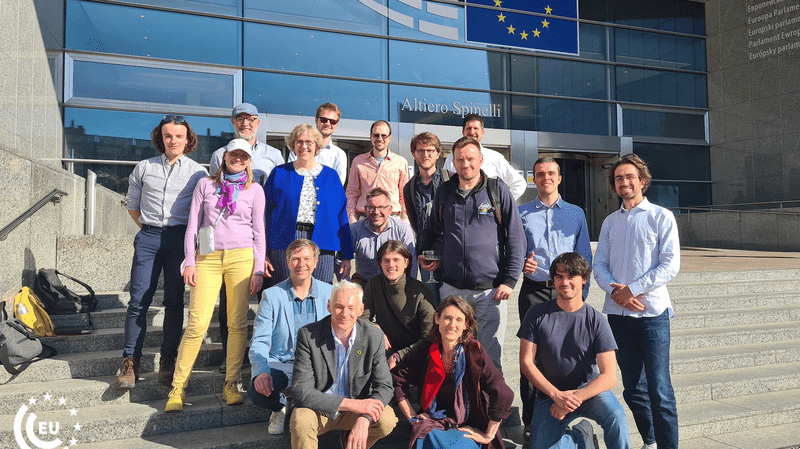
I am the Chair at Citizens’ Climate Europe and a Member of the EU Climate Change Expert Group for ETS2 Implementation. (Front left in photograph of Citizens’ Climate Europe members from CCL members from France, Germany, Belgium, Sweden, Finland, Poland, UK, Portugal and the Netherlands).
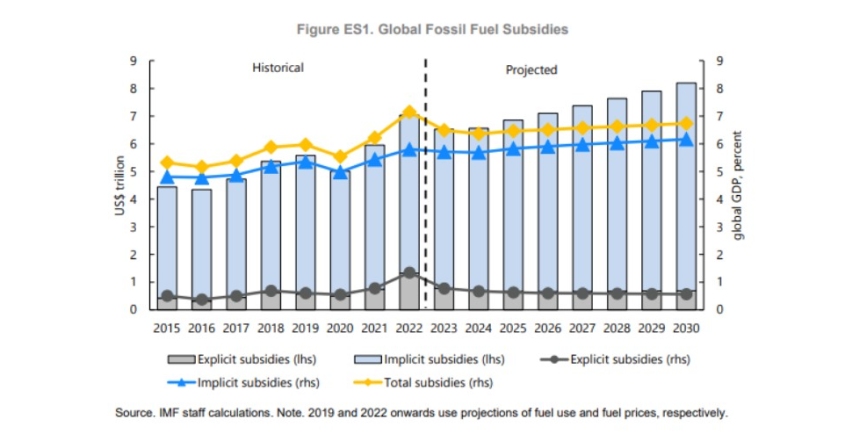
The IMF, Carbon Pricing and Explicit and Implicit Fossil Fuels Subsidies
Here are two terms that anyone who wants to preserve a stable climate needs to know: explicit fossil fuel subsidies and implicit fossil fuel subsidies.
Explicit fossil fuel subsidies from governments directly reduce the price of fossil fuels, thus making it attractive to investors and consumers to buy. Implicit fossil fuel subsidies are the costs taxpayers and insurance are paying for the air pollution and climate impacts experienced because of dirty fossil fuels.
On August 24, 2023, the International Monetary Fund (IMF) released a report. The conclusion of this report was that subsidies for oil, coal, and natural gas cost the equivalent of 7.1% of global gross domestic product.
Explicit subsidies have more than doubled since 2020 but are still only 18% of the total subsidy amount, while nearly 60% is due to implicit subsidies.
Here is a hopeful conclusion from the report: “Full fossil fuel price reform would reduce global carbon dioxide emissions to an estimated 43 percent below baseline levels in 2030 (in line with keeping global warming to 1.5-2C), while raising revenues worth 3.6 % of global GDP and preventing 1.6 million local air pollution deaths per year.”
Making polluters pay (a.k.a carbon pricing) offers us the exact tool needed to ensure this price reform. In fact, the IMF Managing Director Kristalina Georgieva at the Paris Summit in June said, “Our analysis shows that without a carbon price, there is no chance that we will meet the 1.5 degrees Celsius target by 2030. We will miss it.”
Our only home, Earth, has just passed through the hottest three months on record. With the fires, floods, horrendous storms, cryosphere melting and the threats to the Gulf Stream, it is obvious that the impacts of climate change are no longer just a concern for future generations, but are a very real threat at our doorstep. We must listen to the experts and cooperate to enact or strengthen our essential climate policies such as carbon pricing going forward. Happily there are 70 carbon pricing initiatives world wide and the African Summit issued a unanimous call for world leaders to support global price on carbon pollution on September 6, 2023.
The Fossil Fuel Industry Funded Climate Disinformation for Decades
Even to this day, there are individuals who deny or downplay the link between the burning of fossil fuels and the impacts that pollution has on our climate and health. How did this happen?
Key players in the fossil fuel industry knew decades ago that burning coal, oil, and methane gas to warm our homes, power our cars, and generate electricity was warming the planet. Instead of acting on the knowledge, they began financing a massive disinformation campaign. Now, as a consequence, youth are having to fight for their inalienable right to have a safe and liveable future.
Happily, when you inform people that the fossil fuel industry funded a climate disinformation campaign for decades, people are more likely to believe you when you present solutions.
Both Labour and Conservative politicians have been spooked by the narrow by-election win in Uxbridge which has been squarely attributed to campaigning on the proposed extension of the Ulez scheme. Few commentators pointed out that Manchester, Bristol, Birmingham and Bradford received a combined £230m in Government funding for their scrappage schemes, but London and the South East have received none.
Press coverage has rightly pointed out that people should not be made poorer by ill thought out schemes which could be said to put the cart before the horse. There are politicians in both parties who are calling for unpopular policies to be dropped or postponed but neither party is denying the need to reach net zero.
Sam Hall, director of the Conservative Environment Network, told The Observer that …“Environmental policies are an electoral asset when they are fair, affordable, and deliver for people and their communities. I’d warn Conservatives against listening to calls to ditch environmental commitments following the Uxbridge result. Insulating people’s homes, building more renewables, and attracting investment into new clean industries are popular, bill-cutting and job-creating.”
A blog he wrote for CEN points out that…The Conservatives secured a victory against the odds by focusing the campaign on ULEZ expansion. They effectively pulled off a protest vote against an unpopular mayor instead of the usual dynamic of voters protesting the government. This strategy won’t work at a general election, when the party will be asking for a fifth term in government. Senior Conservatives must resist calls to ditch conservative environmental policies. (Over 150 MPs and Peers have signed up to the CEN).
What the by-election shows is that policies which create financial hardship won’t work and in fact will be as counter productive as the tax imposed in France which led to the Gilet Jaunes revolt. Climate Income along with grants or loans based on future carbon dividend payments would go a long way to achieving the decarbonisation of the economy without penalising most people (as outlined in our report published last October).
Whilst not asking directly for Climate Income the Times editorial today puts the case for a Carbon Tax…..The message from policymakers must be that mitigating climate change can best be tackled through the continual innovations that are characteristic of market economies. And that doing so, using the price mechanism to encourage new technologies, is practical. It is widely understood that a carbon tax would be highly effective in persuading consumers and businesses to switch their energy consumption and behaviour. This would need to apply to carbon consumption and not only production, lest richer countries merely outsource their production to poorer economies. Revenues from a carbon tax could be used to subsidise renewable sources of energy and thereby encourage their wide adoption.
Update 25/7/23
Today Lord Deben (outgoing Chair of the CCC) has asked that parties build a cross party consensus on tackling climate change and getting to net zero, based on the recommendation of Chris Skidmore’s UK Net Zero Review. ….“If I were leader of the Labour party at this moment, I know exactly what I’d do,” said Deben. “I would say to the current government: ‘Here is Mr Skidmore’s report, he is a Conservative ex-minister, he was asked to do this report to show how best to deliver net zero by Liz Truss. Now we will accept, if you put it forward, we will do the following basic things [acting on the report’s recommendations]. We will do that. We won’t oppose it. You put them forward, we’ll back it.’” ………..There are those who don’t really take onboard the urgency of climate change, and they are in all political parties.”
Let’s remind our politicians that there is not only no justification for dropping commitments to net zero while Rhodes burns and people die, but also no need!
Tomorrow’s national meeting will be dedicated to this action
A recent report discussed research on attitudes towards climate change and solutions which included Climate Income. The research covered 40,000 respondents from 20 countries representing 72% of global CO2 emissions. The results show climate policy support hinges on three key beliefs:
• effectiveness – does it work ? • inequality – is it fair ? • household self-interest – will we be better off ?
Good News:
Over 80% of people agree that climate change is important and that their country should take measures to fight climate change.
Bad News:
Informing people about the impacts of climate change, with climate impact videos, has little effect…..(to quote a much loved TV character ‘We’re doomed’!)
Good News:
Addressing these concerns, with more positive climate policy videos, can substantially increase the support for climate policies. In particular, for carbon tax with transfers (Climate Income), policy support grew more than double any other policy type. Showing just the policy video, support increases on average by ~10%. In Europe that varies between 8% in France to 15% extra support in Italy. Showing both videos raised the average support across European countries by over 14%.
It is interesting to note that, even before the video viewing, the concept of a carbon tax with the proceeds returned to household garnered wide support in high income European countries. Among those who expressed an opinion support for the policy ranged an average of 54% to 71%.
We tested the video in Brussels with NGOs who have their own priorities for revenue and thus are often the most resistant to citizen rebates. It prompted interest and one particular quote:
“Now I see why the citizen dividend is needed !”
I heartily recommend sharing these videos with NGOs, public, etc, I suspect legislators will also be interested.
In short: 5 minute videos can persuade most people to support Climate Income because it offers a solution to climate change rather than just making people feel either helpless or guilty.
Exposure to information on solutions is persuasive.
Additional exposure to information on climate impact helps, but only marginally.
I recently wrote this article about Climate Income for the John Ray Initiative Website. (their strapline is : Connecting Environment, Science & Christianity). I was asked to reproduce it here and I hope you all find it useful and inspiring!
What if there was a single ‘silver bullet’ policy that would bring down emissions of CO₂. Would you support it?
‘Of course!’ you say.
Ah, but would you really?
It turns out many people find it quite challenging when shown what this might involve. No, I am not talking hair shirts for everyone. The policy I want to introduce is gentle, yet has terrific leverage. You don’t need to buy the idea I am offering. At most I am asking you to give it a test drive for a few minutes. Then you can decide if you want to follow up on it and find out more, following the links.
My starting assumptions are uncontroversial: our industrial society was built on the use of fossil fuel; now we must transition to renewable energies. Yes we have very many other severe environmental challenges – but this one underpins all the others. The great carbon detox will take decades and we are behind schedule. There is no more time to waste. Personal lifestyle changes by those who are climate concerned will not be enough; some things only governments can do. Yet governments face many other crises – cost of living and economic turmoil, not to mention mass migration, famine and war. The challenge is to tackle the climate crisis in a way aligns with other pressing priorities.
Here is where the test drive begins: ask yourself “What conditions would a climate policy have to satisfy for us to say “Yep, this is the silver bullet we have been looking for”? Its not an easy question so here are my seven conditions and you can decide whether they are adequate. The policy would:
Bear down steadily but relentlessly on the use of fossil fuels. It would mean that fossil fuel extraction and use shrank and shrivelled over the next couple of decades.
Be dead simple – transparent, easy to administer, no scope for dodging or special pleading by vested interests.
Protect the less well-off and be seen to be fair.
Be business-friendly, working with the grain of economic life, not paralysing or disrupting it.
Provide a long-lasting stimulus to the demand for renewable energy, thereby encouraging investment and innovation, scaling up supply, and bringing down the cost of renewable energy.
Assist efforts to de-carbonise in other countries.
Be popular with the public (even those who are climate-confused or uninterested) and ‘lock-in’ support on a cross-party basis, long-term.
Take a bit of time to consider the list. Is anything missing? Would you be willing to support such a silver bullet policy? How do you feel about the list?
My guess is you are feeling incredulous, sceptical and now saying, more cautiously, “Well Yes, I suppose I would support it – but what is the policy, for goodness sake?!”
Here’s the answer: the silver bullet is variously known as Climate Income, or Carbon Fee & Dividend. It is comprised of three elements:
1 Carbon pricing, achieved through a steadily rising levy on fossil fuels, which funds….
2 A Climate Income, paid at a flat rate direct to all adult citizens. In Canada this is called a Climate Action Incentive Payment and in Austria it is calledKlimabonus – and it is paid direct to each citizen’s chosen bank account in both cases. Yes, you read that right: the policy has been already been adopted elsewhere.
3 A ‘Border adjustment mechanism’ to prevent fee-dodging, to avoid our exporters being disadvantaged, and to make it advantageous for those who sell to us to adopt a similar approach (for those who know about it, the EU’s Emissions Trading Scheme also involves a Border Adjustment Mechanism).
This policy satisfies all seven conditions for a silver bullet. The chart below gives some indications of how the ‘magic’ is worked, and what underpins that bold claim.
REQUIREMENT
HOW IT WORKS
1 Drive the use of fossil fuels down – and out.
The levy raises the price of carbon, year on year. Over time, carbon is simply priced out of the market.
2 Dead simple to implement
Levy collected at source from the (relatively few) owners of coal mines, and oil & gas wells, and on imports of the same. Child’s play compared to existing tax regulations (and subsidies!) affecting fossil fuels.Making regular flat rate payments to all UK residents (based on National Insurance and/or NHS numbers) requires a large capacity, very simple system.
3 Protect the least well-off; seen to be fair.
‘Polluter pays’ is well understood. Flat rate – everyone treated the same. Redistributive – most households are better off (and that’s before they switch to lower carbon products and services).The poorest households receive a significant increase in disposable income.
4 Business-friendly – eases the transition off carbon
Business associations call for it – it gives them a degree of certainty and a level playing field. Economists love it!
5 Sustained stimulus for investment & innovation in renewable energy systems
Rising demand for ‘greener’ products, services and infrastructure creates investment opportunities. Little need for the government to ‘pick winners’.
6 Assist de-carbonising in other countries
‘Border adjustment’ has this effect providing an incentive for a similar levy in countries that export to the UK, including coal, oil & gas exports
7 Popular, ‘locking-in’ cross-party support
Climate Income ensures support, including from waverers, and ‘don’t knows/don’t cares’.
I don’t expect you to take my word for any of this. To check out the claims these websites may help:
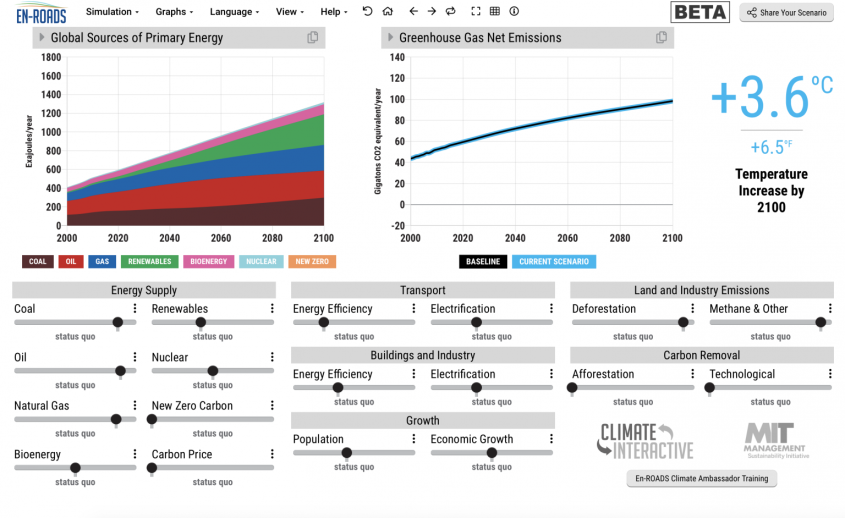
□ Regarding the importance of carbon pricing, visit the EN-ROADS site, a wonderful climate policy simulator devised by a team of climate scientists and policy analysts at MIT. You will have an array of thirty different policy levers – can you combine them to bring down carbon emissions fast enough to prevent catastrophe? It’s a powerful educational tool. If you find a way to get a good result without making assertive use of carbon pricing, and in a way that is half-way credible, politically – then please let me (and the world) know.
□ Regarding the Climate Income itself – giving the money back to citizens – this is what makes the rising fuel levy socially and politically acceptable (instead of causing riots). To get an idea of the redistributive effect it would have in the UK, visit Citizens Climate Lobby UK – one of a family of CCL websites which are stacked full of expert endorsements and campaign testimony. There is even a recent UK report on how it could work in the UK in in the face of the cost of living crisis.
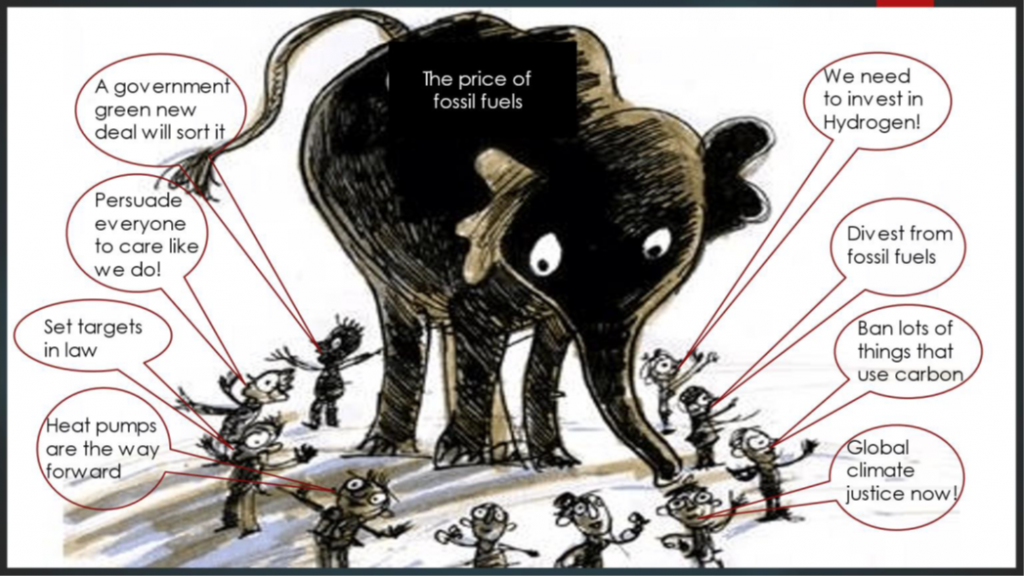
Image credit to Mini Grey from whom this version is adapted with permission
So now, how are you feeling? And have you spotted why many ‘greenies’ are uncomfortable with the idea of Climate Income? One of its great strengths – having support right across the political spectrum – seems also to cause unease.
“What? I’m supposed to march shoulder-to-shoulder with… [insert here the political grouping you love to hate].”
“ Don’t kid me that we should give-the-money-back-to-citizens-and-rely-on-the-market / allow-that-sort-of-state-interference…” [cross out the one that does not apply].
In this country we have a particularly adversarial version of democracy: things have to be done the way we, or our preferred political leaders, think is best. So discussions of climate policy easily slide into arguments between rival political philosophies – market versus state, woke against traditionalists. It’s one of several ways of taking our eye off the carbon ball. An adversarial stance leads us to thinkwe must get othersto think in the way we do, to share a large part of our world-view. We are right (and on the side of the angels); they are mistaken and need winning over.
How likely is that to happen? That’s the question I ask that when giving talks – after explaining what is known about the spread of public opinion. Basically, the research is clear: about 30% are firmly climate concerned. We would need another 20% to become the majority – and then hold that support for, say, twenty years… I say “Hands up if you believe that will really happen.” Only a few hands are raised (would you raise yours?)
And then: “Thank you. Now keep your hand up if you believe that much additional support can be won over fast enough to avoid catastrophe?” I’ve yet to have a single hand remain up.
Adversarial politics has another flaw. We greenies like to say we follow the science. Too often though, we ignore one absolutely solid finding from years of psychological research:uninvited efforts to persuade are the best way to get others to dig in their heels!
Politics doesn’t have to be adversarial. Sometimes we may need to listen more and talk less, to sympathise a bit more with others, and allow that there may be some truth also in what they say. I find it’s rare for anyone to be completely wrong. The implications are profound – and they bring us the idea of relational campaigning, a very different way of ‘doing politics’. It’s beyond the scope of this post to go into this. You can find out more on the websites of Citizens UK, and Citizens Climate Lobby.
Meanwhile a growing number of people are quietly ploughing this furrow under the radar as a way to bring in a Climate Income. Perhaps you might consider joining them…? Remember, you do not have to give up on any of your existing campaign commitments. Climate Income turbo-charges other climate initiatives; it doesn’t undermine them.
Rob Paton is a Quaker. Before retirement he was Professor of Social Enterprise at the Open University. He is active in the Thames Valley chapter of Citizens UK.
Note to see more CCL UK articles by and about Rob Paton and the brilliant work he is doing with Citizens UK please type Rob Paton into the website Search function .
I have just sent a quick email to my MP about the decision to approve Woodhouse Colliery. He, thanks to the efforts of our local CCL group, understands and supports the case for Climate Income but I would have written even if I was not campaignong for Climate Income. The decision makes no sense even under ours and Europe’s current carbon pricing system (ETS).
I am perturbed that the Woodhouse colliery has been approved, ostensibly to prevent the need to import coking coal, yet….There are only two potential customers for this coal in the UK: Tata Steel and British Steel. Yet Chris McDonald, chief executive of the Materials Processing Institute, said earlier this year: “British Steel have said they cannot use the coal from this mine because the sulphur levels are too high. Tata Steel have said if the coal were available, then they may or may not use a small amount. There isn’t anyone in the steel industry who’s calling for the mine.”
This retrograde step delays the industrial changes needed to move away from fossil fuels and will decrease our future competitiveness. We will also lose the credibility and leadership we gained at COP26 with the Powering Past Coal Alliance. As the future for steel is acknowledged to be smelting using green hydrogen and electrolysis for recycling steel we would do better to invest in green hydrogen. According to the LGA Cumbria could have 6,000 new jobs by 2030 with the right investments in green infrastructure, with 600 in Copeland.
BEIS has had a 250 million Clean Steel fund since 2019 and an Industrial Energy Transformation Fund, lets use it to get ahead of the game and future proof our industry. Germany and Sweden are already piloting the technology, we will fast lose any competitive edge if we stick to this outdated technology the industry doesn’t want. With a sensible carbon pricing mechanism like Climate Income the price of coal coking of steel would also soon lose any competitive advantage, and it may even do so under ETS. The decision could be called Luddite, or at least extremely short sighted!
I think we need to show our MPs that the decision was foolhardy to say the least. Send them an email or maybe a Christmas card to show that bad decisions on energy and industrial strategy will always come home to roost!
Enable a global just transition for every worker, community & country.
and:
“phase out fossil fuels as soon as possible”
“halt all new investments in fossil fuel extraction”
“end fossil fuel subsidies”
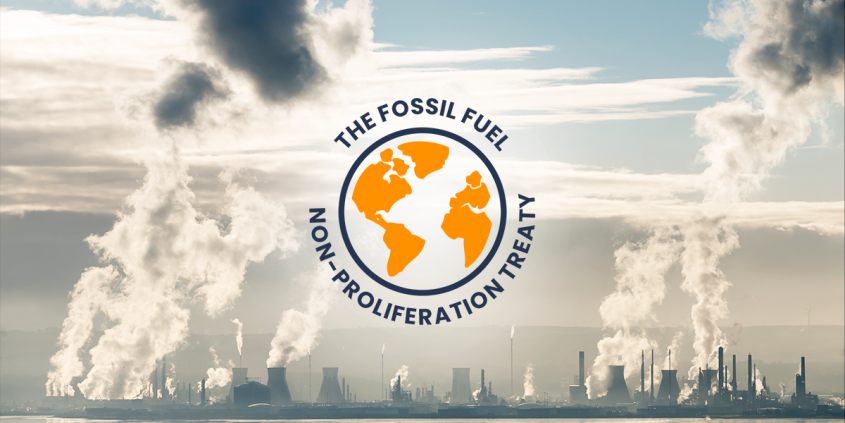
Parliamentarians Call for a Fossil Free Future is a global network of close to 500 legislators from every continent (including the UK) who have called for “new international commitments and treaties, complementing the Paris Agreement, to address the urgency of a swift and just transition away from fossil fuel energy”
Marie Toussaint, French Member of the European Parliament said….
“It was absolutely crucial, ahead of the COP27, to remind European leaders that they cannot use the ongoing energy crisis as an excuse to deepen our dependency on fossil fuels. The call made today by the European Parliament to adopt a Fossil Fuel Non-Proliferation Treaty and phase out all direct and indirect fossil fuel subsidies by 2025 must now be heard by the European Commission and Member States. The EU must also acknowledge its climate debt, and the fact it has been a major polluter, responsible for greenhouse gas emissions over centuries. We have to find ways, within this non proliferation treaty, to ensure justice at global level for those who won’t earn the money they could through fossil fuel extraction.”
Risa Honiveros, Senator of the Philippines and initiator of the Parliamentarians’ Call for a Fossil Fuel Free Future , stated…
“In recent months, parliamentarians on every continent have called for new international commitments and treaties to address the urgency of a swift and just transition away from fossil fuel energy. It is great to see this gaining momentum with the proposed Fossil Fuel Non-Proliferation Treaty which has now been called for by the President of Vanuatu, the President of Timor-Leste, the Vatican and now the European Parliament.”
The main European Parliament resolution on COP27 also stated that it …
Welcomes the fact that several EU trading partners have introduced carbon trading or other carbon pricing mechanisms and invites the Commission to further promote this and similar policies on the global scale; looks forward to a speedy agreement with the Council on the proposal for a socially just EU carbon border adjustment mechanism that includes an effective carbon leakage mechanism and to its effect of pushing a global carbon price, which will contribute to reducing global carbon emissions and to the achievement of the Paris Agreement goals;
It also acknowledged the need for Loss and Damage finance….
Welcomes the fact that the Glasgow Climate Pact underlines the importance of adaptation and the need to scale up action to enhance adaptive capacity, strengthen resilience and reduce vulnerability to climate change; notes in this regard that 47 countries submitted Adaptation Communications or National Adaptation Plans in the last year, and expects other countries to submit their Communications in line with the Paris Agreement; welcomes the creation of a new Glasgow Dialogue on Loss and Damage which should focus on funding arrangements to avert, minimise and address loss and damage associated with the adverse impacts of climate change;
Citizens’ Climate International has welcomed the Fossil Fuel Non-Proliferation Treaty initiative which was launched on September 2020 and has been working with them since 2021.
A Guardian reporton the 5th October examines the predictions of a chapter in the current IMF half yearly World Economic Outlook report. It has a chapter titled Near-Term Macroeconomic Impact of Decarbonization Policies. The chapter models the cost of delaying the tackling of climate change until ‘conditions are right’ and current global inflation has lowered; an IMF blog about it is titled.. ‘Further Delaying Climate Policies Will Hurt Economic Growth…The transition to a greener future has a price—but the longer countries wait to make the shift, the larger the costs’.
The blog argues that concerns about current cost have been perceived to be more real than the nebulous future threat of climate change, causing decades long procrastination …’despite overwhelming evidence that any short-term costs will be dwarfed by the long-term benefits (with respect to output, financial stability, health) of arresting climate change (October 2020 World Economic Outlook; IPCC 2022).
The current crisis has heightened the fear that climate mitigation would just raise inflation further and led to the claim that we need to double down on fossil fuels for energy security (as in the UK). Concurrently a Global Energy Monitor report states that…
New oil and gas development in the North Sea could produce up to 984 megatonnes of CO2 equivalent and contribute to the United Kingdom exceeding its carbon budget for 2023-2037 by a factor of two.
The IMF’s modelling uses the revenue from gradually rising greenhouse gas taxes returned in part to households to drive the transition….
To assess the short-term impact of transitioning to renewables, we developed a model that splits countries into four regions—China, the euro area, the United States, and a block representing the rest of the world. We assume that each region introduces budget-neutral policies that include greenhouse gas taxes, which are increased gradually to achieve a 25 percent reduction in emissions by 2030, combined with transfers to households, subsidies to low-emitting technologies, and labor tax cuts.
It argues that the policy, if started now would have a modest decline in GDP and rise in inflation, slowing global economic growth by 0.15 to 0.25% and rising inflation by 0.1 to 0.45; but if delayed until 2027 with the rationale of waiting until inflation is down the effect on the global economy would be worse….
Is it reasonable to wait—as some have proposed—until inflation is down before implementing climate mitigation policies? We ran a scenario delaying implementation until 2027 that still achieves the same reduction in cumulative emissions in the long term. The delayed package is phased in more rapidly and requires a higher greenhouse gas tax, since a steeper decline in emissions is necessary to offset the accumulation of emissions from 2023 to 2026.
The results are striking. Even in the most favorable circumstances when monetary policy is credible and the transition to decarbonized electricity is rapid, the output-inflation trade-off would rise significantly; GDP would have to drop by 1.5 percent below baseline over four years to drive inflation back to target. Delay beyond 2027 would require an even more rushed transition in which inflation can becontained only at significant cost to real GDP. The longer we wait, the worse the trade-off.
The take home message? ….if the right measures are implemented immediately and phased in gradually over the next eight years, the costs will remain manageable and are dwarfed by the innumerable long-term costs of inaction.
Worldwide adverse weather events this summer have reinforced the moral imperative of Loss and Damage funding, in particular the damage caused by flooding in Pakistan, a nation which contributes less than 1% of worldwide greenhouse gas emissions.
Last year there were several papers which argued for the solution of a global Climate Income policy to level the playing field between those who have historically benefited from fossil fuels and the global south. Oxfam is also interested in the concept. On Monday the 19th September the Guardian reported that a discussion paper has been prepared for the UN General Assembly meeting this week to ask for a ‘climate related and justice-based global tax’, possibly raised by a global carbon tax.
Antigua and Barbuda have also submitted a discussion paper to the Assembly, warning that increasing sea and air temperatures in the Caribbean could create a superstorm within years that would wreak £7.9bn of damage in the island nation alone, six times its annual GDP. Walton Webson, Antigua and Barbuda’s ambassador to the UN and chair of the Alliance of Small Island States, said: “[We] deserve to live without the looming fear of debt and destruction. Our islands are bearing the heaviest burden of a crisis we did not cause, and the urgent establishment of a dedicated loss and damage response fund is key to sustainable recovery. We are experiencing climate impacts that become more and more extreme with each passing year.”
Here’s hoping that the discussions will be productive; at the very least that an agreed framework for the delivery of Loss and Damage funding can be agreed at COP27, if not sooner, and ideally that the case for a socially just global carbon price will be heard and agreed!