First, introduce a carbon tax across all industries to price emissions into the market, closing a huge economic loophole. By gradually increasing the tax, we not only incentivise lower emissions on the supply side, but we also drive demand for low-carbon alternatives.
Second, redistribute the revenue equally to all citizens. This protects the most vulnerable consumers, who already have smaller carbon footprints, from fuel poverty. The wealthiest people with the biggest carbon footprints would see their costs rise, but for the majority, costs would be neutral.
Third, introduce carbon border adjustments. This policy would prevent emissions being transferred offshore, but also protect many UK businesses, especially our vibrant small business community, from competitors in countries without a carbon tax. This policy would help drive many of the others at a time when we need real urgency. Darrin Charlesworth Citizens’ Climate Lobby UK
Congratulations Darrin for succinctly and elegantly summarising how Climate Income would enable the true price of carbon to be reached – thus making decarbonisation a no brainer without impoverishing everyone!
Wiltshire CCL member Jane Renwick recently realised that a hallowed broadcasting institution which likes to think it is ‘cutting edge’ could do with shaking up when it comes to the most important issue of our time!
But I know that CF&D makes sense and it frustrates me that so few people are talking about making it happen.
” …..My grasp of CF&D is pretty akin to my knowledge of plumbing: I have a gist of an idea of the general principles (and the disasters that can occur if it’s not done properly) but not a lot of confidence when it comes to discussing anything beyond the tap that I’m turning or the chain that I’m flushing. Similarly, my knowledge of the workings of government and politics is weak, as is my understanding of economics, power production and the science of climate change. I do know a lot….. but nothing very relevant to this important issue it seems.
Our Parish Magazine carried an article by Rev Michael McHugh quoting James F Byrnes: “Curiosity will conquer fear even more than bravery will.” What an inspiring and liberating thought! So now, instead of thinking that I don’t know enough to join the debate I will think ‘I wonder what would happen if I sent a letter to Woman’s Hour’ or the Women’s Institute or another letter to my MP. What’s to lose? Surely the more people talking about it, the better.
Dear Woman’s Hour
Thank you for your recent item about women who are choosing not to have children because of fears about climate change – which illustrates just how much women are worrying about this. It is a HUGE issue for women and families. As a mother I am terrified. Sadly, I think women are struggling to visualise a positive route to addressing climate change that protects their family.
I would really like to hear Woman’s Hour address climate change, in a positive way, that presents politically effective family friendly strategies that women can campaign for, to make a real difference (in addition to recycling our clothes, reducing waste, eating less meat etc etc……)
For example – ‘Carbon Fee and Dividend’ is an approach that has been recognised by the Government as an effective method of carbon pricing that ‘has merits’ and is being considered as a way forward (The Times, 9 July 2021).
The principles are simple:
Carbon fuels are still being used because they are relatively cheap.
If the Government introduced an incrementally rising charge on carbon fuels, industry would be motivated to explore other options quickly.
Money raised would be returned to every citizen (adult and child) which offsets rising household fuel bills and benefits those who live a less carbon hungry lifestyle.
This is a fair, effective and free policy which supports families and those most vulnerable in the community.
27 Nobel prize winning economists support CF&D https://www.econstatement.org , as well as many prominent women in the UK e.g. the successful children’s author illustrator Mini Grey and another successful children’s author Judy Hindley who speaks very articulately on the subject.
Talking about us all ‘doing our bit’ just isn’t working and women need to feel empowered to push for a change at a much higher level that supports families as well as industry through the tough choices and changes ahead.
Please would you consider raising this as a topic on Woman’s Hour – firstly by going on record in declaring a climate emergency and then by raising awareness of strategies such as Carbon Fee and Dividend as a way forward that puts families and the most vulnerable into the solution.
The CCL Media Team (open to anyone) inspires members to write to newspapers and journals. We alert each other to opportunities and encourage each other’s efforts. It seems to be getting easier to get letters published because of the growing concern about climate change.
I wrote a letter in response to the article by Mark Carney in the New Scientist back in March, not only was my letter published, but also a second letter responding to a criticism of my first letter! This week another CCL Media team member, Gareth Ackland, has had his brilliant letter published:
Your excellent feature on the Climate Crisis was helpful in including a “What can I do?” section. While the impact of personal lifestyle changes is dwarfed by the impacts governments can make, if enough of us commit to reducing our carbon footprint, it can still accomplish a lot.
However, the best option for an individual is surely to collapse that power gap. Organizations such as Hope for the Future and Citizens Climate Lobby insist that the most significant action an individual can take is to engage their elected representatives in the problems we face and their possible solutions. Those of us who live in democracies often forget that the wheels of power are intended to be subject to our views and interventions. If you’re not bending your government’s ear, then who is?
Maybe I am being optimistic but three letters within two months seems to imply a growing interest in hearing about a fair and effective solution to creating the right conditions for a low carbon economy to take root. Our MPs and Councils may also be more receptive, especially if they are aware of the new IEA report!
The world needs a “radical” shift towards renewables to reach net-zero emissions by 2050 and secure the 1.5C goal.
It argues for a total transformation of the energy systems that underpin our economies, with no new oil or gas sites to be developed beyond this year. Current emissions reduction pledges are inadequate, and indeed despite past pledges emissions have risen by 60% since the United Nations Framework Convention on Climate Change was signed in 1992! (This really makes me shudder as 1992 was the year I became a mother).
“Beyond projects already committed as of 2021, there are no new oil and gas fields approved for development in our pathway, and no new coal mines or mine extensions are required.”
“We commit to promoting the increased international flow of public and private capital toward Paris Agreement-aligned investments and away from high-carbon power generation to support the clean energy transition in developing countries. In this context, we will phase out new direct government support for carbon-intensive international fossil fuel energy, except in limited circumstances at the discretion of each country, in a manner that is consistent with an ambitious, clearly defined pathway towards climate neutrality in order to keep 1.5C within reach, in line with the long-term objectives of the Paris Agreement and best available science.
“Consistent with this overall approach and recognising that continued global investment in unabated coal generation is incompatible with keeping 1.5C within reach, we stress that international investments in unabated coal must stop now and commit to take concrete steps towards an absolute end to new direct government support for unabated international thermal coal power generation by the end of 2021, including through Official Development Assistance, export finance, investment, and financial and trade promotion support.”
All the more reason to keep pushing for CFD to facilitate the move away from fossil fuels!
I am sure you will have noticed the explosion of coverage on the climate crisis over the last year, even in sections of the press which have hitherto been in denial! Often, of course, you will find that if a carbon price is mentioned it is presumed to be an assault on our way of life – cheese, meat and holidays in the sun! I do wonder if fear of the ‘red tops’ is one of the reasons why the Government stated in The Future of Carbon Pricing Report (2020) that..
While we recognise the merits of a Carbon Fee and Dividend policy, we do not propose to adopt it at this time.
Articles or letters claiming that climate change policies are bound to be punitive offer a great opportunity to respond with the case for CF&D (or use the more appropriate term Climate Income), pointing out that CI is not like the green levy or even fuel duties because the fee is returned as a dividend to offset the rising cost of fossil fuels until they are basically priced out of the market, thus making the promises made at the G7 and to be made at COP26 more likely to be achievable!
The IEA report emphasises the need for this to start now!
It takes courage to write a letter to your MP (or any of the many other people we lobby in CCL) and we’re incredibly proud of all of those members who have done so. Every letter makes a difference!
But once you’ve made that first contact you may find, as many members have, that the reply is a standard letter that ignores your key points or is jargon-filled and almost incomprehensible. What do you do next?
The temptation is to give up and move on; life is too short for “wading through treacle”. However, as many members have again seen for themselves, this can be the critical moment—an opportunity to clinch true engagement. Most correspondents do give up at this point and so you will stand out if you persist.
However, we know that this next step is daunting and that’s why we’ve created a helpdesk, an email account you can contact if you’ve had a reply and you’re not sure how to respond. It’s not quite as fancy as the picture above (it’s just three of us working from home) but we’ll do what we can to help. Just email us (if that link doesn’t start your email, right click on it and copy the address manually into an email). Attach any reply that you’ve had. We’ll get back to you and see if we can help find a constructive and respectful, yet incisive, way to take your correspondence to the next stage.
I hope many of you caught the news of top climate scientist, Jim Hansen, and his letter to Boris. I’m reposting it in this blog with Jim’s permission but without further comment except to say that much of the, unreported, segment concerns carbon fee and dividend with CCL-UK being recommended as Boris’s next port of call!
In a recent blog I mentioned the value of writing to the media to get more people aware of the advantages of CF&D and that we have set up a media team. A CCL Europe member, Brigitte van Gerven, has just written a very good explanation of why CCL Europe is planning to do the same…….
The goal is to establish a good relationship with the mainstream press and other media, make the carbon fee and dividend and CCL more well known among journalists, and to get articles, letters, and opinion pieces published in the mainstream media…..
When we go lobbying politicians their reactions are generally positive, we have their respect and we come across as people who know what they are talking about. But there are still some barriers which make politicians hesitate to go a step further and support CF&D.
1. CF&D should become more well known 2. CF&D should be broadly supported by the public 3. CF&D should be more credible e.g. backed up by experts and studies 4. CF&D should be perceived as feasible within the EU context
The media group can contribute significantly to 1. and 2. and therefore advance our cause. An article in the mainstream press genuinely attracts the attention of politicians and makes them take notice. Even more ideal would be if we succeed in starting a public discussion about the CF&D in the media.
If you would like to join our media team – just drop a note to [email protected].
We had a great response to our urgent action to contact the experts at the Climate Assembly -Many thanks to everyone who wrote. Here are a couple of examples.
Dear
Rebecca
Thank you for your
efforts on the Climate Assembly – it’s essential work and very exciting for our
global future.
I was lucky enough
to be part of the Oxford Citizen’s Assembly on Climate Change. It was an amazing
and enlightening experience. Often, how to change individual behaviour seemed to
be the issue, especially as the majority of emissions were coming from buildings
(space heating) and travel.
How do we change
behaviour? By making the
desired behaviour the easiest option and/or the cheapest option, so making the
right choices is a no-brainer.
Pricing carbon can
make this happen. But we know a rise in prices for fuel is unpopular – see
President Macron’s struggle with the Gilets Jaunes. So it seems that carbon
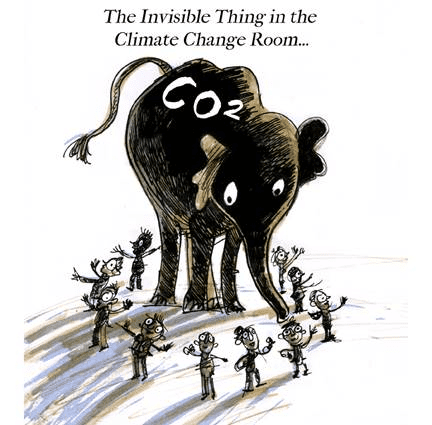
pricing is avoided as a strategy – a bit of an elephant in the
room.
But it is possible
to price carbon in a way that is fair, empowering, simple and
visible.
Carbon Dioxide is a
difficult subject to inspire passion. Unlike plastic, it
is invisible. When we emit it, we can’t see it. We can see the plastic trail
that we leave, but it’s impossible to grasp what size your own carbon dioxide
emission are. But carbon dioxide is key, because the blanket of greenhouse gases
is making Earth warm, melting the arctic and Antarctic and pushing temperatures
worldwide out of the range of recorded history, towards a new climate that none
of us or other life-forms on earth are adapted for.
But the good thing
is, we CAN change this by shutting down the flood of CO2 leaking from humankind
into the atmosphere.
HOW can we take
action on CO2?
We can take action
by putting a meaningful price on carbon, aiming towards $80-$100/tonne.
It is the nudge the
world needs. A puny 5p plastic bag charge drastically reduced plastic bag use by
85%. Pricing really changes behaviour “Our modern economy reflects countless
choices, made by billions of people all over the world. A broad-based carbon
price influences them all. Nothing else can.”
But what is the best
way to price carbon?
I’ve compared
different carbon pricing options. What I’ve discovered
is:
A Carbon Fee and
Dividend (Climate Income) stands out as the most fair, empowering, simple, and
visible way to put a significant price on Carbon.
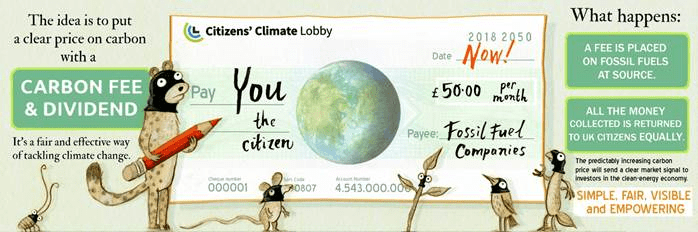
What is Carbon Fee
& Dividend?
The government
places a price on CO2 at source.
The revenue is returned equally to all citizens via a monthly/annual lump sum or ‘dividend’
I think it is the
only way to make a carbon price that is high enough for effective change to be
palatable.
There are a few good
things about a carbon fee and dividend plan. Here they are.
It can appeal to
people who call for social justice and want to battle
inequality
The lump sum system
is progressive:
it
really benefits lower earners most. The richest (and
largest users of CO2-intensive energy) benefit least. Anders Fremstad
of Colorado State University and Mark Paul of Duke University calculate that
taxing a tonne of CO2 at $49 would leave 59% of Americans worse off,
including 75% of the bottom half, if the revenue were used to lower
personal-income taxes. By contrast, recycling the receipts as lump-sum payments
(Dividends) would leave 89% of the bottom half with an average net gain of
$788.
The 6 lowest income
groups all break even or are better off, with the poorest getting the biggest
benefits. The wealthiest, highest fuel users, are the worst
off.
Compared to tax
rebates, it’s demonstrably
fair as all get an equal
dividend.
It’s also possible
to get dividends to the poorest and most marginalised sections of society, by,
for example “investigating inventive ways of paying the dividend to ensure that
the most vulnerable receive it. Linking the dividend to national insurance
numbers would be one way to pay the dividend, but this may mean that the most
vulnerable miss out. The Government should investigate whether new technology
can be used to pay the dividend securely through a mobile app to ensure as many
eligible people as possible receive it.” The Future of Carbon Pricing,
policyexchange.org.uk
It
is motivating and empowering
Through their
dividend the public can support renewables in their choice of what energy to
buy. The dividend is a visible sign of your purchasing power, and the public is
trusted to choose how to spend it; wise choices bring a win-win virtuous spiral
of energy-source-change away from fossil fuels. The dividend also gives voters
an immediate interest in the fight against climate change – a lump sum
arriving in your bank account is a very interesting event. All green energy
sources benefit by becoming comparatively cheaper.
It
sends a signal to industry that the carbon price will be a permanent
policy
The Dividend, once
people are used to it, is hard to withdraw by future governments (see what’s
happened with UK Winter Fuel Payments) – and so acts as a pledge to industry
that the carbon price will endure.
These three aspects
of carbon fee and dividend mean is can appeal to: Green and Social Groups who
want action on climate change but also social justice; the general public who
will find higher fuel prices unacceptable; businesses who want a clear steer to
what the carbon future will be.
Carbon is infused in
all our lives and all our choices. We need to tackle climate change with a way
that involves and empowers everybody, is fair and acceptable and progressive,
and that also is able to set a high enough price for carbon to bring about
change, in a way industry can see will not be overturned by a change of
government.
The following was first published in Marlborough News Online and is effectively an open letter to the newly elected MP for the Devizes Constituency (which includes Marlborough).
The election is over and, given its large majority in
parliament, we’re likely to have a Conservative government for the next 5
years. At the same time, serious action on climate change needs to be taken
within years, rather than decades, and so we must encourage the current
government to take all the necessary steps. We don’t have the luxury of waiting
for another government if you happen to not like the Boris Johnson one.
I was therefore delighted when Danny Kruger dedicated his
first blog, as our new Conservative MP, to the issue of climate change. I
was also happy with his emphasis on the important role that innovation and
free-market economics could play. There’s a Climate Crisis and we must throw
everything we have at the problem.
However, at the moment, you can make money from aggravating
climate change (e.g. by finding oil) but you cannot make money from tackling
climate change (e.g. by burying carbon dioxide underground). And guess what,
our businesses therefore drive climate change because they’d go bust if they did
anything else.
So the markets themselves need to be changed and that can
only be done through government policy. If it costs more money to pollute than it
does to take climate action then climate action will follow. It’s therefore about
taxing “bads” rather than “goods” but such taxes will have to be imposed in a
way that does not hit the least well-off in our society. This is not difficult,
as my
previous column on returning climate-tax revenues to the population as a Climate Income discusses. It was great to
see the Telegraph promoting this idea, too, in an article
it published on Boxing Day.
I’m also with Danny Kruger when he states, in his blog, that
appropriate grazing methods can reduce (but not eliminate) the climate impact
of livestock. But I disagree with his suggestion that grass-fed herds are the
solution. To enhance burial of carbon in soils you need to use more radical
approaches such as mob-grazing
(cycling large herds through a number of small fields) and silvopasture
(mixing grasslands, trees and livestock).
I’ve got one final point of agreement with Danny but, this time, it’s somewhat reluctant. It concerns a comment he made at one of the hustings, leading up to the election, when he said he disliked the term “Climate Emergency”. This earned hisses from the audience but “emergency” is defined, in most dictionaries, as a situation which is both dangerous and unexpected. Climate change is not unexpected. Scientists have been accurately predicting the consequences of increased greenhouse gas levels since the 1890s (that’s not a typo). Perhaps “Climate Crisis” is a better phrase—“Crisis” is defined as a time of intense difficulty or danger. I think that describes the situation nicely.
But then, we don’t really talk to them. Some of us do though. It’s very easy now with social media. You can even tweet animated gifs at your MP. There are plenty to choose from, but it might be better to DM them, or email them. If you really want to go overboard, you can go out and buy a pen and some paper from WH Smith or some other stationery outlet.