Category: Decarbonisation

  • Members respond to the IPPC report – Part 2

    Members respond to the IPPC report – Part 2

    Please note that these essays are not the official view of CCL UK but of some of our members…..

    Carbon Fee and Dividend is structured to provide subsidy to ordinary householders as they begin to confront the costs of transitioning to a net zero carbon economy.  

    In addition, Carbon Fee and Dividend can be expected to accelerate the overdue reallocation of capital towards regenerative enterprise that fossil fuel divestment, by for example pension funds, has already provoked.  For the mainstream of society this is vital, since a transition to a low carbon circular economy based on regeneration and sustainable limits will provide the worthwhile and purposeful new jobs needed.  Hopefully, much of this innovation will be local or even community based and so lead to a multiplier effect as more of the money circulates locally and in turn leads to yet more enterprise and benefits. 

    A capsule of the actual problems lying behind Alok Sharma’s IPPC derived warnings might read: 

    The words assumption, belief, self-interest and delusion are all words that apply to the economic model (Neoliberalism) that has grown ever since money was finally liberated, in 1971, from the limits that being tied to the gold standard imposed.  There were no externality (environmental) costs built in, not least because of lobbying and deception strategies operated by large corporations.

    They appear to overlook that their concept is also the source of inequality; or put another way “too many in Maslow Deficit” (lower 3 tiers) and moreover, that their concept is the source of the debt which begets the growth dependency needed to pay it down.  With externalities largely ignored this all translates into the environmental destruction / climate breakdown that is bringing the world to its knees!   

    Andrew Stott

    On the 9th August 2021, the Intergovernmental Panel on Climate Change (IPCC) released the first part, ‘Working Group I’, of its Sixth Assessment Report. Compiling over 14,000 scientific papers, the work of 234 scientists from 66 different countries, the report outlined and emphasised the need for immediate and drastic action to avoid a rise of over 2°C in the global temperature. A system where fossil fuels are taxed and the money returned to the public is one way to approach this, tackling both the environmental concern and dealing with the required economic traction to get it started. This is known as a carbon fee & dividend (CF&D) scheme.

    The declining cost of renewables

    Renewable energy prices are at the lowest they’ve ever been (according to an analysis by Lazard Ltd.) and the UK government predicts that levelised cost of electricity (LCOE) prices for renewables will drop even further while prices for fossil fuels will largely remain the same. 
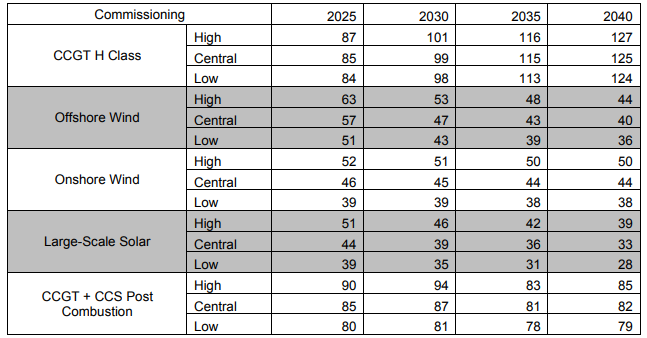
    Figure 1 – Table showing LCOE for the next 20 years in £/MWh as predicted by the UK government in their 2020 report on Electricity Generation Costs.

    The earlier a complete change to renewable energy happens, the more money that will be saved in the long run. A myriad of reasons have prevented the switchover to renewables, despite the apparent advantages they currently have over fossil fuels. The associated costs with starting a new energy plant, new fracking technology significantly lowering the cost of natural gas, existing contracts tied up with fossil fuel suppliers, increased electricity bills for the general public and seasonal inconsistencies with renewable electricity generation are just some of the reasons why, initially, a switch to renewables may not be as economically attractive as one first expects. This is why a carbon tax would ‘even the playing field’ so to speak and incentivise investment into renewables.

    The EU ETS and Britain’s departure

    Economic incentives for reducing carbon emissions are not a foreign idea to the UK. The country used to be part of a cap and trade scheme used throughout the EU. The European Union Emission Trading System (EU ETS) is the largest of its kind in the world and consists of a scheme designed to limit the CO2 released into the atmosphere by allocating emissions allowances to member nations. If a country needs to generate more emissions they can trade for these allowances from a country that has successfully reduced its own. Thus, creating an economic incentive for a country to reduce its emissions. 

    Unfortunately, on the 31st January 2020, Britain left the EU and with it the EU ETS. A similar system was designed and incorporated known as the UK ETS. Emissions trading would continue but between the 4 nations of the UK rather than the 27 member nations and 3 trading partners (Norway, Iceland and Liechtenstein) of the EU. However, the Grantham Research Institute on Climate Change and the Environment (GRICCE) indicated in their 2019 study that this would be “suboptimal” and a carbon tax would be more beneficial in reducing carbon emissions. Again, in 2019, the GRICCE theorised that “a tax of £40 per tonne of CO2 equivalent emissions turned into a £1000 annual return for UK households” would be one of the most ideal ways at reaching net zero emissions by 2050. It also recommends the £40 per tonne tax is just a starting point and the price should slowly be increased.

    How will the money be used?

    One of the main arguments against a carbon fee & dividend scheme is that the general public will bear the brunt of the tax and although environmentally beneficial, it will increase the cost of living. To low income families, an increase in the heating or electricity bill every month is very unappealing, especially as they would not experience the immediate benefits of reduced CO2 emissions. However, the scheme ensures that the money is equally distributed to everyone in a monthly dividend.
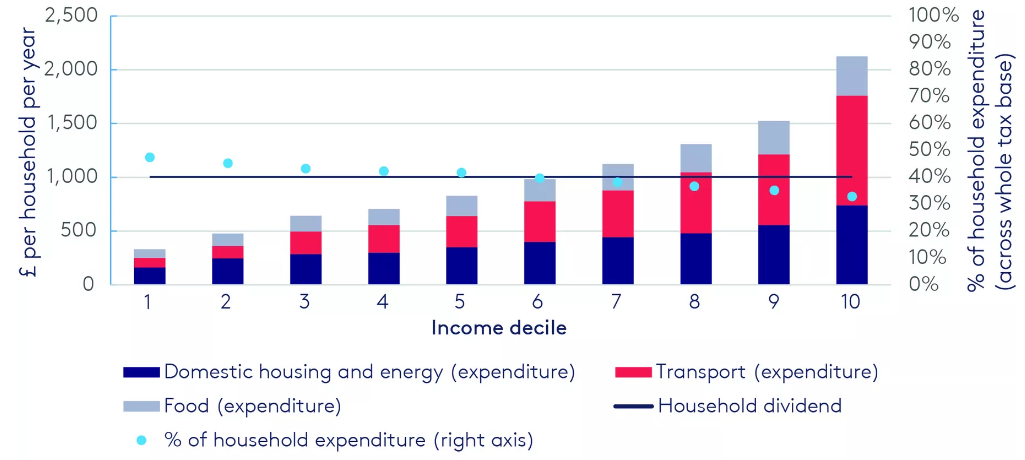
    Figure 2 – Courtesy of the Grantham Research Institute at LSE. Graph showing tax payments and dividend received by income decile.

    Looking at figure 2 we see that the lowest income decile households (1) would be better off with the flat £1000 dividend as it is a larger percentage of their total household expenditure. 

    Canada has a similar system and has been using it since as far back as 2008 (in British Columbia). Helen Mountford of the World Resources Institute states that citizens of Manitoba province, for example, would expect to see a rise of $174 CAD in cost due to the carbon tax. But receive a total rebate of $252 CAD resulting in a net gain of $78 CAD (~£45). Canada may only have a population of just over half of the UK but its CO2  emissions almost treble ours. If an industrial giant like Canada can implement a CF&D scheme and make it work, then so can we.

    The benefits of a CF&D scheme are clear. A switch to a more modern, cheaper and greener economy that will see benefits not only for our children and our children’s children but also us, we who are living currently. Alok Sharma’s warnings, ahead of COP26, are dire and desperately need to be listened to. Change is hard but if we don’t, our planet will.

    Luke Clews

  • The consensus is growing –  what surveys, petitions and the media are saying and what we can do about it…

    The consensus is growing – what surveys, petitions and the media are saying and what we can do about it…

    Reading the daily email alert from Carbon Brief is fascinating and getting more and more time consuming! I have certainly noticed a real shift of media opinion towards the climate emergency over the past year, as the effects of climate change are becoming more and more immediate. There are very few denial editorials these days even if the solutions are still hotly debated.

    The media is reporting growing support for the government to go further and faster such as a Guardian report that ‘Over-50s want climate crisis addressed ‘even if it leads to high prices’. There were also reports in the Independent and Daily Telegraph. It is noteworthy that The Times and Daily Telegraph have written about the threat of famine in Madagascar without disputing the first ‘climate change famine’ description.

    What I found most encouraging in today’s email alert was a report on an editorial entitled ‘Don’t let climate goals be lost in culture wars – cutting emissions means decarbonising the way we live, not giving it up’ which appeared in yesterday’s Financial Times.

    The editorial suggests how politicians and, by implication, campaigners should be approaching the issue of gaining public support for the changes needed to fight climate change now we can no longer rely on the low hanging fruit of removing coal from the energy mix…..

    “…trying to convince everyone they must change their lifestyles radically” in order to tackle climate change is “unlikely to work: demands that essentially put the onus on individuals will alienate too many people in an environment of insufficient knowledge about what net zero means and distrust about the intentions of politicians”..

    Instead, the message politicians must communicate is twofold. First, emphasise the facts: climate change is an urgent threat, it requires all of us to act – but if we act together, the sacrifices are far from prohibitive. Second, acknowledge that people will need help to take the right choices – and ensure that it is forthcoming. A consensus around mass adoption of carbon-reducing technologies can be achieved if adoption is rewarded and costless for those at the bottom. The alternatives – insufficient action, or calls for asceticism — will lead to division and failure.

    If that’s not an endorsement of Climate Income I don’t know what is! I also think it is a very useful hook for an email to a constituency MP, along with mentioning that over 100,000 people signed the ZeroC. petition  and even baby boomers are willing to put their money where their mouth is. (I am afraid I fit in that category but I am sure I am not alone in wanting more support and reassurance before I replace the fairly new gas boiler!)

    The UK has the chance to set an example to the world to make sure there will be no more climate change famines.

    If you email your MP please don’t forget to bcc us/forward to at [email protected].

  • If you can’t beat them, join them!

    If you can’t beat them, join them!

    I have just read an article in the Bloomberg Green newsletter which discusses carbon pricing. Indonesia has announced that it will impose a carbon tax of about $5 per ton of emissions in order to raise revenue as well as meet climate goals. Whilst this is about a tenth of the current EU ETS carbon price it will be welcomed by the IMF which recently suggested that low-income emerging markets should aim for a price of $25 a ton by 2030 (with advanced countries at $75). The IEA is also arguing for international carbon pricing, stating that advanced economies should be at $250 a ton and emerging markets $55 a ton by 2050.

    Carbon pricing is often criticised as an own goal – will it lead to importing countries taking advantage with non carbon priced imports? Canada and the EU are in the process of establishing a Carbon Border Adjustment Mechanism (CBAM) so that importing countries will pay higher tariffs or offset them by imposing their own carbon prices.

    The CBAM ‘threat’ is already having an effect, in the process of watching an ERCST (European Roundtable on Climate Change and Sustainable Transition) discussion today I learnt that it is estimated that Turkish exporters would have to pay 580 million euros in CBAM tariffs and lose 1.125 million jobs in the heavy industry sector. Establishing their own ETS system could raise revenue of 13 billion euros. Could the threat of CBAM also be part of the reason for the Chinese ETS system being established?

    In the Bloomberg Green article Akshat Rathi states that carbon pricing doesn’t raise prices as high as critics claim. According to the Energy Transitions Commission (also arguing for international carbon prices)…..Taking into account all the costs for making zero-carbon cement, steel and plastic, for example, only boosts the price of a house by 3%, a car by 1% and a soda bottle by 1%.

    Akshat then goes on to discuss carbon pricing with Sam Fankhauser, professor of climate change economics and policy at Oxford University. Sam points out the need for an economy wide carbon price, especially in developing countries like Indonesia where emissions are more likely to be generated by agriculture than heavy industry.

    Sam then argues for the Climate Income method (he cites British Columbia)……..,

    Taxes aren’t popular. What’s the best way to overcome that perception?

    The argument should be that a carbon tax is about making polluters pay—it’s not simply yet another way for states to extract more money from people and businesses. In Canada’s British Columbia, they’ve found some clever ways to deal with the problem by sending citizens regular checks from the carbon tax revenues raised.

    Note the Canadian federal backstop ‘Climate Action Incentive Payment’, like the British Columbia policy Sam cites, has been used in Ontario, Manitoba, Yukon, and Nunavut since early 2019….The federal carbon pollution pricing system is not about raising revenues. It is about recognizing that pollution has a cost, empowering Canadians, and encouraging cleaner growth and a more sustainable future. Under the federal approach to pricing carbon pollution, all direct proceeds are returned to the province or territory of origin.

    Sam also argues against the claim that taxing carbon will lead to lower economic growth…..

    What about the argument that taxing carbon may lead to lower economic growth?

    Lower relative to what? If it’s relative to other regulations that cut emissions, then a carbon tax is probably cheaper because it can more efficiently reduce emissions across the economy. That’s one of the attractions for a carbon tax. Lower relative to what? If it’s relative to other regulations that cut emissions, then a carbon tax is probably cheaper because it can more efficiently reduce emissions across the economy. That’s one of the attractions for a carbon tax.

    But if it’s relative to a world where there are no carbon regulations, then countries like Indonesia need to ask, why do they want to cut emissions? Would the cost of climate change in the long term be more affordable? That’s unlikely.

    Some of the hits to the economy of a carbon tax are short-term costs that come from structural adjustment, moving an economy from high carbon to low carbon. That’s not easy. But once you come out at the other end, the penalty will disappear.

    His final comment, on the EU’s CBAM policy, is corroborated by what I heard about Turkey …. From a developing country perspective, they might think, why should I let the Europeans tax my industry and keep that revenue when I can do it myself?

  • How do we talk to ‘big oil’?

    How do we talk to ‘big oil’?

    We had a very interesting national meeting this month entitled ‘How could the oil industry help decarbonise the global economy?’ It included a panellist from the US, Dr Larry Kremer,who  joined two of our UK CCL expert members, Dave Waltham, Professor of Geophysics, who used to lecture about releasing oil and now lectures about how to lock it up and Brian Utton, (ex Castrol), who between them can clock up almost a century of experience in the oil sector! 

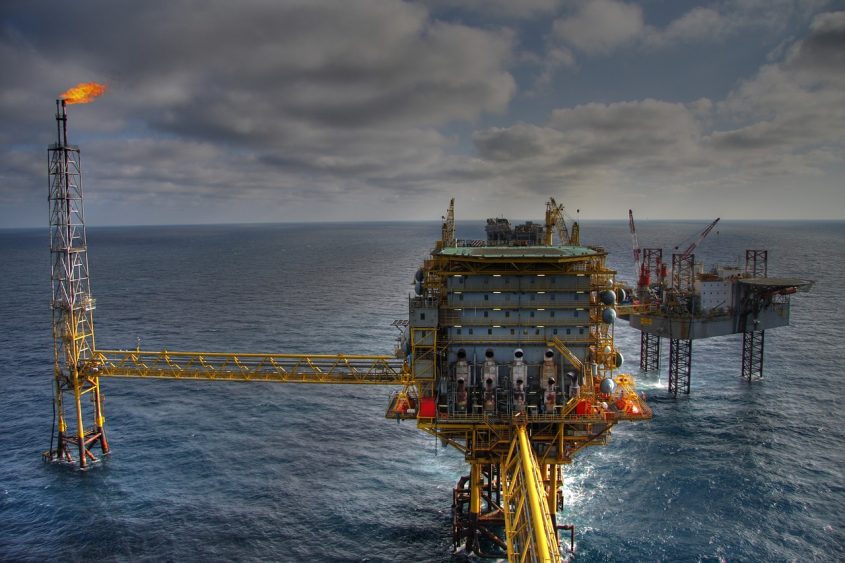
    Oil and natural gas companies are fully aware that they will have to adapt to survive and that fossil fuels are in danger of becoming a stranded asset. Happily for the industry they have the technology, expertise and locations needed to operate Carbon Capture and Storage (CCS). Indeed the expertise has been developing since the 1930’s,  but there was no incentive because releasing carbon dioxide into the atmosphere didn’t cost anything. Not having to pay for the consequences of extraction was a very big invisible subsidy for the industry and it is interesting that Norway developed CCS at the Sleipner gasfield in order to offset the effects of a carbon price!

    The new Northern Lights project will be taking carbon ‘waste’ from all over Europe, because despite the carbon dioxide shortage causing a beer and lemonade crisis a few years back the beverage sector can’t absorb it all! It only takes a carbon price of $50 per tonne to make CCS cost effective. Larry pointed out that the corn oil ethanol production industry in US states with a carbon tax found CCS to be cost effective at a carbon price level of $32.

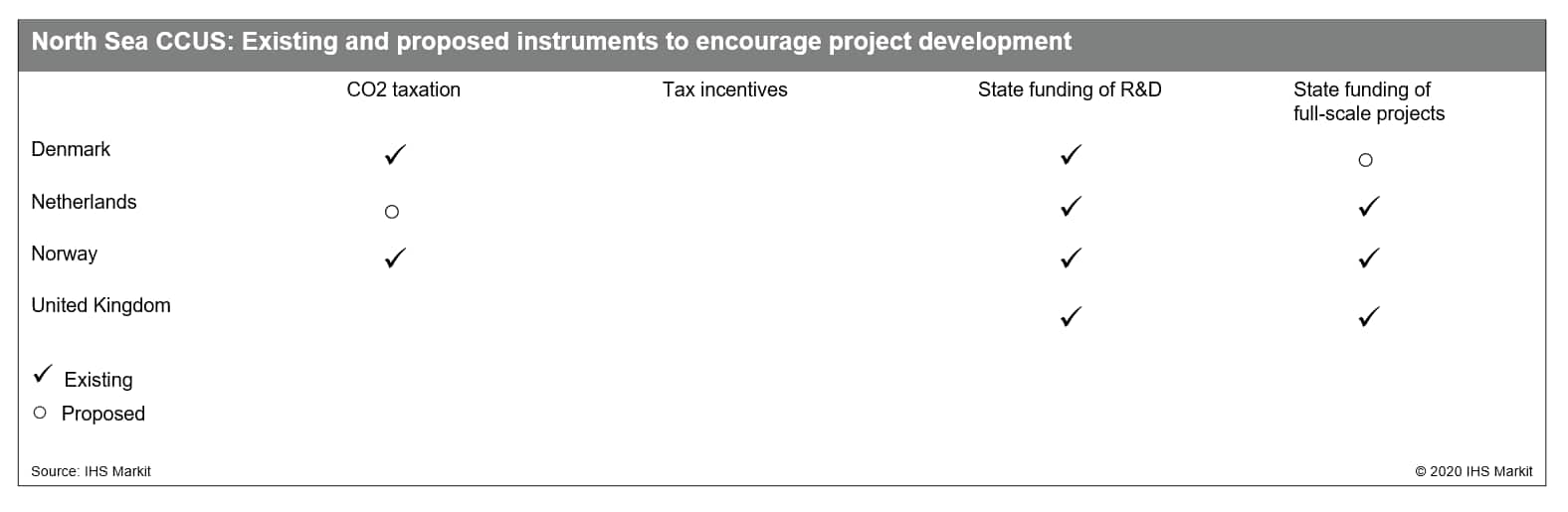
    The North Sea Basin is becoming the international leader in CCS – this chart shows what financial incentives have driven the development of the industry and the accompanying article, entitled Consistent policy support is key to unlocking investment in offshore carbon storage discusses the superiority of a carbon tax incentive as well as ‘consistent policy support’….

    Shifting funding priorities have undermined UK CCS policy

    The UK’s ruling Conservative Party has made investment in CCS a key pillar of its effort to decarbonize the economy. Opposition parties also support the technology, and the Scottish National Party (SNP) is spearheading efforts to develop a CCS industry in the region. Although the UK government has regularly provided funds for CCS research and demonstration projects, progress on launching full-scale developments has been limited so far due to significant and frequent shifts in state funding.…………..

    As one of our panellists pointed out, the UK oil industry does have a plan but there is still uncertainty over what the Government will support, which makes committing to investment difficult! The oil industry in general is known to be keen on carbon pricing rather than regulation, which, as has been very clear in the US over the last four years, is very vulnerable to regime change! 

    The take home message from the discussion is that the oil industry knows which way the wind is blowing and can, with the encouragement of a reliable and progressive carbon pricing mechanism like Climate Income, be incentivised to put its all into CCS. Climate Income would be a far more effective way to transform the oil industry than confrontation as it encourages the industry to finance transformation rather than shutting down and taking the economy and our pensions with it! 

  • Launch of a new tool to track progress in reaching net zero.

    Launch of a new tool to track progress in reaching net zero.

    The 10 Point Plan and subsequent emission reduction targets were far from lacking in ambition. Many commentators, however, are saying that words are easier than actions and, for example, agriculture and hydrogen use strategy remain unpublished 6 months after the 10 Point Plan and 6 months before COP26.

    I have just watched a presentation by the All Party Parliamentary Group on Climate Change on the launch of an online tracker which enables anyone to see what progress the government is making against the objectives stated in the Committee on Climate Change’s 6th Carbon Budget. 

    It looks like a very useful tool to use when preparing to write to/lobby your MP or Council to make the case that Climate Income would go a long way in smoothing the path to Net Zero.

    It was also encouraging to see the APPCC panel’s concern with the delays in policy formulation and implementation – although it was pointed out that MPs no longer have to spend their time trying to reason with climate change deniers in the House! I particularly appreciated the comment by the Chair, broadcaster Tom Heap, of how many trees could have been planted (and then stewarded) as part of a Covid exercise/mental health policy! I might add, as a range anxious EV car user, how many more EV chargers could have been installed over the last year!

    On the 18th May Policy Connect sent further information with useful links:

    The Dashboard is objectivemulti-levelconstructive and transparent. The Dashboard uses around 100 independent policy recommendations from the Climate Change Committee (CCC) to define good-practice in climate policy. Providing an in-depth analysis of each individual policy recommendation and aggregating this to provide an overall progress score for each sector, the Dashboard gives a multi-level perspective on policy development. The Dashboard provides constructive criticism and recommendations to the Government on how best to improve climate policy and, by publishing all workings and methodology, is a transparent assessment of progress.

    Government policy is most highly ranked in the power sector, which receives a 6/10 progress score, while the Government receives a score of 2/10, or critically insufficient, for its development of climate policy in the waste sector. The Dashboard will be updated as the Government releases new policies and the CCC provides new recommendations, and will continue to track Government progress in introducing policy to get the UK on track to meet its climate targets.

    All speakers agreed that the Dashboard was an excellent tool that would help parliamentarians, campaigners and the wider public support and scrutinise the Government in developing climate policy. Tom Heap summarised the Dashboard as “easy to use and available to all, providing excellent analysis on UK climate policy.”

    In the following discussion with MPs, a range of topics were discussed, including areas where the Government has been successful in introducing climate policy, areas where further action is essential and the need for cross-Governmental and cross-societal engagement in climate policy development and implementation. There was also specific discussion around the Hydrogen Strategy, the role of trees and nature-based solutions in meeting our climate targets, and decarbonising the buildings and transport sectors.…..see our write-up on the Policy Connect website. Take a look at the Climate Policy Dashboard, and to learn more about the APPCCG and their work in the run-up to COP26.

  • Damning report by the Public Accounts Committee….

    Damning report by the Public Accounts Committee….

    The House of Commons Committee of Public Accounts report, Environmental Tax Measures, published today, is savage in its condemnation of the failure of the Government to align its environmental ambitions with the means to achieve them through its fiscal policy:

    Tax is an important instrument for pursuing government’s environmental goals, particularly getting to net zero greenhouse gas emissions by 2050. The potential of the tax system in this respect has long been recognised by government, academics and stakeholders, notably the Institute for Fiscal Studies in the Mirrlees Review published in 2011 and more recently the Climate Change Committee. We were therefore concerned that HM Treasury and HM Revenue & Customs (HMRC)—the departments responsible for the strategic oversight and administration of the tax system—have taken a very limited view of the role of tax so far. They could not explain clearly to us how the tax system is used in achieving the government’s environmental goals.

    At present HMRC and HM Treasury only recognise four environmental taxes as these are the only ones with specific environmental objectives. They have limited understanding of the environmental impact of these taxes because their management has focussed on the revenue these taxes raise. The departments have not kept track of the impact of other tax measures with environmental objectives, such as tax reliefs to support energy saving and clean technologies, or the impact of tax measures affecting the consumption of fossil fuels. We were encouraged to hear that the departments have started to assess the impact of fuel duty freezes on the environment, but environmental assessments should be made for all taxes.

    We see a lack of leadership and coordination, which mirrors findings in our recent reports on Achieving government’s long-term environmental goals and Achieving net zero. The tax system interacts with environmental policy areas which are the responsibility of other government departments. These interactions risk being overlooked without greater monitoring and transparency of tax measures affecting the environment. Given HM Treasury’s cross-government remit, it is disappointing to see silo thinking, which we often see in other Whitehall departments, extending to the Treasury itself. HM Treasury is still considering how tax should fit within a comprehensive programme for funding net zero. It acknowledges that further action is needed to hit the 2050 target.

    Given the scale of the climate emergency, HM Treasury and HMRC need to act now. We are concerned that the departments have yet to plan for the impact of the government’s environmental ambitions on tax revenues, including on fuel duty which raised £28 billion in 2019–20 but will decline as people change to electric vehicles. The two departments need to be clear and transparent on the role that tax will play so that: taxpayers can make informed decisions; other government departments can plan; and Parliament has the information it needs to hold government to account. With the UK hosting the UN Climate Change Conference in November 2021 we look to HM treasury to lead by example.

    Analysis of press coverage is available here, including the comment by Labour peer Lord Triesman that:  

    “Government and regulators now need to create an environment where investors and lenders are rewarded for taking the long-term view. What will ultimately bring down green financing costs is longevity and pipeline security.” Interestingly this echoes comments on the similar gap in climate change mitigation plans across the pond:

    An editorial in the Washington Post says of the expected new US climate pledge to cut emissions 50% below 2005 levels by 2030: “Such promises are easy. Making good on them, and on this one in particular, is hard.” Like another recent editorial from the paper, the piece argues for a carbon tax: “What’s missing [from Biden’s proposals] is an economy-wide policy that would cut demand for fossil fuels in every industry in every state. A substantial, steadily rising carbon tax would ensure emissions reductions happened even if some of Mr. Biden’s government-funded green projects failed because it would dampen underlying demand for fossil fuels.”

    The publication of this report offers another very targeted opportunity to write to your MP, especially if they are members of the Public Accounts Committee. You could point out how Climate Income with Border Carbon Adjustments would be the ideal fiscal policy to send the right message to producers and consumers on the needed direction of travel and make investment in low emission technology so much more attractive, as the Government has acknowledged:

    Placing a price on carbon creates the incentive for emissions to be reduced in a cost effective and technology-neutral way, while mobilising the private sector to invest in emissions reduction technologies and measures. While we recognise the merits of a Carbon Fee and Dividend policy, we do not propose to adopt it at this time.

    * Committee of Public Accounts members

    Name /Party /Constituency
    Meg Hillier MP Labour Hackney South and Shoreditch, Chair
    Gareth Bacon MP Conservative Orpington
    Kemi Badenoch MP Conservative Saffron Walden
    Shaun Bailey MP Conservative West Bromwich West
    Olivia Blake MP Labour Sheffield, Hallam
    Dan Carden MP Labour Liverpool, Walton
    Sir Geoffrey Clifton-Brown MP Conservative The Cotswolds
    Barry Gardiner MP Labour Brent North
    Peter Grant MP Scottish National Party Glenrothes

  • ‘A climate summit in every county’, pt.2

    ‘A climate summit in every county’, pt.2

    Our speaker at the March meeting was Kevin Frea, who is a Deputy leader of Lancaster City Council, Council Cabinet Member for Climate Emergency and Rural Affairs and founder of Climate Emergency UK. Kevin pointed out that while 3/4 of UK councils have declared a climate emergency and 126 councils have set a target to reach zero carbon by 2030, for some it has been just words.

    Interestingly the ambition to really put their money where their mouth is occurs across the political spectrum. Councils which have been ambitious and active include Lib Dem Cornwall, Labour Nottingham and Conservative Isle of Wight. Despite budget constraints councils like the above are doing what they can in areas they have control over such as social housing stock and public transport policy. Conservative led Wiltshire council, for instance, is building modular, zero carbon council homes, retrofitting older council homes and supporting housing associations to do the same.

    The Conservative Cabinet Member for Climate Change and Biodiversity at the Staffordshire Moorlands District Council here writes about the council’s Green Infrastructure Delivery Plan. And to top it all, borrowing a concept from the Cold War, Lewes and Amber Valley have joined Barcelona and Vancouver in signing the Fossil Fuel Non-Proliferation Treaty.

    The sole focus of CCL UK remains to campaign and lobby for a national carbon pricing policy to render all other strategies possible and probable. We are convinced, however, after our successful experience in Wiltshire, that it is worthwhile to engage with your council and other local environmentalists.

    Being involved in pushing council action ahead of the central government response can only help to persuade central government that the country is ready and willing to act on climate change with the most effective methods, including taxation! Some areas of the UK are holding citizen’s assemblies on climate change, and the clear message is that any transition must be fair…

    Reshaping the economy to fight climate change must not result in making life “even harder” for disadvantaged communities. (Susie Ventris-Field, Climate.Cymru Campaign.

    Campaigning with other local environmentalists can also help spread the word about the benefits of CF&D, and maybe even get your MP discussing the issue with Alok Sharma ahead of COP 26!

  • A wise comment from The Wall Street Journal

    A wise comment from The Wall Street Journal

    I have rather belatedly succumbed to subscribing to Carbon Brief Daily (weekly is also an option) it is a very useful and free way to find out what is been reported about climate policy…….

    Carbon Brief is a UK based website covering the latest developments in climate science, climate policy and energy policy. We specialise in clear, data-driven articles and graphics to help improve the understanding of climate change, both in terms of the science and the policy response. We publish a wide range of content, including science explainers, interviews, analysis and factchecks, as well as daily and weekly email summaries of newspaper and online coverage.

    Amidst all the deservedly jubilant comments about Biden’s decisive U turn on Trump’s denialism, deregulation and support of fossil fuels there is a note of caution…..

    Holman W Jenkins Jr, a Wall Street Journal columnist writing in an article titled “Biden’s age of climate decadence”, (26/01/21) takes a negative look at the president’s actions. He writes that “no ideas are present in the climate spasms of the Biden administration, just a doubled helping of patronage handouts to established interest groups”. He continues: “Suppose you actually cared about climate change. You would not throw episodic subsidies at things that can survive only as long as you are subsidising them. You would try to set in motion long-term trends that have the advantage of being in accordance with existing trends”. Central to his suggestions is a carbon tax which would “spread a low-carbon incentive through every transaction in the economy”.

    Jenkins explains that Obama and Gore didn’t feel the need to use ‘unpopular’ carbon taxes as public opinion enabled the administration to support decarbonisation through subsidies and regulations. I would guess that had they gone down the carbon tax route and it had proved popular Trump wouldn’t have been able to have such a field day!

    At the moment our Government also seems set on using subsidy and regulation despite acknowledging in The Future of Carbon Pricing in the UK that….

    Placing a price on carbon creates the incentive for emissions to be reduced in a cost effective and technology-neutral way, while mobilising the private sector to invest in emissions reduction technologies and measures. While we recognise the merits of a Carbon Fee and Dividend policy, we do not propose to adopt it at this time.

    CCL US is working hard to lobby the US government to see the benefits of carbon pricing with some regulations, lobbying for the Energy Innovation and Carbon Dividend Act. Some regulation and subsidisation will be necessary where cost benefits of the greener option will not be adequate to encourage change (as with cars), but it works best in conjunction with carbon pricing.

    So keep in mind that we are campaigning for a sensible and tested solution which does not require complete societal and economic overhaul, is well regarded by economists and that carbon pricing in general is the preferred solution of the IMF and UN!

    PS On February 2nd an editorial in The Financial Times (paywall) reiterates this point: “conspicuous omissions that underline the vast political effort that will be required to turn policy into reality”. These include the order to pause new oil and gas leases that apply to federal land only, and his “failure to set out a detailed national plan for pricing carbon

    It is encouraging that the most respected mainstream financial media are making the same point!

  • Encouraging article on CF&D in The Guardian.

    Encouraging article on CF&D in The Guardian.

    Today, the 5th January 2021, there is an article in The Guardian endorsing CF&D as the best way to tax carbon, promote decarbonisation and create a fairer post pandemic world! It will be interesting to see the reaction to this article, it may signal wider acceptance of the benefits of CF&D across the political spectrum.

    In the article in the Opinion section of the Guardian Online (5/1/2021), Henry D Jacoby, Emiritus Professor of Management at MIT and former co-director of the MIT joint program on the science and policy of global change, gives an good summary of the CF&D policy, which he calls

    “so elegant that it seems too good to be true”. 

    Jacoby also discusses the main stumbling block for the promotion of CF&D, namely the public and governmental perception of the role of taxation. However he argues that, as governments are all having to go outside their policy comfort zones to mitigate the effects of the pandemic, now may be the best time for a radical new approach to carbon taxation….

    But if now isn’t the time to try bold new solutions – when we’ve seen that governments can move mountains in the right circumstances – then when is? And though it looks radical, the dividend really is just a rather elegant solution to a major problem, which neatly circumvents many of the usual political objections to increased taxation. It might even be the first highly popular tax.

    Happily I managed to get a letter about this article published in the Guardian on the 7th January, despite the tumultuous events over the pond!..

    In his article “There’s a simple way to green the economy – and it involves cash prizes for all (5/1/21)”Harold D Jacoby gives a brilliant analysis of the benefits of a Carbon Fee or Dividend (or Climate Income) carbon pricing policy and why there are some psychological barriers to its wider adoption. Citizens Climate Lobby is an international grassroots environmental group which has been respectfully encouraging politicians to consider adopting Carbon Fee and Dividend since 2007. 

    CF&D has successfully been adapted in Canada and Switzerland (although Switzerland does not currently tax fuel for energy while it moves towards the development of more renewable energy systems). Canadians could have replaced its implementer, Trudeau, last year and ditch the policy, they didn’t…. 

    Our Government acknowledged the merits of the tax in its recent Carbon Pricing Report but there is a psychological barrier as Jacoby points out…  Treasury doesn’t like hypothecated taxes or dividends! We at Citizens Climate Lobby UK are working hard to change their mind!. Do take a look at our website and consider supporting us.

    Catherine Dawson,

    Citizens Climate Lobby UK

  • 10 Point Plan for green recovery?

    10 Point Plan for green recovery?

    Ahead of the ratifying its Paris Agreement targets (NDCs – Nationally Determined Targets) on 12th December, the UK government have released its ’10 Point Plan for a Green Industrial Revolution’.

    Top of the list is power in the form of offshore wind, hydrogen and nuclear. Transport is highlighted through electric vehicles – and the headline-grabbing phasing out of combustion engines by 2030 – public transport, cycling and walking, and, the elusive ones, ‘Jet Zero’ and shipping. The big emitter, home and business heating, is covered via insulation and heat pumps. Finally, carbon capture and storage development, ‘nature’ (tree planting and conservation), and green innovation.

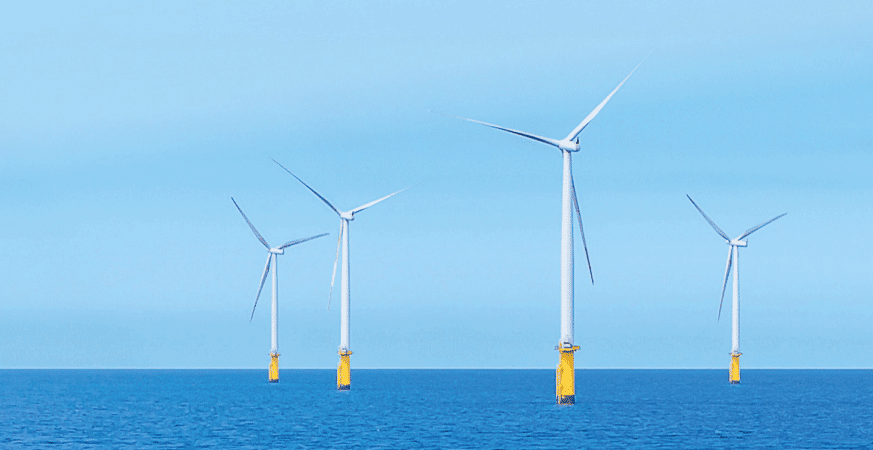
    10 Point Plan offshore wind image

    Conspicuous by its absence in the overview was no reference to ‘climate change’ and, instead, ‘net zero’. Also ignored was urban air pollution and, instead, the Conservative-friendly ‘nature’.

    Carbon brief covers the range of media reaction, and the tempering by the Chancellor’s spending review this week, which cut foreign aid (which may hamper beneficiary countries from investing in their own green revolution and sully the UK’s influence) and pledged a big spend on road building.

    Although Corunavirus may have caused emissions to fall for a while it now threatens the aeroplane’s major alternative, Eurostar, which is currently running at 1 percent of its usual capacity and is asking the government for the same emergency deal as airlines. Covid-19 is also, according to a government adviser in a meeting CCL attended this week, causing an amplification of short termism by government, who now approaches policy on a week-by-week basis – worrying for the kind of longterm vision required to fix climate change.

    Meanwhile, the Climate Coalition is drumming up support for its own Ten Point Plan, aimed at COP26 (but no mention of a carbon price) as is ZeroC which launched its declaration in favour of a carbon charge.