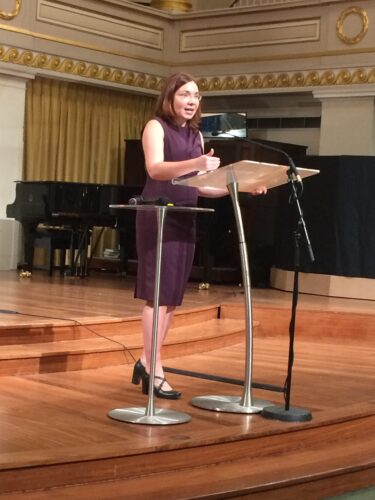
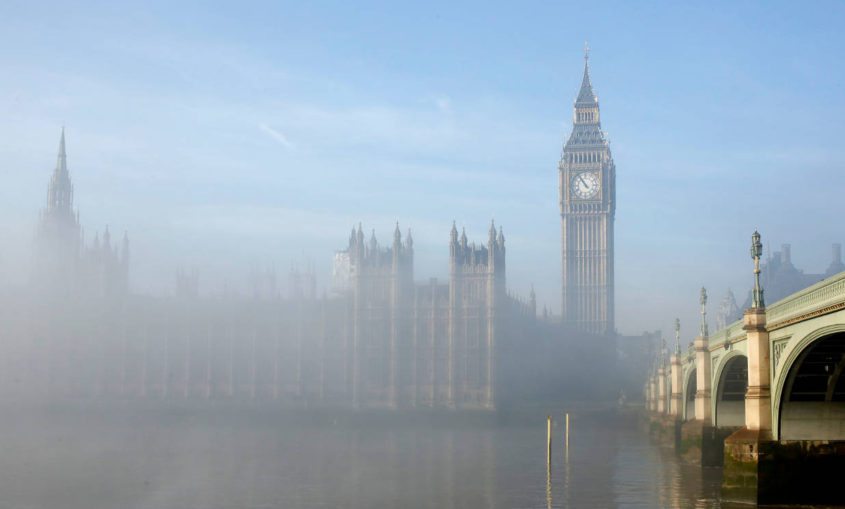
This week (27/28 Nov 2018) I attended two conferences in London: the New Zealand High Commission event on the Impact of Climate Change in the Pacific and the Conservative Environment Network (CEN) Net Zero conference.
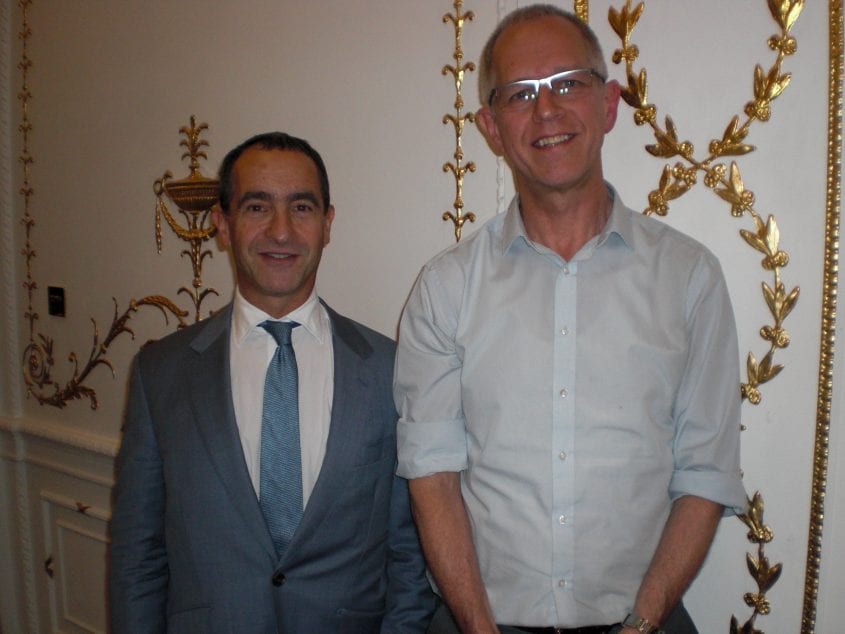
I was photographed with Michael Liebreich, one of the panel members on shipping at the CEN conference (above).
A heartfelt video was shown at the NZ conference, but I’m afraid the whole thing was short on plausible, workable solutions. As usual, I pointed out that 140 million people join the middle class every year (Brookings) – that’s another China every ten years – so personal sacrifices alone will not save us. I explained how Carbon Fee & Dividend (the CCL emissions tax solution to climate change) works to a couple of people afterwards who said they would get in touch. I must remember to practice my spiel, in order to do a better job in a public comment.
The CEN conference was more informed, with several mentions of carbon pricing. They said there was strong resistance to border carbon adjustments from trade lawyers, who say this will disrupt many existing trade mechanisms. However, I was heartened to hear Michael Liebreich say “A conservative principle is Polluter Pays!”
It was interesting to hear about plans for new ships to be powered by hydrogen, ammonia or even just wind, but resistance is apparently being met by shipyards, most of which are in Asia.
Even the CEN conference seemed mostly hope-based, once again on a distant target being reached – net-zero by 2050.
At the end I jumped up to grab the keynote speaker, Lord Deben (John Gummer, chair of the independent Committee on Climate Change which advises the government) before he got inundated. I asked him how we could best support government initiatives to introduce a rebated carbon tax. He said we needed to reach into the existing big groups such as WWF and Friends of the Earth, to educate them.
On my way out, the young CEN Director invited me to join CEN (£20/annum), saying I would “get invited to parties”. I learned they were all off to one at the Shard, and wondered if I could afford that lifestyle, and whether people would want to discuss carbon pricing at them.
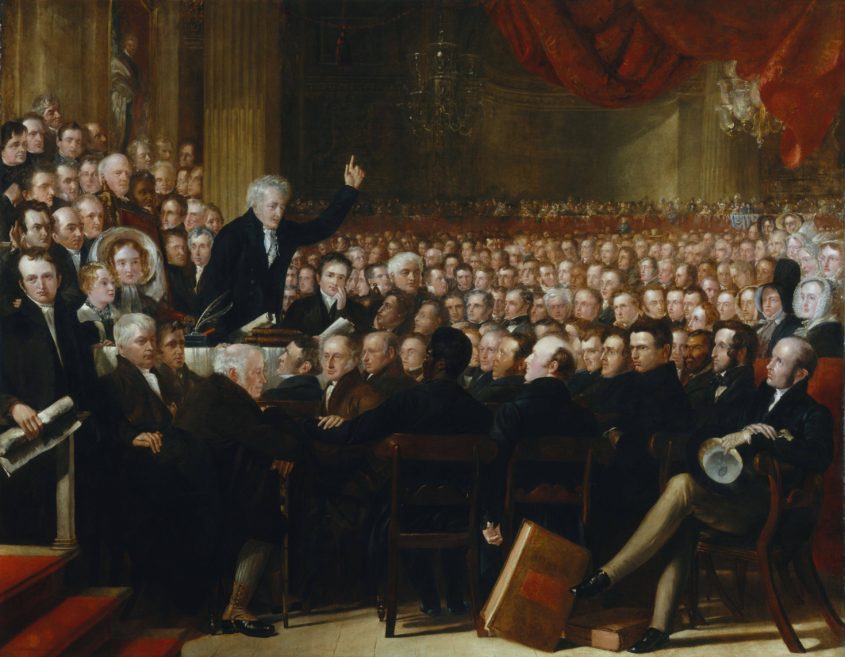
On Friday 1st August 1834 the Slavery Abolition Act, which had been passed the previous year in Parliament, came into force. The gradual freeing of slaves throughout the British Empire began and was complete by 1838 (except in India which was a few years later). The Act was principally passed not for economic or political reasons, but because the majority of the British electorate came to conclude that the facts and ethics of slavery made the case for Abolition compelling.
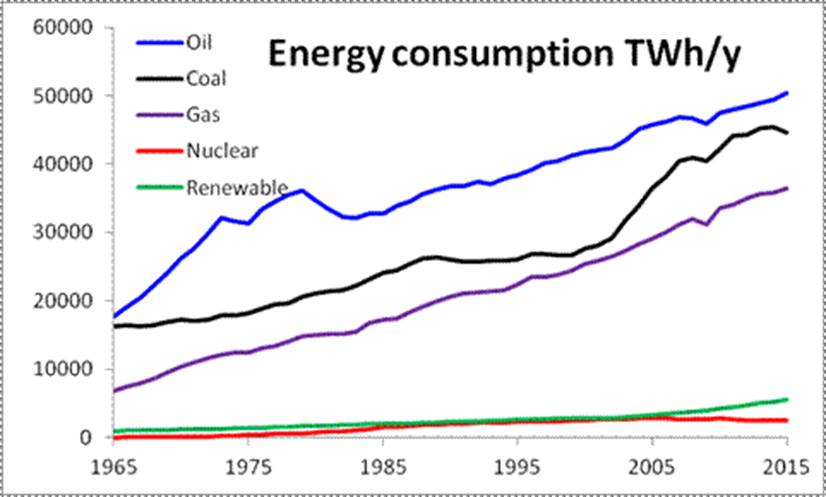
There are parallels here with global campaigns to cease high carbon emissions to our atmosphere. Certainly, action equivalently drastic to Abolition is required because emissions are still rising despite decades of international agreements and targets. The graph below shows how energy use is still rising and is dominated by fossil fuels. Brutal action is required, not more of the same. We can celebrate achievements so far, as the abolitionists could celebrate the 1807 Act for the Abolition of the Slave Trade, but we know that the big step is still ahead.
A simple parallel are the Deniers: people who cannot accept the evidence. In the case of slavery, they maintained that slaves were not fully human or that they benefited from slavery or that slavery was sanctioned by God. With hindsight we now know that such views can be overcome. A yet more encouraging parallel, I trust, is success after perseverance; the Abolitionists must have overcome much disheartenment. While the campaign started with the Quakers centuries before 1833, the active movement that eventually saw Abolition began with Clarkson & Wilberforce in about 1787. The Abolition Act received its third reading just three days before Wilberforce died. All the many supporters made longstanding efforts as well, one example was denying themselves sugar, which was a principal product of the Caribbean slave estates. Campaigning lasted nearly 50 years.
Artwork from the famous campaigning medallion manufactured by Abolition supporter Josiah Wedgwood at his own expense
It seems that gradually the case was won, and what appeared like something that would never happen suddenly became reality. The turnaround seemed to be prompted by two events – the Christmas 1831 slave revolt in Jamaica, with subsequent Parliament inquiries, and the Reform Act of 1832, which widened the electorate and so brought more abolitionists into Parliament. All those feelings of hopelessness, after nearly 50 years of campaigning without the main prize, were blown away. I imagine that the strong measures required to address global warming comprehensively will be implemented suddenly, prompted by the hard work of long term campaigning together with events that change circumstances quickly and unexpectedly. A policy such as the CCL one, which can attract cross-party and popular support, is ideal for this circumstance.
Another parallel is the need for imagination to understand and have empathy over the harm we are producing. There were no BBC reports from the slave plantations, even photography was not yet invented. The public just had drawings, lithographs and reports to help them imagine the harm. For us we also have to trust those giving us the information on the harms that global warming will produce for people, especially in less economically developed countries, and for the environment. If Michael Buerk could report from a famine in 2084 clearly caused by our carbon emissions, as he did report from the 1984 Ethiopian famine, then action would be immediate and robust.
We can again be encouraged by a further parallel, the massive vested interests, especially for those in power. The British upper class were those benefiting from exploiting the misery of slaves and were also those able to exercise power in Parliament. In fact, as we will see, this extended down to many in the middle class as well. In order to introduce robust action to address climate change, we must overcome the vested interests of the fossil fuel multinationals, the lobbyists, even the SUV owners and the frequent flyers. 1833 informs us that this can be done. Again the CCL policy of Fee and Dividend is well suited because it does not outlaw the SUV owner or oil boss in the same way that slave investors were treated sensitively in the 1830s.
The abolitionists must have needed to overcome the fears for the economy, which may have been seen as depended on slavery. A notable example is the Lancashire cotton industry dependent on slave-produced cotton from the American deep south. Of course, that was no longer a part of the British empire in 1833, but the fears would still need to be addressed. The Director of the Centre for the Study of the Legacies of British Slave-ownership at University College London, Dr Nicholas Draper, claims that as many as one fifth of wealthy Victorian Britons derived all or part of their fortunes from the slave economy and that up to 10 per cent of Britons who died in the 18th century had benefited. A sufficiently robust policy to address climate change that can be shown not to adversely impact the economy is required. The CCL policy of a Carbon Fee and a Dividend to households has been shown to prompt healthy growth in the economy and to produce the massive reductions in carbon emissions we require.
My final parallel is one I find most interesting. In 1834 there was a need to compensate slave owners and this was implemented. In fact the compensation of Britain’s 46,000 slave owners was apparently the largest ‘bailout’ in British history until the bailout of the banks in 2009. A total of £20million was passed on as compensation, which was 5% of the British GDP at that time. Interestingly, records show that many normal middle class people living in Britain, not in the slave colonies, were included as they had invested in plantations holding slaves, or had inherited them. This total compensation was vast and itself a potential threat to government finances. £15million had to be borrowed from banks, and amazingly, it was only finally paid back fully in 2015. Today the fossil fuel companies hold assets fully declared in their accounts: the value of the reserves of oil, gas and coal that they hold. Many of our pension funds have investments tied to those assets. But if we are to limit global warming, those reserves must largely stay unused in the ground. They are estimated to be worth about $20 trillion which is about 25% of the global economy of $80 trillion p.a. It is a vast sum, that could be addressed over time rather than the sudden need for compensation after Abolition.
The example of Abolition, shows that this can be accommodated. An analysis has concluded “The amount of money available to the compensation fund reflects how much influence elite Victorians had on the UK government of the day. The fiscal injection of cash into the economy had textbook consequences including an increase in GDP, high inflation and rising asset prices. It is an interesting economic event from Great Britain’s distant past, albeit one generated from the horrors of slavery.”
Once the will is there and a policy fair to all is on offer, then change can occur amazingly rapidly. We have that policy, let’s make sure people know about it when the time arrives.
Twitter can be a fine thing. A while ago I chanced upon Peter Kalmus, author of ‘Being the Change: Live Well and Spark a Climate Revolution’ and climate scientist at NASA’s Jet Propulsion Laboratory. I was drawn to follow him because of his positive messaging about how our individual lifestyle choices do indeed count. He makes the salient point that, as an American climate scientist who has opted for a lifestyle in which he and family consume one tenth of the average American’s fossil fuels, he is leading by example.
I find it refreshing that there are privileged academics among us who are choosing not to live as if it’s still the 1950s. His website noflyclimatesci.org documents “earth scientists, academics, and members of the public who either don’t fly or who fly less”. Along with other climate scientists who have self-declared their low carbon lifestyles, Kalmus encourages me to feel positive these days. Another reason to pay attention is that Kalmus is an articulate CCL member, as I discovered when I listened to his recent discussion about Carbon Fee & Dividend on rootsimple.com. I recommend listening to the whole interview as it’s full of entertaining, deep exchanges with hosts Kelly Coyne and Erik Knutzen, and is highly informative throughout.
Composer pianist Lola Perrin who volunteers for CCL UK, is the founder of ClimateKeys, a global initiative combining musicians and climate change experts to create audience conversations about climate change solutions.
Is technology constraint the main reason we have been unable to drive carbon out of the economy? Is there a stark choice between on the one hand cutting back on our high carbon burning lifestyles in the West and on the other hand allowing global warming to damage the most vulnerable? Or are there viable technology solutions that allow our lifestyles to continue?
The answers to these questions, when widely known, will change the way the public responds to climate change. If people think that it is a choice between their lifestyle and the environment, then it is human nature that they will do all they can to resist the message of man-made climate change. They don’t want to give up so much that is precious to them just because some ‘experts’ they don’t understand say they must.
So what is the answer regarding technology? Imagine a single solar panel array laid out in the desert and of sufficient size to provide all the global energy needs. That is the energy needs for all factories, homes, transport, agriculture and all. All the energy for heating, power and other uses that produce our full lifestyles . Using a single solar panel in one place would be ridiculous, but it is interesting to imagine to get the scale of the problem. How big would it need to be? As you guessed the image above shows that panel in the northern Sahara desert. The panels needed to serve the EU and the MENA (Middle East and North Africa region) are also shown. These seem pretty modest in terms of how much land surface is needed, if solar panels are viable on price.
Solar panels are now competitive with fossil fuels on price. Supplying the worlds energy needs without burning fossil fuels is now technically possible. Certainly there are challenges in storing and distributing the power, but it is not a simple choice between lifestyle and the planet. There is even a city, Georgetown, in that bosom of climate change denial – Texas – that as far back as 2014 opted to use 100% renewable energy in the form of wind and solar power. It was to save cash, not the planet. It was not a decision about going green, a city official said:
What all this implies is that the economy is ready to transfer away from burning fossil fuels if it can be induced to do so. Policies to induce that will not end in hitting a brick wall of technical impossibility and neither will they be certain to prompt popular backlash as people’s lifestyles are interrupted. But this cannot happen by itself because our energy subsidy, distribution and storage is currently set up around fossil fuels. Policy intervention is required and further technical innovations will contribute.
The Citizens’ Climate Lobby proposes a simple policy intervention that will enable lifestyles to be retained by those willing to pay while driving carbon out of the economy. It will drive investment in further technical innovation and will cause people and businesses to change technologies to save money not because the ‘experts’ say they must.
President Barack Obama, right, Leonardo DiCaprio, left, and Dr. Katharine Hayhoe (AP Photo/Carolyn Kaster)
When evangelical Christian Katharine Hayhoe is asked ‘do you believe in climate change?’, she answers, ‘no’.
You’d be forgiven for thinking she’s just another religious climate denier. But you’d be wrong.
Canadian-born Katharine is a professor of atmospheric science, number 15 on this year’s Fortune World Greatest Leaders list and scientific adviser to Citizens Climate Lobby US. Speaking at All Souls Church, London, last night, she told us the reason she said ‘no’.
As in many times throughout her talk fusing Christianity and science, she begins with a bible passage, Hebrews 11:1, ‘Now faith is the substance of things hoped for, the evidence of things not seen’. She adds to it: ‘science is the evidence of things you can see’.
Climate change is not something to believe in: the evidence is there for all to see. It’s provable fact; faith is irrelevant. (more…)
In my last post, I wrote about how we would be more inclined to fight climate change if we focused on an immediate threat we could see: pollution. However, acting to reduce consumption only on obviously polluted days is just not enough to make a meaningful dent in UK emissions. In reality, the air in all but the most densely populated urban areas of the country is mostly clean. Given this, we need to be more proactive than reactive, working to lessen our energy usage on a daily basis. But, as usual, each time we read an article on climate change and turn off a lightbulb somewhere in our home, we’ll have forgotten the whole thing an hour later.
This is where motivational science comes back in – to answer the question of how we can keep ourselves focused day-to-day. An obvious response might be “money.” If we show people how much money they are saving per month when they reduce their usage, they will change their behaviours to meet those goals. Unfortunately, energy is so cheap that any change is really inconsequential to our budgets. However, research from a number of behavioural psychologists such as Inside the Nudge Unit author David Halpern leads us to another potential answer: feedback, and lots of it.
Imagine this: instead of using a speedometer in your car, you get a monthly printout of your average speed for the past four or so weeks. You would only have a vague sense of when you were speeding, and would probably end up going faster a lot more frequently. It’s hard not to, with no immediate feedback on the dashboard. This is how we use electricity in our homes – blindly. We have very little sense of how much electricity our devices use. Sometimes, we even forget that certain things use electricity; according to the American energy.gov site, disconnected phone chargers require 0.26 watts while chargers connected to fully-charged phones use 2.24 watts.
So, what should we do? Luckily, energy companies are rolling out smart meters that show live displays of energy usage. Even better, every home in the UK will be offered one (for free!) by 2020. All you need to do is to display it prominently. Then, you can begin challenging yourself in real time to reduce consumption.
How can we make people care about climate change? Do we show them polar bears perched atop wobbly icebergs? Do we warn them about melting glaciers in Greenland? This seems to work, at least while we’re having the discussion. But then, they forget. They go back to their old ways. Ultimately, humans simply don’t have the mental energy to deal with this abstract, future threat.
American conservation scientist M. Sanjayan has taken a keen interest in studying these issues. What can we do in the face of this well-meaning, but ultimately useless approach? Fortunately, he has an idea that has worked before.
“We’ve faced enormous, scary climate issues before. Remember the hole in the ozone layer? As insurmountable as that seemed in the 1970’s and 80’s, we were able to wrap our heads around that and take action. People got this very simple, easy to understand, concrete image of this protective layer around the earth, kind of like a roof protecting us in this case from ultraviolet light (which, by the way, has the direct health consequence of potentially giving you skin cancer). Then, they came up with this fabulous term, “the ozone hole.” Terrible problem, great term.” People also got a concrete image of how we ended up with this problem; for decades chlorofluorocarbons (or CFCs) were a main ingredient in a lot of products like aerosol spray cans. Then, when scientists discovered that CFCs were actually destroying the atmospheric ozone, people could look at their own hairspray and say “do I want to destroy the planet because of my hairspray?” So, what’s interesting is that sales of hairspray and those kinds of products started dropping quite dramatically. People listened to scientists and took action, and now scientists predict that the hole in the ozone layer will be healed by around 2050.” – M. Sanjayan, VOX
Sanjayan then goes on to discuss climate change, saying that if we had a concrete image – if we could see climate change – then we’d do something.
The thing is, we can see climate change. At least, in a way.
Throughout the UK and particularly in the Greater London Area, air pollution is a hot topic. Moreover, as capital-dwellers will tell you, we can both see and feel it, particularly on any high air-pollution alert day. As a recent resident of Beijing and Hong Kong, I can affirm that it only gets worse. More importantly, air pollution and climate change are intricately linked, as many compounds that are considered as pollution also count as greenhouse gases (CO2, nitrous oxide, ozone, and so on).
Pollution is not a future threat, like climate change. It is affecting you now. According to the Guardian, air pollution kills 9 million around the world annually (more than 5 times as many as car accidents), with that figure set to rise. So, why not focus first on fighting pollution? The actions necessary, such as limiting vehicular emissions and transitioning from fossil fuel power sources (which can be done through Carbon Fee & Dividend!) will do equal work in fighting climate change down the road.
(The following photos I took while hiking show a clear difference – a difference you can see, and act on!)
Investment company, Goldman Sachs’ recent research forecasts renewable energy to be cheaper than other forms of power by 2020.
Alberto Gandolfi, from Goldman Sachs Research said,
What started as a decarbonisation process – thanks to better technology – is about to become a process driven by costs and the economics.
This sounds like more proof that Carbon Fee and Dividend will work. CF&D would drive up the price of fossil fuel and their products and speed up the consumer switch to clean – and now cheaper – alternatives.
It would also give investors confidence that divesting in fossil fuel and investing in the alternatives is the clever move.
The resulting fall in carbon dioxide levels would be a big win for the climate and our planet.
Which begs another question: why is the UK forging ahead with a new nuclear reactor when the cost of renewable power is falling and the technology is coming on in leaps and bounds?
Written by Louisa Davison, 29 August 2017 Views expressed here not necessarily shared by Citizens Climate Lobby.
The climate problem presents a profound challenge to the current economic paradigm. Markets have largely evolved as systems for rewarding those who externalise the most. Pricing in the environmental cost of burning fossil fuels will entail a system-level reworking of the global economy.
There’s also the problem of what kinds of policy are politically viable. Who is going to get elected by proposing to make our fossil fuel powered lifestyle more expensive?
This is where we can make a difference as an alliance of concerned citizens. It’s vital that we let our elected representatives know that we want them to take bold and decisive action on this issue. We want a price on carbon that reflects its environmental cost. And there are solutions to the impact this has on prices for consumers. The revenues from an upstream carbon price can be redistributed to citizens as a dividend, as in the Fee and Dividend policy proposal.
The Carbon Price Floor was introduced in 2013 in order to ensure that the price on carbon in the UK remained in line with our decarbonisation targets – the carbon price the EU Emissions Trading Scheme was delivering wasn’t (and still isn’t) high enough.
The original target was to achieve a price of £30 per tonne of carbon dioxide in 2020 with a starting price of about £16 per tonne.
However in the 2014 Budget the Government announced that prices would be capped at £18 per tonne from 2016 to 2020 to “limit the competitive disadvantage faced by business and reduce energy bills for consumers.”
This decision came after concerted lobbying by business and industry.
The Confederation of British Industry was a major player in this lobbying effort.
Rhian Kelly, the CBI’s director for business & environment explained in 2013 that “British business supports an ambitious but credible EU-wide emissions reduction target…” and that
“This must be underpinned by long-term reform of the EU ETS, creating a robust carbon price across Europe – thus making the UK’s Carbon Price Floor a redundant backstop – with improved provisions to protect vulnerable industries.”
This was – and still is – misleading equivocation.
We need policies that demonstrate the UK is taking a leadership role in the EU decarbonisation effort.
Without the cap on the CPF the UK would be in a stronger position to drive forward the long term reform of the EU ETS.
The cap on the CPF demonstrates the power that industry has to stall action on climate change at policy level.
What can be done to ensure UK climate policy is protected from lobbying by business and industry?
We need to challenge the business/industry lobby and ensure our voices are heard in support of decisive action on climate change by policymakers.