Category: IMF

  • Citizen Climate International’s summary of the truth about fossil fuel subsidies and the fossil fuel industry’s decades long disinformation campaign!

    Citizen Climate International’s summary of the truth about fossil fuel subsidies and the fossil fuel industry’s decades long disinformation campaign!

    The IMF, Carbon Pricing and Explicit and Implicit Fossil Fuels Subsidies

    Here are two terms that anyone who wants to preserve a stable climate needs to know: explicit fossil fuel subsidies and implicit fossil fuel subsidies.

    Explicit fossil fuel subsidies from governments directly reduce the price of fossil fuels, thus making it attractive to investors and consumers to buy. Implicit fossil fuel subsidies are the costs taxpayers and insurance are paying for the air pollution and climate impacts experienced because of dirty fossil fuels.

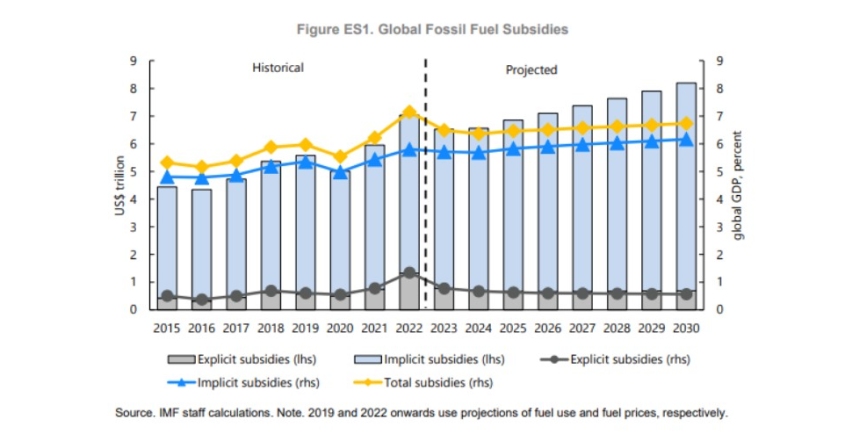
    On August 24, 2023, the International Monetary Fund (IMF) released a report. The conclusion of this report was that subsidies for oil, coal, and natural gas cost the equivalent of 7.1%  of global gross domestic product.

    Explicit subsidies have more than doubled since 2020 but are still only 18% of the total subsidy amount, while nearly 60% is due to implicit subsidies.

    Here is a hopeful conclusion from the report: “Full fossil fuel price reform would reduce global carbon dioxide emissions to an estimated 43 percent below baseline levels in 2030 (in line with keeping global warming to 1.5-2C), while raising revenues worth 3.6 % of global GDP and preventing 1.6 million local air pollution deaths per year.”

    Making polluters pay (a.k.a carbon pricing) offers us the exact tool needed to ensure this price reform. In fact, the IMF Managing Director Kristalina Georgieva at the Paris Summit in June said, “Our analysis shows that without a carbon price, there is no chance that we will meet the 1.5 degrees Celsius target by 2030. We will miss it.”

    Our only home, Earth, has just passed through the hottest three months on record. With the fires, floods, horrendous storms, cryosphere melting and the threats to the Gulf Stream, it is obvious that the impacts of climate change are no longer just a concern for future generations, but are a very real threat at our doorstep. We must listen to the experts and cooperate to enact or strengthen our essential climate policies such as carbon pricing going forward. Happily there are 70 carbon pricing initiatives world wide and the African Summit issued a unanimous call for world leaders to support global price on carbon pollution on September 6, 2023.

    IMF Subsidies Report August 2023

    The Fossil Fuel Industry Funded Climate Disinformation for Decades

    Even to this day, there are individuals who deny or downplay the link between the burning of fossil fuels and the impacts that pollution has on our climate and health. How did this happen?

    Key players in the fossil fuel industry knew decades ago that burning coal, oil, and methane gas to warm our homes, power our cars, and generate electricity was warming the planet. Instead of acting on the knowledge, they began financing a massive disinformation campaign. Now, as a consequence, youth are having to fight for their inalienable right to have a safe and liveable future.

    Happily, when you inform people that the fossil fuel industry funded a climate disinformation campaign for decades, people are more likely to believe you when you present solutions.

    Suggested readings:

  • The IMF says that the world needs to mitigate climate change now using a form of Climate Income, the cost of procrastination will only get higher…

    The IMF says that the world needs to mitigate climate change now using a form of Climate Income, the cost of procrastination will only get higher…

    A Guardian report on the 5th October examines the predictions of a chapter in the current IMF half yearly World Economic Outlook report. It  has a chapter titled Near-Term Macroeconomic Impact of Decarbonization Policies. The chapter models the cost of delaying the tackling of climate change until ‘conditions are right’ and current global inflation has lowered; an IMF blog about it is titled.. ‘Further Delaying Climate Policies Will Hurt Economic Growth…The transition to a greener future has a price—but the longer countries wait to make the shift, the larger the costs’. 

    The blog argues that concerns about current cost have been perceived to be more real than the nebulous future threat of climate change, causing decades long procrastination …’despite overwhelming evidence that any short-term costs will be dwarfed by the long-term benefits (with respect to output, financial stability, health) of arresting climate change (October 2020 World Economic Outlook; IPCC 2022).  

    The current crisis has heightened the fear that climate mitigation would just raise inflation further and led to the claim that we need to double down on fossil fuels for energy security (as in the UK). Concurrently a Global Energy Monitor report states that…

    New oil and gas development in the North Sea could produce up to 984 megatonnes of CO2 equivalent and contribute to the United Kingdom exceeding its carbon budget for 2023-2037 by a factor of two.

    The IMF’s modelling uses the revenue from gradually rising greenhouse gas taxes returned in part to households to drive the transition….

    To assess the short-term impact of transitioning to renewables, we developed a model that splits countries into four regions—China, the euro area, the United States, and a block representing the rest of the world. We assume that each region introduces budget-neutral policies that include greenhouse gas taxes, which are increased gradually to achieve a 25 percent reduction in emissions by 2030, combined with transfers to households, subsidies to low-emitting technologies, and labor tax cuts.

    It argues that the policy, if started now would have a modest decline in GDP and rise in inflation, slowing global economic growth by 0.15 to 0.25% and rising inflation by 0.1 to 0.45; but if delayed until 2027 with the rationale of waiting until inflation is down the effect on the global economy would be worse….

    Is it reasonable to wait—as some have proposed—until inflation is down before implementing climate mitigation policies? We ran a scenario delaying implementation until 2027 that still achieves the same reduction in cumulative emissions in the long term. The delayed package is phased in more rapidly and requires a higher greenhouse gas tax, since a steeper decline in emissions is necessary to offset the accumulation of emissions from 2023 to 2026.

    The results are striking. Even in the most favorable circumstances when monetary policy is credible and the transition to decarbonized electricity is rapid, the output-inflation trade-off would rise significantly; GDP would have to drop by 1.5 percent below baseline over four years to drive inflation back to target. Delay beyond 2027 would require an even more rushed transition in which inflation can be contained only at significant cost to real GDP. The longer we wait, the worse the trade-off.

    The take home message? ….if the right measures are implemented immediately and phased in gradually over the next eight years, the costs will remain manageable and are dwarfed by the innumerable long-term costs of inaction.

    .

  • Growing support for an international carbon price floor.

    Growing support for an international carbon price floor.

    Last year the IMF called for a globally applied carbon price floor corresponding to a country’s wealth, with a suggested tariff in 2021 of $75 for the wealthiest countries and $25 for less developed countries. Today in the Times (paywall) Mehreen Khan, the economics editor, makes the case for an effective international carbon pricing system rather than occasional windfall taxes…. 

    “One levy notably absent from the present debate is a global carbon tax to provide an incentive for the huge shifts required to hit the global net-zero target. Even in relatively benign times, politicians have taken fright at the idea of taxing carbon use, thinking that it will disadvantage their industry at the expense of foreign rivals…

    Arguments against national carbon taxes wither away if all countries agree to impose a price. The International Monetary Fund has devised an international carbon floor where the price paid corresponds to a country’s wealth. It would mean America, Britain and Europe would use a minimum floor of $75 a tonne, falling to $25 for the poorest. This collective jump into carbon taxation would not disadvantage industries in richer countries, the fund says, and would dramatically reduce emissions.” 

    Citizens Climate International supports a carbon price floor mechanism as a necessary step to the goal of Climate Income….

    We support establishment of a global “price floor”, supported by national policies to impose a steadily intensifying price signal disfavoring climate pollution. As the IEA has reported, “There is no need for investment in new fossil fuel supply…” Pricing systems should effectively and efficiently eliminate climate pollution while building incomes for people and enhancing international cooperation for a zero-emissions future.

    Recent studies such as the report in Nature and the Autonomy report have also suggested how Climate Income could be a game changer for the Global South….

    While countries in South America, Sub-Saharan Africa, South-Asia and many other parts of the Global South would profit immensely, most developed economies would only see proportionally relatively small losses.

    …..As a global policy, it could wipe out extreme poverty and easily dwarf the scope of any existing development aid and debt relief schemes, illustrating that, in this sense, it is the Global North that owes an immense debt to the populations in the Global South, not the other way round. It would also go a long way to alleviate the disastrous impacts the Covid pandemic has had on the world’s poorest and most vulnerable, with for instance an additional 100m children falling into poverty, and prevent global disparities from deepening as richer countries recover while poorer countries fall even further behind (UNICEF 2021b). Such a global carbon dividend scheme could end the bitter reality of mass hunger and destitution and be a key building stone of a fairer, more sustainable and more inclusive post-pandemic economy. (Toll gates and money pumps, Autonomy, p.51)

    It is good to see growing support for a carbon pricing system which would remove the uncertainty and short termism thwarting the rapid decarbonisation which the world needs!