Category: Carbon Pricing

  • Tackling fuel poverty during the great transition – 7 principles for climate activists

    Tackling fuel poverty during the great transition – 7 principles for climate activists

    CCL member Rob Paton explains how Climate Income can be used as a solution to the fuel price crisis as well as the environmental one.

    The fuel poverty facing many households and the climate crisis facing us all must be tackled in synch. If they are not dealt with together, each problem worsens the other.  Fuel poverty, accentuated by a price spike, has led to calls questioning support for renewable energy and has clear potential for social and political instability. Yet the necessary action on fuel poverty must not be at the expense of the climate.  Households on benefits, or with low and insecure earnings, will be the least able to protect themselves from the consequences of weaker climate policies.  

    Fuel poverty should be addressed primarily by increased income, not reduced fuel prices.  What those in fuel poverty need is more money.  They know their priorities. And it must be money they can rely on – not complicated special payments, or means tested and arriving late to tackle a spike in prices..

    What businesses and our economy need for the transition to zero carbon is an underlying trend of rising carbon prices.  Economists and business federations agree on this. Most businesses can deal with price fluctuations, or are learning how to. Carbon subsidies and tax reliefs are a part of the problem not part of the solution. 

    4   The direction of travel for public finances should be away from the present high degree of carbon reliance and towards sustainable, post-carbon sources of revenue.  An overhaul of the UK’s current mish-mash of fossil fuel taxes and subsidies is long overdue.  A coherent approach would raise more funds, be fairer and simpler, support the drive to carbon neutrality.  This is bound to take time – so the sooner the taxation system starts down this road the better.

    5  Likewise, the direction of travel for income support during the great transition should be from indirect to direct payments. That is, from transfers hidden in a tax or benefits system to discrete, climate-related payments, labelled as such and paid directly. Citizens need to know that they are being supported in tackling the climate crisis, and enabled to play their part.

    6   Consistent policy on carbon pricing, fiscal reform and income support requires a cross-party political consensus.  Surveys have repeatedly shown that the public mood is to find and sustain the common ground, and to get on with the job.  Political contestation on other issues – including other climate and environmental policies – can and should continue, both locally and nationally. But a framework to tackle the great work of this decades-long transition is needed. These are three essential elements for such a framework. 

    Communicate, communicate, communicate. Public trust in politicians needs to be restored if sometimes unpopular policies are to be sustained. A cross-party consensus in Westminster needs the backing of public opinion, and its calls will be taken more seriously by the public than party-political pronouncements. Especially when promised action follows. Nothing is clearer and more convincing than a payment direct to your bank account.  

    Climate income offers a way forward with the clear potential to satisfy all these principles.  It may not be the only one. But it is the only one I am aware of.        

    Rob Paton 02/02/22 

    We are not the only ones with this message, today’s Carbon Brief Daily reports on two interesting reactions to the Levelling Up White Paper (Business Green is paywalled) ..

    Business Green’s James Murray, analysing the paper, writes that “a government that properly prioritised the net-zero transition, rather than treated them as a separate silo, would find it much easier to embed climate action in its response to the gas price crisis.”

    In another comment on levelling up in Business Green, Prof Henrietta Moore writes that “without tax reform, the cost of funding net-zero will fall disproportionately on the shoulders of those least able to afford but most likely to suffer the consequences of a rapidly degrading environment”. 

    Happily the fuel price crisis mitigation measures announced by Rishi Sunak today do not involve tinkering with carbon pricing and leave all to play for!
  • A simple, fair and effective solution to the UK cost of living crisis – Climate Income.

    A simple, fair and effective solution to the UK cost of living crisis – Climate Income.

    I posted this article on the Linked In Citizens’ Climate Europe page on the 22nd January and have been asked to reproduce it here. I hope you find it a helpful ‘take’ on the current crisis.

    The current fuel crisis is creating problems for governments in the UK and Europe. The conundrum is based on the combination of underlying energy costs, environmental taxation, poverty alleviation and climate policy, all overlapping in a complex mix. Finding a solution that keeps advocates of each policy and it’s raison d’etre supportive is challenging. Here we look at how leaving the EU offers the UK a simpler approach. Climate Income can be used to address the short term imperatives of the rising gas prices, “levelling up” the inequality in the UK, provide a clear pathway to NetZero and make the UK economy more competitive.

    Some of the main elements in the mix …

    Gas prices are rising, and will continue for up to 2 years. Average household energy costs are set to rise by around £600 p.a. in 2022. Energy costs impact everyone, but while low and middle income families use less energy it’s a higher proportion of their income, hence why governments implement policies to address this.

    To protect the vulnerable, old and poor, there have been various means tested financial supports introduced roughly every decade: in 1988 Cold Weather Payments; in 1997 Winter Fuel Payments; and in 2011 Warm Home Discounts. All essentially aiming to reduce the number of people suffering from cold or hunger in our first world economy.

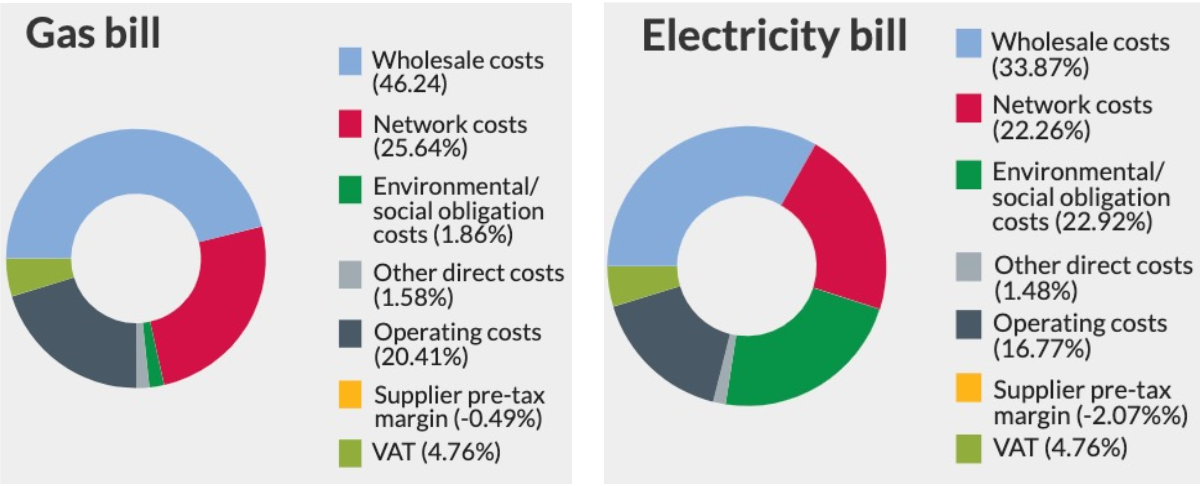
    In 2013 the UK Gov introduced the “Environmental and social levies” to fund energy efficiency, encouraging low carbon generation and reducing fuel poverty. The levies are 10x higher for electricity bills than gas bills. At the time 35% of the UK’s electricity production was from coal, the most harmful fossil fuel for the climate and air quality.

    No alt text provided for this image

    Consequently in 2013 the UK Gov also introduced the Carbon Floor price, initially at £16 (above the EU-ETS at the time) and set to rise to £30 by 2020 (which would now be below the EU-ETS). This has seen Coal reduced to 2% or less (20x smaller) for electricity production. The UK established (EU approved) measures to protect industry and now the EU itself is driving international dialogue on Carbon Border Adjustments.

    Whilst prices fluctuate over time, these policies raise prices for things that pollute (or used to pollute), and at the same time try to alleviate the financial burden on the poorest. The apparently conflicting problems of poverty and climate change. Ironically most of the people living a lifestyle compatible with 1.5ºC are the poorest in society, with the richest 10% causing as much pollution as the other 90% combined.

    Climate Income – the solution?

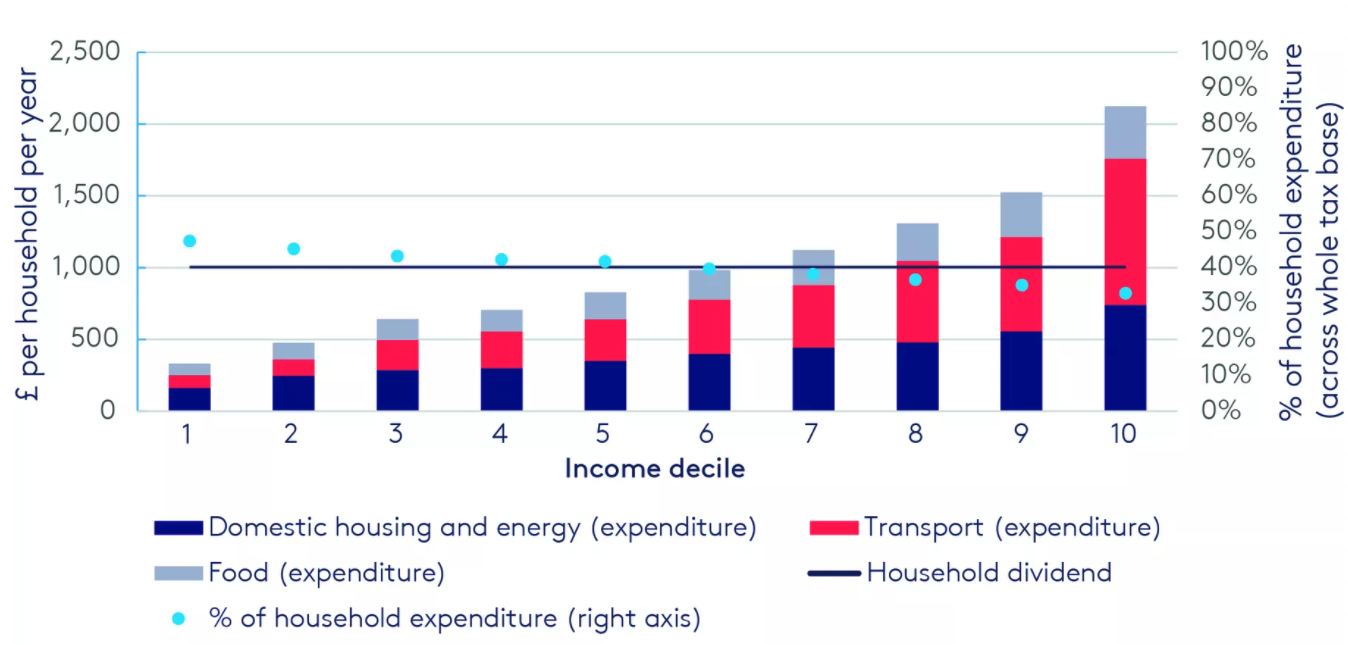
    Climate Income is a revenue neutral, steadily increasing price on pollution fully rebated to all citizens. Revenue neutral means there is no cost to the government, and, significantly, no revenue for the government. The steadily increasing Carbon Price follows the polluter pays principle embedded in UK legislation for nearly 50 years. The key part is returning the money to all citizens equally in a fair monthly payment, much like how child benefits or pensions are paid. Despite the rising costs, the poorest 20% could be £500 better off, enough to match the one of the current UK government suggestions.

    No alt text provided for this image

    London School of Economics data from 2019.

    The rest of society would be proportionally affected depending on the pollution they cause. Once the gas price spike settles over half the population would be better off. The exact amount depends on the level of price introduced. LSE modelled a £40 /tCO2 charge, above the current £18 and the planned £30 level, though significantly below the current UK ETS price circa £75.

    No alt text provided for this image

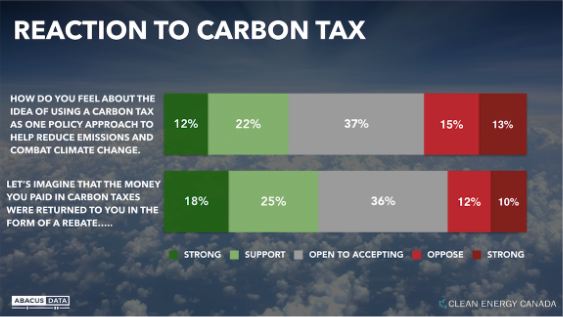
    This type of approach is intrinsically fair, sharing the responsibility and rewards equally on everyone. In Canada a form of Climate Income has been operational since 2019 and the public increasingly understand and support it, re-electing in 2021 parties in favour.

    Above all, it must be clear to the public that this represents a rebalancing of the tax base, in order to incentivise greener technologies and activities, and not simply a backdoor way of the Treasury taking more cash from their pockets.

    What does this mean for the Net Zero goal?

    A clear path to NetZero is supported by aligning the steadily increasing price to the data from the IPCC 1.5ºC report and the latest International Energy Authority report which suggest most (70%+) of NetZero can be achieved with such pricing. What this illustrates is that the long term NetZero objective actually helps clarify how the UK Gov might proceed with other related policy options currently under discussion. 

    e.g.

    1. Subsuming the current Environmental and social levies – reducing the bias against cleaner electricity and shifting the costs more to polluting gas, whilst delivering on the environmental and social objectives.
    2. Removing VAT from household energy bills would be a cost to the treasury that would enable a higher Carbon price, reinforcing 1 above.
    3. Both above measures reduce pressure on the various means tested support programs over time. As the Carbon price rises each year the policy is increasingly progressive, enabling simplification and reduced bureaucratic burden on people and the state.
    4. Windfall taxes might also reduce the immediate financial burden on the treasury enabling more of the existing carbon price (via the UK ETS) to be returned to citizens.
    5. Rebating the money to citizens gives industry the confidence to pass costs on to consumers regardless of how the price rises domestically.
    6. The ETS (copied from the EU) could be replaced by a simpler and more predictable economy-wide carbon price that allows industry to plan and invest with more certainty.
    7. Such pricing strengthens the UK economy to exploit the international trade advantage that already exists in the eyes of this US assessment as the EU and others pursue Border Carbon Adjustments. It also helps create the investment case for industry in the inevitable green revolution the world needs over the next 30 years.

    It could be argued, however, that the current path, with various different ways to raise energy prices and tax revenue whilst only offering minimal and creeping support for the most vulnerable mirrors exactly what unfolded in France with the Yellow Vest movement. Indeed the parallel is further matched by a spike in prices being the trigger to public discontent to such policy creep. In France it was an oil price spike after 4 years of gradual price increases that drew public anger, today it’s gas.

    So to round up here’s a summary other expert opinions that endorse some or all of what is proposed in Climate Income:

    None of these experts are saying this is a magic bullet that fixes everything. They all broadly agree that it is the single most important tool to address climate change. It can also show us how to navigate the short term energy price spike and re-align our worthy intentions in other areas. As Our World in Data summarises: 

    “What’s frustrating about the challenge of climate change is not that we have no options, but that we do not take the options we have. “

    No alt text provided for this image

  • What lessons should be learnt from the fuel crisis?

    What lessons should be learnt from the fuel crisis?

    The current fuel crisis is creating problems for governments in the UK and Europe. The conundrum is based on the combination of underlying energy costs, environmental taxation, poverty alleviation and climate policy all overlapping in a non-aligned mix. Finding a solution that keeps advocates of each policy and it’s raison d’etre supportive is challenging. Here we look at how Climate Income can be the sword that cuts the Gordian knot.

    First let’s examine some of the main policy elements at play …

    The political pressure is coming from the financial pain faced by families with rapidly rising fuel bills where energy use has already been reduced to a minimum with the bottom 50% of the population using energy consistent with a 1.5ºC pathway! Energy costs impact everyone, but low and middle income groups spend a higher proportion of their income on transport and household energy needs than the better paid.

    The main carbon pricing mechanism in the EU and UK is the Emissions Trading Scheme (ETS). The UK left the EU ETS and established an independent ETS which began in January 2021. ETS is considered to be a revenue raising mechanism (tax) as well as a carbon pricing tool. The revenue should be used for appropriate purposes but it is not used as a dividend to the householder to mitigate and thus enable a predictably rising carbon fee as with Climate Income. 

    The UK government has also historically put the burden of paying for the move to renewable electricity onto electricity bills, making this fuel, though increasingly greener than gas, considerably more expensive and adding about £200 to fuel bills. Environmental levies include the Renewable Obligation and the Contracts for Difference, which incentive and support renewable electricity generation, the Feed in Tariff to support solar panel installations, and the Energy Company Obligation, which has provided energy efficiency measures to more than two million households. EPC certificates have also compounded the injustice by rewarding the gas heating home owner over the electric heating owner!

    The government does need to mitigate the effect of rising fuel costs this winter. It refused to implement a post Brexit VAT cut on fuel, claimed to be too much of a ‘blunt instrument’ – although is it fair to just help the very poorest households and not the struggling middle classes? Even if implemented however, 5% of the projected £700 bill rise amounts to a mere £35 and the saving on the average dual fuel bill is estimated to be around £89. Removing the VAT may be a fair and wise move because of what it represents politically but it is not a solution to the underlying problems in our current carbon pricing policies.

    The suggested Warm Home Discount expansion will only target the very poorest and there are logistical problems in applying for the WHD –  meanwhile a targeted home upgrade grant for fuel-poor homes had been halved in the autumn budget! 

    A windfall tax as proposed by the opposition parties looks like an easy solution but it would be hard to implement and it would only cover the oil and gas we produce ourselves (only 40% of our gas is domestic and we imported 20 million tonnes of oil in 2020). It has also been argued that the perceived punitive nature of the tax could be used as a reason for reducing investment in carbon capture and more renewables. Like the other solutions it would be short term and not contribute much to the real solution – more renewables and the price of fossil fuels reliably reflecting their true price to society.

    The carbon price in the ETS (Emissions Trading Scheme) which is the main carbon pricing mechanism in the UK and EU is determined by the market, this led to it being too low to be effective during the recession and now so high that ‘Cost Containment Mechanisms’ has been and may be used to mitigate the immediate effects on industry. Cost Containment not only negates the claim that ETS is market driven rather than part of a command economy but also negates the effectiveness of ETS in encouraging decarbonisation. Under Climate Income Schemes the carbon price is designed to rise but in a predictable way which businesses can plan for.

    The Government had proposed last year that the ETS scheme would be extended to cover the other ⅔ of emissions including building and transport. This was similar to the proposed EU Building and Transport ETS which is meeting resistance in the countries historically dependent on coal (and colder!) such as Poland. The UK proposal was watered down (2nd item) through fear ‘it could trigger a political storm’ in November 2021 and it is no longer described as being about to be ‘radically’ expanded. (Marine and waste incineration emissions are still being considered with the possibility of agricultural emissions in the future).

    The Government had said it wouldn’t have a universal carbon fee back in February because it would raise the price of cheese and meat even though a universal carbon price would send a clear message on all products and eradicate most of the disincentives to electric heating and vehicles. In July the government seemed to be considering CI, which would of course offset the rising price of carbon dependent products while householders and manufacturers adjust, thus mitigating the problem of rising cheese and meat prices! In November at the debate prompted by the Zero C petition its briefing (current carbon charges 2nd para) referred not to the July proposals but back to the February statement on carbon pricing. That debate also took place when it had been decided to scale back the ETS extension but the briefing and government response doesn’t reflect that decision.  Please see Further information on the government response to the Zero C petition for a link to the government response to the petition.

    The government decided against a universal carbon price because of the costs to the householder. The preferred carbon pricing policies however are proving equally unpopular – especially the tariffs on electricity bills to pay for renewables and the VAT on fuel even though the low rate could be considered to be a hidden fossil fuel subsidy like frozen fuel duty. ETS is less visible at the moment – but would have been about to become extremely visible if the government hadn’t scrapped the extension to buildings and transport because of its likely unpopularity! As it is the government uses Cost Containment, whenever the carbon price seems to get too high for comfort – thus rendering ETS far less effective. 

    ETS  in its current form (without CI) can’t be effective without creating further problems for consumers, unpredictability for businesses and future short term cutting of the carbon price every time there is a fuel market crisis.

    Climate Income would mitigate the costs of rising fuel prices without the need to cut the carbon price (and thus reduce incentives to decarbonise) every time the market spikes. The predictably rising price would also allow businesses and households to plan ahead to decarbonise, especially if future carbon dividend payments could be offered as loans for retrofitting and industries could, among other tactics, have fees offset against carbon capture, usage and storage.

    It is unlikely that this current fuel price crisis is a one off – we need a carbon pricing policy which can weather this and future storms without having to be watered down each time. Climate Income is the answer!

    Catherine Dawson and James Collis

  • Another fantastic plug for Climate Income from one of our members!

    Another fantastic plug for Climate Income from one of our members!

    Last year Rob Paton and Citizens:MK succeeded in gaining unaminous support for Climate Income from Milton Keynes Council. Rob then went on to write about the campaign in the national Quaker magazine, The Friend.

    Rob has now succeeded in getting a full article published which he has given me permission to reproduce here. I attended a Zoom meeting organised by Rob for a local climate group and was able to see the issues people have with the concept of CI (which it is easy to lose sight of when you have been immersed in the campaign for three years!) which Rob describes – his approach has lessons for us all! Note that ‘testimony’ refers to the Quaker values of equality, peace, truth, justice and simplicity.

    A year of climate campaigning: What Rob Paton learned

    6 Jan 2022 | by Rob Paton

    ‘It’s often the testimony that does it.’

    ‘The alternative is to look for common ground.’ | Photo: by Li-An Lim on Unsplash

    I had been a ‘greenie’ for years, but not heard about Carbon Fee & Dividend (also known as Climate Income) until a Friend told me about it a couple of years ago. I visited the website of Citizens Climate Lobby UK – and wow! So simple. An arrangement that would turbo-charge all other carbon reduction policies, or render them superfluous. A way to make higher carbon prices not just acceptable, but popular. Like every good convert I set off with missionary zeal. At which point things became… interesting.

    Yes, sometimes people ‘got it’ quite quickly. What really struck me, though, was how often people didn’t (or couldn’t?) ‘get it’. For example, when another Friend passed on something I had written to her daughter, active in XR, the daughter was enthused. She shared it in her circle… to no avail whatsoever! Even professional campaigners who knew their economics seemed to ignore carbon pricing. It was the elephant in the room. As for Climate Income, well, on a good day it would be damned with faint praise. I asked several: ‘What should we be asking for at COP26? Wouldn’t it be great if we had one simple, specific “ask” that everyone could get behind, like “Drop the Debt”?’ Everyone liked the question, but their answers were either lengthy, or pithy but plaintive (‘just keep your promises’). No one expressed much interest in Climate Income. Gradually I came to realise – or re-learn – some important lessons.

    If people are not open, or ready, then I was probably wasting my time as well as theirs. It wasn’t just that trying to persuade people seldom helped. Things went better when people were stimulated to find out for themselves. For example, our local Citizens:mk climate campaign asked the leaders of the three main parties on Milton Keynes Council to consider supporting the idea. Initially, all were wary, but they agreed to check it out. When it came to the debate, genuinely enthusiastic speeches in support came from all sides, and the motion passed unanimously. Likewise, when we asked the local Anglican bishop to consider the idea and how he might use his position to promote it, he was sympathetically cautious: he would meet with us but the issues were complicated and he needed to find out more. But then before we knew it he was on board, asking a pointed question in the House of Lords!

    That illustrated another important point: it’s often the testimony that does it. A remarkable teenager in our campaign group had recounted being confronted with the harsh realities of what climate change would mean for her and her generation. She spoke simply, clearly and from the heart. It was moving and memorable in a way that bald facts and reasoning are not.

    I also noticed how widespread adversarial thinking is among green campaigners. The default stance is to campaign against things – and people. When I asked what was needed for a consensus in support of cutting out carbon, the answer was, essentially, for lots more people to care like we do. We have seen the light; we must convert others to our way of thinking. Worse still, I, too, slipped into adversarial thinking. At one point I was seeing the Treasury as a bogeyman. They didn’t like hypothecated taxes and would be bound to resist this idea. But one of the beauties of the arrangement is that it is revenue neutral – it is a transfer rather than a tax. It doesn’t add to government spending. Better still, by turbo-charging the switch to renewables, it reduces the need to subsidise green technologies which are a drain on the exchequer. It also gives a further basis for cutting out those subsidies still being paid to fossil fuel companies.

    The alternative is to look for common ground. Climate income provides such a common ground, securing support for long-term carbon reduction. In Canada, where this ‘fee & dividend’ approach has been adopted, governors of some provinces with high levels of fossil fuel activity thought they might roll back the legislation… until they found how popular it had become with voters.

    What really took me by surprise, though, was the way climate lobbying led into a deep consideration of truth, and our compromised capacity as humans to face it. I joined a Zoom course on how to engage with political leaders on climate issues. At one point the young course leader said words to this effect: ‘Look, we have enough information in this group to plunge half the country into a state of deep clinical depression. It’s just as well that many people are “in denial” – the health services would be overwhelmed if everyone suddenly woke up to what the disaster will mean for them. That wouldn’t do the planet any good.’

    Instead he introduced us to ways of meeting our leaders where they are, helping them recognise their own ambivalences and uncertainties, and helping them find their own safe next steps. This doesn’t mean that we should only engage with the political system in therapeutic mode – listening supportively, asking gentle questions, building trust. As we Quakers know, discernment requires threshing as part of the process. So explanations, facts, clarifications and analysis all have their place, collegially conducted, among those seeking further understanding. Here too I learned lessons.

    I had to treasure the disagreements and challenges I encountered. They were informative about what I had not explained. For example, if someone said, ‘Won’t people just use all their climate income paying for the higher price of fuels?’ I had to be ready to agree: yes, some would, to begin with. It would be their choice. Only then would it be worth my explaining how the steadily-increasing price of carbon (and climate income) would play out over the medium term: the higher the price the more incentive everyone has to switch to green alternatives. Instead of it being against our economic interests to ‘do the right thing’, we become (even) better off by ‘doing the right thing’.

    Another example: one councillor said we shouldn’t increase the price of fossil fuels until the cost of green alternatives had fallen to the level of current fuel prices, otherwise the poorest would be hard hit. This overlooks how climate income protects the least well off. But I sensed something else was confused in this observation, and it took me time to pin it down. In fact, the price of the alternatives will not fall until they are adopted on a large scale. So we need to make the green alternatives cheaper than fossil fuels in order to bring about large scale adoption. This is precisely what steadily increasing the price of carbon makes happen.

    I also came to appreciate the uncertainty in our predicament: no one knows what will be an achievable and sustainable mix of green fuels. The technologies are still a big cloud of unknowing. Some say heat pumps. Some believe hydrogen is the answer. According to others, the future is electric. Some think that Carbon Capture and Storage is crucial. Each of these has its advocates – and, happily, investors willing to back them.

    Finally I have had further lessons in patience and trust. Having been through panics about nuclear war, the scares about the millennium bug, and the fear that oil was running out, it is a little easier to hold my nerve. Yes, I do know about tipping points. The dangers are very, very real. But so are the emerging opportunities with many signs that the tide has turned. And so we choose life, doing what we can where we are.

  • Happy, if slightly belated New Year to all our members!

    Happy, if slightly belated New Year to all our members!

    As the fuel price crisis is on everyone’s minds this January member Darrin Charlesworth tops the Letters page in today’s Guardian Online………..

    John Vidal’s list (It’s the great green reset: 10 things Britain can do now to save the planet, 3 January) seems very achievable, but I would like to add one more to accelerate change: climate income.

    First, introduce a carbon tax across all industries to price emissions into the market, closing a huge economic loophole. By gradually increasing the tax, we not only incentivise lower emissions on the supply side, but we also drive demand for low-carbon alternatives.

    Second, redistribute the revenue equally to all citizens. This protects the most vulnerable consumers, who already have smaller carbon footprints, from fuel poverty. The wealthiest people with the biggest carbon footprints would see their costs rise, but for the majority, costs would be neutral.

    Third, introduce carbon border adjustments. This policy would prevent emissions being transferred offshore, but also protect many UK businesses, especially our vibrant small business community, from competitors in countries without a carbon tax. This policy would help drive many of the others at a time when we need real urgency.
    Darrin Charlesworth
    Citizens’ Climate Lobby UK

    Congratulations Darrin for succinctly and elegantly summarising how Climate Income would enable the true price of carbon to be reached – thus making decarbonisation a no brainer without impoverishing everyone!

  • Further information on the government response to the Zero C petition.

    Further information on the government response to the Zero C petition.

    I have to apologise for being pressed for time yesterday when writing about the parliamentary debate on the Zero C petition. In my haste I failed to take in the fact that the government had produced a briefing on the petition. The briefing states that…..

    The Government response to the petition refers to the UK Emissions Trading Scheme (ETS). The UK ETS sets a limit on emissions from energy generators and energy intensive industries, which incur a cost if limits are exceeded.  The Government response also points to the Government’s intention (set out in the Energy White Paper) to extend the scheme, and to explore expanding the UK ETS to cover two thirds of the UK’s remaining emissions.

    Carbon pricing can take a wide variety of forms. There were some reports that the Government was considering the options for broader carbon taxes or pricing earlier this year, but that it is no longer the case.

    This is very interesting (and disappointing) but it explains why we heard nothing further after the claims that Liz Truss was supporting a Carbon Border Adjustment Mechanism and the July ‘leak’ to the Times about introducing Climate Income based on the Canadian model.

    The government also states that support for poorer households will be targetted capital support from the tax payer, arguing that….

    Given the significant variation within income groups, it will be more effective to focus on individual technology transitions, with taxpayers providing targeted capital support for those low-income groups most acutely affected by a specific technology transition(and in advance of policies that penalise or phase-out use of high carbon technologies), than to consider the transition in aggregate and develop universal and untargeted policies to support households – such as, changes to tax and welfare. This would also mean that low-income groups could benefit sooner from the household savings that arise from a transition.

    It appears that the debate was used by participants to refute these claims rather than debate universal carbon pricing, although Alan Brown did make a strong case for the lost opportunities caused by the lack of tax hypothecation and a sovereign wealth fund.

    The complicated, costly and intrusive ‘targetting’ of support envisaged by the government in its net zero strategy will, it seems to me, not lead to fair and equitable transition. There is still all to play for!

  • How did the debate on carbon emission charges go?

    How did the debate on carbon emission charges go?

    On November 1st the much anticipated debate on the Zero C petition was held in a extremely uncrowded Westminster Hall. Catherine Mckinnell (Newcastle upon Tyne Central, Lab) moved the petition, stating that its aim is  to impose a single carbon price across all sectors. ……

    In its simplest terms, the petition calls for the Government to work towards a single carbon price across almost all sectors. The campaign argues that a single carbon price would amalgamate the many existing price instruments, including the carbon price support and the UK emissions trading scheme—a different form of carbon charging—into a simple, transparent carbon charge. Zero Carbon points out that our current policies cover emissions across only about a third of the economy, giving the biggest polluters free allowances while the consumers are left to pay. I pay tribute to the petition’s creator, Isabella Goldstein, who is the senior campaign manager at the Zero Carbon campaign.

    The theory behind this form of carbon charging is straightforward. If we had, for example, a single carbon price of £75 per tonne of CO2, it would incentivise people and businesses to pursue any methods of emission reduction that cost less than £75. Hon. Members will be aware that we are far from having a single carbon price across sectors. Instead, we have a patchwork of policies that incentivise or disincentivise emissions in ways that are often unclear. While overall they have the effect of, for example, discouraging the burning of fossil fuels, the cost varies hugely depending on the source of the emissions. It is argued that the key benefit of working towards a uniform carbon price is that it avoids a situation where some sectors face higher carbon prices, and must therefore make more expensive carbon reductions, while others could more easily and cheaply reduce their emissions but do not.

    Mckinnell also pointed out that Zero C are asking for the policy to be fair and equitable…

     Alan Brown (Kilmarnock and Loudoun, SNP)……In a similar vein, I represent a former coalfield area. Carbon taxes had been applied to the extraction of coal over the years, but a few years ago, when the open-cast coal industry collapsed in my constituency, it left massive craters that needed reinstatement work at a cost of millions of pounds. Carbon taxes came from my constituency to the Treasury, but they just went into the black hole. When we asked for assistance for restoration work on those abandoned coalmines, the answer that came was, “No. Too bad. That money came in and it has been used. There is no money coming back to your constituency. It doesn’t work that way.” That shows the folly of not ring-fencing a tax for the purpose that it should be ring-fenced for. Again, transparency is utterly critical if we are to go forward.

    Jerome Mayhew (Broadland, Con) argued cogently for a Carbon Border Adjustment Mechanism policy, as he has been championing for a while. There was interest in CBAM earlier this year  but in July the Board of Trade published a report extolling free trade as the answer, the subject is still under review.

    Unfortunately although the speakers all argued that carbon pricing was necessary and should be fair there was no discussion on how to implement it, such as suggesting a solution like Climate Income. The argument for a single uniform carbon price wasn’t really debated, instead the arguments were vague, focussing on stating that the Net Zero Strategy isn’t doing this, that or the other, our party would spend more and be more equitable than the government and when will the ETS net zero consistent cap be announced. 

    This line of arguing therefore enabled the financial secretary to the treasury, Lucy Frazer, to argue that while “The petition specifically calls for a carbon charge to encourage industries and organisations to reduce their carbon emissions” the government is already doing this through the UK ETS scheme and Carbon Price Support, but she didn’t feel the need to address the petition’s main ask as no-one else had been discussing it.

    In summary the gist of the petition, arguing for a single, uniform carbon price seems to have been lost in the discussions about other aspects of the Net Zero Strategy and finance. 

    One has to wonder if the timing of the debate, falling as it did during COP26, inevitably led to the paucity of ideas and discussion, with no-one from the government, for instance, discussing the ideas leaked in July