
Category: CCI

  • What happened at COP28?

    What happened at COP28?

    This is an extract from the slideshow delivered by Cathy Orlando, CCI program director on the 20th December 2023 giving the CCI analysis of the outcome of COP28. The worst case scenario – that fossil fuels would get a free pass and the pledge to work to keep temperature rises within 1.5 Celsius would be dropped, was averted.

    CCI applauds the eventual operationalisation of the Loss and Damage Fund, the declarations on tripling renewables and doubling energy efficiency, and tackling the fossil fuel subsidy issue. Highlighting the role of agricultural systems and the effects of climate change on human health and the natural world as well as the need for the transition to be just were also welcome signs of progress and proof that COP conferences, while not perfect, are important and necessary.

    CCL UK agrees that COP28 confirms that CCI’s campaigning for the reform of financial systems is the path forward.

    Governments’ 2030 targets will lead to 2.5°C of warming by the end of the century: 0.1°C higher than last year. This change is due to weak existing targets rather than any major shifts in new NDC updates: we take the level of emissions anticipated under current policies for those countries that we expect to overachieve their weak 2030 targets.

    Since COP28 the FFNPT now has 12 nation states signed up, in September the State of California became the largest economy to endorse the call (the 5th largest economy in the world and the largest sub-national economy)…… California Senate Majority Whip Senator Lena A Gonzalez (D – Long Beach), said: “It is essential that we commit once and for all to ending our reliance on fossil fuels. People around the world, especially low-income people of color, are suffering the adverse health impacts of fossil fuel pollution, from asthma to cancer. The recent devastating fires and hurricanes emphasize the urgency of taking action, to prevent further extreme weather changes. The science has been clear for decades—fossil fuels are responsible for the climate crisis. We can prevent further harm to our communities, and that is why I am proud that California has now been added to the growing list of governments endorsing the Fossil Fuel Non-Proliferation Treaty. It is time for our nation to be a part of the solution, to forge strong unity and commitment to phasing out the use of fossil fuels.

    France and Kenya formally launched the ‘Taskforce on International Taxation to Scale Up Development, Climate, and Nature Action‘ with Barbados, Antigua, Barbuda, and Spain signing on as members.

    CCI and CCL UK members will continue to educate and campaign for the solutions that will enable the world’s financial resources to be unlocked to ensure a liveable future in 2024.
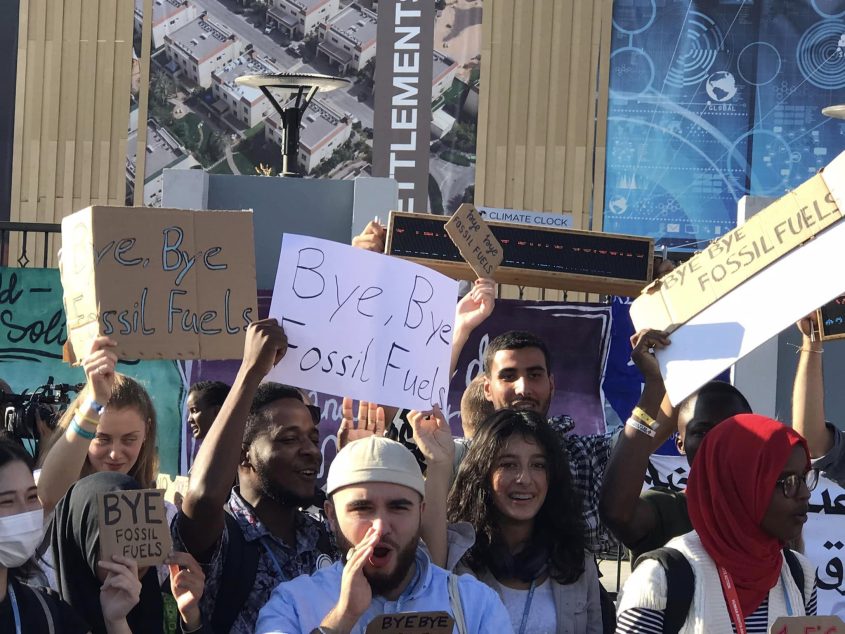
  • When they say we need fossil fuels…Citizens’ Climate International Laser Talk, November 2023

    When they say we need fossil fuels…….The primary driver of inflation around the world is fossil fuels.  Economies are addicted to fossil fuels at every level: mobility, energy production, agriculture and goods production. When the prices of oil and gas go up, every other price tends to go up. Actually, high fossil fuel prices are historically inseparable from inflation and economic crises. Mark Zandi, chief economist at credit rating agency Moody’s, said in an article for Vox that “every recession since World War II has been preceded by a jump in oil prices”. And there is a term for it: fossilflation.

    Factors driving fossil fuel prices are many, and diverse. Most of the time, though, these come directly from producing countries, which raise and lower production, thus flooding or drying up the market. This is often used as a political tool, driving millions of people into despair. Here is just a sample of the many ways of how fossilflation happens:

    1. The market-rigging actions of the OPEC Plus cartel (including Russia);
    2. Profiteering on energy supply disruptions due to Russia’s invasion of Ukraine;
    3. Climate damages (a.k.a. climateflation) Extreme weather, climate and water-related events caused almost $1.5 trillion of economic losses in the decade to 2019, up from $184 billion in the 1970s, according to a World Meteorological Organization (WMO) report.
    4. Embedded energy costs across all classes of consumer products and business services;
    5. Food system effects including embedded fossil fuel costs and climate damage;
    6. Embedded climate risk and liability costs;
    7. Sovereign debt stresses driven by fossil fuels, including:
      a. Public spending and sovereign debt burdens resulting from disaster response;
      b. Direct spending on disaster response;
      c. Extremely high, punishing interest rates linked to that spending compelled by actions a country did not initiate or decide;
      d. All-time record fossil fuel subsidies ($7 trillion), linked to rigged fossil fuel price spikes;
      e. Public spending to compensate consumers for unaffordable price shocks linked to higher embedded energy costs.

    There is one solution: move away from fossil fuels. We need to do it fast, and we need to do it fairly. That is why at COP 28, Citizens’ Climate International is linking arms with many organisations and calling for a fossil fuel phaseout.

    By breaking free of coal, oil and gas, and replacing them with renewable energy sources, we will protect our planet and our economy.

    Summary

    The primary driver of inflation around the world is fossil fuels. In fact there is a term for it: fossilflation. There is a simple solution: move away from fossil fuels. We need to do it fast, and we need to do it fairly.

    That is why at COP 28, Citizens’ Climate International is linking arms with many organisations and calling for a fossil fuel phaseout. By breaking free of coal, oil and gas, and replacing them by renewable energy sources, we will protect our planet and our economy.

  • A message of hope from Citizen Climate International….

    A message of hope from Citizen Climate International….

    The outcome of COP 27 in Sharm El Sheikh treated the consequences – loss & damage, but not the cause – fossil fuels.  It was a huge victory to get loss and damage funding. This is to be celebrated.

    We cannot rest yet. There is no mention of oil and gas in the COP 27 outcome. The math is simple: more fossil fuels burned means more adaptation and loss and damage costs. This victory is unbalanced.  Anything that is unbalanced is doomed.

    We have hope because it’s not the COP sessions that change the world, it’s the actual work that goes on after governments have made those promises.  We have hope because we have been working behind the scenes and monitoring progress at the G7, G20, the United Nations, the World Bank and the IMF for several years now. We have hope because our volunteers are doing fantastic work around the world. We have hope because we know that the tracks have been laid for a resilient and equitable future and the train is about to leave the station. Consequently, we have hope because we know that the transformation of the economy will not be linear.  

    Change is coming. Find out how you can help and spread hope.

    Hope

     And an added thought for fun. We need to name if we are to tame it:

    Bye bye fossil fuels

  • Growing support for an international carbon price floor.

    Growing support for an international carbon price floor.

    Last year the IMF called for a globally applied carbon price floor corresponding to a country’s wealth, with a suggested tariff in 2021 of $75 for the wealthiest countries and $25 for less developed countries. Today in the Times (paywall) Mehreen Khan, the economics editor, makes the case for an effective international carbon pricing system rather than occasional windfall taxes…. 

    “One levy notably absent from the present debate is a global carbon tax to provide an incentive for the huge shifts required to hit the global net-zero target. Even in relatively benign times, politicians have taken fright at the idea of taxing carbon use, thinking that it will disadvantage their industry at the expense of foreign rivals…

    Arguments against national carbon taxes wither away if all countries agree to impose a price. The International Monetary Fund has devised an international carbon floor where the price paid corresponds to a country’s wealth. It would mean America, Britain and Europe would use a minimum floor of $75 a tonne, falling to $25 for the poorest. This collective jump into carbon taxation would not disadvantage industries in richer countries, the fund says, and would dramatically reduce emissions.” 

    Citizens Climate International supports a carbon price floor mechanism as a necessary step to the goal of Climate Income….

    We support establishment of a global “price floor”, supported by national policies to impose a steadily intensifying price signal disfavoring climate pollution. As the IEA has reported, “There is no need for investment in new fossil fuel supply…” Pricing systems should effectively and efficiently eliminate climate pollution while building incomes for people and enhancing international cooperation for a zero-emissions future.

    Recent studies such as the report in Nature and the Autonomy report have also suggested how Climate Income could be a game changer for the Global South….

    While countries in South America, Sub-Saharan Africa, South-Asia and many other parts of the Global South would profit immensely, most developed economies would only see proportionally relatively small losses.

    …..As a global policy, it could wipe out extreme poverty and easily dwarf the scope of any existing development aid and debt relief schemes, illustrating that, in this sense, it is the Global North that owes an immense debt to the populations in the Global South, not the other way round. It would also go a long way to alleviate the disastrous impacts the Covid pandemic has had on the world’s poorest and most vulnerable, with for instance an additional 100m children falling into poverty, and prevent global disparities from deepening as richer countries recover while poorer countries fall even further behind (UNICEF 2021b). Such a global carbon dividend scheme could end the bitter reality of mass hunger and destitution and be a key building stone of a fairer, more sustainable and more inclusive post-pandemic economy. (Toll gates and money pumps, Autonomy, p.51)

    It is good to see growing support for a carbon pricing system which would remove the uncertainty and short termism thwarting the rapid decarbonisation which the world needs!