Category: Campaign

  • National Emergency Briefing

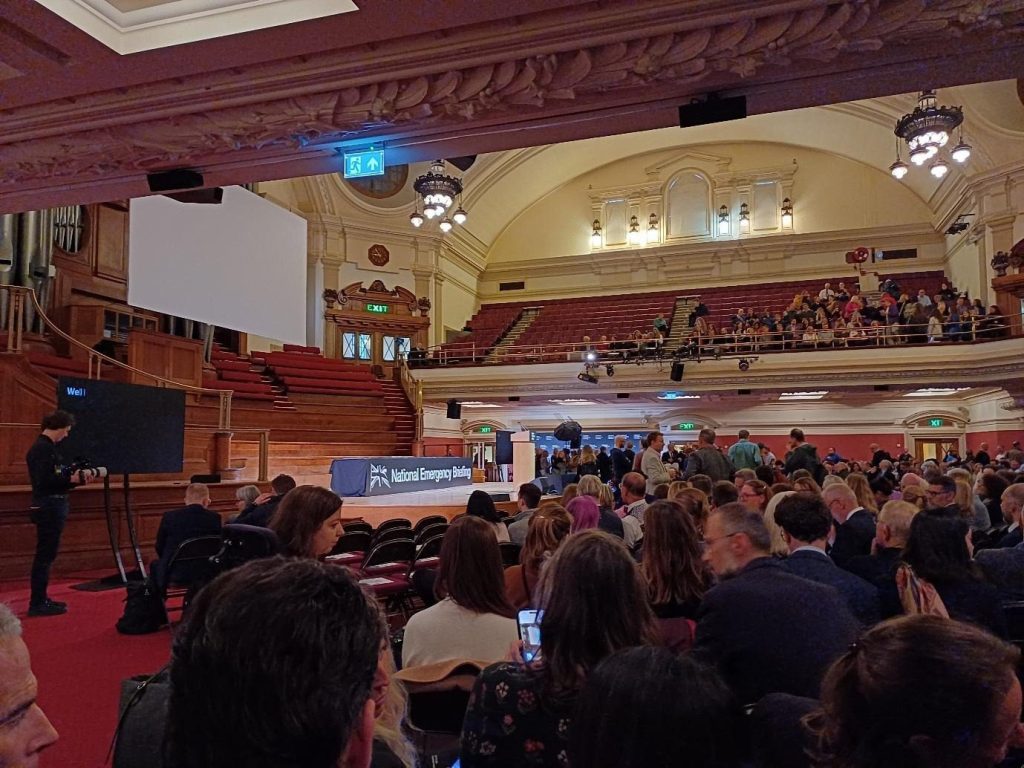
    On November 27th, last year, I was privileged to attend the National Emergency Briefing at Central Hall, Westminster. The briefing was primarily aimed at MPs and Peers but was also attended by around 2000 invited members of the public from climate campaigners to celebrities.

    The queue, when I arrived, stretched around the block but the organisers got us in efficiently and I found myself sitting next to the sustainability manager of Sainsbury’s. However, there wasn’t much time to chat as the talks started. We kicked off with an introduction from Chris Packham and a preview of what to expect from the main meeting organiser, Pofessor Mike Berners-Lee of “How Bad are Bananas?” fame. Then we were into the main part of the meeting, a series of 15 minute talks from some of the UK’s most eminent experts on the impacts of climate change from Health, to National Security and Economics as well as several talks on the science of climate itself.

    I’ve waited until now, to write this blog, because I didn’t want to be writing a long boring description of each talk. Instead, the talks are now all available on-line for you to watch for yourself. Go to https://www.nebriefing.org/ and select each of the talks under “Expert Briefings”. I really can’t recommend these talks highly enough.

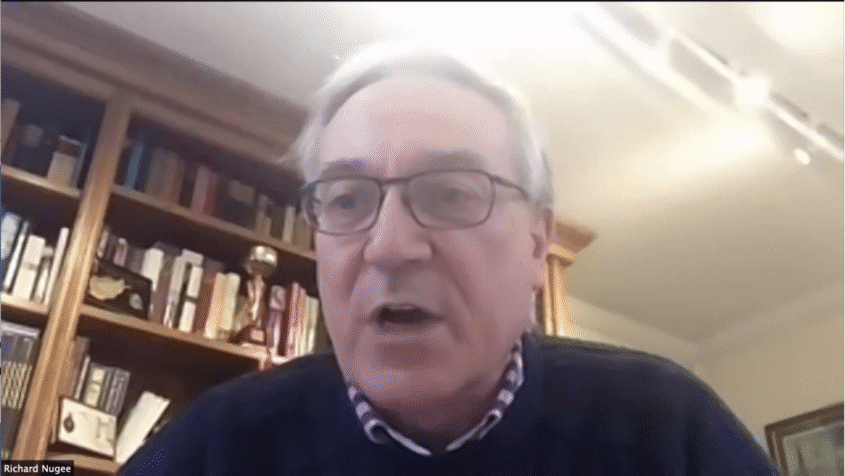
    The main message I took away from the meeting is perhaps summed up by a sentence from Lt Gen Richard Nugee’s talk on National Security. In that context he stated that “the threat position is changing faster than expected”. This is true of all the aspects covered by the speakers.

    Another reason for wanting you to go to the NEB website itself is that you can then sign the open letter to Keir Starmer calling for a televised emergency briefing. Please all sign up.

  • Fiddling while Rhodes burns, we can remind politicians there is a fair and just way to decarbonise….

    Fiddling while Rhodes burns, we can remind politicians there is a fair and just way to decarbonise….

    Both Labour and Conservative politicians have been spooked by the narrow by-election win in Uxbridge which has been squarely attributed to campaigning on the proposed extension of the Ulez scheme. Few commentators pointed out that Manchester, Bristol, Birmingham and Bradford received a combined £230m in Government funding for their scrappage schemes, but London and the South East have received none.

    Press coverage has rightly pointed out that people should not be made poorer by ill thought out schemes which could be said to put the cart before the horse. There are politicians in both parties who are calling for unpopular policies to be dropped or postponed but neither party is denying the need to reach net zero.

    Sam Hall, director of the Conservative Environment Network, told The Observer that …“Environmental policies are an electoral asset when they are fair, affordable, and deliver for people and their communities. I’d warn Conservatives against listening to calls to ditch environmental commitments following the Uxbridge result. Insulating people’s homes, building more renewables, and attracting investment into new clean industries are popular, bill-cutting and job-creating.” 

    A blog he wrote for CEN points out thatThe Conservatives secured a victory against the odds by focusing the campaign on ULEZ expansion. They effectively pulled off a protest vote against an unpopular mayor instead of the usual dynamic of voters protesting the government. This strategy won’t work at a general election, when the party will be asking for a fifth term in government. Senior Conservatives must resist calls to ditch conservative environmental policies. (Over 150 MPs and Peers have signed up to the CEN).

    What the by-election shows is that policies which create financial hardship won’t work and in fact will be as counter productive as the tax imposed in France which led to the Gilet Jaunes revolt. Climate Income along with grants or loans based on future carbon dividend payments would go a long way to achieving the decarbonisation of the economy without penalising most people (as outlined in our report published last October). 

    Whilst not asking directly for Climate Income the Times editorial today puts the case for a Carbon Tax…..The message from policymakers must be that mitigating climate change can best be tackled through the continual innovations that are characteristic of market economies. And that doing so, using the price mechanism to encourage new technologies, is practical. It is widely understood that a carbon tax would be highly effective in persuading consumers and businesses to switch their energy consumption and behaviour. This would need to apply to carbon consumption and not only production, lest richer countries merely outsource their production to poorer economies. Revenues from a carbon tax could be used to subsidise renewable sources of energy and thereby encourage their wide adoption.

    Update 25/7/23

    Today Lord Deben (outgoing Chair of the CCC) has asked that parties build a cross party consensus on tackling climate change and getting to net zero, based on the recommendation of Chris Skidmore’s UK Net Zero Review. ….“If I were leader of the Labour party at this moment, I know exactly what I’d do,” said Deben. “I would say to the current government: ‘Here is Mr Skidmore’s report, he is a Conservative ex-minister, he was asked to do this report to show how best to deliver net zero by Liz Truss. Now we will accept, if you put it forward, we will do the following basic things [acting on the report’s recommendations]. We will do that. We won’t oppose it. You put them forward, we’ll back it.’” ………..There are those who don’t really take onboard the urgency of climate change, and they are in all political parties.”

    Let’s remind our politicians that there is not only no justification for dropping commitments to net zero while Rhodes burns and people die, but also no need!

     Tomorrow’s national meeting will be dedicated to this action

  • Further information on the government response to the Zero C petition.

    Further information on the government response to the Zero C petition.

    I have to apologise for being pressed for time yesterday when writing about the parliamentary debate on the Zero C petition. In my haste I failed to take in the fact that the government had produced a briefing on the petition. The briefing states that…..

    The Government response to the petition refers to the UK Emissions Trading Scheme (ETS). The UK ETS sets a limit on emissions from energy generators and energy intensive industries, which incur a cost if limits are exceeded.  The Government response also points to the Government’s intention (set out in the Energy White Paper) to extend the scheme, and to explore expanding the UK ETS to cover two thirds of the UK’s remaining emissions.

    Carbon pricing can take a wide variety of forms. There were some reports that the Government was considering the options for broader carbon taxes or pricing earlier this year, but that it is no longer the case.

    This is very interesting (and disappointing) but it explains why we heard nothing further after the claims that Liz Truss was supporting a Carbon Border Adjustment Mechanism and the July ‘leak’ to the Times about introducing Climate Income based on the Canadian model.

    The government also states that support for poorer households will be targetted capital support from the tax payer, arguing that….

    Given the significant variation within income groups, it will be more effective to focus on individual technology transitions, with taxpayers providing targeted capital support for those low-income groups most acutely affected by a specific technology transition(and in advance of policies that penalise or phase-out use of high carbon technologies), than to consider the transition in aggregate and develop universal and untargeted policies to support households – such as, changes to tax and welfare. This would also mean that low-income groups could benefit sooner from the household savings that arise from a transition.

    It appears that the debate was used by participants to refute these claims rather than debate universal carbon pricing, although Alan Brown did make a strong case for the lost opportunities caused by the lack of tax hypothecation and a sovereign wealth fund.

    The complicated, costly and intrusive ‘targetting’ of support envisaged by the government in its net zero strategy will, it seems to me, not lead to fair and equitable transition. There is still all to play for!

  • How did the debate on carbon emission charges go?

    How did the debate on carbon emission charges go?

    On November 1st the much anticipated debate on the Zero C petition was held in a extremely uncrowded Westminster Hall. Catherine Mckinnell (Newcastle upon Tyne Central, Lab) moved the petition, stating that its aim is  to impose a single carbon price across all sectors. ……

    In its simplest terms, the petition calls for the Government to work towards a single carbon price across almost all sectors. The campaign argues that a single carbon price would amalgamate the many existing price instruments, including the carbon price support and the UK emissions trading scheme—a different form of carbon charging—into a simple, transparent carbon charge. Zero Carbon points out that our current policies cover emissions across only about a third of the economy, giving the biggest polluters free allowances while the consumers are left to pay. I pay tribute to the petition’s creator, Isabella Goldstein, who is the senior campaign manager at the Zero Carbon campaign.

    The theory behind this form of carbon charging is straightforward. If we had, for example, a single carbon price of £75 per tonne of CO2, it would incentivise people and businesses to pursue any methods of emission reduction that cost less than £75. Hon. Members will be aware that we are far from having a single carbon price across sectors. Instead, we have a patchwork of policies that incentivise or disincentivise emissions in ways that are often unclear. While overall they have the effect of, for example, discouraging the burning of fossil fuels, the cost varies hugely depending on the source of the emissions. It is argued that the key benefit of working towards a uniform carbon price is that it avoids a situation where some sectors face higher carbon prices, and must therefore make more expensive carbon reductions, while others could more easily and cheaply reduce their emissions but do not.

    Mckinnell also pointed out that Zero C are asking for the policy to be fair and equitable…

     Alan Brown (Kilmarnock and Loudoun, SNP)……In a similar vein, I represent a former coalfield area. Carbon taxes had been applied to the extraction of coal over the years, but a few years ago, when the open-cast coal industry collapsed in my constituency, it left massive craters that needed reinstatement work at a cost of millions of pounds. Carbon taxes came from my constituency to the Treasury, but they just went into the black hole. When we asked for assistance for restoration work on those abandoned coalmines, the answer that came was, “No. Too bad. That money came in and it has been used. There is no money coming back to your constituency. It doesn’t work that way.” That shows the folly of not ring-fencing a tax for the purpose that it should be ring-fenced for. Again, transparency is utterly critical if we are to go forward.

    Jerome Mayhew (Broadland, Con) argued cogently for a Carbon Border Adjustment Mechanism policy, as he has been championing for a while. There was interest in CBAM earlier this year  but in July the Board of Trade published a report extolling free trade as the answer, the subject is still under review.

    Unfortunately although the speakers all argued that carbon pricing was necessary and should be fair there was no discussion on how to implement it, such as suggesting a solution like Climate Income. The argument for a single uniform carbon price wasn’t really debated, instead the arguments were vague, focussing on stating that the Net Zero Strategy isn’t doing this, that or the other, our party would spend more and be more equitable than the government and when will the ETS net zero consistent cap be announced. 

    This line of arguing therefore enabled the financial secretary to the treasury, Lucy Frazer, to argue that while “The petition specifically calls for a carbon charge to encourage industries and organisations to reduce their carbon emissions” the government is already doing this through the UK ETS scheme and Carbon Price Support, but she didn’t feel the need to address the petition’s main ask as no-one else had been discussing it.

    In summary the gist of the petition, arguing for a single, uniform carbon price seems to have been lost in the discussions about other aspects of the Net Zero Strategy and finance. 

    One has to wonder if the timing of the debate, falling as it did during COP26, inevitably led to the paucity of ideas and discussion, with no-one from the government, for instance, discussing the ideas leaked in July

  • April Action – Local Elections Count

    April Action – Local Elections Count

    As Kevin Frea, the speaker at last month’s national meeting told us, we need to seize the opportunity offered by these elections to tell our local representatives about Climate Income and gain their support for this brilliant policy. Climate Change is set to be on the agenda; the Liberal Democrat leader Sir Ed Davey, for example, has urged more council involvement in climate policies (BBC). There may even already be an environmental organisation in your area which is coordinating a campaign on this issue, such as Wiltshire Climate Alliance. The Alliance held a debate (Facebook, starts properly at 9.45 mins), involving the Wiltshire leaders of the main political parties on the 15th April.

    Although local councils have no say in national fiscal policy many are setting an example to the government by introducing greener policies in areas they do have control over such as social housing and transport, in advance of government regulations.

    Councillors can show MPs how much local support there is for green measures and thus, if they realise its benefit, could act as advocates for the policy of Climate Income to national politicians.

    We need to contact all the candidates of whatever political party or none.

     On THURSDAY MAY 6th there are elections covering:

    Local Councils, Mayoral and London Assembly, Police and Crime Commissioners and the Scottish and Welsh parliaments. All of these institutions have a great deal of influence.

    Full information about these elections can be found here:

    April 22nd’s action comes in 3 stages:

    1. Check you’ve received your polling card and know where to go to vote.

    If you need to register you must do so by 19th April. Apply here

    2. Check the names and contact details of the candidates:

    Local Elections: Look on your local council website for a list of candidates, do you personally know anyone you could contact?

    Mayors, Police and Parliamentarian: Once again if you have a personal contact use it.

    3. Contact:

    Even if you can’t contact them as a personal contact you can email and ask about their views on climate change and how their role or organisation can influence local and national policy to mitigate climate change. Include your name and postal address so they know you are in their area. Don’t forget to wish them good luck and ask for a response. You may have to look up their contact details on the Who Can I Vote For? website.

    Remember this is just the start of a conversation; you can carry on and explain the climate income policy once they have been elected.

    Our page on contacting your M.P gives ideas for emails and can easily be adapted:

  • ‘A climate summit in every county’, pt.2

    ‘A climate summit in every county’, pt.2

    Our speaker at the March meeting was Kevin Frea, who is a Deputy leader of Lancaster City Council, Council Cabinet Member for Climate Emergency and Rural Affairs and founder of Climate Emergency UK. Kevin pointed out that while 3/4 of UK councils have declared a climate emergency and 126 councils have set a target to reach zero carbon by 2030, for some it has been just words.

    Interestingly the ambition to really put their money where their mouth is occurs across the political spectrum. Councils which have been ambitious and active include Lib Dem Cornwall, Labour Nottingham and Conservative Isle of Wight. Despite budget constraints councils like the above are doing what they can in areas they have control over such as social housing stock and public transport policy. Conservative led Wiltshire council, for instance, is building modular, zero carbon council homes, retrofitting older council homes and supporting housing associations to do the same.

    The Conservative Cabinet Member for Climate Change and Biodiversity at the Staffordshire Moorlands District Council here writes about the council’s Green Infrastructure Delivery Plan. And to top it all, borrowing a concept from the Cold War, Lewes and Amber Valley have joined Barcelona and Vancouver in signing the Fossil Fuel Non-Proliferation Treaty.

    The sole focus of CCL UK remains to campaign and lobby for a national carbon pricing policy to render all other strategies possible and probable. We are convinced, however, after our successful experience in Wiltshire, that it is worthwhile to engage with your council and other local environmentalists.

    Being involved in pushing council action ahead of the central government response can only help to persuade central government that the country is ready and willing to act on climate change with the most effective methods, including taxation! Some areas of the UK are holding citizen’s assemblies on climate change, and the clear message is that any transition must be fair…

    Reshaping the economy to fight climate change must not result in making life “even harder” for disadvantaged communities. (Susie Ventris-Field, Climate.Cymru Campaign.

    Campaigning with other local environmentalists can also help spread the word about the benefits of CF&D, and maybe even get your MP discussing the issue with Alok Sharma ahead of COP 26!

  • A climate summit in every county

    A climate summit in every county

    A climate summit can be a great way of bringing local environmental groups together to show the strength of feeling for climate change action – as Wiltshire found out, we are stronger together.

    It can also be a platform to raise awareness of Climate Income and collate views for your MP to feed back into the UK’s approach to the UN’s COP26, later this year in Glasgow.

    Making a climate summit happen

    Ask your MP to call one in your county – show them what Wiltshire did.

    Ask other environmental groups in your area to do the same thing.

    Write to the other MPs in your county, encouraging them to join in.

    Suggest they host a range of speakers – Wiltshire hosted the chair of the Farmer’s Union, the MOD, young people, county and parish councillors, a representative from the UK’s COP delegation, and the former chair of COP26.

    Maybe you know of, or are involved in, a local group which has succeeded in implementing a grassroots scheme such as electricity generation or flood defences. Examples of successful action and I hope, CCL’s positive message, should help steer MPs who are uncertain of engaging with the issues, away from “it’s not in the job description” negativity!

    It is well worth checking if your MP is already on the list of MPs endorsing the Local Electricity Bill, which received its first reading on the 15th January. Support for the bill would suggest that the MP may well be very open to hearing more from local environmental activists and setting up a summit. You may be surprised to see an MP you have considered highly unlikely to support such a bill to be on the list, it is attracting all sides!

    Need help or advice? Contact Gina.

    Featured image: Lt General Nugee, Climate Change and Sustainability Strategy Lead for the Ministry of Defence, appearing at the Wiltshire Climate Summit, February 2021

  • Autumn Campaign  – Chance for the Government to implement a better form of carbon taxation, aka CF&D!

    Autumn Campaign – Chance for the Government to implement a better form of carbon taxation, aka CF&D!

    As you read this, the Government is writing the rules for the UK economy, post-Brexit. 

    As we leave the EU carbon-pricing scheme (the ETS), this is an unprecedented moment to push for Carbon Fee & Dividend (the official term for Climate Income).
     
    Choose your Action – or more than 1!
     1)  Write to your MP
     Point out that leaving the EU ETS offers the chance to shift to a simpler, more effective, fairer and less costly method of carbon-pricing: Carbon Fee & Dividend.  Emphasize that, unlike the ETS, CF&D will include the whole economy, provide a clear and predictable signal to industry, maximize public support, and shelter those on low incomes.
     You can also mention that CCL EU has established that, if necessary during a transition period,  CF&D can operate alongside a UK ETS.
     
    Ask for your letter to be forwarded to the ministers of the all the relevant departments:
     Alok Sharma, Secretary of State for BEIS (Business, Energy and Industrial Strategy),
    George Eustace, Secretary of State for the Environment, Food and Rural Affairs,
    Rishi Sunak, Chancelor of the Exchequer. 
    Remind your MP that the Government has accepted that CF&D is a good idea, as do 27 Nobel-prize-winning economists https://www.econstatement.org.
     
    Ask for a response, stressing  the urgent need for a green recovery that will benefit the whole economy and secure our future.
     
     2) Meet your MP
    If at all possible, meet your MP to show the strength of your concern, (offer a Skype or Zoom meeting).
     
    3) Write to the media
    Publicise as widely as possible that the government has already, in response to its own consultation, recognised the merit of CF&D – yet went on to say without explanation, that it was not proposing to adopt it.
    Local publications are particularly important to your MP; national publications can influence wider public opinion
     
    4) Spread the word
    Do you know anyone – especially someone in a different constituency – who might be persuaded to write their own MP, on a subject of such urgency?
     
    Please copy any responses or published media to [email protected]
    Many thanks,Ed, Gina, Louisa and Paul
    CCL UK steering committee
    test.citizensclimatelobby.uk/
    BACKGROUND TO THIS CAMPAIGN 
    The ETS (Emissions Trading Scheme) is a Cap & Trade system: the Government gives permits to certain industries that limit the amount of carbon they can emit (the Cap) and they trade these permits among themselves. It has been heavily criticized as being unfair, inadequate and over-complicated. For more information on carbon pricing systems, including a handy table of comparisons, see https://test.citizensclimatelobby.uk/2019/05/carbon-pricing-be-careful-what-you-ask-for/
    Our Government in its recent Response to the Consultation on the Future of Carbon Pricing acknowledges the merits of CF&D  but does not propose to adopt it at this time, preferring to continue with a UK ETS, an emissions reduction policy modelled after the EU ETS, despite acknowledging that:  https://assets.publishing.service.gov.uk/government/uploads/system/uploads/attachment_data/file/889037/Government_Response_to_Consultation_on_Future_of_UK_Carbon_Pricing.pdf
    Scroll to p.38 and 39
    Para 201: UK Government’s and Devolved Administrations’ response201.The preferred approach, expressed by the UK Government and Devolved Administrations in the consultation document and supported by scheme participants, is for an effective emissions reduction tool. Placing a price on carbon creates the incentive for emissions to be reduced in a cost effective and technology-neutral way, while mobilising the private sector to invest in emissions reduction technologies and measures. While we recognise the merits of a Carbon Fee and Dividend policy, we do not propose to adopt it at this time
    Background to Climate Fee and Dividend
    What is carbon fee and dividend?
    Look at the website page test.citizensclimatelobby.uk/policy-makers. A fee is placed on fossil fuels as they are extracted, or enter the UK. This rises each year until it is high enough to make burning fossil fuels uneconomical.
    The money collected is given back as a climate income equally to UK people; all adults receive the same amount, half for children.When fossil fuels are exported by UK businesses the fee is rebated. Countries with a similar carbon fee importing fossil fuels into the UK will not have to pay the UK fee.

    How does carbon fee and dividend/climate income work?It makes fossil fuels uneconomical and so removes their use.It supports UK household incomes (between two thirds and four fifths of households) and vulnerable people by giving them a financial cushion during the transition to clean energy.It supports business by allowing them to plan for the change to clean energy and stimulates investment in clean energy.


  • Update on the CET consultation…

    A big thanks to everyone who rallied to our urgent request to submit a response to the government’s consultation on the Carbon Emissions Tax! We will shortly be adding the official CCL UK submission to the website for you all to read. In the meantime, you can pat yourselves on the back and put your feet up (briefly!)

  • An unlikely opportunity to spread the word…..

    An unlikely opportunity to spread the word…..

    A hot tip from a fellow member of the CCL UK Media Team gave me the hook to write a letter about Climate Income that has been published in last Sunday’s Observer (26th July).
    The trigger was an interview in the fashion section of the magazine with the supermodel and activist Lily Cole, whose book Who Cares Wins: Reasons for Optimism in Our Changing World is published on July 30th (Penguin Life). To our delight, Lily Cole ends the interview with a brilliant endorsement of CF&D – which offered a clear lead to this letter…..

    Cole, not coal

    Lily Cole describes two types of environmental activists, the wizards and the prophets (“We need to be more forgiving”, the Observer Magazine). Currently the prophets seem to grab the headlines in the UK, which results in surveys in which 59% of adults say they can’t afford to be greener. When asked what she would do if she were prime minister for the day, Cole described a method of carbon pricing known as “carbon fee and dividend”, which would enable us all to benefit from the wizardry without having to wear hair shirts.

    This method, also known as “climate income”, is already adopted in Switzerland and Canada and is seriously being considered in the US. As Cole states, it would “put a price on pollution”, rendering greener fuels, heating, production methods etc cheaper than those made with fossil fuels. The monies earned from the escalating fees on fossil fuel extraction are given back to the public as a dividend. Our government has even acknowledged its advantages, but isn’t minded to adopt it at the moment.

    We in the UK Citizens’ Climate Lobby are working hard to encourage our government to change its mind. Carbon fee and dividend could rebuild the economy in a way that doesn’t compound either the disastrous social and economic effects of the pandemic or the disastrous environmental effects of basing our “rebuilding” on fossil fuels.
    Catherine Dawson
    Devizes, Wiltshire

    It’s only a few months now since a few of us formed the Media Team in order to share tip-offs, ideas for publication, and, especially, encouragement. There are numbers of possibilities to spread the word this way – check out Writing to the Media, under Action, on this site – but working as a team can increase our power. Please consider joining us – just drop a note to [email protected]. Remember, letters on the same topic persuade editors as well as MPs of that ‘groundswell of public opinion” which is such a key objective for CCL UK.

    Meanwhile, if you fancy reading Who Cares Wins (and it does look like an enormously readable and thoughtful book), try to get a book review out on websites like Goodreads, Librarything.com, social media, local environmental group websites or parish newsletters – and send us a copy!

    Green prophet: Lily Cole’s new book divides climate activist into Wizards (who innovate) and Prophets (who champion less consumption). Photograph: Phil Fisk/The Observer