In Millions of Britons cannot afford to ‘go green’ poll claims (Independent 8/7/20) Emma Elsworthy reported that 59% of 2000 adults said their budget would not allow them to be any ‘greener’. Government policies such as the Climate Change Levy and Green Deal as well as Macron’s disastrous policy have ‘fuelled’ this assumption that going green has a price. We have to strive to show that with Carbon Fee and Dividend this need not be the case, especially now that everyone is arguing that we can not go back to the status quo after the pandemic.
One celebrity who seems to have got this is Lily Cole, who was interviewed in last week’s Observer newspaper, (the Fashion section) in an article entitled We need to be more forgiving.
Lily has written a book, Who Cares Wins: Reasons for Optimism in Our Changing World. She divides environmentalists into prophets and wizards…
The Tesla tech whiz Elon Musk is just one of the so-called “Wizards” she has interviewed for her book, Who Cares Wins: Reasons for Optimism in Our Changing World. The Wizards are the people who are using technology in an attempt to innovate us out of the environmental crisis. In the other camp are the “Prophets” who say we must cut back, travel less, consume less, simplify. Cole examines both approaches in the book.
Lily discusses how tree hugging activism can be alienating to people who don’t want to end up in prison, which I presume is most of us, and also recounts a horrifying plane free journey we can all sympathise with! Although she is doing a lot to live out and encourage a sustainable lifestyle Lily has realised that piecemeal individual efforts are not enough and that we need a mechanism to make structural change the no brainer option which benefits rather than penalises society and she describes just that….
What law would she introduce if she were prime minister for the day? “From an environmental point of view? Put a price on pollution.” A similar tax caused uproar in France, when fuel tax riots engulfed Paris in 2018. “But the devil is in the detail right? They didn’t design it in the right way, so it impacted people financially. But there are examples, like Canada, where it’s well designed and doesn’t penalise poorer communities, and can even offer wealth redistribution, with the tax redistributed equally among citizens, so the less you pollute the more you make.”
Here’s hoping that, like Lily, we can help shift the perception that that going green has to hurt to be effective and get the message across that there is another way….
CCL’s policy of carbon fee and dividend1 is designed to operate at a national level. Fees are levied when fossil fuels are extracted or imported into a nation and the revenue is distributed as an equal income to all citizens of the same country. But there’s a need for climate action at other levels too. CCL should be just as relevant in the personal, workplace, local government and international arenas. We should be offering solutions in these areas that are as beautiful and effective as fee-and-dividend at the national level.
But, at first sight, fee-and-dividend doesn’t translate easily to other levels. Or does it? I think we can even apply it to running a local car park.
I’ve been thinking about the University where I work and what we are doing about the Climate Crisis. Sadly, the answer is “almost nothing” but that’s starting to change. In fact, I’ve been asked to give a talk there about CCL and that got me thinking. Could we introduce a fee-and-dividend scheme for car parking to encourage staff and students to use public transport? The idea is simple, a fee for car-parking is introduced but, instead of the University keeping the money, it redistributes the income as a flat-fee to staff and students. The beauty of this is that you can set a high parking fee, to ensure a strong incentive to walk/cycle/catch the bus, without actually penalizing people very much (because the dividend would offset the full cost).
There are a few details to work on. The scheme would probably need to be split into three separate parts, one for staff, one for students who live off campus and one for students who live on campus. This would recognize that the car-parking needs of these three groups are quite different. There are also tax-implications for staff who get a net-payment (students could just get a discount on their fees). But these are minor issues that I believe could be overcome.
The same idea might also work for councils but it’s a bit trickier in that context. Parking price-hikes in return for council-tax rebates would penalize those not living in town centres and it would also drive even more of us away from the high streets. Perhaps this could only work if done in conjunction with introduction of greatly improved public transport. Still, it’s worth thinking about.
At the international level, too, there is scope for fee-and-dividend approaches. The recent COP meeting in Madrid largely failed because of arguments over which countries should pay into a mitigation-fund and which should benefit from it. The answer could be that everyone should pay in and everyone should get payments out. For example, if we set a carbon price of $10 per tonne of CO2(eq), that would produce a dividend of about $65 per person. The UK, for example, would then pay in about $5 billion but get back a refund of $4.35 billion.
The beauty of this is that, as with my car-parking example, incentives are magnified by the imposition of a relatively high fee whilst keeping the true cost relatively small because of the refund. Perhaps the fee-and-dividend approach to carbon pricing can be used across a wider range of applications than we’ve generally considered. It’s certainly worth thinking about.
1. Sorry, I’m not calling it “Climate Income” here but only because my title wouldn’t work if I did.
According to The Guardian:
“She also issued a putdown to David Davis when he confused her with another female Tory minister, Caroline Nokes. Referring to Davis’s previous campaigning slogan, she is reported to have told him: “David, let me help you: Caroline is a C cup, I am a double D.”
I remember the sexist vitriol she suffered in the papers, and her edgy outbursts about giving blowjobs to have a say (a quote you could source back to original female hero Ripley in movie Aliens from 1986, and that was probably taken from a real world quote). The embarrassment was not because they were rude but because they put the reality of a woman working in Westminster under a harsh spotlight.
After all, the current PM and his closest allies aren’t strangers to public gaffs and causing upsets when it suits, and yet they survive.
Claire has been often, it seems to me, at odds with her role and the establishment. Sometimes she would totally toe the Tory whip line, to protect her position it seemed, and other times she would stick her neck out and rebel, as she did for a time over Brexit.
She is a hard working and often effective advocate for the climate, instrumental in the net zero legislation, and yet, as a minister, also supported fracking and voted for the third Heathrow runway.
Is it harder for a woman in Westminster, and harder for anyone trying to have a meaningful family life, to stay true to personal values (and keep their job) in an apparently toxic atmosphere of Punch and Judy politics?
When Claire took a sabbatical from her cabinet ministerial position earlier this year due to a family illness, she told me in a CCL local meeting that MPs had no working rights and this was the first time this had been allowed, and only possible with the support of the then PM, Theresa May.
Fast forward a few months to Boris’ new regime and she found herself relegated to the back benches.
Whatever the real story behind Claire’s COP26 sacking, the political system needs to be less brutal, more nurturing. These are the people whose job is to care about our interests.
Fixing the climate isn’t about finding the most economical solution, though we at CCL have to sometimes employ this argument. It’s not about tackling climate change because doing nothing is the most expensive option. To really stop causing this problem now, and different problems in the future, we have to be capable of empathy; to care for and respect ourselves and each other and our liveable world.
And we, at Citizens’ Climate Lobby, have to leave bitter thoughts at our MP’s door when exploring that crucial common ground, and act how we wish it to be. Our caring and respectful actions and words will help make it so.
Louisa Davison is on CCL’s Steering Committee. These are her personal opinions and not necessarily the official opinion of CCL.
Under the 1992 United Nations Framework Convention on Climate Change (UNFCCC), most countries are treaty-bound to avoid “dangerous climate change”. Countries who signed and ratified the 2015 Paris Accord then had to produce nationally defined contributions (NDCs) to meet the decarbonisation targets.
As the twenty-fifth annual UN Conference of the Parties (COP) begins in Madrid, attention has been focused on Article 6 of the Paris Accord and how this may shape global carbon markets.
Article 6 of the Paris Accord lays out an opportunity to implement the NDCs through cooperation mechanisms. These mechanisms seek to assist the existing targets and raise the ambition of future targets and forms the legal framework to allow market-based solutions, with an option for a common, cross-border carbon market potentially also linked to existing schemes such as the EU emissions trading system (ETS). This could be de-centralised through bi-lateral cooperation or centralised through an international body designated by COP. And another sub-section in Article 6 leaves the door open for non-market-based approaches although this has yet to be defined. The best way to proceed and enact this Article is to be decided at this year’s COP.
This is in response to the virtual collapse of the previous regime- the clean development mechanism (CDM). This was the world’s only global system for trading carbon which was designed to allow developed countries to achieve compliance through purchasing offsets from CDM projects in developing countries. This collapse was brought about by a myriad of factors coming together, such as the US’ refusal to ratify Kyoto; emerging economies classified as developing, such as China and India, meaning they have no emission reduction targets; and the recession and Eurozone crisis throughout Europe.
Eighty-eight of the countries that have continued to commit to the Paris Accord, representing more than half of global emissions, have stated that they plan to use or are using carbon pricing as a tool.
Now, the question is whether the tool will be fit-for-purpose and be all-encompassing. There is potential to create a sensible international carbon trading market that is fair for all countries- whether their economies are developing or developed. The simplest, transparent and most complete solution is the Climate Income from the Citizens’ Climate Lobby.
The UK is a successful case-study in implementing a carbon price that has the desired effect. The carbon price floor (CPF) policy was initiated to support the ETS in 2013 and since then electricity generation using coal has decreased to almost zero. However, the CPF only covers electricity generation, which is not the largest sector of emissions, and the pound per tonne of carbon dioxide (£/tCO2) was frozen at £18/tCO2 in 2016. Although the CPF worked as designed it could be more ambitious by targeting all sectors equally; using pound per tonne of carbon dioxide equivalent (£/tCO2e) to also capture methane emissions and other greenhouse gases; and not allowing a freeze on the price, instead investing more into the alternatives that mature or returning the revenue collected to the public, such as the Climate Income.
Climate Income works by, through new legislation, charging the businesses that extract or import fossil fuels, according to the amount they burn (£/CO2e). Import fees are levied on products imported from countries without a price on carbon along with rebates to UK industries exporting to those countries, discouraging businesses from relocating where they can emit more greenhouse gases.
So, a global carbon market that encourages participation across all countries, taxes the emitters at source, gives the revenue back to the citizens of the country from which the tax was collected, and accounts for importing or exporting sources of emissions sounds like the way forward and hopefully this will be discussed and realised at COP 25 with a commitment to implement this essential global carbon market.
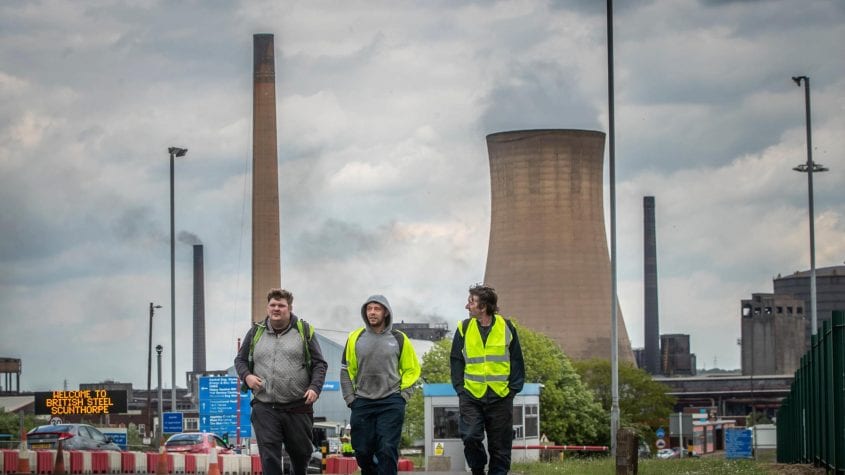
British Steel, an icon of the industrial heritage of the very nation that initiated the Industrial Revolution is on the brink of collapse. Its decline since the 1970s has been precipitous and it is now facing the closure of its last plant in Scunthorpe.
Carbon taxes have been squarely blamed for driving up costs that the business can no longer bear and so it faces collapse. While this is superficially true, the real root cause is the failure of the market to properly price carbon from all sources, domestic and foreign. It’s a failure of the design of the European ETS. In short, this is not a case of too much carbon pricing – it’s a case of not enough.
A Carbon Fee with effective border adjustment taxes would simultaneously action four key goals:
properly price steel, factoring in its carbon emissions,
incentivise reductions in carbon emissions from the sector
protect the British heavy industry from dirty, unfair competition, and
preserve, and indeed nurture, a vital strategic industry
20th Century Policy for a 21st Century Problem
The immediate problem for British Steel is the bill for Carbon Credits that has come due under the European Emissions Trading Scheme (ETS). The company has sought a loan of £100M from the U.K. government to pay this bill but it has no obvious sources of revenue to repay the loan, making propping up British Steel a very risky prospect from the taxpayer’s point of view.
But ultimately, the pressure is coming from British Steel’s inability to raise enough revenue from sales due to the crushing competition that the company faces from cheap imports of steel into the EU from China.
So while the ETS is trying to correct the market failures associated with the externalised costs of fossil fuels used in European production, there is no accounting for the massive emissions embedded in imported steel coming from China, leaving European manufacturers at a huge disadvantage.
Border taxes level the playing field for carbon
A border adjustment tax on carbon imposes tariffs on imports from countries that are not adequately pricing carbon themselves. This immediately strips out the cost advantage of imports from dirty economies associated with underpriced carbon in those economies. In fact, as the carbon price rises, these tariffs dominate the cost of such dirty imports and they become completely uncompetitive.
Furthermore, to keep the market fair in the opposite direction, for exports from the clean producer to the high-carbon economy, the relevant carbon fees are refunded to the producer on export, removing the advantage that the dirty producer has, even in their own territory.
What about the effect on consumer prices?
A common objection to tariffs is that they raise consumer prices, often punishing those who can least afford higher prices. This is an especially prevalent concern in a time of incipient trade wars and the economic distress they cause.
This is where the Dividend element of the Carbon Fee & Dividend policy comes in. All revenues from the carbon pricing, whether from domestic producers or tariffs on imports are fully distributed to citizens. This not only protects low and middle earners, it actually benefits them overall.
Price ALL carbon to rebuild British industry
The U.K. has made significant progress decarbonising its energy supply and just recently it boasted the longest period of coal-free energy production since 1882. But at present, the U.K., and relatively low-carbon economies like France, have no way to fully monetise their cleaner power sector when it comes to international trade.
Plentiful cheap clean energy combined with fees on imported carbon can reverse the decline of the British steel industry
This can be directly addressed by a Carbon Fee & Dividend policy, and when it is, it will give shelter to traditional industries that are being unfairly eroded by dirty imports and will provide a huge boost to investment in new, clean industrial production that can leverage the burgeoning low-carbon energy sector that the U.K. is building.
Carbon taxes are a much discussed mechanism for using market mechanisms to incentivise a transition to a zero-carbon energy from fossil fuels, exploiting the innovation and flexibility that markets can provide.
However, detractors cite potential economic harm to those on low and middle incomes as a reason to avoid such action. Many such detractors turn out to be straight-up fossil fuel shills with no care whatsoever for the poor but who will use any arguments that come to hand to deflect policy makers from adopting a robust carbon tax.
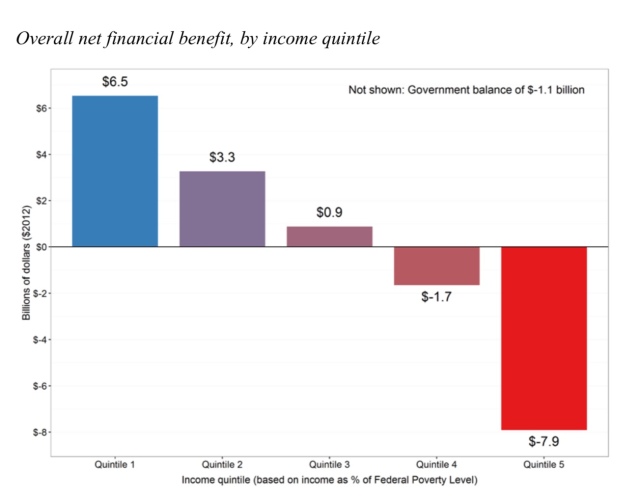
A Carbon Fee and Dividend policy directly answers any such concerns, real or disingenuous, by turning carbon taxation into a progressive policy that actually redistributes wealth from the richest 20% to the poorest 40% while leaving the middle classes broadly unaffected.
Carbon taxes win Nobel Prizes
Carbon taxes have been found to be a highly effective and efficient way of driving the economy to adopt alternatives to fossil fuel energy. Notably, William Nordhaus of Yale University was been jointly awarded the 2018 Nobel Prize in Economic Sciences with Paul Romer for ‘integrating climate change into long-run macroeconomic analysis’.
Nordhaus has proved prescient on the progress of CO2 emissions, writing in 1974, :
I have performed a rough calculation of the atmospheric concentration of carbon dioxide… Assuming that 10% of the atmospheric carbon dioxide is absorbed annually (G. Skirrow), the concentration would be expected to rise from 340 ppm [parts per million] in 1970 to 487 ppm in 2030 – a 43% increase. Although this is below the fateful doubling of carbon dioxide concentration, it may well be too close for comfort.
It turns out we are right on track to hit 487 ppm of carbon dioxide in 2030. In two papers (Nordhaus 1975, 1977), he laid the groundwork for what is now an entire field on the economics of climate change.
Now, there is certainly valid criticism to be made at where Nordhaus and others would set carbon taxes to maximise global growth. Many believe that there is insufficient weight given to factors such as warming feedback and the fate of the poor global south and these are certainly issues of concern. Such concerns would lead to carbon taxes well above the $30/tCO2 that Nordhaus originally proposed. However, there is no doubt that Nordhaus has established carbon taxes as a powerful tool in how we re-shape the economy to prevent climate change.
Clutching at straws and crocodile tears
Of the various stages of climate change denial and resistance to action, one of the later symptoms is an unconvincing concern among opponents that imposing a carbon tax will hurt the poor.
Such attacks coincidentally always seem to come from politicians and lobbying groups closely aligned with the fossil fuel industry and with a long history of denying the existence or risk of climate change in the first place. Such people rarely have a track record of championing high taxes or corporate regulation or social policy that could benefit the poor in other contexts so their concern here is somewhat uncharacteristic.
But if we were to take their challenge seriously, do they have a point? Are carbon taxes bound to condemn the poor to further hardship?
Well, unsurprisingly, it turns out the answer is no.
Carbon Fee and Dividend is a progressive, redistributive policy
The Carbon Fee and Dividend policy has 3 central features:
Tax carbon on fossil fuels as they are sold into the economy
Implement a border adjustment tax system to impose tariffs on imported goods that didn’t bear comparable carbon pricing
Pay the revenues back to citizens as a flat per-head dividend
Imposing a carbon fee and border adjustment tax does raise prices, especially for fossil fuel energy. According to a review of the policy (as proposed by CCL) by Wharton School Public Policy initiative:
For the first year that a $15 per metric ton of CO2 carbon tax is implemented, the cost of gasoline would go up by 16 cents per gallon, natural gas by 19 cents per therm (a 7.4 percent increase), and electricity by 0.6 to 1.1 cents per kilowatt-hour (kWh), depending on whether its source is coal or natural gas.
Seeing the whole picture
So looking at this effect alone, you could be forgiven for imagining the poor suffering further under such a policy. But that’s before you apply a dividend. This is the secret sauce that turns the entire picture around, to the point that the poor become the main beneficiaries of the policy.
According to a comprehensive study carried out by the International Institute for Applied Systems Analysis to model the effects of a carbon fee and dividend policy:
Given these assumptions, the policy confers a net financial benefit on 54% of households nationwide (59% of individuals). The distributional effects are highly progressive. Ninety percent of households living below the Federal Poverty Level are benefited by the policy. The average net benefit in this group is $342 per household, equivalent to nearly 3% of pre-tax income. Overall, the primary distributional effect is to shift purchasing power from the top quintile to the bottom two quintiles of the income distribution
This picture perhaps provides more instruction as to the motivation of rich, conservative fossil fuel lobbyists that oppose such a policy. Using the plight of the poor is nothing more that a disingenuous tactic designed to smear a progressive policy. For all those engaged in an honest debate, the facts are clear.
Only the top 20% by income (those best placed to deal with it) experience a significant net cost from the Carbon Fee and Dividend, leaving the middle class broadly unaffected, while those on low incomes are net beneficiaries.
A Carbon Fee and Dividend is therefore highly effective at mitigating entrenched inequality in society and gives the large majority of citizens a valuable stake in a fossil-fuel free future.
This week (27/28 Nov 2018) I attended two conferences in London: the New Zealand High Commission event on the Impact of Climate Change in the Pacific and the Conservative Environment Network (CEN) Net Zero conference.
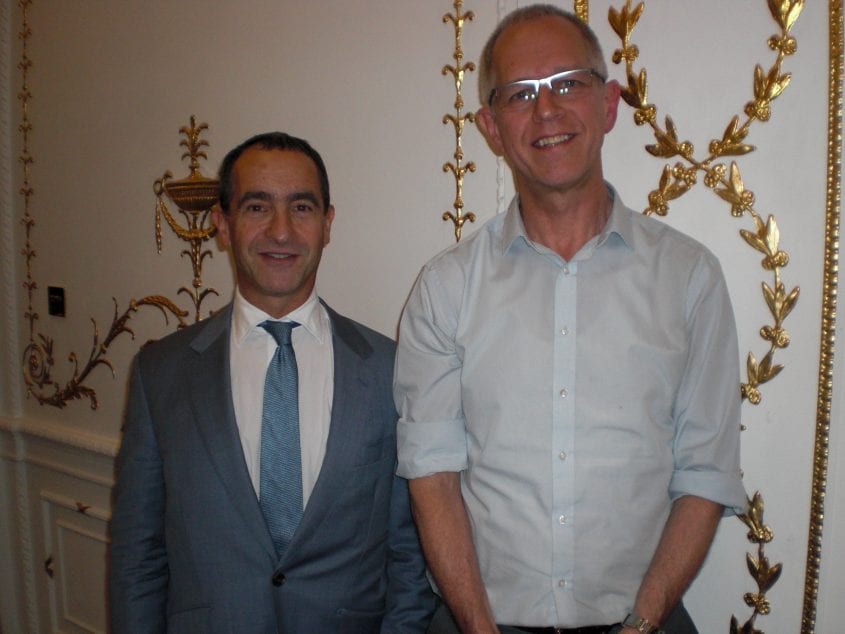
I was photographed with Michael Liebreich, one of the panel members on shipping at the CEN conference (above).
A heartfelt video was shown at the NZ conference, but I’m afraid the whole thing was short on plausible, workable solutions. As usual, I pointed out that 140 million people join the middle class every year (Brookings) – that’s another China every ten years – so personal sacrifices alone will not save us. I explained how Carbon Fee & Dividend (the CCL emissions tax solution to climate change) works to a couple of people afterwards who said they would get in touch. I must remember to practice my spiel, in order to do a better job in a public comment.
The CEN conference was more informed, with several mentions of carbon pricing. They said there was strong resistance to border carbon adjustments from trade lawyers, who say this will disrupt many existing trade mechanisms. However, I was heartened to hear Michael Liebreich say “A conservative principle is Polluter Pays!”
It was interesting to hear about plans for new ships to be powered by hydrogen, ammonia or even just wind, but resistance is apparently being met by shipyards, most of which are in Asia.
Even the CEN conference seemed mostly hope-based, once again on a distant target being reached – net-zero by 2050.
At the end I jumped up to grab the keynote speaker, Lord Deben (John Gummer, chair of the independent Committee on Climate Change which advises the government) before he got inundated. I asked him how we could best support government initiatives to introduce a rebated carbon tax. He said we needed to reach into the existing big groups such as WWF and Friends of the Earth, to educate them.
On my way out, the young CEN Director invited me to join CEN (£20/annum), saying I would “get invited to parties”. I learned they were all off to one at the Shard, and wondered if I could afford that lifestyle, and whether people would want to discuss carbon pricing at them.
Did a shaft of light just break through the media eclipse of Brexit? A brief moment when Earth’s destruction became a mere 12 stories behind the flimsiest thoughts of newly-promoted Tory cannon-fodder?
Yes. I hope you caught it. Credit for this brief anomaly goes to Extinction Rebellion (XR), a new civil disobedience outfit responsible for blockading five bridges in Central London on Saturday. A reported six thousand protesters appeared, me included, to voice concern over government inaction on tackling Climate Change. XR is part of the Rising Up network, committed to nonviolent protest and boasting a very broad remit. Rising Up has the will and ability to execute protests on a wide range of social ills, most recently Universal Credit. It also has a Draft manifesto, which is a far more thoughtful and relevant sketch than the sixthform daydreaming that stereotypically commands the protest scene.
Not that the gathering and the organization were one and the same. The XR team were there somewhere, busily coordinating speakers, poets, singers. But the throng itself was a broader church. Many people were there merely to express their anger on an issue that doesn’t get the coverage it deserves, an issue bigger than politics itself. And Rebellion Day was the handiest vessel for it.
In the back of my mind, however, was the last time I protested. That was a day that left me with less hope than I had started with. The event was hijacked by organizations promoting themselves rather than any climate solutions. Corbyn’s a good egg in many ways, but not very climatey. He was keen to reopen coalmines at that time, yet turned up as star eco-speaker. Other marauding revolutionaries sought recruits to their causes, colours rarely green. The day ended with a sense that ‘they’ had not heard our message. Perhaps there was no ‘us’. And the message didn’t contain a solution. But how could it have been different?
XR has an unusual approach. It involves playing the media, and it has an emotional component. A portion of the volunteers must be arrested, generating news stories. And the gathering is intended as a chance to publicly, collectively and peacefully grieve our dying world, displaying the tragedy and desperation of our situation. And pay attention to the name. Extinction Rebellion. We, the gathered, are humans protesting against our own coming extinction! This deeper reality of the situation is familiar to readers of New Scientist or is perhaps implicit in Naomi Klein, but has never yet held court on Westminster Bridge.
It was a wow moment for me. There was a stir of feeling, of love for the Earth that sustains us, and a yearning to heal it. Discussion and camaraderie bloomed since we were mingling, not marching. One speaker was a Green, Jenny Jones. Brilliant, but not given star billing. Most other speakers were just ordinary people who told XR they wanted to speak. They represented young, old, London, Dorking, India, Ghana, Lincolnshire. They represented us.
If we were grieving, we were also hoping. I spoke to many who were excited about Carbon Fee & Dividend, especially in the light of Canada’s recent commitment. And those who hadn’t heard of it mostly wondered why, with a “that sounds brilliant!” and a head-scratching “there must be some reason why it wouldn’t work…” Others were simply hostile to anything that resembled a system, but there was a healthy passion even among them. They enthused over rewilding projects, and the growing thirst for a better politics.
These issues need to grow into something politicians can ride on. Right now, my hopes are up. Carbon Fee & Dividend is on the up (thanks to Policy Exchange taking it to Westminster) and Extinction Rebellion have galvanized the hordes of worried and wise voters across the UK and 14 other countries, with dozens of future events planned.
The eco-passionate are not uniform, but we all benefit from coming together like this. We are becoming hard to ignore. Thank you, XR.
Scottish MP Stephen Gethins reply to CCLUKer Charlie Webb
Our campaign to galvanize Parliament in advance of the recent UN climate negotiations (COP 23) in Bonn – which has just ended – has resulted in a surge of action and some splendid results.
The numbers tell just a small part of the story. CCLUK members have been talking up our policy up and down the country, sharing it with friends and family, posting it (in many imaginative ways) on Facebook, generally spreading the word.
How many conversations did you find yourself taking part in? One volunteer signed up 21 letter-writers. Only seven of them actually produced the letters…But that was 21 conversations that wouldn’t have happened otherwise. Experience has shown what a difference that can make. ( I’ve had people come back to me after a year to say, “Ah! Now I get it!”) (more…)
President Barack Obama, right, Leonardo DiCaprio, left, and Dr. Katharine Hayhoe (AP Photo/Carolyn Kaster)
When evangelical Christian Katharine Hayhoe is asked ‘do you believe in climate change?’, she answers, ‘no’.
You’d be forgiven for thinking she’s just another religious climate denier. But you’d be wrong.
Canadian-born Katharine is a professor of atmospheric science, number 15 on this year’s Fortune World Greatest Leaders list and scientific adviser to Citizens Climate Lobby US. Speaking at All Souls Church, London, last night, she told us the reason she said ‘no’.
As in many times throughout her talk fusing Christianity and science, she begins with a bible passage, Hebrews 11:1, ‘Now faith is the substance of things hoped for, the evidence of things not seen’. She adds to it: ‘science is the evidence of things you can see’.
Climate change is not something to believe in: the evidence is there for all to see. It’s provable fact; faith is irrelevant. (more…)