I recently wrote this article about Climate Income for the John Ray Initiative Website. (their strapline is : Connecting Environment, Science & Christianity). I was asked to reproduce it here and I hope you all find it useful and inspiring!
What if there was a single ‘silver bullet’ policy that would bring down emissions of CO₂. Would you support it?
‘Of course!’ you say.
Ah, but would you really?
It turns out many people find it quite challenging when shown what this might involve. No, I am not talking hair shirts for everyone. The policy I want to introduce is gentle, yet has terrific leverage. You don’t need to buy the idea I am offering. At most I am asking you to give it a test drive for a few minutes. Then you can decide if you want to follow up on it and find out more, following the links.
My starting assumptions are uncontroversial: our industrial society was built on the use of fossil fuel; now we must transition to renewable energies. Yes we have very many other severe environmental challenges – but this one underpins all the others. The great carbon detox will take decades and we are behind schedule. There is no more time to waste. Personal lifestyle changes by those who are climate concerned will not be enough; some things only governments can do. Yet governments face many other crises – cost of living and economic turmoil, not to mention mass migration, famine and war. The challenge is to tackle the climate crisis in a way aligns with other pressing priorities.
Here is where the test drive begins: ask yourself “What conditions would a climate policy have to satisfy for us to say “Yep, this is the silver bullet we have been looking for”? Its not an easy question so here are my seven conditions and you can decide whether they are adequate. The policy would:
- Bear down steadily but relentlessly on the use of fossil fuels. It would mean that fossil fuel extraction and use shrank and shrivelled over the next couple of decades.
- Be dead simple – transparent, easy to administer, no scope for dodging or special pleading by vested interests.
- Protect the less well-off and be seen to be fair.
- Be business-friendly, working with the grain of economic life, not paralysing or disrupting it.
- Provide a long-lasting stimulus to the demand for renewable energy, thereby encouraging investment and innovation, scaling up supply, and bringing down the cost of renewable energy.
- Assist efforts to de-carbonise in other countries.
- Be popular with the public (even those who are climate-confused or uninterested) and ‘lock-in’ support on a cross-party basis, long-term.
Take a bit of time to consider the list. Is anything missing? Would you be willing to support such a silver bullet policy? How do you feel about the list?
My guess is you are feeling incredulous, sceptical and now saying, more cautiously, “Well Yes, I suppose I would support it – but what is the policy, for goodness sake?!”
Here’s the answer: the silver bullet is variously known as Climate Income, or Carbon Fee & Dividend. It is comprised of three elements:
1 Carbon pricing, achieved through a steadily rising levy on fossil fuels, which funds….
2 A Climate Income, paid at a flat rate direct to all adult citizens. In Canada this is called a Climate Action Incentive Payment and in Austria it is called Klimabonus – and it is paid direct to each citizen’s chosen bank account in both cases. Yes, you read that right: the policy has been already been adopted elsewhere.
3 A ‘Border adjustment mechanism’ to prevent fee-dodging, to avoid our exporters being disadvantaged, and to make it advantageous for those who sell to us to adopt a similar approach (for those who know about it, the EU’s Emissions Trading Scheme also involves a Border Adjustment Mechanism).
This policy satisfies all seven conditions for a silver bullet. The chart below gives some indications of how the ‘magic’ is worked, and what underpins that bold claim.
| REQUIREMENT | HOW IT WORKS |
| 1 Drive the use of fossil fuels down – and out. | The levy raises the price of carbon, year on year. Over time, carbon is simply priced out of the market. |
| 2 Dead simple to implement | Levy collected at source from the (relatively few) owners of coal mines, and oil & gas wells, and on imports of the same. Child’s play compared to existing tax regulations (and subsidies!) affecting fossil fuels.Making regular flat rate payments to all UK residents (based on National Insurance and/or NHS numbers) requires a large capacity, very simple system. |
| 3 Protect the least well-off; seen to be fair. | ‘Polluter pays’ is well understood. Flat rate – everyone treated the same. Redistributive – most households are better off (and that’s before they switch to lower carbon products and services).The poorest households receive a significant increase in disposable income. |
| 4 Business-friendly – eases the transition off carbon | Business associations call for it – it gives them a degree of certainty and a level playing field. Economists love it! |
| 5 Sustained stimulus for investment & innovation in renewable energy systems | Rising demand for ‘greener’ products, services and infrastructure creates investment opportunities. Little need for the government to ‘pick winners’. |
| 6 Assist de-carbonising in other countries | ‘Border adjustment’ has this effect providing an incentive for a similar levy in countries that export to the UK, including coal, oil & gas exports |
| 7 Popular, ‘locking-in’ cross-party support | Climate Income ensures support, including from waverers, and ‘don’t knows/don’t cares’. |
I don’t expect you to take my word for any of this. To check out the claims these websites may help:
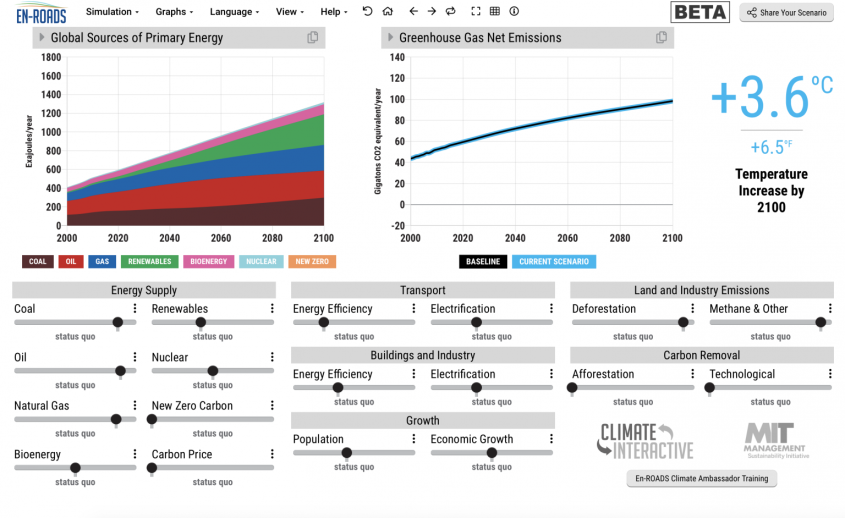
□ Regarding the importance of carbon pricing, visit the EN-ROADS site, a wonderful climate policy simulator devised by a team of climate scientists and policy analysts at MIT. You will have an array of thirty different policy levers – can you combine them to bring down carbon emissions fast enough to prevent catastrophe? It’s a powerful educational tool. If you find a way to get a good result without making assertive use of carbon pricing, and in a way that is half-way credible, politically – then please let me (and the world) know.
□ Regarding the Climate Income itself – giving the money back to citizens – this is what makes the rising fuel levy socially and politically acceptable (instead of causing riots). To get an idea of the redistributive effect it would have in the UK, visit Citizens Climate Lobby UK – one of a family of CCL websites which are stacked full of expert endorsements and campaign testimony. There is even a recent UK report on how it could work in the UK in in the face of the cost of living crisis.
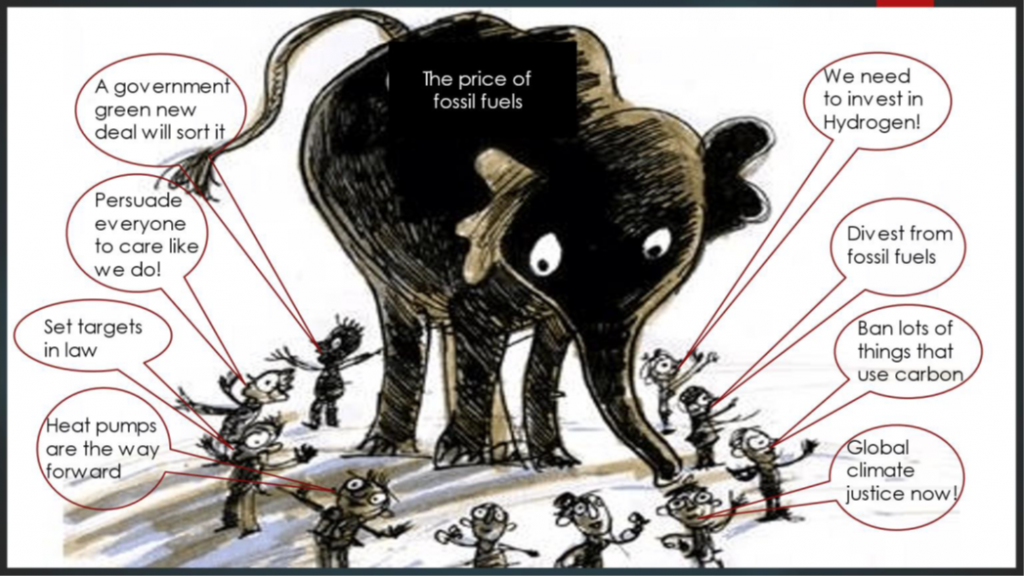
Image credit to Mini Grey from whom this version is adapted with permission
So now, how are you feeling? And have you spotted why many ‘greenies’ are uncomfortable with the idea of Climate Income? One of its great strengths – having support right across the political spectrum – seems also to cause unease.
“What? I’m supposed to march shoulder-to-shoulder with… [insert here the political grouping you love to hate].”
“ Don’t kid me that we should give-the-money-back-to-citizens-and-rely-on-the-market / allow-that-sort-of-state-interference…” [cross out the one that does not apply].
In this country we have a particularly adversarial version of democracy: things have to be done the way we, or our preferred political leaders, think is best. So discussions of climate policy easily slide into arguments between rival political philosophies – market versus state, woke against traditionalists. It’s one of several ways of taking our eye off the carbon ball. An adversarial stance leads us to think we must get others to think in the way we do, to share a large part of our world-view. We are right (and on the side of the angels); they are mistaken and need winning over.
How likely is that to happen? That’s the question I ask that when giving talks – after explaining what is known about the spread of public opinion. Basically, the research is clear: about 30% are firmly climate concerned. We would need another 20% to become the majority – and then hold that support for, say, twenty years… I say “Hands up if you believe that will really happen.” Only a few hands are raised (would you raise yours?)
And then: “Thank you. Now keep your hand up if you believe that much additional support can be won over fast enough to avoid catastrophe?” I’ve yet to have a single hand remain up.
Adversarial politics has another flaw. We greenies like to say we follow the science. Too often though, we ignore one absolutely solid finding from years of psychological research: uninvited efforts to persuade are the best way to get others to dig in their heels!
Politics doesn’t have to be adversarial. Sometimes we may need to listen more and talk less, to sympathise a bit more with others, and allow that there may be some truth also in what they say. I find it’s rare for anyone to be completely wrong. The implications are profound – and they bring us the idea of relational campaigning, a very different way of ‘doing politics’. It’s beyond the scope of this post to go into this. You can find out more on the websites of Citizens UK, and Citizens Climate Lobby.
Meanwhile a growing number of people are quietly ploughing this furrow under the radar as a way to bring in a Climate Income. Perhaps you might consider joining them…? Remember, you do not have to give up on any of your existing campaign commitments. Climate Income turbo-charges other climate initiatives; it doesn’t undermine them.
Rob Paton is a Quaker. Before retirement he was Professor of Social Enterprise at the Open University. He is active in the Thames Valley chapter of Citizens UK.
Note to see more CCL UK articles by and about Rob Paton and the brilliant work he is doing with Citizens UK please type Rob Paton into the website Search function .